Samenvatting van de inhoud
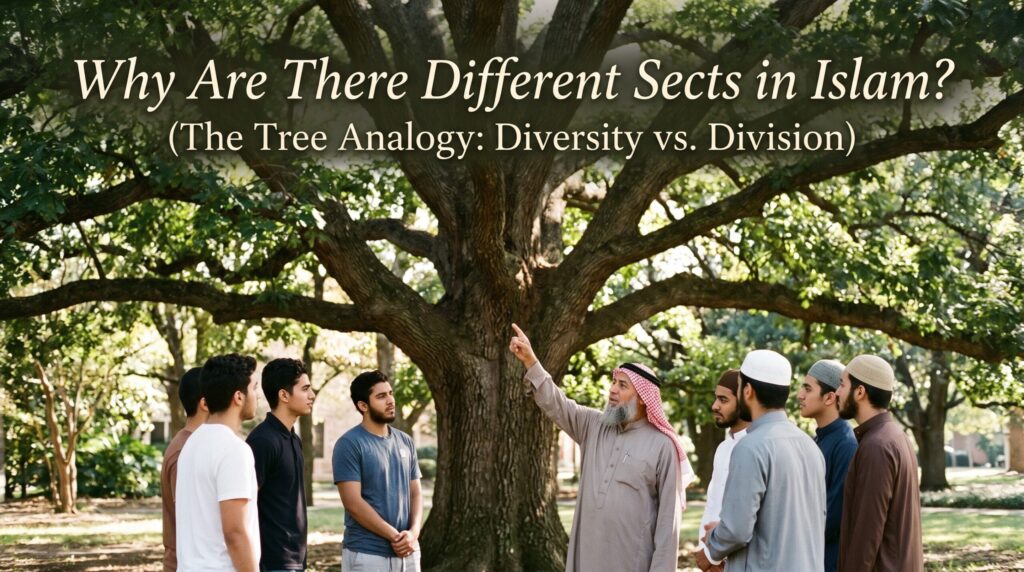
Why Are There Different Sects in Islam? (The Tree Analogy: Diversity vs. Division): One of the most frequent questions posed by Muslims and non-Muslims alike is, “If Islam is based on a single, perfectly preserved book—the Holy Quran—why are there so many sects, schools of thought, and internal divisions?” At first glance, this fragmentation seems contradictory. However, a closer examination reveals a crucial distinction between natural, healthy intellectual diversity (Ikhtilaf) and destructive, ego-driven sectarian division (Tafriqah). Using the profound Tree Analogy, this guide explains how branches naturally emerge from a single living trunk, why scholarly diversity is a blessing, what red lines cause a branch to sever itself from the root, and how the Quran calls humanity back to essential unity.
Inhoudsopgave
| Sectietitel | Belangrijke vragen beantwoord |
|---|---|
| 1. The Fundamental Paradox: One Book, Diverse Understandings | Why do different interpretations exist when the text of the Quran has remained identical for 1,400 years? |
| 2. The Tree Analogy: The Seed, Trunk, and Living Branches | How does the visual model of a tree clarify the relationship between core faith and secondary schools of thought? |
| 3. Natural Diversity vs. Destructive Division | What is the critical difference between valid intellectual exploration and sinful sectarian factionalism? |
| 4. The Historical and Practical Causes of Diverse Schools | How did geography, linguistic nuance, and cultural expansion naturally produce varying jurisprudential traditions? |
| 5. When Does a Branch Break Away? Unacceptable Red Lines | What specific theological corruptions—such as Shirk, false prophethood, and religious innovation—cut a group off from Islam? |
| 6. The Quranic Call to Unity: Holding the Rope Together | What practical steps must ordinary believers take to foster brotherhood and overcome sectarian prejudice? |
1. The Fundamental Paradox: One Book, Diverse Understandings
Unlike many historical scriptures that exist in multiple, competing manuscripts and translations, the Holy Quran is universally recognized for its unmatched preservation. A copy recited in West Africa is identical word-for-word, letter-for-letter, with one recited in Southeast Asia or the Arabian desert. Millions of believers across fourteen centuries have committed its exact Arabic phrasing to memory (Hifz).
This reality creates a natural question: If the source text is one, why are Muslims divided into different sects and groups?
The answer lies in understanding the nature of human cognition and divine purpose. The Quran was not sent down to automate human beings into robotic uniformity. It was revealed to living, thinking individuals endowed with reason, distinct linguistic temperaments, and varying levels of life experience.
The Creator explicitly tells us that human diversity is an intentional, foundational sign of His creation:
“And of His signs is the creation of the heavens and the earth and the diversity of your languages and your colors. Indeed, in that are signs for those of knowledge.”
— Surah Ar-Rum (30:22)
While the core principles of faith (Aqeedah)—such as the Oneness of God (Tawheed), the finality of Prophet Muhammad’s ﷺ prophethood, and the certainty of the Day of Judgment—are crystal clear and leave no room for disagreement, secondary matters of application, administrative jurisprudence, and legal reasoning were designed to adapt across different times, geographies, and cultures.
2. The Tree Analogy: The Seed, Trunk, and Living Branches
To understand how unity and diversity coexist in Islam, consider the visual model of a living tree:
Around 1,400 years ago, a single divine seed was planted on planet Earth through the final revelation of the Quran and the living model of the Prophet Muhammad ﷺ. As that seed sprouted, it formed a massive, immovable trunk.
         [ Branch A: Shafi'i ]      [ Branch B: Hanafi ]
                   \                    /
         [ Branch C: Maliki ]      [ Branch D: Hanbali ]
                     \                /
                      \              /
                       [ THE TRUNK ]
               - Belief in One Unseen Creator
               - Preserved Text of the Quran
               - Muhammad ﷺ as the Final Seal
               - Day of Resurrection & Accountability
                             |
                             |
                      [ THE SEED/ROOT ]
                      Divine Revelation
Deconstructing the Analogy:
- The Root and Trunk (The Invariable Core): The trunk represents the non-negotiable foundations of Islam: pure monotheism, the five daily prayers, fasting, Zakat, Hajj, moral decency, and total submission to the Quran. Every sincere Muslim is anchored here.
- The Branches (Natural Diversification): As the tree grew across continents—from Arabia to Persia, North Africa, Central Asia, and beyond—it naturally developed branches. These represent the legitimate schools of legal thought (Madhabs) and philosophical traditions (such as Hanafi, Maliki, Shafi’i, and Hanbali).
- The Leaves and Blossoms (Contextual Practice): Each branch grows leaves suited to its climate and environment, addressing unique localized challenges while drawing its life-giving water from the very same trunk.
As long as a branch remains firmly joined to the trunk and draws its nourishment from the root, it is a healthy, vital expression of the tree’s overall life. It is not an enemy of the other branches; it shares the same sap, the same ground, and the same sky.
3. Natural Diversity vs. Destructive Division
In the Arabic language and Islamic jurisprudence, there is a profound distinction between two concepts that are frequently confused: Ikhtilaf (scholarly diversity of opinion) and Tafriqah (sectarian fragmentation and discord).
1. Ikhtilaf (Healthy Diversity)
When qualified scholars examine a text to extract practical guidelines for modern situations, differing perspectives naturally emerge. This process (Ijtihad) is welcomed and rewarded in Islam.
The Prophet Muhammad ﷺ explicitly affirmed this intellectual mercy:
“If a judge makes a ruling striving his best and is correct, he receives two rewards; and if he makes a ruling striving his best and errs, he still receives one reward.”
— Sahih al-Bukhari (Hadith 7352), Sahih Muslim (Hadith 1716)
Healthy diversity encourages reflection, prevents religious rigidity, and offers practical solutions for humans facing diverse life circumstances.
2. Tafriqah (Sinful Sectarianism)
Division, by contrast, occurs when human egos, political tribalism, arrogance, and jealousy hijack religion. Sectarian division happens when a group claims: “Only our specific branch represents the entire tree, and all other branches must be cursed, excommunicated, or cut off.”
The Quran severely condemns this divisive mentality:
“Indeed, those who have divided their religion and become sects—you, [O Muhammad], are not associated with them in anything. Their affair is only with Allah; then He will inform them about what they used to do.”
— Surah Al-An’am (6:159)
Allah identifies the psychological root of sectarianism not as a search for truth, but as jealous animosity and pride:
“And they did not become divided until after knowledge had come to them—out of jealous animosity between themselves…”
— Surah Ash-Shura (42:14)
“…and do not be of those who associate others with Allah—of those who have divided their religion and become sects, every faction rejoicing in what it has.”
— Surah Ar-Rum (30:31-32)
Comparison Matrix: Diversity vs. Division
| Aspect | Healthy Diversity (Ikhtilaf) | Destructive Division (Tafriqah) |
|---|---|---|
| Core Motivation | Sincere search for truth and beneficial application. | Pride, cultural ego, jealousy, and sectarian supremacy. |
| View of Other Believers | Brothers and sisters striving toward the same goal with different juristic approaches. | Deviants, hypocrites, or enemies to be debated, insulted, or excommunicated. |
| Connection to Sources | Rooted in the Quran and authentic Sunnah. | Rooted in personality worship, party loyalty, or unverified cultural innovations. |
| Social Consequence | Mutual respect, broad social adaptability, and compassion. | Broken families, boycotts, hatred, violence, and public disrepute for the faith. |
4. The Historical and Practical Causes of Diverse Schools
Why did the branches emerge in the first place? History shows that the growth of different schools of thought was driven by four practical, rational realities:
1. Linguistic Nuance in the Arabic Language
The Arabic of the Quran is rich, layered, and concise. A single word can encompass multiple subtle meanings. For instance, when Allah commands believers during purification in Surah Al-Ma’idah (5:6) regarding what breaks ritual ablution (Wudu), the phrase “or you touch women” was understood by Imam Ash-Shafi’i as physical skin-to-skin contact, whereas Imam Abu Hanifah understood it as a metaphor for marital intimacy. Both views are based on legitimate Arabic linguistic usage, leading to differing rulings without altering any fundamental belief.
2. Geographical Spread and Accessibility of Hadith
In the early generations following the Prophet’s ﷺ demise, his companions migrated to lands spanning from Spain to India. Scholars in Madinah (like Imam Malik) had daily exposure to the living traditions and customs of the city of the Prophet. Meanwhile, scholars in Kufa, Iraq (like Imam Abu Hanifah) dealt with complex, multi-ethnic urban centers that required extensive use of analogical deduction (Qiyas) and logical reasoning to address unprecedented situations.
3. Differing Scholarly Methodologies (Usul al-Fiqh)
Scholars established varying principles for evaluating evidence. One jurist might prioritize a sound solitary Hadith over local custom, while another prioritized the established continuous practice of the people of Madinah (‘Amal Ahl al-Madinah). These methodological variations created diverse legal schools, functioning like distinct branches designed to serve different societal needs.
4. Cultural Adaptation Within Lawful Limits
Islam entered established civilizations—Persian, Roman, African, and South Asian—without destroying their benign customs. It purified what contradicted monotheism and preserved what was wholesome. This cultural diversity enriched the Muslim world, demonstrating that Islam is a global faith rather than a rigid cultural monolith.
5. When Does a Branch Break Away? Unacceptable Red Lines
While Islam accommodates wide diversity in jurisprudence and personal practice, the tree analogy carries an essential warning: a branch that snaps off from the trunk dies.
Any movement, ideology, or sect that directly contradicts the foundational roots of Islam ceases to be an authentic branch. Islam does not own, endorse, or accept practices that violate the essential criteria of faith:
“Follow, [O mankind], what has been revealed to you from your Lord and do not follow other than Him any allies. Little do you remember.”
— Surah Al-A’raf (7:3)
1. Associating Partners with the Creator (Shirk)
The foundational root of Islam is pure Tawheed—direct, unmediated devotion to the One Unseen Creator. Any sect that introduces worship of saints, creates idols, prays to deceased mortals for unseen divine assistance, or claims that human beings share Allah’s supreme attributes has severed itself from the trunk.
2. Rejecting the Finality of Prophethood
Prophet Muhammad ﷺ is the final messenger sent to humanity. The Quran explicitly establishes this seal:
“Muhammad is not the father of [any] one of your men, but [he is] the Messenger of Allah and the Seal of the Prophets. And Allah is ever, of all things, Knowing.”
— Surah Al-Ahzab (33:40)
Any group that claims a new prophet has appeared after Muhammad ﷺ, or invents new mandatory holy scriptures beyond the Quran, is not an Islamic school of thought; it has severed its connection to the root.
3. Religious Innovations (Bid’ah) and Altering the Sacred Text
Inventing arbitrary rituals of worship not grounded in revelation, altering the Quranic text, or claiming esoteric hidden knowledge that overrides the plain word of God corrupts the pure religion.
4. Unjust Violence, Terrorism, and Hasty Excommunication (Takfir)
Any sect that turns religion into an instrument of terror, slaughtering innocent human beings, declaring general Muslim populations to be “disbelievers,” or violating human dignity opposes the very objective of Islam, which was sent as a mercy to all creation (Surah Al-Anbiya 21:107).
6. The Quranic Call to Unity: Holding the Rope Together
How does the Quran instruct believers to conduct themselves amidst this landscape of diverse interpretations? It offers a permanent, unshakeable directive:
“And hold firmly to the rope of Allah all together and do not become divided. And remember the favor of Allah upon you—when you were enemies and He brought your hearts together and you became, by His favor, brothers…”
— Surah Ali ‘Imran (3:103)
The “Rope of Allah” is the Holy Quran. When individuals anchor themselves to human personalities, cultural factions, or sectarian badges, division is inevitable. But when they elevate the Quran as the final criterion (Furqan), unity naturally returns.
Practical Steps for Everyday Believers:
- Learn the Core Before the Branches: Focus first on developing a strong personal relationship with the One Creator, mastering your daily prayer, purifying your speech, and practicing ethical integrity before jumping into heated theological debates.
- Eliminate Sectarian Name-Calling: Avoid using offensive labels, nicknames, or derogatory accusations against other Muslims who follow a different recognized school of thought.
- Practice Kind Communication: The Quran commands believers to “speak words of appropriate justice” (33:70) and to remember that harsh words function like destructive seeds, while kind words grow into enduring trees of peace.
- Distinguish Secondary Details from Primary Pillars: Recognize that how someone places their hands in prayer or slight differences in calculation methods are secondary juristic matters, whereas brotherhood and love among believers are primary obligations commanded by Allah.
Guidance Section: Cultural Misconceptions vs. Authentic Sunnah
| Area | Misconception / Cultural Habit | True Islamic & Quranic Perspective |
|---|---|---|
| The Nature of Differences | Believing that every legal disagreement among scholars is a sign of weakness, error, or corruption in the religion. | Legitimate scholarly diversity (Ikhtilaf) in secondary matters is a natural mercy that enables Islamic law to address differing cultures, eras, and personal circumstances without rigidity. |
| Sectarian Exclusivity | Believing that one’s specific local cultural group or sect possesses exclusive monopoly over Paradise, while all others are damned. | Allah’s judgment is based on sincere faith, avoidance of Shirk, moral integrity, and righteous deeds (Surah Al-Baqarah 2:62). Arrogant claims of exclusivity reflect the exact tribalism condemned in the Quran. |
| Hasty Excommunication (Takfir) | Accusing another Muslim of being a disbeliever simply because they differ on a minor interpretation or belong to a different school of thought. | Strongly forbidden by the Prophet Muhammad ﷺ, who warned that whoever unjustly calls their brother a disbeliever, the accusation returns upon the accuser (Sahih al-Bukhari 6104). |
| Intermediaries and Shrines | Believing that reaching Allah requires praying to deceased pious people, grave shrines, or holy intermediaries. | Pure monotheism demands direct communication with the Unseen Creator. The Quran states: “And when My servants ask you concerning Me, indeed I am near. I respond to the invocation of the supplicant when he calls upon Me” (Surah Al-Baqarah 2:186). |
| Blind Sectarian Loyalty | Defending one’s local sectarian leader even when their statements directly contradict a clear verse of the Holy Quran. | In Islam, absolute loyalty belongs solely to the Word of Allah and His Messenger ﷺ. Scholarly opinions are respected tools for understanding, but they must never supersede direct divine guidance. |
Vrijwaring
This article is prepared solely for educational, historical, and spiritual reflection based on the Holy Quran and authentic Sunnah. Islamic jurisprudence and scholarly differences are expansive fields governed by rigorous academic principles (Usul al-Fiqh). This publication does not constitute a formal legal ruling (Fatwa), nor is it intended to pronounce individual theological judgments upon specific contemporary persons or organizations.
An Invitation to Reflect
The beauty of the Quran lies in its power to unite human hearts across every racial, linguistic, and national boundary under one universal message of peace, justice, and accountability. It is a Book designed not for sectarian division, but for human elevation. We warmly invite every reader, thinker, and seeker of truth to open the Holy Quran and read it with reflection in your own native language at least once in your life. Observe how its timeless principles sweep away manufactured divisions, ground your soul in pure monotheism, and restore clarity to your purpose on Earth.
Veelgestelde vragen (FAQ's)
1. What does the famous Hadith about the Muslim community splitting into 73 sects mean?
The Prophet Muhammad ﷺ stated that this nation would divide into 73 sects, all of which are in the Fire except one: “Those who follow what I and my companions are upon” (Jami’ at-Tirmidhi 2641). Islamic scholars clarify that this Hadith is a warning against abandoning the core foundational path of the Prophet and his companions in favor of political extremism, philosophical deviation, and religious innovation. The “saved group” is not a political label or exclusive club; it consists of those who sincerely follow the preserved Quran and authentic Sunnah in belief, character, and practice.
2. Are the four Sunni schools of jurisprudence (Hanafi, Maliki, Shafi’i, Hanbali) separate sects?
No. The four Madhabs are not distinct sects; they are respected schools of legal interpretation (Fiqh). They share identical articles of faith (Aqeedah), believe in the same Quran, pray toward the same Ka’bah, and respect one another as legitimate brothers in faith. Their differences pertain solely to the detailed application of secondary legal rulings, reflecting the rich intellectual heritage of Islam.
3. Can a person be just a “Muslim” without belonging to any specific sect?
Yes, absolutely. In fact, identifying purely as a Muslim is the standard established by the Quran. Allah states: “He named you ‘Muslims’ before [in former scriptures] and in this [revelation]” (Surah Al-Hajj 22:78). While studying under a recognized school of jurisprudence helps one learn practical worship systematically, a believer’s ultimate identity must remain rooted in Islam and the Quran, free from sectarian arrogance.
4. What makes a group officially outside the fold of Islam?
A group or individual places themselves outside Islam when they reject or deny an explicit, definitive pillar of faith established through clear revelation. This includes denying the Oneness of Allah, directing worship to creation (Shirk), claiming that a new prophet has been sent after Muhammad ﷺ, rejecting the authenticity of the Quran, or denying the resurrection and final judgment.
5. Why do ordinary Muslims get confused by scholarly debates?
Confusion usually arises when laypeople without foundational training delve into complex, nuanced arguments of historical jurisprudence or speculative theology instead of focusing on what is essential: sincere prayer, moral speech, family stability, and honest livelihood. Scholars encourage ordinary believers to focus on practicing what is clear, seeking knowledge with humility, and avoiding contentious online debates that breed arrogance and ill will.
6. How should I respond when someone from another group insults my way of practice?
Follow the Quranic instruction on speech: “Repel evil with that which is better” (Surah Fussilat 41:34). Respond with calm dignity, avoid escalating arguments, and remember the Prophetic standard: “He who is deprived of kindness is deprived of all goodness” (Sahih Muslim 2592). Preserving brotherhood and exemplifying good character is far superior to winning an argument.