Samenvatting van de inhoud
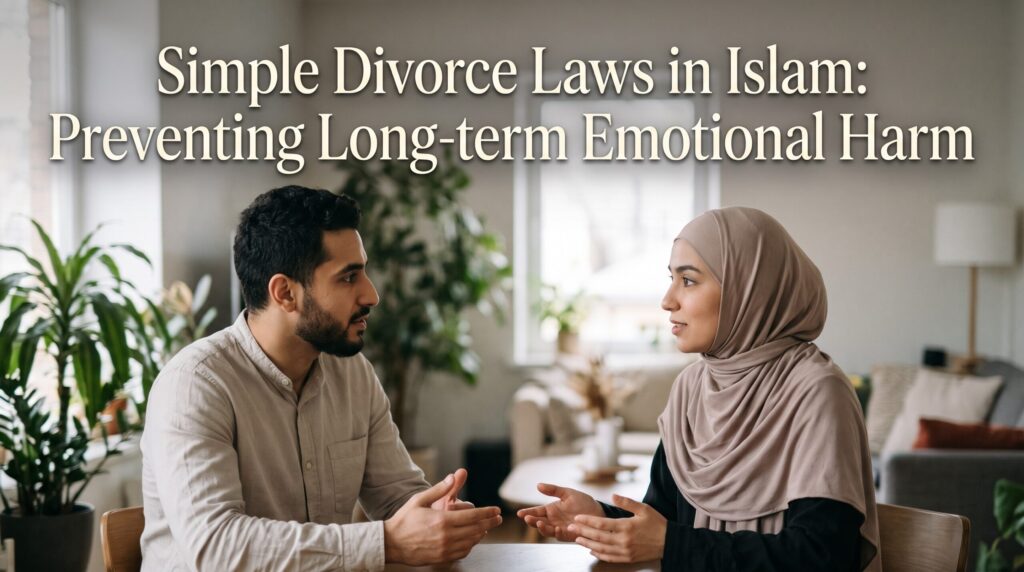
Simple Divorce Laws in Islam: Preventing Long-Term Emotional Harm and Preserving Human Dignity: Divorce is widely recognized as one of the most stressful, emotionally destructive events an individual or family can endure. In many modern and secular legal systems, marital dissolution often spirals into prolonged courtroom warfare, severe financial drain, character assassination, and traumatic fallout for children. The Holy Quran presents a radically different model: a structured, phased, and dignified exit designed to contain anger and prevent long-term psychological scarring. Grounded in the reality of human emotions, speech ethics, and divine accountability, Islamic divorce law balances the right to separate with an absolute prohibition against cruelty and spite. This guide details how the Quranic process of divorce safeguards emotional health, protects the rights of women and children, and ensures that even ending a marriage remains an act of ethical responsibility.
Inhoudsopgave
| Sectietitel | Belangrijke vragen beantwoord |
|---|---|
| 1. The Quranic Philosophy: Separation as Mercy, Not Warfare | Why does Islam permit divorce, and how does it prevent prolonged emotional suffering in irreconcilable marriages? |
| 2. Mandatory De-escalation: Arbitration and the Preservation of Speech | What procedural steps must precede divorce, and how do words function as seeds during intense conflict? |
| 3. The Architecture of Phased Divorce: The Purpose of Iddah | Why does the Quran strictly forbid impulsive, instant endings, and how does the waiting period heal emotional impulses? |
| 4. Financial Ethics and the Principle of Ihsan | What strict economic protections prevent husbands from using money or property as weapons of intimidation? |
| 5. Khula and Agency: The Woman’s Equal Right to Exit | How does Islamic jurisprudence empower a woman to dissolve an unhappy or abusive marriage with dignity? |
| 6. Shielding Future Generations: Co-Parenting Without Trauma | How do Islamic custody guidelines protect children from becoming emotional casualties of parental disputes? |
1. The Quranic Philosophy: Separation as Mercy, Not Warfare
Human marriage in Islam is a sacred, consensual covenant (Mithaqan Ghalidha). The Quran explicitly identifies the core purpose of union as the attainment of mutual peace, emotional safety, and genuine mercy:
“And among His signs is that He created for you spouses from among yourselves so that you may find tranquility in them, and He placed between you affection and mercy. Indeed, in that are signs for a people who reflect.”
— Surah Ar-Rum (30:21)
Yet, because human beings possess unique psychological profiles, differing temperaments, and free will, not all partnerships achieve this intended tranquility. When mutual compatibility collapses completely, forcing two individuals to remain trapped in an environment of chronic bitterness, silent hatred, or daily hostility directly damages their emotional and spiritual well-being.
In ancient civilizations and certain religious systems, divorce was entirely forbidden, forcing spouses—particularly women—to endure lifelong domestic subjugation. Conversely, secular modern systems often permit chaotic, litigious separations that drag on for years, enriching legal institutions while devastating the mental health of both parties.
The Quran eliminates both extremes. It establishes that while divorce is an outcome to be avoided when possible, it is nonetheless legislated as an honorable, civilized escape valve when continuing together causes spiritual degradation and emotional ruin:
“And if they separate [by divorce], Allah will enrich each [of them] from His abundance. And Allah is ever encompassing and wise.”
— Surah An-Nisa (4:130)
Divorce in Islam is not an act of vengeance; it is a mechanism of mercy designed to stop emotional bleeding and allow both souls to move forward in peace.
2. Mandatory De-escalation: Arbitration and the Preservation of Speech
Human psychology is highly vulnerable to emotional hijacking during marital disputes. In moments of rage, the human mind tends to magnify flaws, discard years of shared goodness, and resort to verbal destruction. In the Quranic worldview, words act like seeds planted within the subconscious memory:
“Have you not considered how Allah presents an example: a good word is like a good tree—its root firm and its branches in the sky.”
— Surah Ibrahim (14:24)
The Prophet Muhammad ﷺ specifically warned of the destructive power of unmanaged speech:
“He who is deprived of kindness is deprived of all goodness.”
— Sahih Muslim (Hadith 2592)
To prevent couples from uttering irreversible words in moments of temporary anger, the Quran commands a mandatory preliminary intervention through familial arbitration before any formal divorce is initiated:
“And if you fear dissension between the two, send an arbitrator from his people and an arbitrator from her people. If they both desire reconciliation, Allah will cause it between them. Indeed, Allah is ever knowing and acquainted.”
— Surah An-Nisa (4:35)
The Psychology of Third-Party Arbitration:
- Neutral De-escalation: Bringing two mature, objective representatives—one from each family—removes toxic isolation and stops circular private arguments.
- Confidentiality and Dignity: Spousal vulnerabilities and private matters remain contained within trusted elders rather than becoming public gossip.
- Honest Evaluation: The arbitrators evaluate whether the breakdown stems from solvable miscommunication, unrealistic expectations, or fundamental incompatibility.
Only when sincere arbitration confirms that staying together causes more psychological and spiritual harm than parting does the legal process of divorce begin.
3. The Architecture of Phased Divorce: The Purpose of Iddah
One of the greatest legal protections in the Quran is its outright rejection of hasty, unilateral, or instant separations. Pre-Islamic Arabian customs allowed men to divorce and revoke divorces hundreds of times at whim, keeping women in perpetual emotional limbo.
The Quran eliminated this tyranny by creating a structured, multi-stage process governed by deliberate waiting periods (Iddah):
“Divorce is twice. Then, either keep [her] in an acceptable manner or release [her] with good treatment…”
— Surah Al-Baqarah (2:229)
The Divine Rules of the Divorce Procedure
The Quran legislates a specific timeframe for pronouncing a revocable divorce (Talaq Raj’i):
- Pronouncement During Purity (Tuhr): A husband cannot pronounce divorce while the wife is menstruating, nor during a period of purity in which intimacy has taken place. This deliberate delay obliges the man to wait, cooling any immediate temper or heated confrontation.
- A Single Pronouncement: The husband pronounces only one single Talaq, leaving the door wide open for emotional repair.
- The Living Arrangement of Iddah: The woman does not pack her bags or get evicted. The Quran commands that she remains in the shared family residence throughout her three menstrual cycles (or three months):
“O Prophet, when you [Muslims] divorce women, divorce them for [the commencement of] their waiting period and keep count of the waiting period, and fear Allah your Lord. Do not turn them out of their [husbands’] houses, nor should they [themselves] leave [during that period] unless they are committing a clear immorality…”
— Surah At-Talaq (65:1)
Psychological Wisdom of Remaining in the Home
By requiring both spouses to continue sharing the residence during the waiting period, the Quran uses human psychology to heal the rift:
- Cooling Off: The initial surge of anger subsides over days and weeks.
- Rediscovering Affinity: Daily proximity without constant pressure allows affectionate memories and familiar routines to reassert themselves.
- Effortless Reconciliation: If the couple desires to reconcile during this period, no new marriage contract, dowry, or ceremony is needed. The husband simply revokes the divorce verbally or physically, and normal marital life resumes.
If, after three full cycles of reflection, both agree that life together cannot be sustained, the divorce becomes final with total dignity.
4. Financial Ethics and the Principle of Ihsan
In contentious secular divorces, money is routinely weaponized. Spouses hide assets, cancel credit cards, deplete joint accounts, or demand that previously given gifts be returned in exchange for granting freedom.
The Quran completely forecloses this emotional and economic exploitation. The overarching principle regulating Islamic divorce is Ihsan—transcendent excellence, graciousness, and generosity:
“And when you divorce women and they have [nearly] fulfilled their term, either retain them according to acceptable terms or release them according to acceptable terms, and do not keep them, intending harm, to transgress [against them]. And whoever does that has certainly wronged himself…”
— Surah Al-Baqarah (2:231)
The Creator strictly forbids clawing back financial gifts or the mandatory bridal gift (Mahr):
“…And it is not lawful for you to take anything of what you have given them unless both fear that they will not be able to keep [within] the limits of Allah…”
— Surah Al-Baqarah (2:229)
The Quran goes even further, commanding that a parting gift (Mut’ah al-Talaq) be provided to soften the emotional blow of separation:
“There is no blame upon you if you divorce women you have not touched nor specified for them an obligation. But give them [a gift of] compensation—the wealthy according to his capability and the poor according to his capability—a provision according to what is acceptable, a duty upon the doers of good.”
— Surah Al-Baqarah (2:236)
Allah seals this standard with an unforgettable moral directive:
“…And do not forget graciousness between you. Indeed Allah, of what you do, is Seeing.”
— Surah Al-Baqarah (2:237)
Quranic Separation Matrix
| Metric | Spiteful Separation (Ego-Driven) | Quranic Separation (Ihsan-Driven) |
|---|---|---|
| Mededeling | Insults, screaming, slander, and revealing private secrets. | Dignified speech (Qawlan Karima), discretion, and mutual respect. |
| Financial Conduct | Freezing maintenance, evicting the spouse, and demanding dowry back. | Full living expenses provided during Iddah; gifts and Mahr retained unconditionally. |
| Children’s Treatment | Using kids as spies, messengers, or emotional leverage. | Protecting children from parental conflict; consistent, loving co-parenting. |
| Conscience | Driven by a desire to “win” and punish the other party. | Driven by fear of accountability before the All-Seeing Creator on the Day of Judgment. |
5. Khula and Agency: The Woman’s Equal Right to Exit
Just as a husband can initiate divorce through Talaq, Islam explicitly guarantees a woman the legal and spiritual right to dissolve an unworkable marriage through Khula.
A woman is not forced to prove physical abuse, adultery, or criminal activity to be freed. If she simply cannot find emotional warmth, love, or attraction with her husband, her right to exit is absolute.
This was definitively established in the Sunnah of the Prophet Muhammad ﷺ:
The wife of Thabit ibn Qays came to the Prophet ﷺ and said: “O Messenger of Allah, I do not blame Thabit for any defect in his character or religion, but I dislike ungratefulness in Islam [i.e., failing to fulfill spousal duties because of lack of love].” The Messenger of Allah ﷺ asked her: “Will you return his garden to him [which he gave as dowry]?” She said: “Yes.” The Prophet ﷺ said to Thabit: “Accept the garden and divorce her once.”
— Sahih al-Bukhari (Hadith 5273)
Key Features of Khula:
- Zero Guilt or Stigma: The Prophet ﷺ did not reprimand the woman, investigate her private feelings, or order her to force herself to love her husband.
- Fair Equity: Because the husband fulfilled all his moral and marital duties without fault, the woman simply returns the original Mahr (dowry) to balance the financial equation.
- Immediate Protection: Once agreed or decreed by an Islamic judge, the marriage ends cleanly, shielding the woman from ongoing psychological misery.
6. Shielding Future Generations: Co-Parenting Without Trauma
A major source of long-term trauma following divorce is the emotional destruction inflicted upon children. Human children are born physically and emotionally dependent, designed by the Creator to absorb their sense of safety from their caregivers.
When divorced parents engage in spiteful custody battles, speak ill of one another, or withhold visitation rights out of revenge, they plant toxic seeds in the child’s mind, frequently producing chronic anxiety, low self-esteem, and relationship phobias in adulthood.
The Quran anticipated this danger 1,400 years ago, establishing clear boundaries to protect mothers, fathers, and children from being used as weapons:
“…No mother should be harmed through her child, and no father through his child…”
— Surah Al-Baqarah (2:233)
Quranic Co-Parenting Mandates:
- Mandatory Fatherly Maintenance: Even after divorce, the biological father remains legally and religiously obligated to provide complete financial support for his children, including shelter, food, healthcare, and education. The mother’s personal wealth is never tapped for this duty.
- Compassionate Consultation (Tashawur): In Surah Al-Baqarah (2:233), Allah commands that critical decisions regarding the child’s weaning, education, and development must be resolved through mutual consent and dignified consultation (Tashawur).
- Preservation of Kinship (Silat ar-Rahim): Denying a child access to their father, mother, grandparents, or extended family is categorized as a severe moral transgression before Allah.
When parents remember that every action and intention is recorded for the Day of Judgment, they treat one another with fairness, ensuring their children grow up emotionally secure despite the change in family structure.
Guidance Section: Cultural Misconceptions vs. Authentic Sunnah
| Area | Misconception / Cultural Habit | True Islamic & Quranic Perspective |
|---|---|---|
| “Triple Talaq” in One Breath | Uttering “I divorce you three times” in one sitting, believing it instantly and permanently destroys the marriage. | Strongly condemned by the Prophet ﷺ. In authentic Sunnah (Sahih Muslim 1472), pronouncements in a single sitting are counted as only one revocable divorce, allowing opportunity for reconciliation. |
| Immediate Eviction of the Wife | Forcing the divorced wife to leave the family home on the very night divorce is pronounced. | Expressly forbidden in Surah At-Talaq (65:1). The wife has the legal right to remain fully housed and maintained in the marital home throughout the entire Iddah period. |
| Withholding the Mahr or Dowry | Demanding the wife give up her jewelry, past maintenance, or unpaid Mahr before “granting” her a divorce. | Classified as theft and oppression (Zulm). Surah An-Nisa (4:20-21) strictly prohibits taking back any portion of what was given to the wife upon separation. |
| Slandering the Ex-Spouse | Spreading damaging stories, exposing private marital secrets, or turning community members against an ex-partner. | Categorically prohibited. Believers must speak “words of appropriate justice” (33:70) and part with graciousness (Ihsan). Exposing intimate private affairs is a severe breach of trust (Amanah). |
| Using Children as Weapons | Brainwashing children against the other parent or blocking court-mandated visitation out of spite. | Directly violates the divine command: “No mother should be harmed through her child, and no father through his child” (Surah Al-Baqarah 2:233). |
Vrijwaring
This article is prepared solely for educational, ethical, and spiritual reflection based on the Holy Quran and authentic Sunnah. Islamic family law involves complex jurisdiction-specific procedures, custody evaluations, and legal details. This content does not constitute formal legal counsel, professional mediation, or an official Islamic ruling (Fatwa). Couples experiencing marital breakdown should consult a certified Islamic scholar, local family counselor, or legal authority.
An Invitation to Reflect
The precision and emotional mercy woven through Islamic family law demonstrate that the Quran is not merely a book of personal devotion, but a complete guide for human social preservation. Designed by the One who understands the subtleties of human psychology, its laws provide safety when love blossoms, and dignity when relationships must end. We warmly invite every reader, spouse, and seeker of truth to read the Holy Quran with deep reflection in your own language at least once in your life. Observe how its guidance shields human hearts, prevents injustice, and brings enduring peace to society.
Veelgestelde vragen (FAQ's)
1. Does saying “I divorce you” three times at once instantly finalize a divorce?
No. According to authentic Hadiths in Sahih Muslim and the rulings of numerous classical and contemporary jurists, pronouncing three divorces in one sitting is counted as a single, revocable divorce (Talaq Raj’i). The Prophet Muhammad ﷺ became visibly angry when informed that a man had pronounced three divorces at once, condemning it as playing with the Book of Allah (Sunan an-Nasa’i 3401).
2. Is a husband permitted to take back the Mahr (dowry) during a standard divorce?
No. When a husband initiates a standard divorce (Talaq), he is strictly forbidden from demanding the return of any part of the Mahr, past financial maintenance, or jewelry gifted to the wife (Surah An-Nisa 4:20-21). Doing so is classified as sinful extortion in Islamic law.
3. What is the difference between Talaq and Khula?
- Talaq is initiated by the husband. The wife retains her full Mahr, receives complete financial maintenance throughout her Iddah, and receives an additional parting gift (Mut’ah).
- Khula is initiated by the wife when she cannot continue the marriage. In fairness to a husband who has committed no legal wrong, the wife agrees to return the original dowry (Mahr) in exchange for the dissolution of the marriage contract.
4. Can a divorced woman remarry her former husband after divorce?
Yes, but only under specific circumstances:
- If the divorce was a first or second pronouncement, the couple may reconcile during the Iddah period without a new contract. If the Iddah has expired, they may remarry each other by mutual agreement through a fresh marriage contract and dowry.
- If a third separate divorce has occurred after two previous reconciliations, the separation is irrevocable (Talaq Ba’in Kubra). They cannot remarry unless the woman naturally marries another person, lives a genuine marital life, and that second marriage subsequently ends through death or natural divorce without collusion.
5. Why must the divorced wife remain in the husband’s house during the Iddah?
The Quran explicitly mandates this in Surah At-Talaq (65:1) for three reasons: it provides the woman with guaranteed shelter and maintenance, it protects the emotional privacy of the family, and it maximizes the psychological likelihood of cooling tensions, open communication, and peaceful reconciliation.
6. Who receives custody of young children following a divorce in Islam?
Classical Islamic jurisprudence, grounded in Prophetic Hadiths, prioritizes the mother for the primary physical care and nurturing of young children during their early formative years, provided she is capable and acts in the child’s best interests. Concurrently, the father is religiously obligated to pay all financial living costs and retains full rights to regular visitation, education oversight, and moral guidance.