Samenvatting van de inhoud
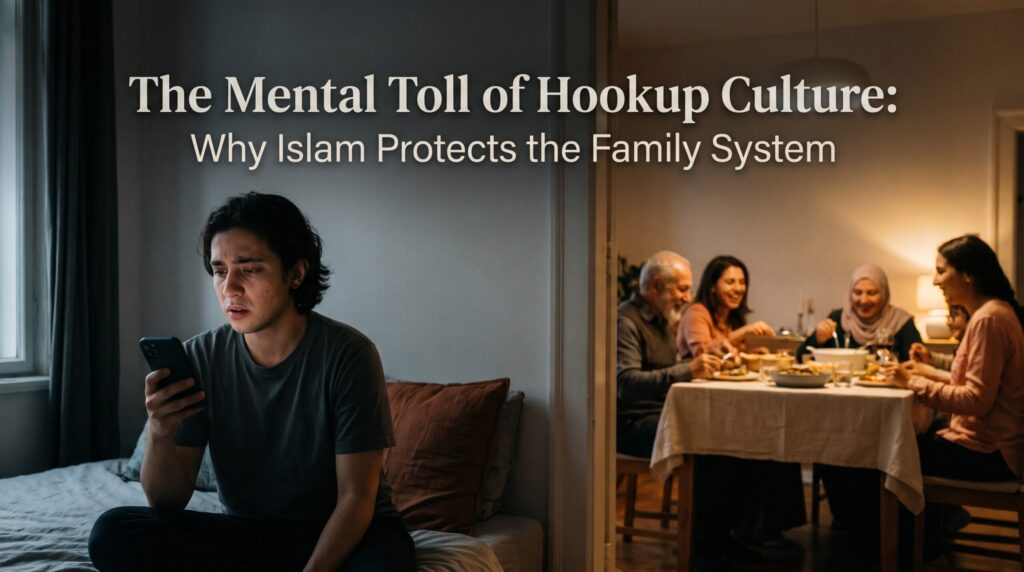
The Mental Toll of Hookup Culture: Why Islam Protects the Family System: Modern culture often celebrates casual intimacy as the ultimate expression of personal freedom. However, beneath the surface lies a growing crisis of emotional burnout, anxiety, and relational distrust. This post examines the severe mental toll of hookup culture through the lens of human psychology and explains why Islam strictly safeguards the family system to protect human mental health, dignity, and future generations.
Inhoudsopgave
| Sectietitel | Belangrijke vragen beantwoord |
|---|---|
| 1. The Biological and Psychological Mismatch of Casual Sex | Can humans truly separate physical intimacy from emotional attachment? What happens when natural design is ignored? |
| 2. The Mental Toll: Memory, Emotional Imprints, and Emptiness | Why does the human brain retain intimate encounters? How does transactional intimacy breed chronic anxiety and regret? |
| 3. The Reproduction Cycle as a Sacred Trust | Why is human reproduction different from animal breeding? What social hazards arise when commitment is stripped away? |
| 4. The Family System as an Emotional Sanctuary | How does lawful marriage restore mental tranquility (sakinah)? What practical steps allow individuals to break free and heal? |
1. The Biological and Psychological Mismatch of Casual Sex
Contemporary hookup culture operates on a flawed premise: that physical intimacy can be completely disconnected from emotional bonding, moral responsibility, and future consequences. It encourages individuals to treat intimate relations like consumer goods—convenient, disposable, and purely transactional.
Yet human beings are not built like animals. Animals mate based on seasonal instinct; they do not possess moral conscience, long-term conceptual memory, or the capacity to build complex ethical civilizations. Humans, however, were consciously designed with emotional depth, reflective intellect, and a heart that naturally seeks lasting connection.
“And among His signs is that He created for you spouses from among yourselves so that you may find tranquility in them, and He placed between you affection and mercy. Indeed, in that are signs for a people who reflect.”
— Surah Ar-Rum (30:21)
When intimacy is stripped of mawaddah (deep affection) and rahmah (mercy) and reduced to physical gratification, an internal dissonance occurs. Studies in neuroscience and psychology consistently show that intimate encounters trigger the release of powerful bonding hormones like oxytocin and dopamine. When these biochemical bonds are repeatedly formed and violently severed in casual encounters, the psyche experiences silent trauma.
Instead of liberation, individuals frequently experience emotional numbing, attachment anxiety, and an inability to trust future partners.
2. The Mental Toll: Memory, Emotional Imprints, and Emptiness
One of the foundational realities of human design is that the human brain records sensory experiences permanently. Memories are not erased when an encounter ends; they linger in the subconscious, shaping expectations, triggers, and self-worth.
When a person engages in repeated, casual encounters without commitment, they accumulate emotional baggage that slowly corrodes their inner peace. Rather than experiencing fulfillment, the pursuit of unanchored desires leaves an acute internal void:
“Have you seen the one who takes his desires as his god? Allah has left him astray knowingly and sealed his hearing and his heart and put a veil over his sight…”
— Surah Al-Jathiyah (45:23)
“And whoever turns away from My remembrance will have a life of hardship…”
— Surah Ta-Ha (20:124)
Psychological Consequences of Hookup Culture
| Mental & Emotional State | The Reality in Casual Hookup Culture | The Reality in the Islamic Marital Framework |
|---|---|---|
| Sense of Self-Worth | Tied to physical appeal, performance, and external validation; leads to chronic insecurity. | Grounded in character (Taqwa), spiritual substance, and being valued as a whole human being. |
| Emotional Safety | Constant vulnerability to sudden rejection, ghosting, and emotional abandonment. | Protected by contractual commitment, mutual honor, and social accountability. |
| Trust Dynamics | High skepticism toward future partners; constant fear of betrayal and comparison. | Deepened intimacy built on transparency, exclusivity, and shared long-term goals. |
| Mental Clarity | Cognitive clutter caused by regret, secrecy, guilt, and emotional detachment. | Serenity and peace of mind resulting from clean conscience and transparent living. |
Living in perpetual emotional defense mode exhausts the human soul. When human relationships become purely disposable, individuals end up feeling used rather than appreciated.
3. The Reproduction Cycle as a Sacred Trust
Human intimacy is not a casual game; it is the natural mechanism through which new, conscious human souls enter this world. Because bringing up a child requires years of emotional stability, financial investment, and ethical nurturing, the reproduction cycle must be protected with the utmost seriousness.
When sexual relations are detached from commitment, society inevitably suffers predictable consequences:
- Unplanned pregnancies and the tragedy of abortion
- The crisis of fatherlessness and single-parent emotional exhaustion
- Damaged reputations and severe loss of social trust
- Deep-seated feelings of guilt, shame, and betrayal
Islam does not merely condemn adultery and fornication (Zina); it cuts off the entire pathway leading toward them:
“And do not approach unlawful sexual intercourse. Indeed, it is ever an immorality and is evil as a way.”
— Surah Al-Isra (17:32)
The Qur’an explicitly forbids casual flings and hidden partnerships:
“…not committing unlawful intercourse, nor taking secret lovers.”
— Surah Al-Ma’idah (5:5)
Prophet Muhammad ﷺ warned that the private desires are among the greatest tests of human existence, promising immense spiritual reward for those who maintain self-discipline:
“Whoever guarantees me what is between his jaws and what is between his legs, I guarantee him Paradise.”
— Sahih al-Bukhari (6474)
Restricting intimacy to lawful marriage is not an arbitrary limitation. It is a proactive protective measure that guarantees every child an identifiable lineage, an emotionally invested mother and father, and a secure social sanctuary.
4. The Family System as an Emotional Sanctuary
The family is the basic building block of any healthy civilization. If the family unit breaks down, the entire social structure begins to collapse.
By establishing marriage (Nikah) as a formal, recognized social covenant, Islam transforms intimacy into an act of dignity and worship. A lawful union provides clear legal protections, emotional accountability, and mutual security.
       [ Mutual Responsibility & Legal Covenant ]
                         │
        ┌────────────────┴────────────────┐
        ▼                                 ▼
[ Emotional Security ]           [ Societal Stability ]
• Deep peace (Sakinah)           • Protected lineage
• Mutual respect & mercy         • Secure upbringing for children
• Freedom from shame & guilt     • Low rates of emotional trauma
Breaking Free: The Power of Repentance (Tawbah)
For those who have suffered the wounds of hookup culture, Islam offers complete psychological renewal. The Creator does not bind anyone permanently to their past mistakes. Sincere repentance cleanses past guilt and allows a person to build a clean future:
“Say, ‘O My servants who have transgressed against themselves, do not despair of the mercy of Allah. Indeed, Allah forgives all sins. Indeed, it is He who is the Forgiving, the Merciful.'”
— Surah Az-Zumar (39:53)
“Except for those who repent, believe, and do righteous deeds—for them Allah will replace their bad deeds with good deeds. And Allah is ever forgiving and merciful.”
— Surah Al-Furqan (25:70)
Healing begins by valuing oneself through the Creator’s eyes, cutting ties with environments of casual temptation, practicing modesty of gaze and speech, and channeling natural desires toward honorable marriage.
Guidance Section: Correcting Common Misconceptions
| Misconception / Cultural Assumption | Purpose Ignorance Behind It | Qur’anic & Authentic Sunnah Correction |
|---|---|---|
| “Casual dating and flings are harmless as long as both adults consent.” | Assuming that mutual consent erases emotional bonding, reproductive consequences, and spiritual harm. | Divine law recognizes that casual intimacy leaves psychological scars, risks unwanted pregnancies, and destabilizes society. The Qur’an explicitly forbids both open fornication and “secret lovers” (Surah Al-Ma’idah 5:5). |
| “Marriage is merely an outdated financial and legal paper.” | Failing to recognize that commitment creates the psychological safety needed for true vulnerability. | Marriage in Islam is a sacred covenant (Mithaq) rooted in affection, mercy, and mutual protection (Surah Ar-Rum 30:21), without which intimacy becomes exploitative. |
| “Suppressing desires outside of marriage causes severe psychological harm.” | Confusing disciplined restraint with unhealthy repression and glorifying instinct over intellect. | Disciplining desires through fasting, modesty, and healthy routines builds executive self-control and resilience, whereas feeding unchecked desires leads to addiction and emptiness. |
| “A person who fell into hookup culture is permanently damaged and unlovable.” | Believing human errors define one’s spiritual essence forever; despairing of Allah’s mercy. | Allah forgives all past sins through sincere repentance (Tawbah) and promises to turn sincere remorse into righteous strength (Surah Az-Zumar 39:53, Surah Al-Furqan 25:70). |
Vrijwaring
This article is prepared for educational, psychological, and moral reflection based on Qur’anic guidance and prophetic teachings. It does not replace individualized legal rulings (fatwas) or licensed clinical psychotherapy for severe trauma or psychological disorders.
An Invitation to Reflect
The laws revealed by the Creator are not restrictions placed upon your joy; they are protective instructions from the One who crafted your intricate biology, emotions, and mind. We invite every thoughtful reader—regardless of your personal journey—to pick up a translation of the Holy Qur’an and read it with reflection and an open heart at least once in your life in your own language.
Examine its timeless wisdom on human nature, observe the balance of the universe, and discover the lasting peace that comes from aligning your life with divine order.
Veelgestelde vragen (FAQ's)
1. Why does casual intimacy often lead to depression and emotional numbness?
Human brains release oxytocin and dopamine during intimate contact, naturally encouraging long-term attachment. In casual hookups, these neurochemical bonds are formed and abruptly severed, leaving the subconscious feeling rejected and unvalued. Over time, individuals develop emotional defense mechanisms, leading to apathy, anxiety, and depression.
2. What does the Qur’an mean by prohibiting “secret lovers”?
In Surah Al-Ma’idah (5:5), the Qur’an uses the term akhdan (secret paramours or friends with benefits). This explicitly outlaws private romantic or sexual relationships conducted outside the transparent, publicly recognized, and legally binding contract of marriage.
3. How does Islamic modesty protect people from the harms of hookup culture?
Modesty (Haya) acts as a preventative shield. By regulating dress, lowering the gaze, and setting respectful boundaries in male-female interactions, modesty prevents casual physical commodification and ensures that people are valued for their intellect, character, and faith rather than mere physical availability.
4. Can a person who was deeply involved in hookup culture find a pure and fulfilling marriage?
Yes. In Islam, genuine repentance (Tawbah) erases past sins. When a person turns sincerely to Allah, resolves not to return to past mistakes, and adopts moral discipline, they start with a clean slate. Countless individuals have built deeply loving, stable marriages after leaving destructive lifestyles behind.
5. Why does Islam discourage “test-driving” relationships before marriage?
Modern trial cohabitation rarely produces lasting security; studies show that cohabiting couples often face higher divorce rates due to lack of foundational commitment. Islam emphasizes thorough, transparent vetting of character, values, and family background with family involvement, followed by full commitment through marriage.
6. How does the family system protect the next generation?
Children raised within a committed, two-parent marriage benefit from emotional security, defined identity, and financial stability. They are protected from the psychological trauma of parental abandonment and are taught healthy models of communication, loyalty, and empathy.