Blog

  • What is Islam? How the Human’s Creation Style is a Strongest Point to Define Islam?

    What is Islam? How the Human’s Creation Style is a Strongest Point to Define Islam?

    Table of Contents

    What is Islam? What is Islam? Why Quran calls Islam true religion of nature for Humanity and Why Tawhid is Main Core of Islam

    What is the main purpose of Islam?

    The main purpose of Islam is to unite humanity by Tawhid (belief in one unseen Creator) and to guide people by truth and righteousness through His divine guidance, as revealed in the Qur’an and reflected in nature. Islam seeks to promote unity, justice, and compassion, while helping individuals and societies by avoiding divisions (caused by distorted beliefs), misguidance, conflicts, and injustice.

    What is the purpose of Humans life defined by Islam?

    Life on earth is a designed test for everyone, where their all choices, actions, and responses to life’s situations are being recorded. It is about how sincerely a person recognizes and follows the truth, applies it in practice, and passes it on to others, regardless of whether they are Muslim or not.
    Ultimately, after death, on the day of judgment, Creator will resurrect everyone for accountability, rewarding those who’s actions\intention was good for others and punishing those who was wrong for others, leading to an unimaginable and eternal life in the Hereafter.


    1. Why Creation of Humans is One of the Core Part to Understand Islam?

    Until we don’t know the true creation style of humans, we can’t understand the purpose of life, and right way to live the life.
    Let’s explore it through the Holy Book Quran – Quran described the two very strongest points of humans’ design with truth, for better understanding.

    According to Quran (4:28), Human was created in a physically weaker body, in pair, But they were also given the power of speech for sharing and easiest survival as compared to other creatures on Earth.

    Example: animals don’t need clothes, shoes, cooked foods for survival, but humans needs many things for survival. Also, human babies need more care for a longer time to grow.

    • | “We have certainly created man in the best form; Then We return him to the lowest of the low.” At-Tin (95:4–5)
    • | “He created man, [and] taught him speech.” Ar-Rahman (55:3–4)
    • | “Allah wants to lighten for you [your difficulties]; and mankind was created weak.” An-Nisa (4:28)
    • | “And We created you in pairs.” An-Naba (78:8)
    • | “O mankind, fear your Lord, who created you from one soul and created from it its mate and dispersed from both of them many men and women. And fear Allah,….” An-Nisa (4:1)
    • | “He who created death and life to test you as to which of you is best in deed—and He is the Exalted in Might, the Forgiving.” Al-Mulk (67:2)

    2. How does this creation style make life a test?

    Humans’ cannot survive solely like animals, their weak bodies plays a big role for this. We see, humans’ lives in the complex lifestyle and they are dependent on each other for survival; they built civilization and tools to survive: clothes, homes, trades, and many other things etc. And their speaking power makes survival easy but also with upgradation (generation to generation), they do discussions, teach each other , and organize their lifestyle with earth’s environment. These all fact clearly shows, human design is not randomly evolved but designed intentionally to test them, so their Good and bad actions can be recorded for afterlife judgment.

    • | “And indeed, over you are keepers, Noble and recording, They know whatever you do.” Al-Infitar (82:10–12)
    • | “You will surely be tested in your wealth and yourselves…” Al-Imran (3:186)
    • | “He who created death and life to test you as to which of you is best in deed—and He is the Exalted in Might, the Forgiving.” Al-Mulk (67:2)

    It can also be seen that every single creature on the earth has a familiar body according to its living environment without any essentials, but humans are not like them.

    Things to note:

    That’s why Islam don’t accept the Darwin’s theory of humans’ evolution. Because if humans were evolved only through natural processes, then why they became physically weaker instead of being more stronger (and made their survival complex & hard instead of making it easy & simple), while at the same time developing advanced abilities like speaking power? And one more thing, if creatures can only learns by seeing, hearing or sensing then who taught humans all these things which doesn’t belong to other creatures on earth like making clothes, fire, cooking and many others etc?

    • | “He is the One who sent among the unlettered a Messenger from themselves, reciting His verses, purifying them, and teaching them…” Al-Jumu’ah (62:2)
    • | “And Allah has made for you from that which He has created shadows and has made for you from the mountains, places of refuge, and has made for you garments which protect you from the heat and garments which protect you in battle. Thus does He complete His favor upon you that you might submit.” An-Nahl (16:81)
    How do Quran summarize the creation and history of humans, diversity and purpose of life on earth?

    3. Population Growth, and Divine Guidance: Understanding Religion and Prophets

    Humans live until death with reproductive bodies, like other creatures on earth. Over time, humans’ population grew and spread on earth; they developed multiple languages by observing & naming things differently at different locations with different symbolic writings, inventions, and social skills with sharing each other by speaking power. And keep sharing to the next generations.

    Why Creator sent Prophets?

    As the population growth didn’t only developed benefits but it also brings major social challenges, which leads different school of thoughts, confusions and which could caused conflicts then divisions then convert them to multiple groups (religions).

    That’s why Islam don’t accept any association with Creator, it is the main root of divisions, injustice.

    In the solutions of these challenges and confusions, The Creator sent guidance through the chosen individuals (Prophets) in many nations to guide them toward truth and righteousness, Those instruction were compiled in the form of Holy Books and culminating in Quran as final guidance.

    • | “O mankind, indeed We have created you from male and female and made you peoples and tribes that you may know one another…” Al-Hujurat (49:13)
    • | “And of His signs is the creation of the heavens and the earth and the diversity of your languages and your colors…” Ar-Rum (30:22)
    • | “Mankind was [of] one religion [community]. And Allah sent the prophets as bringers of good tidings and warners and sent down with them the Book in truth to judge between the people concerning that in which they differed…” Al-Baqarah (2:213)
    • | “Indeed, the religion in the sight of Allah is Islam. And those who were given the Book did not differ except after knowledge had come to them — out of jealousy and animosity between themselves……” Aal-‘Imran (3:19)

    Who Taught skills to Humans?

    The Qur’an explicitly says Allah taught Prophet Dawud (David) a craft – metalworking / armor-making

    • | “… And We made the iron soft for him. Saying, ‘Make full coats of armor and carefully measure the links, and work righteousness. Indeed I am Seeing of what you do.’ Saba (34:10–11)

    According to some Islamic scholars: Earlier Prophets also taught skills to survive, Like Prophet Idris (Enoch) is known in for teaching making clothes, writing and some other skills to the people.

    • | “And Allah has made for you from that which He has created shadows and has made for you from the mountains, places of refuge, and has made for you garments which protect you from the heat and garments which protect you in battle. Thus does He complete His favor upon you that you might submit.” An-Nahl (16:81)
    Learn About: How Prophets applied social justice rules, for survival and reproduction?


    Learn with Ai
    (just copy and past the post link in ai websites)
    🤖 Ask AI
  • How Islam Defines Faith and True Mean of Worship?

    How Islam Defines Faith and True Mean of Worship?

    Table of Contents

    The Creator’s Divine Guidance in Quran:

    As we discussed before, about the creation of humans in a pair form, and how their weak physiques create dependencies and their growth on earth brought religion conflicts, and why The Creator sent guidance by angels to chosen individuals (Prophets) to guide humans.

    | “Mankind was [of] one religion [community]. And Allah sent the prophets as bringers of good tidings and warners and sent down with them the Book in truth to judge between the people concerning that in which they differed…” Al-Baqarah (2:213)


    1. What They taught about Faith? What is the purpose of right belief?

    Every Prophet taught about the Tawhid (Worship one God for Unity), belief in one unseen Creator who created human beings and made this life a test (trial) for recording everyone’s actions. And after death, on the day of judgment, He will resurrect everyone for accountability, rewarding those who did good to others and punishing those who did wrong to others, leading to an unimaginable and eternal life in the Hereafter – with the supreme honor of meeting their Lord.

    The Identical lives, death, memories and actions with aftereffects for other humans are the clear signs for the Resurrection.

    Purpose of Right Belief:

    • Tawhid: Builds unity, equality, and peace in society. Prevents misgudances, divisions and injustice caused by false beliefs.
    • Fear of afterlife accountability: Creates self-accountability, even in private actions.
    • Hope of eternal reward in the afterlife promotes right actions and brings peace and justice in life.

    That’s why Shirk (associates with One Creator) is unforgivable sin in Islam, it is main root of misguidance, divisions, long term instabilities in a society.
    For Example – A man lives with wrongdoings, driven by wrong belief, and build a chain by influencing others by his words/action. Till his death he didn’t break that wrong chain by reflecting/accepting/declaring himself wrong, for other’s safies. As a result, their influence continues beyond their lifetime, becoming a source of ongoing misguidance for others.


    They taught The Creator’s presence is unseen while the trial, so social life is not directly controlled by force or fear. Believe in the one Creator only by seeing his signs in nature. Also, the Creator has already placed the true belief in humans’ hearts and sense of true and false for self-judgment. Without engaging in such activities like proving the existence of Creator.

    1. | “Say, ‘He is Allah, [who is] One. Allah, the Eternal Refuge. He neither begets nor is born, nor is there to Him any equivalent.’” Al-Ikhlas (112)
    2. | “And hold firmly to the rope of Allah all together and do not become divided…” Aal-e-Imran (3:103)
    3. | “By the soul and the One who formed it, and inspired it with its wrongdoing and its righteousness, successful indeed is the one who purifies it.” Ash-Shams (91:7–9)
    4. | “Indeed, Allah does not forgive Shirk (associates with Allah),…” An-Nisa (4:116)
    5. | “O you who believe! Avoid much assumptions. Indeed, some assumptions are sin….” Al-Hujurat (49:12)
    6. | “And do not pursue that of which you have no knowledge….” Al-Isra (17:36)
    7. | “And if all the trees on the earth were pens and the sea were ink, with seven more seas added to it, the words of Allah would not be exhausted. Indeed, Allah is All-Mighty, All Wise.” Al-Luqman (31:27)
    8. | “Indeed, within the heavens and earth are signs for the believers. And in your own creation, and whatever living beings He dispersed, are signs for people of sure faith.” Al-Jathiya (45:3–4)
    9. | “And they ask you concerning the Spirit (ar-Rūḥ). Say: The Spirit is of the affair of my Lord. And mankind has not been given of knowledge except a little.” Al-Isra 17:85

    True Meaning of Worship?

    True meaning of worship is – purifying thoughts, souls, and actions by praising One Creator for everything with patience and gratitude, while seeking forgiveness for own ignorance and mistakes with humility. In the same way as Quran described.

    | “Righteousness is not that you turn your faces toward the east or the west, but true righteousness is in one who believes in Allah, the Last Day, the angels, the Book, and the prophets; who gives wealth ‘despite loving it’ to relatives, orphans, the needy, the traveler, those who ask, and for freeing slaves; who establishes prayer and gives zakāh; who keeps their promises when they make them; and those who are patient in hardship, suffering, and during battle. Those are the ones who are truthful, and it is they who are the righteous.” — Al-Baqarah 2:177

  • How The Five pillars, Books in Islam works for a stable society?

    How The Five pillars, Books in Islam works for a stable society?

    Table of Contents

    Five pillars, books, and sectors in Islam and why Islam faced resistance from other religions

    1. How the Five Pillars of Islam Forms the Individual’s & Social Life?

    With the implementation of social laws, Last Prophet Muhammad ﷺ established just society with 5 pillars, to regulate individual and social routines for a stable and responsible society.

    1. Declaration (Shahadah): “There is no Creator but Allah (For unity), and Muhammad ﷺ is His Messenger” (A Role model to follow)
    2. Prayer (Salah): 5 times daily—Promotes discipline, mindfulness, and structured daily work routine practice (with physical activity).
    3. Fasting (Sawm): Fasting in Ramadan builds self-control, discipline thoughts, and moral reflection.
    4. Charity (Zakat): A mandatory annual contribution of 2.5% on unused or surplus wealth. Intended to reduce poverty, support the needy, and strengthen social solidarity.
    5. Pilgrimage (Hajj): Every muslim is responsible to perform Hajj one time in his life (if capable) in the city Makkah. It encourages unity, equality, and a shared sense of purpose among humans.

    Ka’ba in Islam, is a symbol for one direction and unity for humans’ on earth, it is not an object to worship.

    What is the True Meaning of Worship Prophets Taught Through Quran?

    All Prophets taught True meaning of worship – purifying thoughts, souls, and actions by praising One Creator for everything with patience and gratitude while seeking forgiveness for own ignorance and mistakes with humility. In the same way as Quran described.

    | “Righteousness is not that you turn your faces toward the east or the west, but true righteousness is in one who believes in Allah, the Last Day, the angels, the Book, and the prophets; who gives wealth ‘despite loving it’ to relatives, orphans, the needy, the traveler, those who ask, and for freeing slaves; who establishes prayer and gives zakāh; who keeps their promises when they make them; and those who are patient in hardship, suffering, and during battle. Those are the ones who are truthful, and it is they who are the righteous.” — Al-Baqarah 2:177


    2. Books in Islam

    2.1. Quran

    The Quran (book of truth for humanity) is the primary book of Islam with true facts for right guidance with basic laws for human society. Perfectly preserved from 1400+ years through memorization and oral transmission. Also, the Quran itself secures its message from editing/removing, with repeated and similar verses.

    | “Indeed, it is We who sent down the Qur’an, and indeed, We will be its Guardian.”  Al-Hijr (15:9 2).

    2.2. Hadith Books

    Hadith Books were compiled by scholars on Prophet Muhammad’s ﷺ life, in accordance with the Qur’an’s command to follow the Prophet’s example. These books are serving as secondary guidance that explains how Qur’anic teachings were practiced in real life.

    | “Indeed, in the Messenger of Allah you have an excellent example for whoever has hope in Allah and the Last Day and remembers Allah often.” Al-Ahzab (33:21)

    Prophet Muhammad ﷺ himself commanded the followers to use the Quran’s wording to invite people toward truth.


    3. Sectors in Islam (Like Shia, Sunni)

    After Prophet Muhammad’s ﷺ lifetime, differences in jurisprudence and methodology for understanding the Qur’an and Prophet’s ﷺ teaching contributed to the formation of different schools of thought. Which caused diversifications in Islam.

    Sectors in Islam are not divided, but they are only diversified because they are still connected to the main root—the holy book Quran, the foundation of Islam in the present world.

    Islam doesn’t accept such activities:

    In Islam, any practice that contradicts pure monotheism and the guidance of the Qur’an and the Prophet’s ﷺ teachings is not owned or approved by Islam, even if any person from any sector or community engages in it. Like:

    • Shirk (associations with Creator, Create Divisions in the name of Creator)
    • New Prophets after Prophet Muhammad ﷺ (it threats Quran’s message and causes confusions)
    • Bid‘ah (Religious innovations)
    • Bijgeloof en waarzeggerij
    • Hulp zoeken via doden, engelen, heiligen, geesten of graven in plaats van Allah rechtstreeks te vragen.
    • Mensen onrechtvaardig schade toebrengen in naam van religie – Elke daad die het leven, de waardigheid, de rijkdom, de veiligheid of het mentale welzijn van een mens schaadt zonder waarheid en gerechtigheid.

    4. Waarom de islam weerstand ondervond van andere religies

    Each group resisted Islam for its own reason:

    • The People of the Book (Jews & Christians) — out of jealousy and pride.
    • The Mushriks (associators, idolaters)—out of fear of losing business and control, which was based on division.
    • The Atheists — out of denial and misunderstanding of reality.
  • How Social Survival and Human Reproduction Works on Nature’s Laws In Religion Islam? As Quran described Prophets Teachings

    Hoe sociale overleving en menselijke voortplanting werken op basis van de wetten van de natuur in de religieuze islam? Zoals de Koran de leringen van de Profeet beschrijft

    Table of Contents

    2. How Prophets Shaped Societies by Creator’s Instructions for better Survival and Human Reproduction?

    Why human design is most important point to understand Islam?

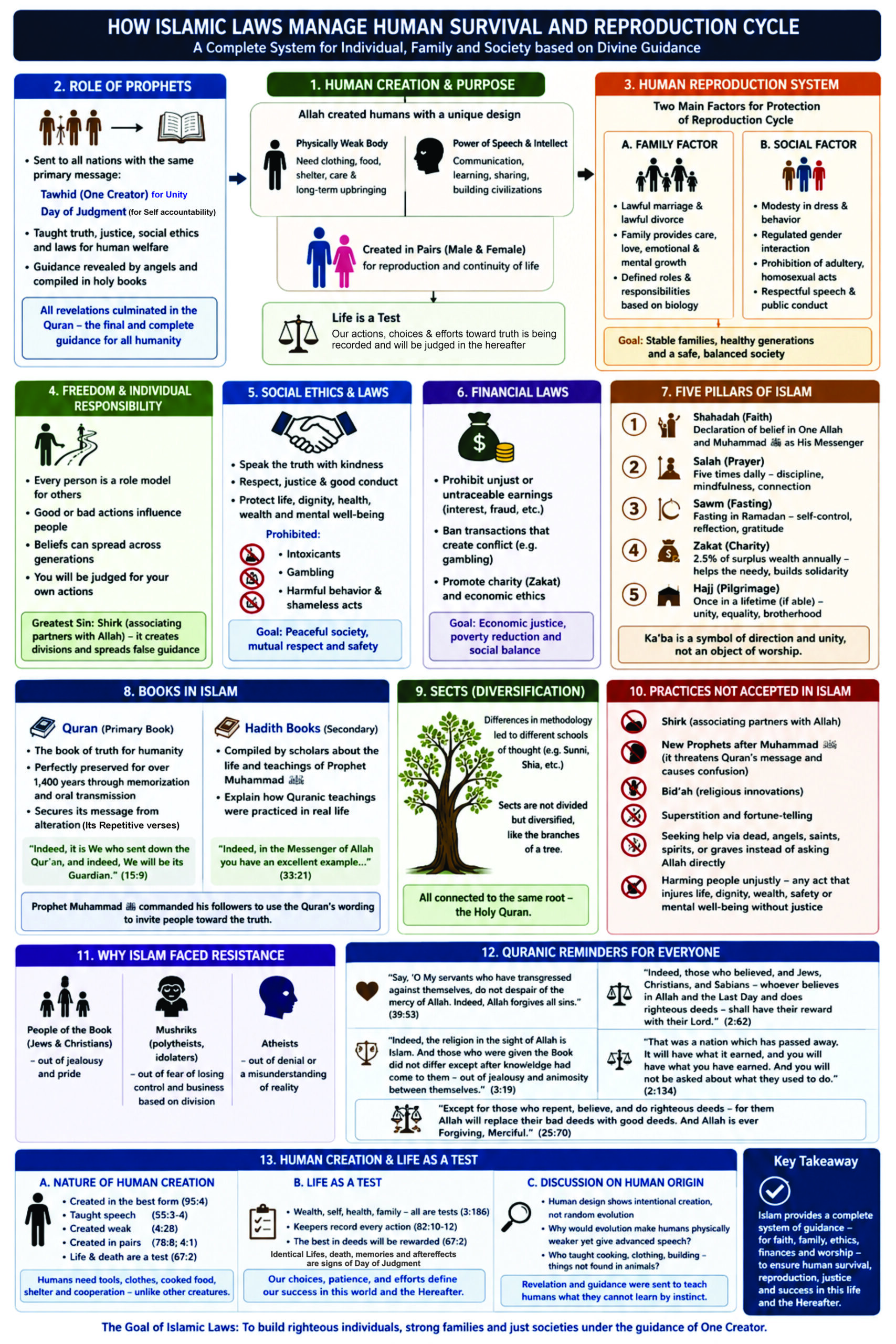
    The creation design of humans is a key point in understanding Islam and purpose of life (is test/trail for judgment); the Quran explains the two unique aspects of human creation (a weak body and the power of speech) and their reproduction through a pair. It is understandable how their weak bodies create dependencies on others and tools (such as wearing clothes, building civilizations, and trading), and how their power of speech helps them learn and share for better survival. As they spread across the earth, they divided into tribes and nations, learned multiple languages, and faced social challenges alongside religious conflicts and divisions.
    To address these matters, the Creator sent guidance (revelation) through angels to chosen people (Prophets) in many nations to show them the right path. These messages and laws were compiled in holy books within different religions, such as Christianity and Judaism. Ultimately, these were culminated in the last holy book—the Quran—as the complete guidance for all humanity.

    • | “O mankind, indeed We have created you from male and female and made you peoples and tribes that you may know one another…” Al-Hujurat (49:13)
    • | “And of His signs is the creation of the heavens and the earth and the diversity of your languages and your colors…” Ar-Rum (30:22)
    • | “Mankind was [of] one religion [community]. And Allah sent the prophets as bringers of good tidings and warners and sent down with them the Book in truth to judge between the people concerning that in which they differed…” Al-Baqarah (2:213)
    • | “Indeed, the religion in the sight of Allah is Islam. And those who were given the Book did not differ except after knowledge had come to them — out of jealousy and animosity between themselves……” Aal-‘Imran (3:19)

    Islam teaches humans diversification over divisions. like many branches of a tree


    2.1. Primary Education:

    According to the Quran, all Prophets (from Adam to Muhammad صلى الله عليه وسلم ) primarily focused on Tawhid (belief in one Creator and the Day of Judgment) for humans unity and self-accountability. This was intended to avoid divisions, conflicts and false guidance based on distorted beliefs. Additionally, they educated people on securing the human reproduction cycle and social ethics based on Divine Guidance with truth and justice.

    Faith:

    Rather than engaging in debates to prove the existence of the Creator, they taught that the Creator’s presence remains unseen during this trial, meaning social life is not directly controlled by force or fear. Belief in the one Creator is achieved by observing His signs in nature.
    Furthermore, the Creator has already placed true belief within human hearts and a sense of good and bad for self-judgment.

    • | “Say, ‘He is Allah, The One. Allah, the Eternal Refuge. He neither begets nor is born, nor is there to Him any equivalent.’” Al-Ikhlas (112)
    • | “And hold firmly to the rope of Allah all together and do not become divided…” Aal-e-Imran (3:103)
    • | “O you who believe! Avoid much assumptions. Indeed, some assumptions are sin….” Al-Hujurat (49:12)
    • | “And do not pursue that of which you have no knowledge….” Al-Isra (17:36)
    • | “And they ask you concerning the Spirit (ar-Rūḥ). Say: The Spirit is of the affair of my Lord. And mankind has not been given of knowledge except a little.” Al-Isra 17:85
    • | “And if all the trees on the earth were pens and the sea were ink, with seven more seas added to it, the words of Allah would not be exhausted. Indeed, Allah is All-Mighty, All Wise.” AlLuqman (31:27)
    • | “Indeed, within the heavens and earth are signs for the believers. And in your own creation, and whatever living beings He dispersed, are signs for people of sure faith.” Al-Jathiya (45:3–4)

    They made people aware of the truth by inviting them to observe the signs in nature for right guidance. In doing so, some Prophets migrated with their followers to save their faith and lives, establishing just social systems and protecting the innocent from injustice.
    After Prophet Muhammad صلى الله عليه وسلم, his followers looked to the Holy Quran as the main source of guidance in Islam for resolving social challenges

    Let see through, how Prophets follow Creator’s instructions, individually and socially:

    Prophet Muhammad ﷺ: “Whoever guarantees me what is between his jaws (kind & true use of tongue) and what is between his legs (lawful use of private parts), I guarantee him Paradise.” Sahih al-Bukhari, Book of Riqaq, Hadith 6474


    2.2. Two factors for Humans’ Reproduction cycles:

    Why unlawful sexual intercourse (zina) is prohibited (haram)?

    Since human newborns require long-term care, Prophets emphasized the importance of family for the protection and development of new generations. To reduce the risk of children being left without support, they guided people toward:

    1. Family Factor

    • Lawful sexual relationships (marriage) and lawful breakups (divorce) in simple and easy ways, to ensure a stable reproduction system, protection of family rights for generational safety and continuity.
    • Family is a supportive environment that promotes the physical, emotional, and mental development of children.
    • Guidance for Genders interactions in a family systems. Clear definition of roles and responsibilities within the family, including biologically based roles and duties.

    | “Do not approach unlawful sexual intercourse.” — Al-Isrāʾ (17:32)

    | “Men are protectors and maintainers of women, because Allah has given one more strength than the other, and because they support them from their wealth.”  Surah An-Nisā’ (4:34)

    | “Tell the believing men to lower their gaze and guard their private parts. That is purer for them. Indeed, Allah is All-Aware of what they do. And tell the believing women to lower their gaze and guard their private parts and not to display their adornment except what normally appears of it, and to draw their headcovers over their chests, and not to display their adornment except to their husbands, their fathers, their husbands’ fathers, their sons, their husbands’ sons, their brothers, their brothers’ sons, their sisters’ sons, their women, those their right hands possess, or those male attendants having no physical desire, or children who are not yet aware of women’s private aspects. And let them not stamp their feet to make known what they conceal of their adornment. And turn to Allah in repentance, all of you, O believers, that you might succeed.” An-Nur (24:30-31)


    2. Social Factor

    To maintain social order and protect individual dignity and mental well-being, the Prophets regulated public behavior by:

    • Adjusting dress standards by limiting body shape exposure and skin-revealing clothing to reduce unwanted sexual attraction, encouraging modest clothing (parda) for females, to protect identity and promote privacy in public places.
    • Promoting respectful gender interaction to ensure a balanced and safe society, by providing a clear definition of roles and responsibilities, including biologically based roles and duties.
    • Restricting homosexual acts for safety of reproduction cycles. Like we know how Qaum-e-Loot (The People of Lot) were punished for this act.
    • Discouraging inappropriate or shameless speech and behavior in public spaces, which could trigger others minds toward wrongdoings.

    | “Do not approach unlawful sexual intercourse.” — Al-Isrāʾ (17:32)

    | “O children of Adam! We have sent down to you clothing to conceal your private parts and as adornment. But the clothing of righteousness—that is best. That is from the signs of Allah, so that they may remember.” Al-A‘raf (7:26)

    A example for how genders duties works naturally:

    Biology shapes human roles: if a five-year-old boy and girl stand near a 3-kg stone, society instinctively expects the boy to lift it based on physical design. This childhood division grows into distinct adult experiences, for example, a man working in a wheat field gains the practical problem-solving skills, which helps him alot in leadership in the field, while women are shielded from such tasks and perform the tasks according to their biology.That’s why, Forcing the identical duties ignores these natural differences, leading to long-term social imbalance, because human desires cannot override biological reality.
    That’s why men are responsible according to their biological ways and women as well according to their biology, for duties.


    2.3. Why Freedom is a Individual’s Responsibility:

    | “You are the best nation produced for mankind: you enjoin what is right, forbid what is wrong, and believe in Allah.”- Āl-‘Imrān 3:110

    In Islam, Each human is a role model for others; his good and bad actions affects and influence others’ actions too.
    Life on earth is a designed test (a trail before eternal life) for everyone, to record their good & bad choices and their efforts. Like how everyone learn from truth, practice it, and share it to the others, Whether they are muslims or non-muslims.

    So everyone, who did good or bad to others, can be judged in the afterlife for punish and reward. Identical lifes with memories are the clear sign for the Day of Judgment.

    For Example: If a person lives with a wrong belief and follows its false guidance, even though they are not truly satisfied inside, they may still continue practicing it and teaching it to others. By doing this, they create a chain of false beliefs among family and friends.
    If they never correct themselves before death, that chain may continue even after they are gone, and they remain a cause of those wrong actions.

    That’s why In Islam, associating others with the One Creator (shirk) is the greatest sin, because it creates divisions then spreads false guidance, cause confusions and can mislead others as well.

    | “Indeed, Allah does not forgive associating partners with Him (shirk), but He forgives what is less than that for whom He wills…” – An-Nisa (4:48)
    | “O you who believe! Fear Allah as He should be feared, and do not die except as Muslims.” – Aal-Imran (3:102)

    | “Righteousness is not that you turn your faces toward the east or the west, but true righteousness is in one who believes in Allah, the Last Day, the angels, the Book, and the prophets; who gives wealth ‘despite loving it’ to relatives, orphans, the needy, the traveler, those who ask, and for freeing slaves; who establishes prayer and gives zakāh (charity); who keeps their promises when they make them; and those who are patient in hardship, suffering, and during battle. Those are the ones who are truthful, and it is they who are the righteous.” — Al-Baqarah 2:177


    2.4. Social ethics & laws:

    About communication ethics, As we know, all the humans borns with empty minds, they live and die while learning. So making mistakes is the part of learning, that’s why speaking truth with the kindness is the purest way to guide everyone. kindness is a superpower.

    “He who is deprived of kindness is deprived of all goodness.” Sahih Muslim, Kitab al-Birr wa al-Silah, Hadith 2592

    After that, they did also prohibited intoxicants and harmful activities. Safeguarding life, dignity, health, Wealth by educating and punishing any wrongdoings with truth and justice.

    | “Satan only wants to sow enmity and hatred among you through intoxicants and gambling and to prevent you from the remembrance of Allah and prayer. Will you then desist?” — Al-Mā’idah 5:91


    2.5. Financial laws:

    As financial activities performs the major part in humans social life. So for fair trades, Islam restricted unjust/untraceable activities (Interest, Fraud, etc.), and restricted the transactions which create conflicts and injustice (gambling, bets, etc.) for social peace and safety. And promoted charity (for poverty reduction), teaches economic ethics, etc.

    | “Consumeer elkaars rijkdommen niet op onrechtvaardige wijze...” – Al-Baqarah 2:188


    Vijf pijlers, boeken en sectoren in de islam……(lees meer)


    Conclusie

    Concluderend benadrukt het artikel hoe profeten dienden als morele en sociale gidsen, zoals de Koran beschrijft, wier leringen de fundamenten vormden van rechtvaardige en stabiele samenlevingen. Door hun boodschappen leerden mensen het belang van rechtvaardigheid, eerlijkheid, mededogen en verantwoordelijkheid in zowel het persoonlijke als het collectieve leven.

    Hun begeleiding hielp mensen te begrijpen hoe ze gezinnen, gemeenschappen en bestuur konden organiseren op een manier die de menselijke waardigheid beschermt en sociale stabiliteit op de lange termijn garandeert. Door deze principes te volgen, konden samenlevingen het onrecht terugdringen, het wederzijdse vertrouwen versterken en de samenwerking tussen individuen bevorderen.

    Over het geheel genomen werden de leringen van de profeten een bron van leer voor de mensheid, die een raamwerk bood voor ethisch leven en mensen hielp evenwichtige samenlevingen op te bouwen waar overleving, groei en morele ontwikkeling van generatie op generatie konden worden voortgezet.


    Herinnering aan de Koran voor iedereen:

    | “Zeg: ‘O Mijn dienaren die zichzelf hebben overtreden, wanhoop niet aan de genade van Allah. Allah vergeeft inderdaad alle zonden. Voorwaar, Hij is de Vergevensgezinde, de Barmhartige.’” – Az-Zumar 39:53

    | “Voorwaar, degenen die geloofden, en degenen die Joden waren, en de Christenen, en de Sabiërs - iedereen die in Allah en de Laatste Dag gelooft en goede daden verricht - zal zijn beloning bij zijn Heer ontvangen. Er zal geen angst over hen zijn, noch zullen zij treuren.” Al-Baqarah (2:62)

    | “Dat was een natie die is overleden. Het zal krijgen wat het heeft verdiend, en jij zult krijgen wat je hebt verdiend. En er zal je niet worden gevraagd naar wat ze vroeger deden.” — Al-Baqarah 2:134

    | “Behalve degenen die berouw tonen, geloven en goede daden verrichten; voor hen zal Allah hun slechte daden vervangen door goede daden. En Allah is altijd Vergevensgezind, Genadevol.” – Al-Furqan 25:70

    | “Indeed, the religion in the sight of Allah is Islam. And those who were given the Book did not differ except after knowledge had come to them — out of jealousy and animosity between themselves……” Aal-‘Imran (3:19)


    Learn with Ai
    (just copy and past the post link in ai websites)
    🤖 Ask AI