Samenvatting van de inhoud
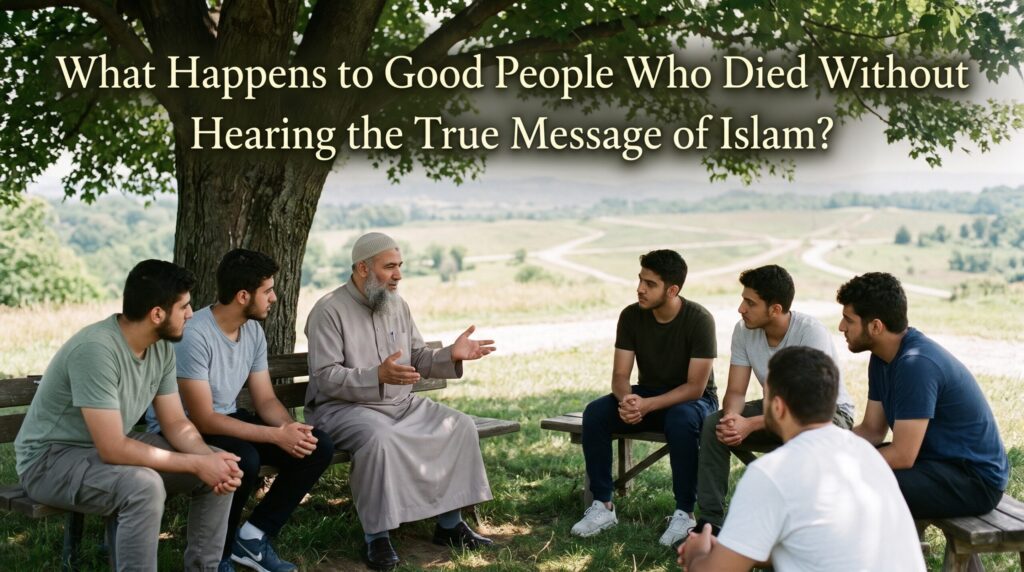
One of the most profound moral questions people ask about religion is: What is the fate of moral, good-hearted people who lived and died without ever hearing the true message of Islam? This article explores the universal principles of divine justice in the Qur’an, explaining how accountability is strictly tied to knowledge, intention, and sincere effort—proving that no soul will ever be wronged.
Inhoudsopgave
| Sectietitel | Belangrijke vragen beantwoord |
| 1. The Absolute Foundation of Divine Justice | Does God hold people accountable for what they never knew? |
| 2. The Innate Moral Compass: Understanding Fitrah | Can someone recognize the Creator without a formal scripture? |
| 3. Universal Accountability in the Qur’an | What does Surah Al-Baqarah (2:62) reveal about seekers of truth? |
| 4. The Fate of Those in the Interval (Ahl al-Fatrah) | How are people tested if no messenger or accurate message reached them? |
| 5. Why Are We Born into Different Religions and Cultures? | Why didn’t God make all humans born into one single faith? |
| 6. Guidance Section: Common Misconceptions | What false assumptions exist regarding salvation and divine mercy? |
| 7. Veelgestelde vragen | Quick, practical answers to common questions on this topic. |
1. The Absolute Foundation of Divine Justice
A common dilemma that troubles thoughtful minds is whether a merciful and just Creator would hold someone responsible for a message they never had the chance to understand. If someone lived on a distant island, in a secluded valley, or in a society where Islam was entirely misrepresented or unheard of, would they be punished?
The Qur’an settles this matter with ultimate clarity: God is the Supreme Judge, and His justice is absolute. Accountability only begins when authentic guidance has been delivered clearly and comprehended.
“Whoever is guided is only guided for [the benefit of] his soul. And whoever errs only errs against it. And no bearer of burdens will bear the burden of another. And We never punish until We have sent a messenger.” — Surah Al-Isra (17:15)
“And We place the scales of justice for the Day of Resurrection, so no soul will be treated unjustly at all. And if there is [even] the weight of a mustard seed, We will bring it forth. And sufficient are We as accountant.” — Soera Al-Anbiya (21:47)
Divine justice guarantees that God does not evaluate human beings based on geographical accident or cultural inheritance. Every person is judged strictly according to the light, knowledge, and opportunities they were actually granted during their earthly life.
2. The Innate Moral Compass: Understanding Fitrah
Even when external prophetic messages do not reach an individual, human beings are not left without guidance. The Creator has placed inside every person an innate nature, called the Fitrah, along with the capacity to observe the universe and distinguish right from wrong.
“So direct your face toward the religion, inclining to truth. [Adhere to] the natural disposition (fitrah) of Allah upon which He has created [all] people. No change should there be in the creation of Allah. That is the correct religion, but most people do not know.” — Surah Ar-Rum (30:30)
“By the soul and the One who proportioned it, and inspired it with its wickedness and its righteousness. Successful indeed is the one who purifies it, and failed is the one who corrupts it.” — Surah Ash-Shams (91:7-10)
Every human being observes the harmony of nature—the sunrise, the rain reviving parched earth, and the delicate balance of life. This natural observation points naturally to One Unseen Creator. When an individual follows this inner compass by living with humility, doing good to others, refraining from harm, and avoiding the worship of man-made idols or symbols, they are acting in harmony with the Fitrah.
3. Universal Accountability in the Qur’an
The Qur’an explains that salvation is not a tribal label or an inherited cultural badge. What truly matters in the sight of the Creator is sincere faith in One God, belief in moral accountability, and practicing righteousness with the knowledge one possessed.
“Indeed, those who believed, and those who were Jews, and the Christians, and the Sabians—whoever believed in Allah and the Last Day and did righteousness—will have their reward with their Lord, and no fear will there be concerning them, nor will they grieve.” — Surah Al-Baqarah (2:62)
This verse illustrates that before the arrival of the final revelation or in situations where true knowledge has not reached a soul, those who held fast to the oneness of God, lived with awareness of accountability, and did good to humanity will not have their virtues lost.
The Creator does not ignore the good deeds of any soul:
“So whoever does an atom’s weight of good will see it, and whoever does an atom’s weight of evil will see it.” — Soera Az-Zalzalah (99:7-8)
4. The Fate of Those in the Interval (Ahl al-Fatrah)
In Islamic scholarship, individuals who lived in times or places where prophetic guidance was absent, distorted, or completely unheard of are referred to as Ahl al-Fatrah (the people of the interval).
Classical scholars and authentic traditions confirm that the Creator will not hold these people accountable for laws they never received. Instead, their ultimate sincerity and obedience will be tested directly by the Creator on the Day of Resurrection in a manner suited to divine wisdom.
The Messenger of Allah ﷺ said:
“There are four [types of people] who will plead their case on the Day of Resurrection: a deaf person who could hear nothing, an insane person, a very elderly senile person, and a person who died during the fatrah (interval between messengers). … God will take their covenants of obedience, and a command will be sent to them. Whoever obeys will enter Paradise, and whoever disobeys will enter the Fire.” — Musnad Ahmad (Hadith 16301, authenticated by classical scholars)
This authentic teaching demonstrates that God’s mercy and fairness leave no blind spots. If a person had no way to know the truth on Earth, their test is postponed to the Day of Judgment, ensuring every soul receives an entirely fair opportunity.
5. Why Are We Born into Different Religions and Cultures?
A logical question follows: If God desires everyone to know the truth, why did He allow humans to be born into diverse cultures, lands, and religious traditions?
The Qur’an explicitly states that diversity is an essential part of the earthly test. Life is not designed as a place of automatic conformity, but as a testing ground where individuals exercise free will, choose between truth and falsehood, and strive toward goodness.
“O humanity! We created you from a male and a female and made you into nations and tribes so that you may know one another…” — Surah Al-Hujurat (49:13)
“…If Allah had willed, He would have made you one community, but He tests you through what He has given you. So race towards all that is good. To Allah is your return all together, and He will inform you about that in which you used to differ.” — Surah Al-Ma’idah (5:48)
Our birth environment is our starting ground, not our final verdict. A person born in a non-Muslim environment who sincerely seeks truth, acts justly, and treats people with empathy is far closer to the pleasure of God than someone born with a Muslim name who lives heedlessly, oppresses others, and acts corruptly.
Guidance Section: Misconceptions Around Salvation and Accountability
| Misconception | Reality According to the Qur’an & Sunnah | Practical Impact on Mindset |
| “All non-Muslims are condemned to punishment, regardless of whether they heard the message.” | The Qur’an (17:15) explicitly states that God never punishes any people until a clear messenger has been sent to them. Those who never heard the truth are judged fairly based on their capacity and sincerity. | Removes fatalistic thinking and reveals God’s boundless justice and mercy. |
| “Being born into a Muslim family guarantees Paradise without personal effort.” | Salvation is based on sincere faith and righteous deeds (Qur’an 2:177). Surnames and cultural roots hold zero weight if one’s actions and intentions are corrupt. | Prevents religious arrogance and promotes self-accountability and humble action. |
| “Distorted portrayals of Islam count as hearing the message.” | If an individual only heard hateful, violent, or false depictions of Islam, they have not truly received the message. They are categorized among those who did not receive the truth. | Calls Muslims to represent truth through upright character and ethical speech. |
| “Good deeds done by people unaware of Islam are completely wasted.” | God is never unjust; an atom’s weight of good is recorded (Qur’an 99:7-8). Sincere seekers who acted on the truth available to them will find their Lord All-Merciful. | Promotes deep respect for universal goodness, charity, and moral integrity. |
Vrijwaring
The judgments of specific individuals in the Hereafter belong solely to Allah, the Knower of the Unseen. No human being has the authority to declare who enters Paradise or Hellfire. The role of scripture is to clarify the universal rules of divine justice, not to pass individual verdicts.
An Invitation to Reflect
Take a quiet moment in your life to read the Holy Qur’an directly with an open heart and deep understanding in your own native language, at least once. Beyond cultural labels and media interpretations, you will discover a clear, profound dialogue that speaks directly to human reason, conscience, and the universal thirst for justice.
Frequently Asked Questions
1. Does someone who never heard of Islam go straight to Hell?
No. The Qur’an clearly states in Surah Al-Isra (17:15) that God does not punish anyone until a messenger with clear guidance has been sent to them. People who never heard the true message are evaluated with complete fairness by the All-Wise Creator.
2. What happens to someone who only heard a negative, distorted version of Islam?
Islamic scholars, including Imam Al-Ghazali, explained that those who only received a distorted or demonized portrayal of Islam cannot be blamed for rejecting that distortion. They are treated like those to whom the genuine message never reached.
3. How will God judge moral people from isolated areas of the world?
They will be judged based on what they knew, their response to their inner moral conscience (Fitrah), their belief in the Creator of the universe, and their treatment of fellow human beings. Authentic Hadith also affirm that they will receive their fair test on the Day of Judgment.
4. Are non-Muslims rewarded for their good deeds?
God never wrongs anyone by even a speck of dust (Qur’an 4:40). Sincere actions done with kindness, justice, and compassion are fully recognized by the Creator, who is the most appreciative (Ash-Shakur).
5. Why is seeking the truth an individual responsibility?
Because God gave every human intellect, speech, and moral discernment. Life is a purposeful test, and each person is encouraged to look past cultural habits and sincerely seek the reality of their existence.
6. Does a Muslim name guarantee salvation?
No. The Qur’an repeatedly emphasizes that faith must be accompanied by righteous action and sincere intention. Hypocrisy and oppression are severely condemned, regardless of a person’s outward religious title.