Samenvatting van de inhoud
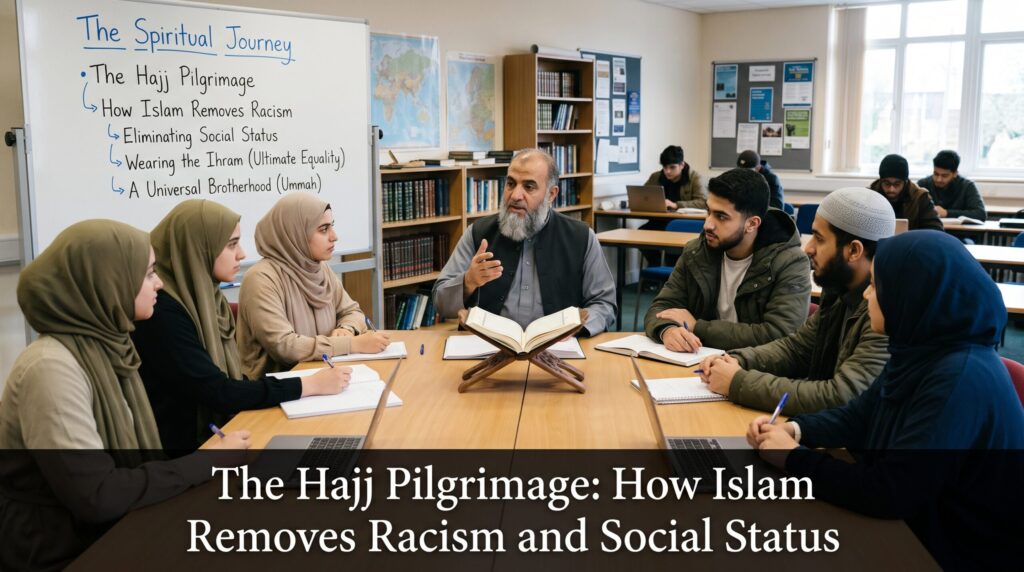
The Hajj Pilgrimage: Throughout human history, society has struggled with division. We categorize people by their skin color, their bank accounts, their passports, and their social standing. These artificial barriers breed arrogance, racism, and inequality. However, Islam offers a profound, practical solution to this universal problem. According to the deep insights found in the document “Humanity By Quran,” the acts of worship in Islam are not merely spiritual rituals; they are a complete social system of discipline. The Hajj pilgrimage is the ultimate expression of this system. It is a divine masterclass in equality, designed to physically and psychologically strip away worldly status and unite millions in absolute brotherhood. In this post, we will explore how the Hajj pilgrimage destroys racism, the true purpose of the Ka’bah, and how Islam builds a unified global community.
Inhoudsopgave
| Sectietitel | Belangrijke vragen beantwoord |
|---|---|
| The Disease of Arrogance and Social Division | Why do humans naturally divide themselves by race and wealth? |
| What is Hajj? The Discipline of Global Unity | Is the pilgrimage just a physical journey or a social regulation? |
| The Ihram: Stripping Away Worldly Status | How does a simple piece of cloth destroy social hierarchies? |
| The Ka’bah: A Symbol of Direction, Not Worship | Why do millions of Muslims walk around a stone building? |
| The Ultimate Social Impact: Brotherhood Before the Creator | What happens when the CEO and the laborer stand shoulder-to-shoulder? |
The Disease of Arrogance and Social Division
Human beings are created with a natural diversity of languages, cultures, and colors. The Qur’an explicitly states that this diversity is a deliberate design, meant to help us recognize and learn from one another. However, human ego and ignorance often twist this beautiful diversity into a source of pride and prejudice.
People begin to believe that their wealth, their tribe, or their skin color makes them superior to others. This arrogance is the root of racism and social injustice. When society judges individuals by their worldly status rather than their moral character, empathy dies, and the strong exploit the weak.
To cure this psychological and social disease, a theoretical lecture on equality is not enough. Humanity requires a practical, physical discipline that forces individuals to leave their egos behind and experience true equality. This is precisely what the Hajj pilgrimage achieves.
What is Hajj? The Discipline of Global Unity
Hajj is the fifth pillar of Islam, an obligation required once in a lifetime for every Muslim who is physically and financially capable. But beyond the logistics of travel, what is its true purpose?
“Humanity By Quran” beautifully describes Hajj as the “discipline of equality and collective unity.” It is a global regulation system. Every year, millions of people from all nations, races, and backgrounds travel to Mecca. They leave behind their comfortable homes, their businesses, and their titles to participate in a shared physical and spiritual journey.
“And proclaim to mankind the Hajj; they will come to you on foot and on every lean camel from every distant pass.” (Surah Al-Hajj 22:27)
By demanding that millions gather in one place for a shared purpose, Hajj transcends nationality and wealth. It is a profound reminder that life on Earth is a temporary journey, and ultimately, all of humanity is moving toward the exact same destination: accountability before the Creator.
The Ihram: Stripping Away Worldly Status
In our everyday lives, clothing is one of the primary ways we communicate our social status. A designer suit signals wealth and power, while worn-out clothes often invite judgment or pity. Clothing creates immediate, visible barriers between human beings.
During Hajj, these barriers are entirely dismantled through the Ihram. The Ihram is a state of purity, physically represented by the simple clothing worn by male pilgrims: two unstitched pieces of plain white cloth. (Women also wear simple, modest clothing without covering their faces or hands).
“Humanity By Quran” emphasizes that this simple cloth strips away all worldly status. When millions of people wear the exact same unstitched fabric, it becomes impossible to distinguish a billionaire CEO from a daily wage laborer or a king from a common citizen.
This profound physical equality forces a psychological shift. It destroys arrogance. It teaches the soul that in the sight of the Creator, your bank account and your designer labels are worthless. The only currency that matters is the purity of your heart and your righteous deeds.
The Ka’bah: A Symbol of Direction, Not Worship
A common misunderstanding among observers of the Hajj is the purpose of the Ka’bah—the cube-shaped building in the center of the Grand Mosque in Mecca. Some mistakenly assume it is an idol or an object of worship.
Islam, which is founded on pure monotheism, strictly rejects the worship of any object, stone, or created being. “Humanity By Quran” clarifies that the Ka’bah is simply a “symbol of central direction.”
Just as the planets revolve around the sun in perfect order, the Ka’bah serves as a central point for human alignment on Earth. It was built by Prophet Ibrahim (Abraham) to establish the worship of the One Unseen Creator. When millions of diverse pilgrims circle the Ka’bah (the Tawaf), it represents the ultimate unity of purpose: humanity moving in perfect harmony, revolving their lives around the obedience of the Creator, rather than revolving around their own selfish desires.
The Ultimate Social Impact: Brotherhood Before the Creator
The ultimate goal of worship in Islam is not just personal spiritual highs; it is the betterment of human society. The Hajj pilgrimage is a transformative experience that reshapes a person’s worldview.
When a person stands shoulder-to-shoulder with people of every conceivable skin color, speaking hundreds of different languages, and praying to the exact same Creator, the illusion of racial superiority shatters completely. “Humanity by Quran” notes that Hajj reinforces global brotherhood and humility.
It teaches humanity a profound lesson in selflessness. The pilgrims experience fatigue, crowds, and physical exertion together, learning patience and mutual respect. They return to their home countries carrying this discipline of equality, becoming a source of safety and justice for their communities. Through Hajj, Islam proves that a world free of racism and social division is not just a utopian dream; it is a practical reality experienced by millions every single year.
Begeleidingssectie
| Onderwerp / Concept | Veel voorkomende misvatting of onwetendheid | De praktische waarheid (gebaseerd op richtlijnen uit de Koran) |
|---|---|---|
| The Ka’bah | Muslims worship the black stone box (the Ka’bah) in Mecca during their pilgrimage. | Islam strictly forbids worshipping objects. The Ka’bah is merely a physical focal point for global unity, symbolizing that all life must revolve around the One Unseen Creator. |
| Social Status | Wealth, nationality, and high social standing make a person superior to others. | In Islam, all humans are equal. Hajj physically strips away worldly status through the simple Ihram clothing, proving that true nobility is based only on righteousness and character. |
| The Purpose of Hajj | Hajj is just a difficult, ancient travel ritual that people do to erase their sins. | Hajj is a practical discipline of global unity and equality. It trains the human soul in humility, patience, and selflessness, actively destroying racism and social barriers. |
Vrijwaring
De inzichten die in deze blogpost worden gedeeld, zijn bedoeld voor educatieve en reflectieve doeleinden, waarbij gebruik wordt gemaakt van de concepten uit de aangeleverde kennisbestanden en de islamitische leer. Ze zijn gericht op het bevorderen van harmonie, logisch denken en morele verantwoordelijkheid. Lezers worden aangemoedigd om kennis te zoeken, na te denken over de natuur en gekwalificeerde wetenschappers te raadplegen voor diepere theologische studies.
Een oprechte uitnodiging
Echt begrip komt voort uit directe reflectie en een open hart. Wij nodigen u van harte uit om de Heilige Koran minstens één keer in uw leven te lezen, in een taal die u volledig begrijpt. Laat je eigen geest de wijsheid, logica en diepe vrede observeren die deze de mensheid biedt.
Veelgestelde vragen (FAQ's)
1. What is the main purpose of the Hajj pilgrimage? The main purpose of Hajj is to submit to the Creator while participating in a massive, practical discipline of equality and global unity. It trains individuals in humility, patience, and brotherhood, stripping away all racial and economic divisions.
2. Why do pilgrims wear simple white clothes (Ihram)? The Ihram clothing removes all outward markers of wealth, social status, and nationality. By wearing the exact same simple cloth, a billionaire and a laborer become physically indistinguishable, teaching profound humility and equality before the Creator.
3. Do Muslims worship the Ka’bah? Absolutely not. Islam is based on pure monotheism and strictly forbids worshipping any created object. As stated in “Humanity By Quran,” the Ka’bah is a symbol of central direction and unity, not an object of worship.
4. How does Hajj cure racism? Hajj forces people from every corner of the globe, representing every race and color, to stand shoulder-to-shoulder in the exact same conditions. Experiencing this absolute equality destroys the arrogant illusion that one race is superior to another.
5. Is Hajj required for everyone? Hajj is one of the Five Pillars of Islam, but it is only obligatory once in a lifetime for those who are physically and financially capable of making the journey. The Creator does not burden a soul beyond its capacity.