Samenvatting van de inhoud
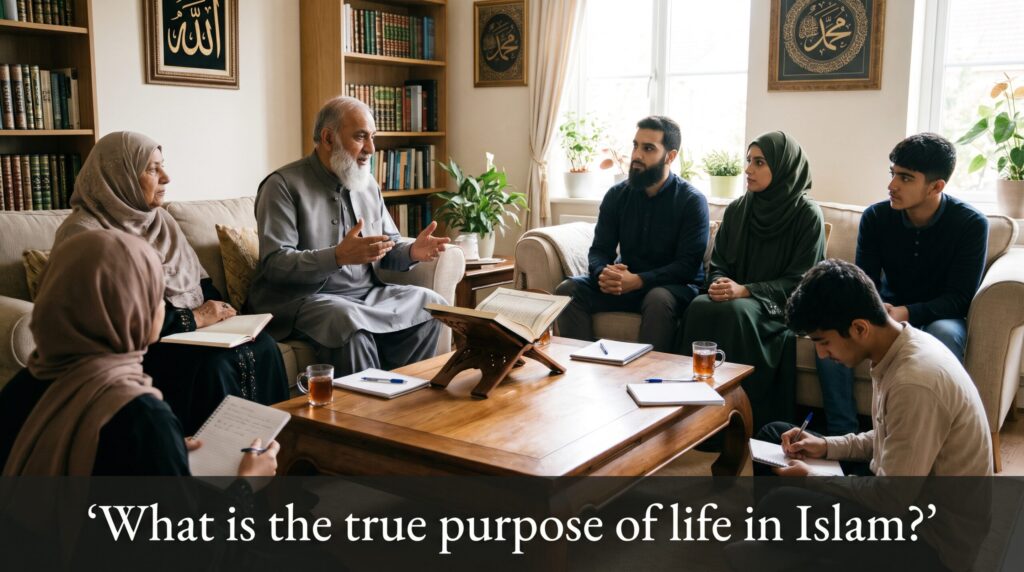
What is the true purpose of life in Islam: Have you ever looked up at the stars and asked yourself, “Why am I here?” Unlike any other creature on earth, humans possess a deep inner compass that constantly seeks meaning, justice, and purpose. We are not driven solely by biological survival; we have consciousness, morality, and the profound gift of free will. But what is the ultimate goal of all this? According to the profound insights found in the document “Humanity By Quran,” human life is not a random cosmic accident. It is a highly organized, temporary testing ground. In this post, we will explore the true purpose of life in Islam, understanding how our daily choices, our belief in the Unseen Creator, and our ultimate accountability shape a life of true peace, justice, and value.
Inhoudsopgave
| Sectietitel | Belangrijke vragen beantwoord |
|---|---|
| The Unique Design of Humanity | Why are humans fundamentally different from animals? |
| Life as a Deliberate Testing Ground | What is the actual purpose of our time on earth? |
| Free Will and Ultimate Accountability | Why does every single choice and word matter? |
| Living for the Creator vs. Living for the World | How do we find true inner peace and stability? |
| Being a Source of Safety for Humanity | How does fulfilling our purpose affect the people around us? |
The Unique Design of Humanity
When we observe the natural world, we see a universe of perfect order. Animals are born with built-in survival instincts—fur for the cold, claws for defense, and an innate knowledge of how to build nests or hunt. Humans, however, are born physically fragile and remain entirely dependent on others for years.
Yet, we possess something no other creature has: a highly advanced intellect and the superpower of complex speech. As highlighted in “Humanity By Quran,” this unique balance of physical weakness and intellectual superiority points directly to an intentional divine design. We were not made just to survive the elements; we were designed to think, cooperate, and make moral choices.
“Did you think that We created you without purpose and that you would not be returned to Us?” (Surah Al-Mu’minun 23:115)
Our ability to reflect on our own existence proves that we are meant for something greater than simply eating, working, and dying. Our design demands a higher purpose.
Life as a Deliberate Testing Ground
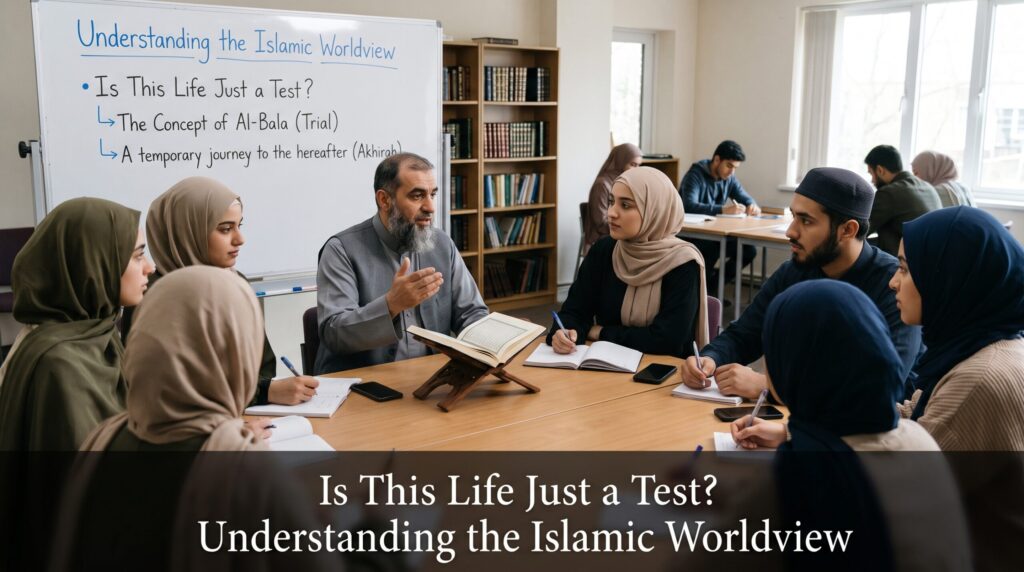
In Islam, the true purpose of life is beautifully simple yet incredibly profound: life is a temporary test. Earth is a well-organized testing ground where situations are continuously created to measure our choices between right and wrong, truth and falsehood, and patience and anger.
The Creator did not place us here because He needs us. Rather, He placed us here to reveal our true character through our own free will.
“He who created death and life to test you as to which of you is best in deed—and He is the Exalted in Might, the Forgiving.” (Surah Al-Mulk 67:2)
This means that every stage of life—whether it brings the joy of success, the pain of loss, or the struggle of temptation—is a part of the test. The hardships we face are not punishments, but opportunities to practice patience and trust. The wealth we gain is not just a reward but a test of our gratitude and charity. Understanding that life is a temporary exam brings immense clarity; it stops us from expecting heaven on earth and helps us focus on earning it in the afterlife.
Free Will and Ultimate Accountability
If life is a test, then there must be a result. In Islam, the belief in the One Unseen Creator is always paired with the belief in the Day of Judgment.
“Humanity by Quran” emphasizes that animals operate on instinct, but humans operate on free will. Because we can choose to lie or tell the truth, to help or to harm, and to believe or to deny, our actions carry moral weight. And to ensure absolute justice, the Creator has established a flawless system where every action, word, and even the hidden intention behind it is perfectly recorded.
“Hij zegt geen woord of er is een waarnemer bij hem in de buurt die klaarstaat om op te nemen.” (Soera Qaf 50:18)
Accountability is the ultimate anchor of human society. If a person believes they can commit injustice and simply die without facing consequences, corruption spreads. But when a person truly internalizes that they will stand before the Creator to answer for every deed, they discipline their tongue, purify their intentions, and act with profound justice, even when no one is watching.
Living for the Creator vs. Living for the World
People generally live their lives chasing one of two things: the approval of society or their own personal desires. Living for the approval of others brings constant anxiety, as people’s opinions change daily. Living only to satisfy one’s own desires often leads to emptiness, selfishness, and a lack of moral boundaries.
The true purpose of life in Islam offers a third, liberating path: living for the Creator.
When you centralize your life around the Unseen Creator, you attain deep inner peace. You do what is right because it is right, regardless of whether people praise you or criticize you. You seek truth through the signs in nature, and you practice gratitude in times of ease and patience in times of difficulty.
“Say, indeed, my prayer, my sacrifice, my living, and my dying are for Allah, Lord of the worlds….” (Surah Al-An’am 6:162)
This is the essence of true worship. It is not just about rituals; it is a comprehensive system of living where your daily habits, your honesty at work, and your kindness at home all become acts of worship that fulfill your ultimate purpose.
Being a Source of Safety for Humanity
Fulfilling your purpose in Islam is not an isolated, selfish journey. According to the practical wisdom in “Humanity By Quran,” true freedom is the responsibility to be a source of safety and value for others.
A meaningful, purpose-driven life is measured by how safe others feel around you. Are people’s wealth, dignity, and emotions safe from your tongue and your hands? The Creator commands us to use our unique gifts—our intellect and our speech—to build society, establish justice, and protect the vulnerable.
“…En spreek goede woorden tegen mensen...” (Soera Al-Baqarah 2:83)
Our ultimate purpose is to recognize the Creator, follow His guidance, and leave the world better than we found it. By planting good seeds of ethical communication, compassion, and fairness, we secure a peaceful society in this temporary life and eternal success when we finally meet our Creator.
Begeleidingssectie
| Onderwerp / Concept | Veel voorkomende misvatting of onwetendheid | De praktische waarheid (gebaseerd op richtlijnen uit de Koran) |
|---|---|---|
| The Purpose of Life | Life is a random accident, and the only goal is to maximize pleasure and wealth before we die. | Life is a deliberate, temporary testing ground designed by the Creator to measure our moral choices, patience, and gratitude. |
| Verantwoordelijkheid | When we die, everything goes dark, and there are no long-term consequences for our actions. | Every intention, word, and action is meticulously recorded. Absolute justice will be served on the Day of Judgment by the Unseen Creator. |
| True Worship | Worship only involves praying in a mosque and has nothing to do with how I treat people. | Worship is a complete system of life. Being honest, speaking kindly, protecting others, and being a source of safety are profound acts of worship. |
Vrijwaring
De inzichten die in deze blogpost worden gedeeld, zijn bedoeld voor educatieve en reflectieve doeleinden, waarbij gebruik wordt gemaakt van de concepten uit de aangeleverde kennisbestanden en de islamitische leer. Ze zijn gericht op het bevorderen van harmonie, logisch denken en morele verantwoordelijkheid. Lezers worden aangemoedigd om kennis te zoeken, na te denken over de natuur en gekwalificeerde wetenschappers te raadplegen voor diepere theologische studies.
Een oprechte uitnodiging
Echt begrip komt voort uit directe reflectie en een open hart. Wij nodigen u van harte uit om de Heilige Koran minstens één keer in uw leven te lezen, in een taal die u volledig begrijpt. Laat je eigen geest de wijsheid, logica en diepe vrede observeren die deze de mensheid biedt.
Veelgestelde vragen (FAQ's)
1. What is the main purpose of life in Islam? The main purpose of life is to recognize the One Unseen Creator, follow His guidance, and successfully navigate the moral test of life by choosing truth, justice, and compassion, ultimately preparing for accountability in the afterlife.
2. Why did the Creator make life a test? Because humans were given the unique gift of free will. A test allows humans to consciously choose between right and wrong, making our ultimate reward (Paradise) earned through sincere effort and moral discipline rather than forced obedience.
3. Does everything happening in my life mean I am being tested? Yes. Both hardships and blessings are forms of testing. Hardships test our patience, reliance on the Creator, and emotional resilience, while blessings and wealth test our gratitude, humility, and willingness to help others.
4. How does believing in accountability change a person’s behavior? When you truly believe that every word and action is recorded and will be judged, you develop strong inner self-control. You choose to act with justice and integrity even when you are completely alone, preventing corruption in society.
5. How can I fulfill my purpose every single day? You can fulfill your purpose by living with sincere intentions: practicing gratitude to the Creator, seeking forgiveness for your mistakes, treating people with kindness, and ensuring that you are a source of safety and value for everyone around you.