Samenvatting van de inhoud
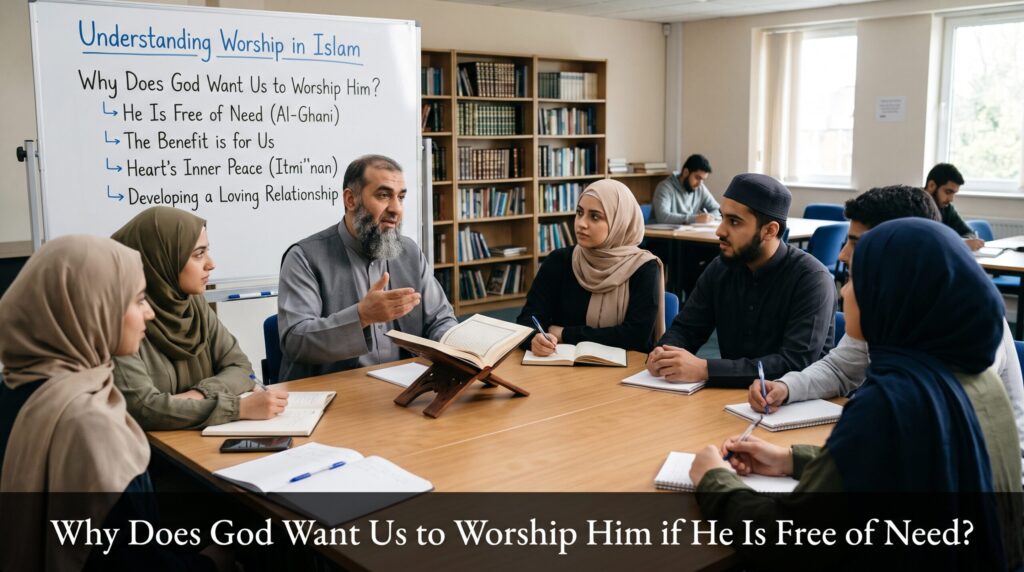
Why Does God Want Us to Worship Him: One of the most profound and frequently asked questions regarding religion is, “If the Creator is all-powerful and free of all needs, why does He demand our worship?” Many ancient belief systems taught that deities needed human sacrifices, food, or continuous praise to sustain their power. However, Islam completely shatters this concept. According to the deep, practical insights found in the document “Humanity By Quran,” the Creator is absolutely independent. He gains nothing from our obedience and loses nothing from our disobedience. In this post, we will explore the true meaning of worship in Islam, discovering how it is actually a comprehensive system of discipline designed entirely to regulate, protect, and benefit human beings.
Inhoudsopgave
| Sectietitel | Belangrijke vragen beantwoord |
|---|---|
| The Divine Independence: Free of All Need | Does the Creator require our prayers to sustain His power? |
| The True Meaning of Worship in Islam | Is worship merely a collection of physical rituals? |
| The Five Disciplines: Regulating Human Life | How do the pillars of Islam function as a human management system? |
| Gratitude and Forgiveness: The Core of the Heart | Why is praising the Creator essential for human balance? |
| Worship as the Ultimate Liberation | How does worshipping One Creator free us from other masters? |
The Divine Independence: Free of All Need
To understand worship, we must first understand the nature of the One we are worshipping. A common misconception is that the Creator is like a human king who demands continuous praise to feel powerful. This idea is fundamentally rejected in Islam.
The Creator is the Ever-Living and the Sustainer of all existence. He does not suffer from fatigue, hunger, or emotional dependency. As highlighted in “Humanity By Quran,” Allah is entirely independent of His creation. When He commands human beings to pray, fast, or give charity, it is not because He has a gap in His majesty that needs to be filled.
“O mankind, you are the ones who stand in need of Allah, while Allah is Free of all need, the Praiseworthy.” (Surah Fatir 35:15)
If every single human being on Earth decided to turn away and disbelieve, it would not diminish the Creator’s power by a single atom.
“If you disbelieve, then indeed Allah is free of need of you…. But if you are grateful, He approves it for you….” (Surah Az-Zumar 39:7)
We are the ones who are born physically weak, dependent, and continuously in need of guidance, peace, and sustenance. Therefore, the command to worship is actually a divine gift, providing us with the exact tools we need to navigate the tests of life.
The True Meaning of Worship in Islam
If worship is not a transaction to “feed” the Creator, then what is it? Humanity By Quran” provides a transformative definition: In Islam, worship (‘Ibadah) is not merely a set of isolated religious rituals. It is a complete social system of discipline designed to purify souls and regulate human life within society.
The purpose of worship is to train individuals to live responsibly, maintain justice, and contribute to a balanced and peaceful community. True righteousness is not just about the physical direction you face when you pray; it encompasses your moral character, your honesty in trade, and your compassion toward the vulnerable.
“Righteousness is not that you turn your faces toward the east or the west, but true righteousness is in one who believes in Allah, the Last Day, the angels, the Book, and the prophets; who gives wealth—despite loving it—to relatives, orphans, the needy, the traveler, those who ask, and for freeing slaves; who establishes prayer and gives zakah… Those are the ones who are truthful, and it is they who are the righteous.” (Surah Al-Baqarah 2:177)
Every command in Islam is built around human benefit. Worship is the practical method through which we align our daily lives with the flawless, natural order established by the Creator.
The Five Disciplines: Regulating Human Life
To see how worship benefits humanity rather than the Creator, we only need to look at the Five Pillars of Islam. “Humanity By Quran” perfectly describes these not just as pillars of faith, but as five essential disciplines for human regulation:
- Shahadah (Mental & Social Foundation): The declaration of faith liberates the human mind. By acknowledging that there is no Creator but Allah, a person is freed from worshipping their own desires, wealth, or powerful leaders. It establishes ultimate accountability.
- Salah (Daily Regulation): The five daily prayers are a masterclass in time management, focus, and patience. Tied to the natural cycles of the sun, Salah forces a person to pause their worldly chase, reset their mental focus, and practice humility.
- Sawm (Emotional Regulation): Fasting during Ramadan is a profound discipline of self-control. By restraining from food, water, and anger, humans train their emotional resilience and develop deep empathy for those who suffer from poverty.
- Zakat (Economic Regulation): This mandatory charity prevents the hoarding of wealth by the rich. It ensures that money circulates within society, reducing poverty and building a community based on compassion and trust.
- Hajj (Global Unity Regulation): The pilgrimage strips away all worldly status. Millions of people, wearing the exact same simple cloth, stand equal before the Creator, destroying racial and social barriers to reinforce global brotherhood.
None of these acts increase the Creator’s wealth or power. They are a comprehensive human management system designed entirely to keep society just, healthy, and emotionally stable.
Gratitude and Forgiveness: The Core of the Heart
At the very core of true worship are two living qualities: gratitude and seeking forgiveness. “Humanity by Quran” explains that humans are born with an empty mind and learn through continuous trial and error. Because we are constantly learning, we inevitably make mistakes.
Worship provides the psychological safety net for this human condition. When we experience success or ease, worship trains us to respond with gratitude (Shukr), which prevents arrogance. When we make mistakes, worship provides the mechanism of forgiveness (Istighfar), which prevents us from falling into despair or carrying lifelong guilt.
“Allah does not intend to make difficulty for you, but He intends to purify you and complete His favor upon you so that you may be grateful.” (Surah Al-Ma’idah 5:6)
Praising the Creator brings peace to the human heart. It reminds us that we are not carrying the weight of the world alone. We praise Him because acknowledging His perfection keeps our own egos in check and keeps us grounded in reality.
Worship as the Ultimate Liberation
Why does God want us to worship Him? He wants us to worship Him because He wants us to succeed. Life is a temporary testing ground, and humans are incredibly susceptible to losing their way. We easily become slaves to our careers, our bank accounts, the opinions of our peers, or our own fleeting desires.
Worship is the daily act of remembering who we truly are and where we are ultimately going. By bowing to the One Unseen Creator, we refuse to bow to anything or anyone else.
“Indeed, we created man from a sperm drop to test him, and we made him hearing and seeing.” (Surah Al-Insan 76:2)
Worship does not restrict human freedom; it defines it. It gives our lives a structure of justice, a community of empathy, and an inner sanctuary of peace, ensuring that we pass the test of life and earn eternal success in the Hereafter.
Begeleidingssectie
| Onderwerp / Concept | Veel voorkomende misvatting of onwetendheid | De praktische waarheid (gebaseerd op richtlijnen uit de Koran) |
|---|---|---|
| The Need for Worship | The Creator demands our prayers because He needs our praise to maintain His divine authority and power. | The Creator is absolutely free of all needs. Worship is commanded purely for the benefit, discipline, and spiritual purification of human beings. |
| The Nature of Rituals | Islamic practices like prayer and fasting are just ancient, empty rituals designed to control people. | Acts of worship are practical systems of regulation. They manage our time (Salah), emotions (Sawm), and economy (Zakat) to maintain a healthy society. |
| Human Freedom | Submitting to the Creator restricts my personal freedom and stops me from enjoying life. | True freedom is the responsibility to be a source of safety. Worshipping the Creator liberates you from being a slave to human approval, wealth, and worldly desires. |
Vrijwaring
De inzichten die in deze blogpost worden gedeeld, zijn bedoeld voor educatieve en reflectieve doeleinden, waarbij gebruik wordt gemaakt van de concepten uit de aangeleverde kennisbestanden en de islamitische leer. Ze zijn gericht op het bevorderen van harmonie, logisch denken en morele verantwoordelijkheid. Lezers worden aangemoedigd om kennis te zoeken, na te denken over de natuur en gekwalificeerde wetenschappers te raadplegen voor diepere theologische studies.
Een oprechte uitnodiging
Echt begrip komt voort uit directe reflectie en een open hart. Wij nodigen u van harte uit om de Heilige Koran minstens één keer in uw leven te lezen, in een taal die u volledig begrijpt. Laat je eigen geest de wijsheid, logica en diepe vrede observeren die deze de mensheid biedt.
Veelgestelde vragen (FAQ's)
1. Does Allah need our prayers? No. The Qur’an explicitly states that Allah is completely free of all needs. If every human stopped praying, it would not decrease His power. We pray because we are the ones who need guidance, peace, and discipline.
2. What is the real purpose of the Five Pillars of Islam? The Five Pillars are not just spiritual rituals; they are practical disciplines. They regulate a person’s mental state, time management, emotional control, financial responsibility, and social equality, ensuring a balanced human society.
3. If God doesn’t need worship, why is it a sin to abandon it? Because abandoning worship removes the discipline and moral framework required to pass the test of life. Without the anchor of worship, humans easily fall into injustice, arrogance, and corruption, which harms themselves and society.
4. How does worshipping Allah lead to human freedom? Human beings are naturally wired to serve something. If you do not worship the Creator, you will end up worshipping your desires, money, or the approval of society. Worshipping the One True Creator frees you from all worldly masters.
5. What does “Humanity By Quran” say about gratitude and forgiveness? It teaches that gratitude and seeking forgiveness are the core of true worship. Gratitude expands blessings and cures arrogance, while seeking forgiveness purifies the soul from the inevitable mistakes humans make as they learn and grow.