Samenvatting van de inhoud
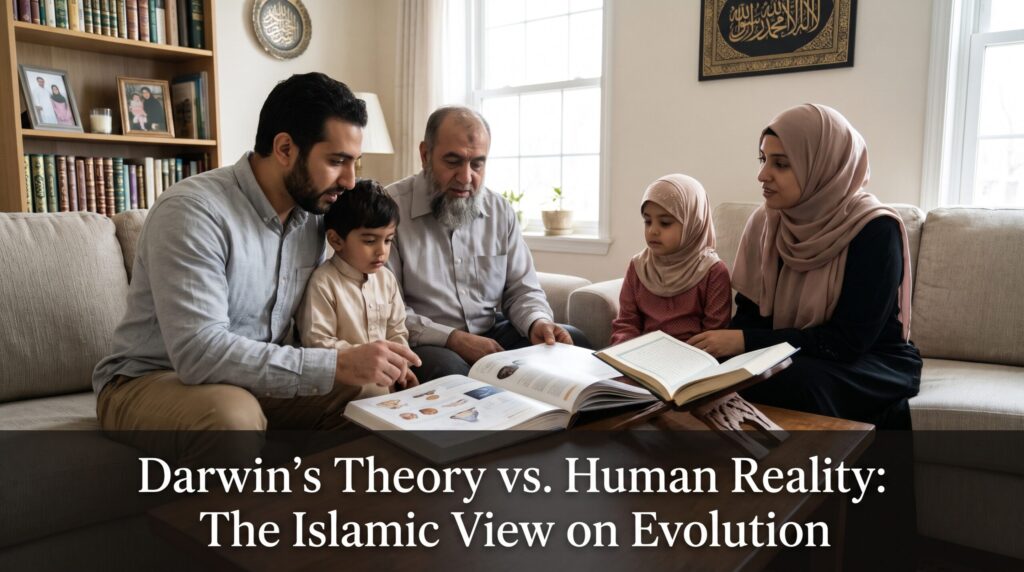
When we explore the origins of life, modern science often points to Darwin’s theory of evolution, suggesting that humans evolved from earlier primates through a blind process of natural selection. However, when we apply this theory of “survival of the fittest” to present human reality, a profound contradiction emerges. Why did the most intellectually advanced creature on Earth become the most physically fragile? In this post, we will explore the deep insights found in the document “Humanity By Quran” to understand why blind evolution cannot fully explain the human experience. We will discover how our unique balance of physical weakness and intellectual superiority points directly to an intentional divine design, created specifically for a moral and social test.
Inhoudsopgave
| Sectietitel | Belangrijke vragen beantwoord |
|---|---|
| The Core Conflict: Evolution vs. Human Reality | Why does human physical weakness contradict natural selection? |
| The Unexplained Miracles: Speech and Morality | Can blind biological survival explain human intellect and conscience? |
| The Social Harm of Misusing Evolutionary Theory | What happens when society believes we are merely advanced animals? |
| The Divine Design: Purpose Beyond Biology | Why were we intentionally designed to be interdependent? |
The Core Conflict: Evolution vs. Human Reality
Darwin’s theory of evolution proposes that species develop and adapt over millions of years to become better suited to their environments. The driving force behind this is “survival of the fittest”—the idea that nature selects the strongest, most resilient traits to pass on to the next generation.
If this theory were the absolute truth for human development, then as our species advanced, our bodies should have naturally become tougher, more resilient, and perfectly adapted to the harshness of the earth. We should have developed natural armor, thick fur for the winter, and an independent physical strength akin to the great apes.
Yet, human reality shows the exact opposite. As our intellect advanced, our physical forms became incredibly fragile. A human being cannot survive a harsh winter without woven clothing, cannot digest most foods without cooking them with fire, and requires artificial shelter to stay safe from the elements.
According to “Humanity by Quran,” this stark contrast points away from accidental evolution. A random process aimed purely at biological survival would not logically produce a creature so physically dependent yet intellectually supreme. This delicate balance reflects intentional design by a Supreme Creator.
“We have certainly created man in the best of stature; then we return him to the lowest of the low.” (Surah At-Tin 95:4-5)
The Unexplained Miracles: Speech and Morality
Animals possess remarkable instincts designed for short-term survival. A bird knows how to build a nest, and a bee knows how to construct a hive. However, humans possess traits that completely transcend biological necessity: complex symbolic speech and moral reasoning.
While evolutionary theory attempts to explain the development of the physical body, it struggles to explain the sudden and unique appearance of human language. Humans do not just communicate danger or mating calls; we assign names to abstract concepts, build philosophical thoughts, and transfer vast amounts of historical knowledge across generations.
Furthermore, human beings possess a deep inner compass that seeks justice, meaning, and purpose. We act beyond mere instinct, often showing compassion, self-sacrifice, and empathy for the weak—traits that directly oppose the ruthless logic of “survival of the fittest.” Nature cannot accidentally create a creature that looks at the stars and asks, “Why am I here?”
“He created man. He taught him speech.” (Surah Ar-Rahman 55:3-4)
The complexity of human consciousness and our innate desire for truth are profound signs of a Creator who breathed purpose into our existence.
The Social Harm of Misusing Evolutionary Theory
While the biological study of adaptation and genetics brings great medical and scientific benefits, treating unverified evolutionary assumptions as the absolute explanation for human existence has caused significant harm.
As highlighted in “Humanity By Quran.pdf,” when we teach generations that humanity is merely a cosmic accident driven by the survival of the fittest, we strip life of its higher moral foundation. If life is only about survival and reproduction, then morality becomes purely subjective.
When society removes the Creator and accountability from its foundation, the results are devastating. The focus shifts entirely to materialism. The concept of “survival of the fittest” has historically been misused to justify selfishness, racial superiority, exploitation, and the destruction of the weak.
We end up producing highly advanced, technologically rich societies that are emotionally empty, anxious, and devoid of true meaning. Humans inherently crave justice, proving that our inner compass demands a connection to a divine moral law, not just the laws of the jungle.
The Divine Design: Purpose Beyond Biology
Instead of getting lost in unanswerable questions about the exact biological mechanisms of our ancient origins, we must look at the practical questions nature places before us today. Why are we physically weak? Why can we speak?
Our physical fragility is not an evolutionary flaw; it is a profound catalyst for human civilization. Because we lack natural defenses, we are forced to think, invent, and—most importantly—cooperate. We need each other to build homes, grow food, and share knowledge. Our physical weakness creates the foundation of human society and the family unit.
We were not shaped to dominate through physical force as animals do. We were shaped for moral responsibility, intellect, and spiritual testing. Life on earth is a well-organized testing ground where our choices, our use of speech, and our treatment of others are recorded for ultimate accountability.
“Were they created by nothing, or were they themselves the creators? Or did they create the heavens and the earth? Rather, they are not certain.” (Surah At-Tur 52:35-36)
“Indeed, we created man from a sperm drop to test him, and we made him hearing and seeing.” (Surah Al-Insan 76:2)
We are here by design, placed in a temporary world to recognize our Creator through His signs, to live with justice, and to prepare for our return to Him.
Begeleidingssectie
| Onderwerp / Concept | Veel voorkomende misvatting of onwetendheid | De praktische waarheid (gebaseerd op richtlijnen uit de Koran) |
|---|---|---|
| Human Origins | Humans are just advanced animals resulting purely from accidental, blind evolution. | The unique combination of advanced intellect and extreme physical weakness points directly to intentional divine design, not blind survival. |
| The Ultimate Law | “Survival of the fittest” is the natural law that should govern human societies and progress. | Applying animal survival laws to humans leads to exploitation. Humans are governed by divine moral laws of justice, compassion, and ultimate accountability. |
| Human Purpose | Life has no higher meaning other than to survive, reproduce, and pass on genetics. | Human life is a deliberate, temporary test of free will and moral choices. Every action is recorded for the Day of Judgment. |
Vrijwaring
De inzichten die in deze blogpost worden gedeeld, zijn bedoeld voor educatieve en reflectieve doeleinden, waarbij gebruik wordt gemaakt van de concepten uit de aangeleverde kennisbestanden en de islamitische leer. Ze zijn gericht op het bevorderen van harmonie, logisch denken en morele verantwoordelijkheid. Lezers worden aangemoedigd om kennis te zoeken, na te denken over de natuur en gekwalificeerde wetenschappers te raadplegen voor diepere theologische studies.
Een oprechte uitnodiging
Echt begrip komt voort uit directe reflectie en een open hart. Wij nodigen u van harte uit om de Heilige Koran minstens één keer in uw leven te lezen, in een taal die u volledig begrijpt. Laat je eigen geest de wijsheid, logica en diepe vrede observeren die deze de mensheid biedt.
Veelgestelde vragen (FAQ's)
1. Does Islam completely reject the study of biology and evolution? Islam encourages the study of nature, biology, and science as a way to understand the Creator’s signs. However, Islam rejects the philosophical conclusion that life is an accident without a Creator or a higher purpose.
2. Why does human physical weakness challenge Darwin’s theory? If natural selection aims to make a species tougher for survival, humans should have evolved natural armor or fur. Our physical dependence on external tools and clothing shows that we were designed for intellect and cooperation, not just brute biological survival.
3. How does the Quran explain the origin of human speech? The Quran explicitly states that Allah created humanity and taught us speech. Language is a divine gift that allows us to think, build societies, and bear the responsibility of ethical communication, something blind evolution cannot logically produce.
4. What is the danger of believing we are just animals? When a society believes it is merely the product of “survival of the fittest,” morality becomes relative. This mindset has been used to justify selfishness and injustice, stripping human life of its sacred value and ultimate accountability.
5. If we didn’t evolve just to survive, what is our purpose? Our purpose is to recognize the One Unseen Creator, live according to His moral guidance, establish justice on earth, and prepare for the afterlife. Our physical weaknesses are intentionally designed to force us into cooperative societies where this moral test takes place.