Samenvatting van de inhoud
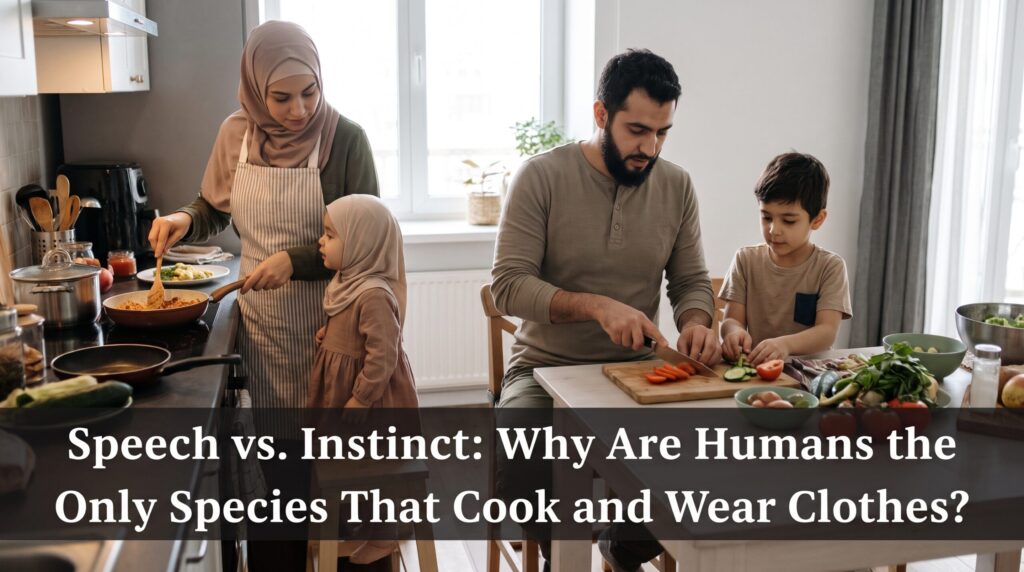
Speech vs. Instinct: Have you ever stopped to wonder why a cat does not need to weave a sweater for the winter or why a bird does not need to build a fire to cook its food? Throughout the animal kingdom, creatures are born with the physical traits and natural instincts required to survive in their environments effortlessly. Humans, however, are entirely different. We are born physically fragile and remain dependent on external tools like cooked food and woven clothing just to stay alive. According to the deep insights in the document “Humanity By Quran,” this is not an evolutionary accident. The unique combination of our physical weakness and our extraordinary gift of speech is a deliberate, divine design. This contrast forces us to build societies, communicate, and face the moral tests of life on Earth.
Inhoudsopgave
| Sectietitel | Belangrijke vragen beantwoord |
|---|---|
| The Missing Instincts: Why Are We Physically Weak? | Why do animals survive naturally while humans need tools? |
| The Spark of Civilization: Cooking and Clothing | How did our physical fragility force us to build communities? |
| The Power of Speech: The Ultimate Superpower | How did humans learn to invent and share knowledge? |
| Speech vs. Instinct: A Divine Design | Why does our unique design point to a Creator rather than blind evolution? |
The Missing Instincts: Why Are We Physically Weak?
When we observe nature, we see a world of immediate survival. Animals are naturally equipped with thick fur, tough skin, sharp claws, or wings. They also possess built-in instincts; a bee knows how to build a complex hive without going to school, and a newborn calf can stand and nurse within an hour of its birth.
Humans, in stark contrast, are born incredibly fragile. We do not have fur to protect us from the freezing cold. We cannot safely digest most raw meats or hard grains found in the wild. Without artificial shelter, we are highly vulnerable to the elements. From a purely biological standpoint, human beings are one of the physically weakest creatures on Earth.
However, as highlighted in “Humanity By Quran,” this physical weakness is not a biological flaw. It is a profound catalyst. Because we lack natural armor, we are forced to think, innovate, and most importantly, cooperate.
“We have certainly created man in the best of stature; then we return him to the lowest of the low.” (Surah At-Tin 95:4-5)
Our physical vulnerability ensures that we can never live in total isolation. It is the very reason we need each other.
The Spark of Civilization: Cooking and Clothing
If we had thick fur and tough stomachs, human history would look very different. We would likely live solitary lives in the wilderness, much like great apes or bears. But because we get cold, we had to invent clothing. Because our digestive systems are delicate, we had to master fire and learn the art of cooking.
These basic necessities—clothing and cooked food—cannot be easily produced by a single person living alone. To harvest cotton, weave fabric, hunt, gather, and maintain a fire requires a division of labor. It requires a family unit, and eventually, a community.
Our physical needs forced humanity out of isolation and into cooperative societies. We had to establish trade, build permanent shelters, and share resources. The very things that make us physically weak are the foundation of human civilization. We were designed with needs so that we would learn to serve and support one another.
The Power of Speech: The Ultimate Superpower
If we are physically weak, how did we manage to invent these life-saving tools? The answer lies in the greatest gift given to humanity: speech.
Animals can communicate basic emotions like fear or readiness to mate, but they only memorize sensory experiences for short-term survival. Humans possess complex, symbolic speech. We can assign names to abstract concepts, build philosophical thoughts in our minds, and transfer vast amounts of knowledge to the next generation.
“He created man. He taught him speech.” (Surah Ar-Rahman 55:3-4)
“And He taught Adam the names of all things…” (Surah Al-Baqarah 2:31)
Because of speech, the discovery of fire was not lost when the first discoverer died. The knowledge of how to cook meat or weave clothing was taught, refined, and passed down. Speech allows us to organize our societies, establish laws of justice, and share the truth. It is the perfect counterbalance to our physical weakness.
Speech vs. Instinct: A Divine Design
When we look at the reality of human existence, the theory of blind evolution struggles to provide a complete answer. If the law of nature is purely the “survival of the fittest,” human bodies should have evolved to become tougher, not weaker.
The perfect balance between extreme physical dependency and supreme intellectual communication points directly to an intentional Creator. We were not shaped to dominate the wilderness with brute force. We were intentionally designed with a combination of weakness and wisdom to face a moral test.
Our weaknesses keep us humble and interdependent. Our gift of speech allows us to seek truth, practice justice, and recognize the signs of the Creator in the universe. Life on Earth is a well-organized testing ground where our choices, our use of speech, and how we treat one another are recorded for ultimate accountability.
Begeleidingssectie
| Onderwerp / Concept | Veel voorkomende misvatting of onwetendheid | De praktische waarheid (gebaseerd op richtlijnen uit de Koran) |
|---|---|---|
| Human Uniqueness | Humans only cook and wear clothes because we evolved larger brains to survive the cold. | Clothing and cooking are results of a deliberate divine design where physical weakness forces humans to cooperate and build moral societies. |
| The Origin of Speech | Complex language evolved randomly from basic animal grunts over millions of years. | The Quran states that the Creator explicitly taught humanity speech. It is a divine gift designed for thought, communication, and ethical testing. |
| Doel van het leven | Life is an accident, and humans are just highly evolved animals driven by instinct. | Humans transcend instinct. We possess free will, morality, and speech, proving life is a temporary test of choices leading to accountability. |
Vrijwaring
De inzichten die in deze blogpost worden gedeeld, zijn bedoeld voor educatieve en reflectieve doeleinden, waarbij gebruik wordt gemaakt van de concepten uit de aangeleverde kennisbestanden en de islamitische leer. Ze zijn gericht op het bevorderen van harmonie, logisch denken en morele verantwoordelijkheid. Lezers worden aangemoedigd om kennis te zoeken, na te denken over de natuur en gekwalificeerde wetenschappers te raadplegen voor diepere theologische studies.
Een oprechte uitnodiging
Echt begrip komt voort uit directe reflectie en een open hart. Wij nodigen u van harte uit om de Heilige Koran minstens één keer in uw leven te lezen, in een taal die u volledig begrijpt. Laat je eigen geest de wijsheid, logica en diepe vrede observeren die deze de mensheid biedt.
Veelgestelde vragen (FAQ's)
1. Why are humans the only species that wear clothes? Unlike animals that are born with natural fur or thick skin for protection, humans are physically fragile. This weakness is a deliberate design that forces us to invent, cooperate, and rely on one another to produce necessities like clothing.
2. How does cooking food separate us from animals? Animals digest raw food naturally through instinct and biological adaptation. Human digestive systems require cooked food to extract maximum energy safely, which forced early humans to master fire, gather together, and form cooperative communities.
3. What does “Humanity By Quran.pdf” say about human speech? The document highlights that the Creator explicitly taught mankind speech (Ar-Rahman 55:3-4). Speech is not just an evolutionary tool; it is a divine trust that allows us to think, share complex knowledge, and bear moral responsibility.
4. Why doesn’t evolution fully explain human physical weakness? If natural selection is driven by biological survival, humans should have naturally evolved tougher bodies, fur, and natural armor. Our unique intellectual superiority combined with severe physical fragility points to intentional, intelligent design.
5. What is the ultimate purpose behind our physical needs? Our needs for food, shelter, and clothing prevent us from living in isolation. They force us to build families and societies. It is within these complex social interactions that our true character is tested and recorded for the Day of Judgment.