Content Summary
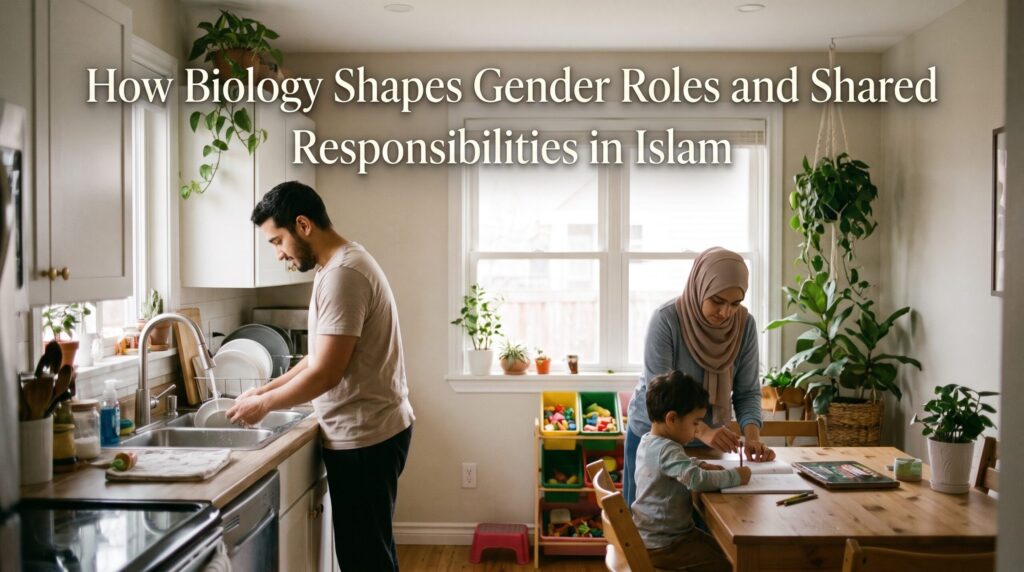
How Biology Shapes Gender Roles and Shared Responsibilities in Islam: Modern debates on gender frequently reduce fairness to absolute sameness, assuming that men and women can only have equal worth if they fulfill identical social and domestic roles. However, nature and observable reality demonstrate that physical structure directly influences function, psychology, and survival needs. This article examines how biology naturally informs gender roles and shared responsibilities within the Islamic framework. Grounded in Qur’anic wisdom, biological reality, and social balance, we explore why complementary duties—rather than competitive duplication—safeguard the family unit, honor individual dignity, and ensure the flourishing of future generations.
Table of Contents
| Section Title | Key Questions Addressed |
|---|---|
| 1. The Divine Principle of Pairs: Equal Worth, Distinct Functions | Does spiritual equality require men and women to be identical? How does the Qur’an define human worth before the Creator? |
| 2. Biological Design: How Physical Structure Informs Capability and Need | Why does physical anatomy influence human roles? What happens to society when biological realities are ignored? |
| 3. Financial Maintenance and Family Custody: The Practical Balance | What does Qawwamun mean in Islam? Why are men legally obligated to provide while women retain independent wealth? |
| 4. Shared Moral and Social Duties: Building a Culture of Safety | In what areas do men and women carry identical responsibilities? How does cooperation protect the reproduction cycle? |
1. The Divine Principle of Pairs: Equal Worth, Distinct Functions
Throughout the universe, the Creator has built balance not through uniform replication, but through complementary pairing. Positive and negative electrical charges, daylight and darkness, soil and rain—each side of a pair possesses distinct attributes that allow the larger system to operate smoothly.
Humanity was fashioned under this same universal law:
“And we created you in pairs.”
— Surah An-Naba (78:8)
“And of all things, we created two pairs; perhaps you will reflect.”
— Surah Adh-Dhariyat (51:49)
When it comes to human essence, spiritual worth, and moral capacity, Islam makes no distinction between men and women. Both are endowed with free will, both possess an inner soul (nafs), both are tested with choices, and both will stand individually before Allah on the Day of Judgment:
“O mankind, indeed, we have created you from male and female and made you peoples and tribes that you may know one another. Indeed, the most noble of you in the sight of Allah is the most righteous of you…”
— Surah Al-Hujurat (49:13)
“For men is a share of what they have earned, and for women is a share of what they have earned…”
— Surah An-Nisa (4:32)
Spiritual equality, however, is not functional identity. Islam rejects the notion that equal value demands identical responsibilities. Just as the heart and the lungs carry equal importance to human survival yet perform completely different biological functions, men and women possess distinct natural advantages that equip them for complementary societal and familial roles.
2. Biological Design: How Physical Structure Informs Capability and Need
A universal principle of biology is that structure dictates function. Across every animal species, physical physique, hormonal systems, and reproductive biology shape behavioral patterns, division of labor, and survival strategies. Humans are no exception to this natural reality.
Men and women are physiologically distinct:
- Musculoskeletal Structure: On average, biological males have greater upper-body muscle mass, higher bone density, and a cardiovascular framework adapted for intense physical labor and direct defense.
- Reproductive Investment: Biological females carry the miraculous yet physically demanding capacity for gestation, childbirth, and lactation. Carrying a child for nine months and nursing an infant requires immense metabolic energy, emotional focus, and periods of physical vulnerability.
These differences are not cultural socializations; they are biological baselines woven into human fitrah (innate disposition).
The Reality of Practical Alignment
Consider a practical example: if a heavy physical task—such as clearing fallen timber or lifting a three-ton beam—needs to be done on a worksite, human intuition naturally turns to male physical strength. This instinct is not prejudice; it is a recognition of structural aptitude.
Similarly, early infant survival is intrinsically tied to the mother’s biology. No technology or cultural philosophy can duplicate the biological bond, nourishment, and physical shelter a mother provides during gestation and early infancy.
When societies attempt to enforce identical duties regardless of biology, two predictable harms emerge:
- Female Burnout: Women are burdened with the dual expectation of competing equally in rigorous external economic labor while continuing to carry the physiological demands of child-bearing and early nurturing.
- Male Abdication: Men are relieved of their biological obligation to protect and provide, leading to fatherlessness, relational instability, and social withdrawal.
Aligning duties with natural strengths is not inequality; it is practical mercy and organizational wisdom.
3. Financial Maintenance and Family Custody: The Practical Balance
Because female biology carries the physical load of human reproduction, divine justice requires that women be protected from mandatory economic burdens. In the Islamic family framework, rights and duties are balanced with mathematical precision.
The Qur’an outlines this financial and protective guardianship:
“Men are the protectors and maintainers of women because Allah has given one more [strength/favor] than the other and because they support them from their wealth…”
— Surah An-Nisa (4:34)
Understanding Qawwamun (Protectors and Maintainers)
The term “Qawwamun” is often misunderstood as a license for authoritarian dominance. In authentic Islamic jurisprudence, qawwamah is a heavy legal burden and accountability, not an entitlement. It means:
- The husband carries the sole mandatory obligation to feed, house, clothe, and medically support his wife and children.
- Even if the wife is wealthy or earns an income through investments or work, her money belongs entirely to her. She is not obligated by divine law to spend a single cent on rent, food, or children’s expenses.
- The husband’s physical strength and social exposure are deployed as an outer security perimeter to keep his household safe from danger and exploitation.
Balancing the Social Ledger
| Dimension | Role of the Husband (Father) | Role of the Wife (Mother) |
|---|---|---|
| Primary Financial Duty | Legally mandatory provider; accountable before Allah for household sustenance. | Retains 100% personal ownership of her wealth; financial contribution is voluntary charity (Sadaqah). |
| Physical Vulnerability | Absorbs external physical strains, hazardous tasks, and defense. | Shielded from hazardous labor during critical phases of pregnancy, recovery, and nursing. |
| Internal Family Role | Sets strategic direction, provides safety, models integrity, and maintains household order. | Serves as the emotional anchor, builds the home atmosphere (Sakinah), and oversees foundational child training. |
| Accountability | Answerable for neglect of family rights, maintenance, and lack of justice. | Answerable for preserving marital trust, managing the domestic sanctuary, and maternal duties. |
The Prophet Muhammad ﷺ established this reciprocal stewardship:
“All of you are shepherds, and each of you is responsible for his flock. The ruler of the people is a shepherd and is responsible for them. A man is the shepherd of his household and is responsible for them. A woman is the shepherd of her husband’s house and his children and is responsible for them…”
— Sahih al-Bukhari (7138)
This structure prevents toxic rivalry. Instead of two partners competing for the exact same authority and burdening themselves with identical demands, they operate as a unified team where each excels in their natural sphere.
4. Shared Moral and Social Duties: Building a Culture of Safety
While biological differences divide domestic and economic obligations, both genders share an identical responsibility to establish moral order and serve as a source of safety (Amanah) for their surroundings.
The Qur’an details the cooperative nature of male and female believers:
“The believing men and believing women are allies of one another. They enjoin what is right and forbid what is wrong and establish prayer and give zakah and obey Allah and His Messenger. Those—Allah will have mercy upon them. Indeed, Allah is Exalted in Might and Wise.”
— Surah At-Tawbah (9:71)
Core Areas of Equal and Shared Responsibility
- Moral Accountability and Self-Discipline: Both men and women are commanded to guard their chastity, practice modesty, and control their vision (Surah An-Nur 24:30–31).
- Speech and Communication Ethics: Both are required to speak truthfully, avoid gossip, refuse unverified claims, and respond to hostility with patience (Surah Al-Hujurat 49:11–12).
- Intellectual Growth and Education: Seeking knowledge is an obligatory duty upon every individual Muslim, regardless of gender. Women historically served as scholars, jurists, educators, and community leaders.
- Safeguarding Future Generations: Both mother and father are jointly responsible for raising children who understand accountability, practical life skills, and spiritual devotion.
When biology and divine guidance work in tandem, human society operates smoothly. Men find meaning in productive responsibility and protective service; women find security in lawful provision and societal honor; and children are raised in stable two-parent homes rooted in affection, clear identity, and emotional peace.
Guidance Section: Correcting Common Misconceptions
| Misconception / Cultural Distortion | Root Ignorance Behind It | Qur’anic & Authentic Sunnah Correction |
|---|---|---|
| “Equal rights must mean performing identical social and physical roles.” | Confusing moral equivalence with physiological sameness; ignoring the structural differences between male and female biology. | Spiritual status and legal rights are equal (Surah Al-Hujurat 49:13; Surah An-Nisa 4:32). However, biological differences dictate differentiated functions to ensure family survival and balance. |
| “Islamic leadership (Qawwamah) means absolute male dictatorship and dominance.” | Using divine responsibility as an excuse for cultural tyranny, abuse, and personal pride. | Qawwamah is a servant-leadership model based on protective care, financial maintenance, and mutual consultation (Shura). Abuse of authority is a major sin before Allah. |
| “Muslim women are forbidden from earning wealth, owning property, or working.” | Blending patriarchal cultural customs with Islamic jurisprudence. | Islam granted women full financial independence 1,400 years ago. A woman owns her money, businesses, and inheritance outright; her husband has zero legal claim over her property. |
| “Managing the home and raising children is an inferior, secondary occupation.” | Measuring human value purely through external corporate employment and capitalistic production. | The home is the foundation of civilization. Islam regards maternal care and the moral training of conscious human souls as one of the highest forms of worship and societal service. |
Disclaimer
This article is written for educational, logical, and theological reflection based on the Qur’an and authentic prophetic teachings. It does not replace individualized legal rulings (fatwas) for specific domestic disputes, custody matters, or commercial agreements, which should be referred to qualified, objective Islamic scholars and local legal authorities.
An Invitation to Reflect
The Creator who fashioned the human genome, calibrated male and female biology with perfect complementarity, and established the intricate systems of life knows what stabilizes the human family and what brings it to ruin. His laws are not arbitrary constraints; they are protective instructions from the One who designed our nature.
We invite every reader—regardless of your faith, background, or social views—to pick up the Holy Qur’an and read it with reflection and an open heart at least once in your life in your own language. Examine its balanced approach to human relations, ponder the wisdom of its social ethics, and discover the lasting peace that emerges when life is lived in harmony with divine order.
Frequently Asked Questions (FAQs)
1. Does Islam teach that men are superior to women?
No. In the sight of Allah, superiority is determined strictly by piety, righteous conduct, and God-consciousness (Taqwa), not by gender, race, or social status (Surah Al-Hujurat 49:13). Men are granted functional authority within the home only because they carry the mandatory financial responsibility and physical duty to protect the family (Surah An-Nisa 4:34).
2. Can a Muslim woman work outside the home or pursue a career?
Yes. Islamic law allows women to work, own property, conduct business, and pursue education, provided the work is ethical (Halal), does not violate Islamic moral boundaries, and does not lead to the neglect of essential marital and familial responsibilities agreed upon within the home.
3. What happens if a husband refuses to provide financially for his wife?
Financial maintenance (Nafaqah) is a legally binding obligation in Islam. If a husband capable of earning refuses to provide basic shelter, food, and clothing for his wife and children, he is guilty of a major sin and the wife has the legal right to seek intervention, financial compensation, or divorce (Khula’/judicial annulment).
4. Why does Islam assign child custody primarily to mothers in early childhood?
Islamic jurisprudence prioritizes the emotional, physical, and psychological welfare of the child. Due to the mother’s biological bond, capacity for nursing, and natural nurturing instincts, she is granted primary physical custody during early childhood, while the father remains strictly obligated to finance the child’s living and educational expenses.
5. Why do men and women inherit different shares in certain Islamic inheritance cases?
In scenarios where a brother inherits twice the share of his sister, the allocation reflects financial obligations, not personal value. A brother must use his inheritance to support his wife, children, mother, and unmarried sisters. The sister, however, owes financial maintenance to no one; her inheritance remains entirely her personal savings, with all her living expenses covered by her father, husband, or brothers.
6. How does the concept of mutual consultation (Shura) apply to marriage?
Islam does not endorse unilateral decisions in marital life. The Qur’an encourages husbands and wives to manage domestic affairs through mutual consultation (Shura) and shared goodwill (Surah Al-Baqarah 2:233). A righteous husband listens to his wife’s counsel and treats her opinions with respect and honor.