Content Summary
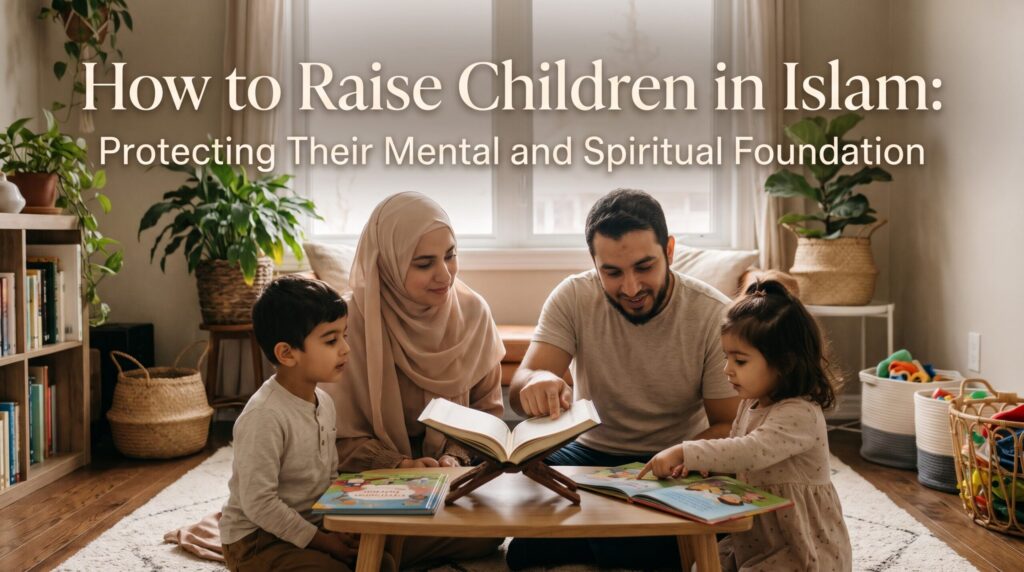
How to Raise Children in Islam: Protecting Their Mental and Spiritual Foundation: In an increasingly distracted and chaotic world, raising resilient, emotionally secure, and spiritually grounded children is one of the most vital tasks for parents. This guide explores the Quranic blueprint for nurturing a child’s mental and spiritual foundation. Drawing from natural human design (Fitrah), ethical speech, family stability, and deliberate role modeling, this post provides practical, faith-centered strategies to safeguard young minds from modern anxiety, nihilism, and moral confusion.
Table of Contents
| Section Title | Key Questions Addressed |
|---|---|
| 1. Understanding the Child’s Natural State (Fitrah) | What is the natural spiritual state of a child, and how does the modern world challenge it? |
| 2. The First Foundation: Ethical Speech and Communication | How do words act as seeds in a child’s development, and why is gentle speech essential? |
| 3. The Second Foundation: Relational Purity and Family Stability | Why are marital stability, modest boundaries, and a lawful home critical for child psychology? |
| 4. Anchoring the Mind: Faith, Accountability, and Resilience | How does teaching belief in the Creator and the Day of Judgment prevent mental fragility? |
| 5. Silent Instruction: The Transformative Power of Parental Example | Why do actions impact children more than spoken rules, and how should parents handle mistakes? |
1. Understanding the Child’s Natural State (Fitrah)
Every child enters the world with a clean slate and an innate inner compass known as the Fitrah. This natural disposition is instinctively inclined toward truth, compassion, fairness, and the recognition of the Creator. Unlike other living creatures that rely purely on physical strength and raw instinct from birth, human beings are born physically vulnerable and dependent. This vulnerability is not an accidental flaw; it is a deliberate design that creates the necessity for nurturing, structured family life, and deep emotional connection.
The Prophet Muhammad ﷺ clarified this foundational principle:
“Every child is born upon the Fitrah (natural disposition), and it is their parents who make them a Jew, a Christian, or a Zoroastrian.”
— Sahih al-Bukhari (Hadith 1358), Sahih Muslim (Hadith 2658)
The Creator highlights this natural inclination in the Quran:
“So set your face toward the religion, upright—the natural way (fitrah) of Allah upon which He created all people. There is no change in the creation of Allah. That is the correct religion, but most people do not know.”
— Surah Ar-Rum (30:30)
Why Modern Conditioning Distorts the Inner Compass
When children are raised solely on materialistic benchmarks—such as chasing validation on screens, hyper-competitiveness, and living without higher purpose—their innate compass gets buried beneath noise and desire.
A child disconnected from their spiritual origin becomes fragile, constantly measuring their personal worth through the shifting opinions of peers. Protecting a child’s mental foundation begins by acknowledging and preserving this original, untainted fitrah.
2. The First Foundation: Ethical Speech and Communication
Human beings were endowed with a capability that no other creature on Earth possesses: the gift of symbolic, memorized speech. While animals remember immediate sensations, humans build complex internal worlds and long-term memories using words. Because a child’s brain absorbs language like a sponge, speech functions as an emotional and spiritual seed.
The Quran describes the enduring power of speech:
“Have you not considered how Allah presents an example: a good word is like a good tree—its root firm and its branches in the sky.”
— Surah Ibrahim (14:24)
The Prophet Muhammad ﷺ emphasized the weight of this trust:
“Whoever guarantees me what is between his jaws and what is between his legs, I guarantee him Paradise.”
— Sahih al-Bukhari (Hadith 6474)
[Kind, Honest Words] ───> Seeds of Confidence, Truth & Calmness ───> Emotionally Stable Child
[Harsh, Mocking Words] ───> Seeds of Fear, Resentment & Deceit ───> Mentally Anxious Child
Kindness as an Educational Superpower
Children learn continuously by trial and error. Because they lack adult experience, mistakes are an inevitable part of their growth. When parents react with anger, sarcasm, or mockery, they activate defensiveness and fear in the child.
In contrast, responding with patience, gentle correction, and clear communication preserves the child’s dignity and openness to learning.
The Prophet ﷺ stated:
“He who is deprived of kindness is deprived of all goodness.”
— Sahih Muslim (Hadith 2592)
To protect your child’s mental well-being through communication:
- Avoid harsh labels: Calling a child “lazy,” “hopeless,” or “foolish” plants destructive beliefs that root deeply in their subconscious memory.
- Teach truthfulness over fear: Never intimidate a child so severely that lying becomes their primary survival mechanism.
- Practice active listening: Let them express their doubts and fears fully before offering guidance, demonstrating that truth can be spoken safely in your home.
3. The Second Foundation: Relational Purity and Family Stability
The emotional health of any child is directly tied to the stability of the environment in which they are conceived and raised. Human life is a sacred trust (Amanah), not a casual byproduct of undisciplined desires. When adult relationships are built on commitment, lawful boundaries, and mutual respect, children grow up with clear identity and emotional equilibrium.
The Quran outlines the purpose of marriage and companionship:
“And among His signs is that He created for you spouses from among yourselves so that you may find tranquility in them, and He placed between you affection and mercy. Indeed, in that are signs for a people who reflect.”
— Surah Ar-Rum (30:21)
Protecting Boundaries and Emotional Health
When male-female relationships are treated casually without discipline, families fracture. Research consistently demonstrates that family instability, betrayal, and high-conflict homes leave permanent psychological marks on children, manifesting as chronic anxiety, identity confusion, and behavioral struggles.
Children need:
- A Shield of Modesty (Haya): Shielding young eyes and minds from hyper-sexualized media, adult topics, and indecent entertainment prevents early cognitive distortion.
- Predictable Emotional Boundaries: Parents must resolve major disputes away from children’s ears. Exposing children to constant marital hostility shatters their sense of security.
- Clear Gender Roles Grounded in Nature: Boys and girls benefit from understanding their distinct, complementary responsibilities, learning to treat one another with honor, modesty, and mutual respect rather than competitive antagonism.
4. Anchoring the Mind: Faith, Accountability, and Resilience
One of the greatest causes of contemporary youth depression and existential emptiness is the feeling that life is random, purposeless, and devoid of ultimate justice. When life is presented as a blind evolutionary accident, suffering feels pointless, and individual struggles feel cruel.
Islam remedies this root cause by providing an unshakable intellectual and spiritual anchor: Life is a purposeful, designed test.
The Quran reminds us:
“He who created death and life to test you as to which of you is best in deed—and He is the Exalted in Might, the Forgiving.”
— Surah Al-Mulk (67:2)
Building an Internal Compass Through Accountability
Teaching a child to believe in One Unseen Creator and the Day of Judgment (Akhirah) equips them with an internal moral compass. When a child understands that the Creator is All-Hearing and All-Seeing:
- They choose honesty even when adults are not watching.
- They recognize that unaddressed injustices in this world will be settled with atomic precision by a Just Creator.
- They do not need to seek validation from social media or popular trends because their primary viewer is Allah.
Regulating Daily Emotion: Salah, Gratitude, and Dua
Routine anchors the human nervous system. The five daily prayers (Salah) provide children with a rhythmic structure throughout the day, drawing their focus away from screens and sensory overload back toward calm reflection.
The Quran states:
“Surely, in the remembrance of Allah do hearts find peace.”
— Surah Ar-Ra’d (13:28)
Furthermore, cultivating daily gratitude (Shukr) prevents entitlement and resentment:
“If you are grateful, I will surely increase you…”
— Surah Ibrahim (14:7)
When children are taught to raise their hands in Dua (supplication) during distress, they realize they are never alone or helpless. This reliance (Tawakkul) dissolves chronic anxiety and builds emotional resilience.
5. Silent Instruction: The Transformative Power of Parental Example
Children rarely do what we tell them to do; they do what they see us do. Every parental action, choice, facial expression, and tone of voice serves as silent instruction.
The Quran warns believers against hypocrisy between word and practice:
“O you who have believed, why do you say what you do not do? Great is hatred in the sight of Allah that you say what you do not do.”
— Surah As-Saff (61:2-3)
Allah also explicitly instructs parents to safeguard the household:
“O you who have believed, protect yourselves and your families from a fire whose fuel is people and stones…”
— Surah At-Tahrim (66:6)
Practical Role-Modeling Matrix for Parents
| Area of Growth | Ineffective Approach (Verbal Lecture) | Effective Approach (Living Role Model) |
|---|---|---|
| Patience (Sabr) | Screaming at the child to stop crying or shouting. | Remaining calm, pausing, and breathing through unexpected stress. |
| Honesty | Telling the child never to lie, then asking them to lie on the phone. | Demonstrating total truthfulness even when a mistake costs money or pride. |
| Forgiveness | Holding silent grudges and demanding perfect behavior. | Sincerely apologizing when you lose your temper and asking for forgiveness. |
| Digital Balance | Yelling at the child to put down their smartphone while scrolling. | Putting your own device away during dinner, family conversation, and prayer times. |
Normalizing Repentance (Tawbah)
No parent is perfect, and no child will remain free of errors. When parents openly admit their human flaws, seek forgiveness from Allah, and make amends with family members, children learn that mistakes do not mean failure.
They learn that returning to balance through sincere repentance (Tawbah) is the natural, healthy state of a believing soul.
Guidance Section: Misconceptions & Corrections in Islamic Parenting
| Area | Misconception / Cultural Habit | True Islamic & Quranic Perspective |
|---|---|---|
| Authority & Fear | Believing that parenting through terror, yelling, and physical intimidation produces righteous children. | True authority is established through consistent kindness, reason, and emotional presence. Fear-based parenting produces resentment, rebellion, or deceitful double lives. |
| Spiritual Focus | Forcing children to memorize religious rituals blindly without explaining their meaning, logic, or connection to the Creator. | Faith must be understood. The Quran constantly asks humanity to observe nature, think, and reflect before commanding devotion. Ritual without understanding breeds eventual apostasy or indifference. |
| Parental Infallibility | Believing parents can never apologize to their children because it diminishes respect or authority. | Humility and seeking forgiveness are core Islamic virtues. Acknowledging a misstep teaches children justice, accountability, and genuine respect. |
| Gender Expectations | Treating sons with excessive leniency while imposing strict moral and household burdens exclusively on daughters. | Modesty, moral accountability, and ethics of speech apply equally to boys and girls before Allah. The Prophet ﷺ washed his own garments, assisted at home, and commanded equal justice among children. |
Disclaimer
The information provided in this article is intended for educational, moral, and spiritual guidance based on the Quran, authentic Sunnah, and natural child psychology. It does not replace professional clinical therapy, pediatric medical advice, or psychiatric treatment for diagnosed developmental or mental disorders.
An Invitation to Reflect
No human ideology or parenting manual can replace the timeless wisdom designed by the One who created human consciousness. We warmly invite every parent, seeker, and thinker to open the Holy Quran and read it with deep contemplation, in your own native language, at least once in your life. Observe how its guidance aligns with human nature (Fitrah), brings peace to homes, and protects future generations.
Frequently Asked Questions (FAQs)
1. At what age should parents begin teaching Islam to children?
Spiritual development begins in infancy through the emotional tone of the home, the sound of Quran recitation, and the affection shown to the baby. Conceptual discussions, teaching prayer, and explaining right from wrong typically begin in an age-appropriate, encouraging manner between the ages of 5 and 7.
2. How do I protect my child from toxic content on social media?
Create open communication rather than relying solely on technical restrictions. While parental control software is useful, the primary shield is teaching the concept of Muraqabah (mindfulness that Allah sees all things) and keeping devices out of private bedrooms at night.
3. What if my child asks difficult questions about God or the unseen?
Welcome questions with patience and genuine curiosity. The Quran itself encourages questioning and reflection on the natural world. Never silence a child with anger; if you do not know the answer, acknowledge it honestly, study the Quranic perspective together, and explain how the signs in nature demonstrate divine wisdom.
4. How can I get my teenager to pray Salah regularly without constant conflict?
Shift your approach from punitive surveillance to collective habit. Pray together as a family, emphasize the emotional calm and reset that prayer provides, and ensure your home atmosphere during prayer is peaceful rather than a battleground of nagging.
5. Does gentle parenting contradict traditional Islamic discipline?
No. Gentle parenting that upholds clear, firm boundaries mirrors the Prophetic methodology. The Prophet Muhammad ﷺ was famously gentle with children, never struck a child or servant, and used wisdom and empathy to guide human behavior.
6. What should I do if my child has already adopted harmful habits?
Never despair of Allah’s mercy. The human mind retains neural plasticity, and the soul is designed for renewal. Re-establish trust, eliminate harsh lecturing, increase private Dua for your child, and introduce gradual positive routines through shared time and open conversations.