Content Summary
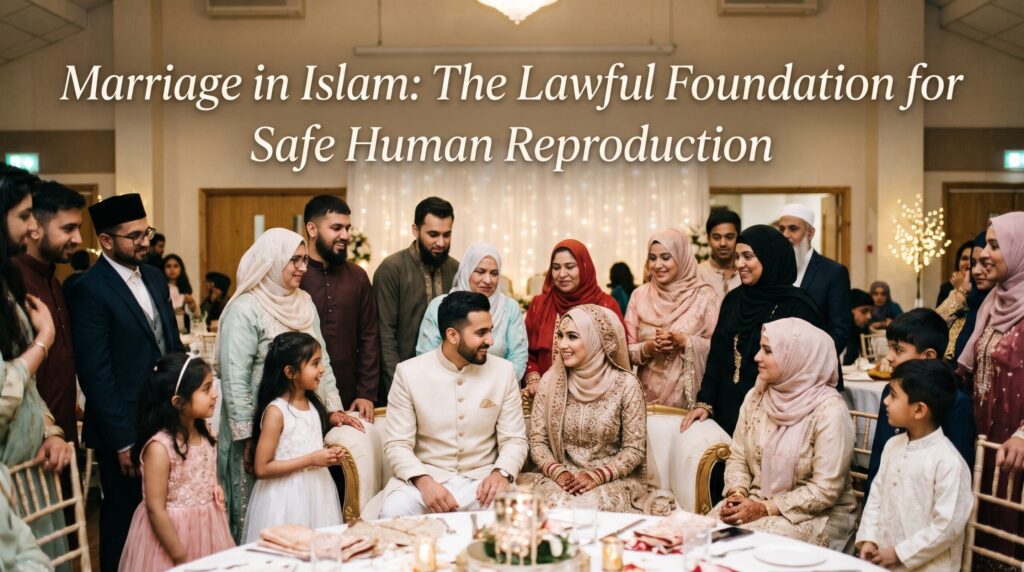
Marriage in Islam: The Lawful Foundation for Safe Human Reproduction: Human reproduction is fundamentally distinct from animal instinct. While animals mate purely for biological survival without moral responsibility, humans possess consciousness, free will, long-term memory, and the duty to build enduring civilizations. When intimacy is separated from lawful commitment, society suffers deep psychological and social fractures—ranging from emotional trauma and identity crises to the breakdown of two-parent homes. This article examines marriage (Nikah) in Islam as a profound, divinely calibrated legal framework designed to safeguard the human reproduction cycle, cultivate mental peace (Sakinah), and protect future generations.
Table of Contents
| Section Title | Key Questions Addressed |
|---|---|
| 1. The Human Lifecycle: Beyond Animal Instinct | Why is human reproduction different from animal breeding? What makes intimacy a sacred trust rather than mere recreation? |
| 2. Marriage (Nikah) as a Legal, Moral, and Psychological Sanctuary | What is the true Islamic definition of marriage? How does a public covenant create psychological peace (Sakinah)? |
| 3. The Devastating Fallout of Detaching Reproduction from Commitment | What happens to mental health and children when intimacy is casual? Why does Islam strictly prohibit fornication and secret affairs? |
| 4. The Role of Fair Divorce and Accountability in Preserving Human Dignity | How does Islam handle marital irreconcilability without cruelty? Why is a just exit mechanism essential for societal health? |
1. The Human Lifecycle: Beyond Animal Instinct
Across the animal kingdom, reproduction is guided by seasonal hormones and biological reflexes. Animals do not establish moral codes, sign legal contracts, record ancestry, or pass down ethical values to their descendants.
Human beings were fashioned upon an entirely different blueprint. We are endowed with complex intellect, articulated speech, moral conscience, and permanent memory. Because of this intentional design, physical intimacy between men and women carries consequences that reach far beyond immediate physical gratification; it is the sacred portal through which new conscious human souls enter existence.
The Qur’an emphasizes that humans were not created to drift aimlessly:
“Does man think that he will be left neglected? Was he not a sperm from semen emitted? Then he was a clinging clot, and He created [his form] and proportioned [him] and made of him the two sexes, male and female.”
— Surah Al-Qiyamah (75:36–39)
“And among His signs is that He created for you spouses from among yourselves so that you may find tranquility in them, and He placed between you affection and mercy. Indeed, in that are signs for a people who reflect.”
— Surah Ar-Rum (30:21)
Human children are born uniquely delicate, requiring years of shelter, nourishment, emotional bonding, and moral guidance. Unlike animal offspring that achieve independence within weeks, a human child requires an established, committed domestic sanctuary to develop into an emotionally stable and socially responsible adult.
The Prophet Muhammad ﷺ identified self-mastery in physical desire as one of the two greatest moral tests of human life:
“Whoever guarantees me what is between his jaws and what is between his legs, I guarantee him Paradise.”
— Sahih al-Bukhari (6474)
When intimate relations are honored as a trust from the Creator, reproduction becomes an act of societal construction. When reduced to disposable recreation, it destabilizes both personal mental health and the generational continuity of mankind.
2. Marriage (Nikah) as a Legal, Moral, and Psychological Sanctuary
In Islam, marriage (Nikah) is neither a sacramental trap nor a casual private understanding. It is a formal, transparent, and legally binding covenant (Mithaq) witnessed by the community.
This divine framework rests upon three foundational pillars:
- Clear Lineage and Child Identity: Marriage ensures that every child born has an undisputed, legally recognized father and mother, guaranteeing emotional belonging, inheritance rights, and genealogical clarity.
- Mandatory Financial Maintenance (Nafaqah): The husband is legally and spiritually bound to provide complete shelter, food, clothing, and medical care for his wife and children, shielding the mother from financial vulnerability during gestation and child-rearing.
- Mutual Emotional Tranquility (Sakinah): The covenant replaces the anxiety of transactional dating with deep emotional security, allowing partners to share vulnerability without the fear of sudden abandonment.
The Psychological Dimension: Memory and Certainty
The human brain records sensory and emotional experiences permanently. Memory cannot be erased like digital data; every intimate bond leaves an enduring psychological imprint. In temporary or uncommitted relationships, intimacy is overshadowed by anxiety, fear of betrayal, and the pressure of continuous performance.
In contrast, Islamic marriage removes secrecy and ambiguity, establishing an environment of complete safety.
| Life Dimension | Lawful Islamic Marriage (Nikah) | Undisciplined / Casual Relationships |
|---|---|---|
| Legal Status | Public, recognized covenant with clearly defined rights and duties before law and Creator. | Unregulated, ambiguous arrangement with no enforceable legal protection for either partner. |
| Paternal Obligation | Father is legally and morally bound to provide continuous maintenance and protection. | Father can easily walk away, shifting total financial and physical strain onto the mother. |
| Psychological State | Deep peace (Sakinah), mutual trust, absence of guilt, and emotional stability. | Chronic anxiety, fear of abandonment, emotional exhaustion, and lingering regret. |
| Child Upbringing | Two-parent environment rooted in shared responsibility, clear values, and emotional safety. | Heightened risk of fatherlessness, identity confusion, and single-parent burnout. |
The Prophet Muhammad ﷺ urged those with the means to anchor their desires within this protective structure:
“O young men, whoever among you can afford it, let him get married, for it is more effective in lowering the gaze and guarding chastity…”
— Sahih al-Bukhari (5066)
Marriage channels natural biological drives into an honorable institution that elevates the individual from self-centered desire to purposeful leadership and societal service.
3. The Devastating Fallout of Detaching Reproduction from Commitment
When a society normalizes casual intimacy divorced from responsibility, the human reproduction cycle is compromised. Natural desires remain, but the protective perimeter required to support the fruits of those desires is destroyed.
This disconnection produces predictable and severe societal damages:
- Unplanned Pregnancies and Abortion: Treating intimacy as consumer entertainment results in millions of unplanned pregnancies, frequently resolved through the termination of defenseless human life.
- Single-Parent Exhaustion: Mothers are left to shoulder the dual burden of sole financial provider and primary caregiver, leading to chronic physical and emotional fatigue.
- Psychological Regret and Guilt: Because human beings possess an innate conscience (Fitrah), casual physical transactions often leave feelings of emptiness, degradation, and self-reproach.
- Damaged Trust and Cynicism: Individuals who experience multiple casual breakups often develop emotional defense mechanisms, making it difficult to trust or commit to a spouse later in life.
For these reasons, the Qur’an does not merely forbid fornication; it strictly prohibits taking the preliminary paths that lead toward it:
“And do not approach unlawful sexual intercourse. Indeed, it is ever an immorality and is evil as a way.”
— Surah Al-Isra (17:32)
Divine guidance explicitly warns against covert arrangements and temporary romances:
“…not committing unlawful intercourse, nor taking secret lovers.”
— Surah Al-Ma’idah (5:5)
Islam insists on social modesty, disciplined gazes, and respectful gender boundaries precisely to prevent casual physical commodification. By protecting the reproduction cycle at the gate, Islam ensures that intimacy remains an uplifting source of life, rather than an engine of social decay.
4. The Role of Fair Divorce and Accountability in Preserving Human Dignity
While Islam builds marriage as a lasting foundation for the family, it recognizes that human beings are fallible and that irreconcilable incompatibilities or genuine harms may arise. Unlike systems that forbid divorce or trap individuals in abusive, toxic unions, Islam provides a realistic, just, and simple exit mechanism.
Divorce in Islam (Talaq initiated by the husband, or Khula’ initiated by the wife) exists to prevent lifelong cruelty, emotional destruction, and domestic injustice.
The Qur’an mandates that if a marriage must end, it must be conducted with absolute fairness, dignity, and kindness:
“Divorce is twice. Then, either keep [her] in an acceptable manner or release [her] with good treatment…”
— Surah Al-Baqarah (2:229)
“…And do not keep them, intending to harm them, in order to transgress. And whoever does that has certainly wronged himself…”
— Surah Al-Baqarah (2:231)
Preserving Child Safety During Separation
Even when marital partnership ends, the duties toward the reproduction cycle remain active:
- Uninterrupted Financial Support: The father remains 100% legally obligated to provide financial maintenance, housing, and education for his children. Separation from the wife does not dissolve his financial paternity.
- Protection of Maternal Custody: In early childhood, custody typically remains with the mother to preserve biological nurturing and emotional security, while the father maintains visitation and oversight.
- Prohibition of Retaliation: Neither parent is permitted to use the children as weapons of emotional leverage or speak maliciously of one another.
Every human interaction—whether entering a marriage with joy or exiting it through divorce—is governed by divine accountability. When justice governs both union and separation, the dignity of both adults is preserved, and the innocent lives born from that union remain protected.
Guidance Section: Correcting Common Misconceptions
| Misconception / Modern Distortion | Root Ignorance Behind It | Qur’anic & Authentic Sunnah Correction |
|---|---|---|
| “Marriage is just a piece of paper; mutual love is enough without contracts.” | Ignoring that legal commitment provides enforceable protections, paternal accountability, and social certainty for children. | The Qur’an defines marriage as a solemn covenant (Mithaqan Ghalidha, Surah An-Nisa 4:21). Without legal recognition, women and children are left vulnerable when emotional feelings shift. |
| “Islamic marriage makes the wife subordinate property of the husband.” | Confusing cultural oppression with Islamic law; misunderstanding protective maintenance (Qawwamah). | A Muslim wife retains her independent surname, legal identity, and complete ownership of her wealth. The husband is commanded to treat her with kindness, honor, and consultation (Surah An-Nisa 4:19). |
| “Divorce in Islam is a shameful failure that ruins a family forever.” | Imposing cultural stigmas onto a divinely ordained legal relief mechanism. | Islam permits divorce when living together justly becomes impossible (Surah Al-Baqarah 2:229). It is a compassionate release that prevents deeper spiritual, mental, and physical harm. |
| “Cohabitation before marriage is necessary to test compatibility.” | Believing that low-commitment trials produce relational stability. | Statistical reality shows cohabitation without marriage breeds higher rates of infidelity, domestic instability, and breakup. Islam encourages thorough pre-marital vetting with family oversight, followed by full commitment. |
Disclaimer
This article is written for educational, psychological, and moral reflection based on the Holy Qur’an and authentic prophetic teachings. It does not replace individualized legal rulings (fatwas) or legal counsel for complex divorce settlements, child custody disputes, or marital arbitration, which require consultation with qualified Islamic scholars and authorized legal professionals.
An Invitation to Reflect
The One who engineered the human reproductive system, calibrated male and female emotional psychology, and laid the foundations of human conscience knows what sustains our homes and what shatters them. His guidelines are not heavy burdens; they are the merciful blueprint for human flourishing, emotional peace, and social preservation.
We invite every reader—regardless of your faith, background, or personal journey—to pick up the Holy Qur’an and read it with reflection and an open heart at least once in your life in your own language. Contemplate its profound clarity on human relationships, observe the wisdom behind its legal balances, and discover the lasting serenity that blossoms when life is aligned with divine guidance.
Frequently Asked Questions (FAQs)
1. Why does Islam view marriage as half of a person’s faith?
The Prophet Muhammad ﷺ taught that when a person marries, they have fulfilled half of their religion (Al-Bayhaqi, Shu’ab al-Iman 5100). Marriage disciplines private desires, establishes an arena for patience, sacrifice, and unselfish service, and shields individuals from sins of immorality, thereby protecting foundational moral integrity.
2. Can a Muslim woman initiate a divorce if her husband is neglectful or abusive?
Yes. Islamic law grants women the legal right to seek separation through Khula’ (dissolution of marriage by mutual agreement or judicial authority) or Faskh (annulment by a judge). If a husband is abusive, fails to provide basic financial maintenance, or causes emotional or physical harm, the wife has the full right to end the marriage.
3. What is the wisdom behind the bridal gift (Mahr) in Islam?
The Mahr is a mandatory gift given directly by the groom to the bride at the time of marriage (Surah An-Nisa 4:4). It symbolizes the husband’s sincere commitment, financial responsibility, and willingness to provide. The gift belongs entirely to the wife; neither her parents nor her husband have any legal claim over it.
4. How does Islamic marriage protect children compared to casual unions?
In Islamic marriage, paternal identity and financial accountability are non-negotiable from the moment of conception. The father cannot abandon his children without committing a major sin and facing legal liability. This guarantees children an established name, emotional security, familial support, and inheritance rights.
5. Why does Islam prohibit secret marriages?
Islam requires that a marriage be publicly announced and witnessed by reliable members of the community. Secret unions (Akhdan) lack transparency, invite suspicion, deny the woman her social honor, and leave children vulnerable to abandonment if the father denies parentage.
6. What should a couple do if they experience severe conflict in their marriage?
The Qur’an outlines a step-by-step conflict resolution method based on private dialogue, patience, and mutual counsel. If the dispute cannot be resolved between the couple, the Qur’an commands appointing fair arbitrators from both families to mediate with wisdom and reconcile the union (Surah An-Nisa 4:35).