Content Summary
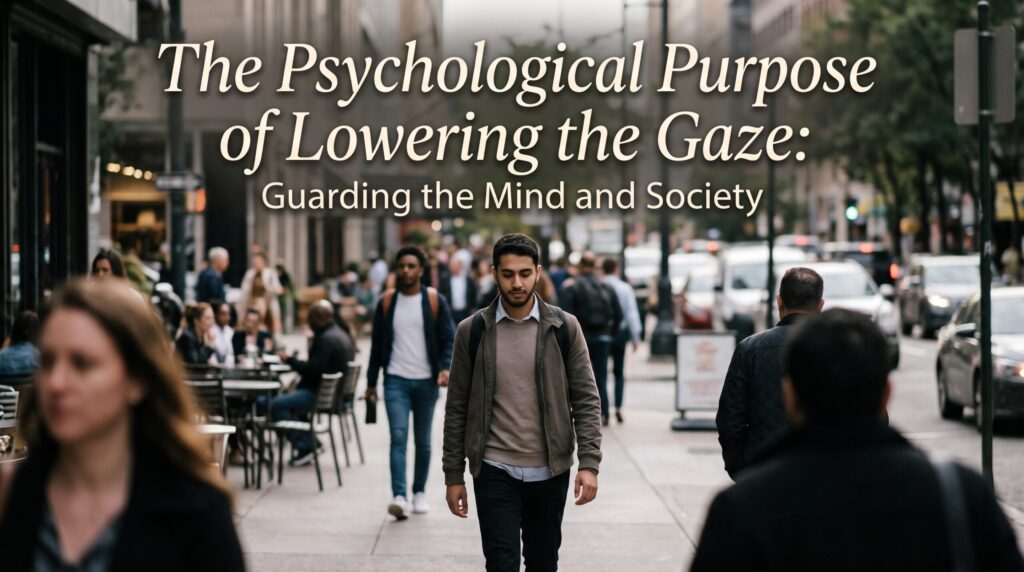
The Psychological Purpose of Lowering the Gaze: Guarding the Mind and Society: In our hyper-visual modern world, screens, billboards, and public spaces constantly compete for human attention. While popular culture often regards casual looking as innocent and harmless, cognitive psychology and divine wisdom reveal that vision is the primary gateway to the human mind. This article explores the psychological and societal necessity of lowering the gaze (Ghad al-Basar). Grounded in Qur’anic insights and observable human nature, we examine how intentional visual discipline purifies mental space, prevents emotional exhaustion, stabilizes the family system, and fosters a culture of mutual safety and respect.
Table of Contents
| Section Title | Key Questions Addressed |
|---|---|
| 1. The Sensory Gateway: How Vision Shapes the Human Mind | Can the human brain experience something visually without processing it? How do sensory inputs convert into thoughts and desires? |
| 2. The Cognitive and Emotional Cost of an Unchecked Gaze | What mental baggage results from visual overstimulation? How does casual looking fuel anxiety, chronic comparison, and guilt? |
| 3. The Qur’anic Sequence: Why Discipline Begins with Men | Why did Allah command men to lower their gaze before women? How does internal restraint differ from external blame? |
| 4. Guarding Society: Protecting the Family and Being a Source of Safety | How does disciplined vision safeguard marriage and the reproduction cycle? What does it mean to be a presence of safety for others? |
1. The Sensory Gateway: How Vision Shapes the Human Mind
Human consciousness does not generate thoughts in a vacuum. A person cannot imagine, dream, or deliberate upon anything without prior sensory input—what we see, hear, touch, smell, and experience. Among all the sensory organs, the eyes serve as the most direct and potent conduit of information to the intellect.
The Qur’an highlights the profound trust and accountability embedded within our perceptive faculties:
“And do not pursue that of which you have no knowledge. Indeed, the hearing, the sight, and the heart—all of these will be questioned.”
— Surah Al-Isra (17:36)
“And Allah has extracted you from the wombs of your mothers, not knowing a thing, and He made for you hearing, vision, and intellect that perhaps you would be grateful.”
— Surah An-Nahl (16:78)
Notice the recurring sequence: sensory receptors—especially hearing and sight—nourish and direct the heart and intellect.
When light hits the retina, it does not simply record shapes; it activates biochemical and psychological pathways. A visual input plants an idea; that idea, if dwelled upon, blossoms into an inclination; that inclination triggers an emotional craving; and unchecked cravings eventually demand physical fulfillment.
Every physical deed starts with an unvetted glance. By prescribing the lowering of the gaze, Islam does not restrict sight; it establishes an intentional mental firewall at the earliest, most controllable stage of cognitive processing.
2. The Cognitive and Emotional Cost of an Unchecked Gaze
A common human fallacy is the belief that visual consumption carries no lasting footprint—that what is seen can easily be forgotten. Observable human psychology proves the opposite. Memory is an indelible faculty of the human soul; what enters the mind leaves an enduring impression.
When an individual allows their eyes to wander freely—whether in public or on digital devices—they subject their cognitive faculties to chronic overstimulation.
The Cycle of Mental Baggage and Dissatisfaction
| Stage of Exposure | Internal Psychological Process | Impact on Well-being |
|---|---|---|
| 1. The Unfiltered Glance | Unchecked intake of hyper-curated, attractive, or provocative visual material. | Sensory overload; initial spark of novelty and curiosity. |
| 2. Memory Retention | The brain imprints the image into long-term recall; sensory data cannot simply be wiped away. | Lingering mental clutter; intrusive thoughts and daydreams. |
| 3. Chronic Comparison | Subconscious evaluation of one’s real life, body, or lawful spouse against idealized images. | Erosion of gratitude (Shukr); emergence of discontent and resentment. |
| 4. Emotional Agitation | Craving what cannot be lawfully or realistically attained. | Inner restlessness, guilt, anxiety, and loss of tranquility (Sakinah). |
When people consume visual imagery indiscriminately, they cultivate unrealistic expectations that reality can never satisfy. This breeds persistent dissatisfaction with one’s spouse, lowers self-worth, and fuels marital friction.
The Prophet Muhammad ﷺ warned of the deep accountability surrounding our desires and physical conduct:
“Whoever guarantees me what is between his jaws and what is between his legs, I guarantee him Paradise.”
— Sahih al-Bukhari (6474)
Lowering the gaze is the foundational safeguard for both the tongue and the private parts. When the visual gate is guarded, the mind remains uncluttered, and the soul is shielded from artificial temptations that breed inner turmoil.
3. The Qur’anic Sequence: Why Discipline Begins with Men
In many societies, discussions around modesty focus exclusively on women’s attire, placing the burden of moral discipline entirely on the observed rather than the observer. The Qur’an corrects this imbalance with remarkable structural precision by directly addressing men first:
“Tell the believing men to lower their gaze and guard their private parts. That is purer for them. Indeed, Allah is acquainted with what they do.”
— Surah An-Nur (24:30)
Only after this direct instruction to men does the revelation instruct women:
“And tell the believing women to lower their gaze and guard their private parts and not display their adornment except that which appears thereof…”
— Surah An-Nur (24:31)
The Wisdom Behind the Sequence
- Direct Personal Responsibility: By commanding men before women, divine guidance destroys the excuse that a man’s lack of discipline is caused by someone else’s presence or dress. A man is fully responsible for his own eyes, thoughts, and actions.
- Preemptive Guarding (Hifz): Notice that lowering the gaze is placed before guarding chastity in both verses. Restraining the eyes is the practical prerequisite to physical chastity. Those who cannot control their eyes eventually lose control over their limbs.
- Inner Purification (Azka Lahum): The Qur’an explicitly states that lowering the gaze “is purer for them.” It frees the mind from predatory instincts, eliminates the guilt associated with covert staring, and fosters intellectual and spiritual focus.
Allah describes His absolute awareness of even the subtlest glances:
“He knows that which deceives the eyes and what the breasts conceal.”
— Surah Ghafir (40:19)
Lowering the gaze is not a sign of social awkwardness or weakness; it is a manifestation of profound executive control and reverence for the Creator.
4. Guarding Society: Protecting the Family and Being a Source of Safety
Human life is designed with a profound social trust: the human reproduction cycle and the protection of the family unit. Unlike animals that mate on instinctive seasonal cycles, humans possess moral awareness, deep attachment chemistry, and the obligation to build stable homes where future generations are nurtured with love and dignity.
When public spaces become saturated with unrestrained visual objectification, societal trust collapses. The gaze ceases to be an innocent observation and becomes an intrusive, consumerist appraisal of other human beings.
Modesty as Social Protection
A noble human life is one where others feel entirely safe in your presence—safe in their dignity, mental well-being, and boundaries.
[ Lowering the Gaze / Mindful Eyes ]
                 │
  ┌──────────────┴──────────────┐
  ▼                             ▼
[ Personal Benefits ]    [ Societal Benefits ]
• Mental clarity         • Safe public environments
• Protected marriage     • Prevention of harassment
• Freedom from guilt     • Honor preserved for families
• Deepened Taqwa         • Children raised in moral clarity
When men and women consciously practice visual restraint:
- Public Interactions Remain Professional: Collaborative work, education, and social contributions can occur based on intellectual merit rather than physical appearance.
- Marital Loyalty Is Preserved: Intimacy, romantic affection, and emotional vulnerability are concentrated exclusively within the sanctuary of marriage.
- The Vulnerable Are Shielded: Women, men, and children are spared from predatory scrutiny and public objectification.
The Qur’an cautions humanity against taking incremental steps toward destruction:
“And do not approach unlawful sexual intercourse. Indeed, it is ever an immorality and is evil as a way.”
— Surah Al-Isra (17:32)
Divine guidance does not simply prohibit the final act of immorality; it forbids the preliminary steps leading toward it. Lowering the gaze is the first, most powerful line of defense that keeps individuals and societies safely removed from that destructive path.
Guidance Section: Correcting Common Misconceptions
| Misconception / Cultural Innovation | Purpose Ignorance Behind It | Qur’anic & Authentic Sunnah Correction |
|---|---|---|
| “Looking is harmless as long as there is no physical touch.” | Failing to recognize that visual sensory inputs directly build thoughts, desires, and persistent memories. | The Qur’an identifies sight as an accountable faculty that directly shapes the heart (Surah Al-Isra 17:36). Unchecked looks deposit mental imprints that erode inner peace and eventually provoke physical missteps. |
| “Men gaze only because women do not dress modestly enough.” | Shifting personal moral accountability onto others and indulging in external blame. | Allah commanded men to lower their gaze before addressing women’s clothing (Surah An-Nur 24:30). External circumstance does not absolve an individual from personal discipline. |
| “Lowering the gaze is outdated in the digital era of smartphones.” | Believing that physical space and digital screens operate on different moral rules. | Pixels carry the same sensory payload as physical sights. Allah warns that He knows “that which deceives the eyes” (Surah Ghafir 40:19), whether on a street or through a private digital screen. |
| “Looking away displays weakness, lack of confidence, or an anti-social personality.” | Measuring dignity and social power through brazenness and entitlement rather than restraint. | Islam defines true strength through masterly self-control (Jihad al-Nafs). Respecting others’ boundaries and guarding one’s own purity reflects high emotional intelligence and spiritual maturity. |
Disclaimer
This article is prepared for educational, psychological, and moral reflection based on Qur’anic guidance and prophetic teachings. It does not replace formal legal rulings (fatwas) on detailed personal matters, nor does it substitute for professional clinical therapy for individuals struggling with severe compulsive behavioral or digital addictions.
An Invitation to Reflect
The Creator who engineered the complex optics of the human eye, synchronized its neural connections to the brain, and placed a moral conscience within your chest knows what preserves your tranquility and what disrupts it. His commands are not designed to restrict human life, but to protect our minds from confusion and our societies from collapse.
We invite every thoughtful reader—regardless of your background, beliefs, or personal journey—to pick up the Holy Qur’an and read it with an open heart and deep contemplation at least once in your life in your own language. Reflect upon its timeless wisdom, observe the delicate balance of human nature, and experience the profound mental and spiritual peace that blossoms when life is lived in harmony with divine order.
Frequently Asked Questions (FAQs)
1. What does “lowering the gaze” (Ghad al-Basar) practically mean in daily life?
Lowering the gaze does not mean walking with closed eyes or staring perpetually at the pavement. It means actively diverting one’s sight from anything unlawful, immodest, or inappropriate. It involves withholding a second, lingering, or lustful look, respecting personal boundaries in conversation, and refraining from intrusive staring in public or private spaces.
2. What happens if a person glances at something inappropriate accidentally?
Islam recognizes human reality and does not hold a person accountable for unintentional, accidental first glimpses. The Prophet Muhammad ﷺ instructed his companion Ali (may Allah be pleased with him): “Do not follow a glance with another, for an accidental glance is forgiven, but any following glance is not” (Sunan Abi Dawud 2149). The test lies in what one chooses to do immediately after noticing: whether to turn away or indulge the look.
3. Does lowering the gaze apply to smartphones, social media, and internet browsing?
Yes, absolutely. The psychological impact of digital imagery is identical to—and often more potent than—real-world sights due to algorithms engineered to exploit curiosity and desire. Lowering the gaze online means unfollowing provocative accounts, scrolling past indecent imagery immediately, installing filters, and guarding one’s private screen habits.
4. Why did Allah mention lowering the gaze before guarding private parts?
In Surah An-Nur (24:30–31), lowering the gaze precedes the protection of the private parts because the eyes are the feeding channel to the desires. Chastity cannot be preserved if the visual portal remains wide open. Controlling the eye eliminates the trigger before it becomes an overwhelming impulse.
5. How does lowering the gaze improve marital relationships?
When a person guards their gaze from filtered, idealized, and artificial depictions of physical appearance, they protect their ability to appreciate their lawful spouse. It prevents toxic comparisons, deepens emotional trust, safeguards intimacy, and keeps the home filled with gratitude and mutual affection.
6. Are women also required to lower their gaze?
Yes. Surah An-Nur (24:31) explicitly commands believing women to lower their gaze as well. While male and female psychology may have varying triggers, both genders possess eyes, emotional sensibilities, and a soul that must be guarded against visual indecency and spiritual degradation.