Samenvatting van de inhoud
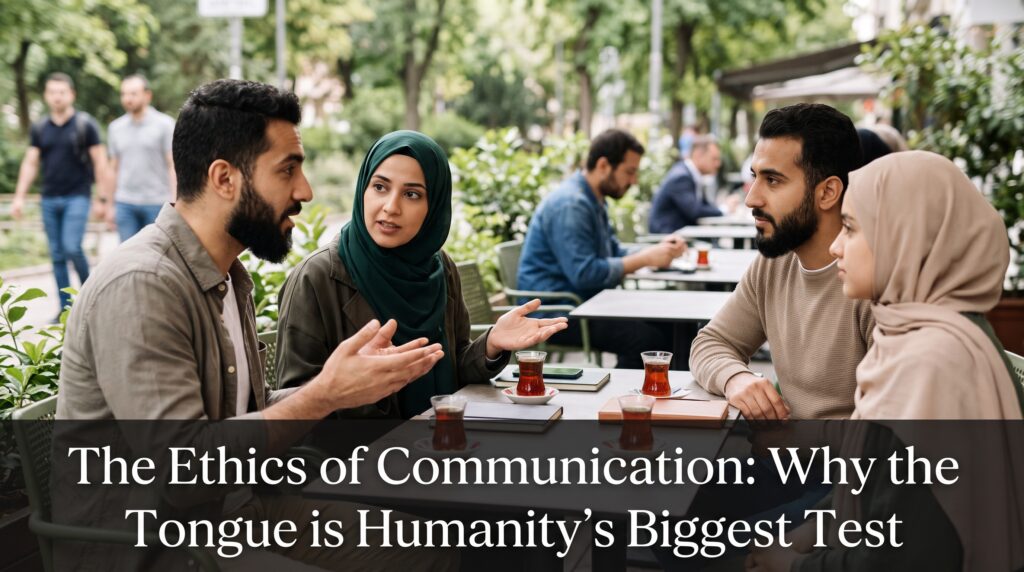
The Ethics of Communication: Among all the creatures on Earth, humans possess a unique and powerful superpower: the gift of complex speech. While animals survive on basic instinct, humans use words to build thoughts, share knowledge, and establish civilizations. However, with this immense power comes an equally immense responsibility. According to the deep insights found in the document “Humanity By Quran,” communication is not just a social tool; it is a divine trust. The tongue has the power to heal and unite, but it can also deceive, destroy, and ignite conflicts. In this post, we will explore the Islamic perspective on the ethics of communication, why every word we speak is recorded for ultimate accountability, and how mastering our speech is the ultimate test of human character.
Inhoudsopgave
| Sectietitel | Belangrijke vragen beantwoord |
|---|---|
| The Gift of Speech: A Divine Superpower | What makes human communication fundamentally different from animals? |
| The Weight of Words: Everything is Recorded | Why does Islam place such heavy accountability on what we say? |
| The Social Impact: Building vs. Destroying | How do unverified news and gossip destroy the fabric of society? |
| The Prophetic Guarantee: Guarding the Tongue | What did Prophet Muhammad promise to those who control their speech? |
| Planting Good Seeds: The Metaphor of the Good Tree | How can our words act as seeds for a better future? |
The Gift of Speech: A Divine Superpower
When we observe the natural world, we see that animals communicate to express basic needs like fear, hunger, or readiness to mate. Their communication is strictly tied to immediate physical survival. Humans, however, are entirely different. We do not just make sounds; we assign meaningful names to abstract concepts. We can discuss the past, plan for the future, and share complex philosophies.
As highlighted in “Humanity By Quran,” this ability is not a random evolutionary accident. It is a deliberate gift from the Creator. Because humans were designed with physical weaknesses—lacking fur, tough skin, or immediate survival instincts—we were given the power of speech to cooperate, teach, and build societies.
“He created man. He taught him speech.” (Surah Ar-Rahman 55:3-4)
This gift elevates humanity above all other creations. However, it also introduces our greatest moral challenge. Because we can speak, we are given the free will to choose what we say, making the tongue the primary tool through which our character is tested.
The Weight of Words: Everything is Recorded
In our modern, fast-paced world, words are often thrown around carelessly. People type out angry comments, spread rumors, or speak harshly without a second thought, assuming their words simply vanish into thin air. Islam teaches a profoundly different reality.
In the Islamic worldview, words do not disappear. They possess spiritual weight and permanent consequences. The Creator has established a perfect system of accountability where every single syllable uttered by a human being is documented.
“Hij zegt geen woord of er is een waarnemer bij hem in de buurt die klaarstaat om op te nemen.” (Soera Qaf 50:18)
Understanding this reality completely shifts how a person behaves. When you realize that your words—whether spoken in public or whispered in private—will be presented to you on the Day of Judgment, you begin to filter your speech through the lens of truth and justice. The ethics of communication in Islam demand that we pause and reflect before we speak, ensuring our words bring benefit rather than harm.
The Social Impact: Building vs. Destroying
Society is held together by the invisible threads of trust, and nothing destroys trust faster than unethical communication. According to “Humanity By Quran,” the stability of any community relies heavily on how its members speak to and about one another.
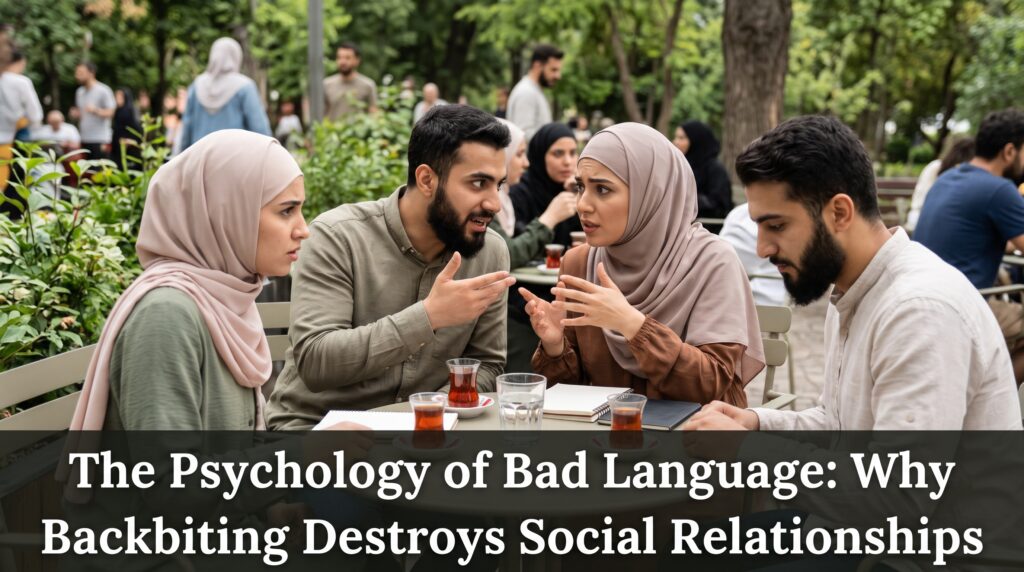
Islam explicitly forbids the misuse of the tongue in ways that harm the social fabric. This includes backbiting, mockery, spreading assumptions, and insulting others with offensive nicknames. Furthermore, in an era of digital media where fake news spreads instantly, the Qur’an provides a timeless ethical command:
“O jullie die geloofd hebben, als er een ongehoorzame naar jullie toe komt met informatie, onderzoek het dan, opdat jullie niet uit onwetendheid een volk schade berokkenen en spijt krijgen van wat jullie gedaan hebben.” (Soera Al-Hujurat 49:6)
Forwarding unverified news or participating in gossip can lead to massive social destruction. The tongue can spark conflicts that last for generations. Conversely, ethical communication—speaking with honesty, patience, and empathy—prevents conflict and promotes justice. Replying to harsh words with kindness has the power to turn enemies into devoted friends, securing the peace of the entire community.
The Prophetic Guarantee: Guarding the Tongue
To understand the sheer magnitude of the test of the tongue, we must look at the guidance of Prophet Muhammad (peace be upon him). He deeply understood human nature and recognized that the majority of human sins and social conflicts originate from two physical sources: unchecked speech and unchecked desires.
He offered a profound and powerful guarantee to humanity:
“Whoever guarantees me what is between his jaws (kind and wise use of the tongue) and what is between his legs (lawful use of private parts), I guarantee him Paradise.” (Sahih al-Bukhari)
This statement highlights that holding your tongue when you are angry, refraining from gossip when it is tempting, and choosing to speak the truth even when it is difficult, are among the highest forms of worship and self-discipline. Mastering the tongue is mastering the self.
Planting Good Seeds: The Metaphor of the Good Tree
In Islam, words do not just have immediate effects; they have long-term, generational impacts. A harsh word can implant deep insecurities in a child, while a wise, kind word can inspire someone to change their life for the better.
“Humanity By Quran” beautifully illustrates that every action and word operates like a seed. If you repeatedly water it, it grows into a strong tree. The Qur’an uses this exact metaphor to describe the lasting power of ethical communication:
“Heb je er niet over nagedacht hoe Allah een voorbeeld geeft, door een goed woord te maken als een goede boom, waarvan de wortel stevig vastzit en zijn takken [hoog] in de lucht zijn?” (Soera Ibrahim 14:24)
When we communicate with justice, kindness, and truth, we are planting good seeds in the hearts of others and in the fabric of society. These seeds bear fruit long after we are gone. By recognizing that the tongue is our biggest test, we can consciously choose to be a source of safety and value, using our divine gift of speech to heal, guide, and uplift humanity.
Begeleidingssectie
| Onderwerp / Concept | Veel voorkomende misvatting of onwetendheid | De praktische waarheid (gebaseerd op richtlijnen uit de Koran) |
|---|---|---|
| Weight of Words | Words are just sounds or text; they vanish and have no real consequences as long as no physical harm is done. | Every word is a seed that impacts society and is meticulously recorded by angels for ultimate accountability on the Day of Judgment. |
| Freedom of Speech | Freedom of speech means I have the right to say whatever I want, including mocking, insulting, or spreading rumors. | Freedom comes with profound responsibility. Islam forbids mockery, backbiting, and spreading unverified news to protect human dignity and social trust. |
| Handling Conflict | If someone speaks harshly to me, the only way to defend my honor is to insult them back even worse. | Repelling evil with kindness and a better word is a sign of immense strength, often turning hostility into lasting friendship and peace. |
Vrijwaring
De inzichten die in deze blogpost worden gedeeld, zijn bedoeld voor educatieve en reflectieve doeleinden, waarbij gebruik wordt gemaakt van de concepten uit de aangeleverde kennisbestanden en de islamitische leer. Ze zijn gericht op het bevorderen van harmonie, logisch denken en morele verantwoordelijkheid. Lezers worden aangemoedigd om kennis te zoeken, na te denken over de natuur en gekwalificeerde wetenschappers te raadplegen voor diepere theologische studies.
Een oprechte uitnodiging
Echt begrip komt voort uit directe reflectie en een open hart. Wij nodigen u van harte uit om de Heilige Koran minstens één keer in uw leven te lezen, in een taal die u volledig begrijpt. Laat je eigen geest de wijsheid, logica en diepe vrede observeren die deze de mensheid biedt.
Veelgestelde vragen (FAQ's)
1. Why is the tongue considered humanity’s biggest test in Islam? Because humans were given the unique gift of complex speech and free will. Our words can build societies or destroy them. Since we speak constantly, the tongue requires continuous self-control, making it our most frequent and difficult moral test.
2. Does Islam track every word a person says? Yes. The Qur’an explicitly states that an observing angel is ready to record every single word uttered by a human being. This ensures absolute justice and accountability for how we use our gift of speech.
3. What did the Prophet say about controlling the tongue? Prophet Muhammad (peace be upon him) guaranteed Paradise to anyone who could safeguard what is between their jaws (the tongue) and what is between their legs (desires), highlighting that these two are the greatest trials for humans.
4. How does Islam view spreading unverified news or rumors? Islam strictly forbids it. The Qur’an commands believers to investigate and verify information before sharing it, warning that spreading false news causes harm out of ignorance and leads to deep regret and social division.
5. How should a Muslim respond to harsh words or insults? Islam encourages responding to bad words with better words. Repelling evil with kindness is a powerful ethical tool that calms the ego, de-escalates conflict, and can turn an enemy into a close friend.