Samenvatting van de inhoud
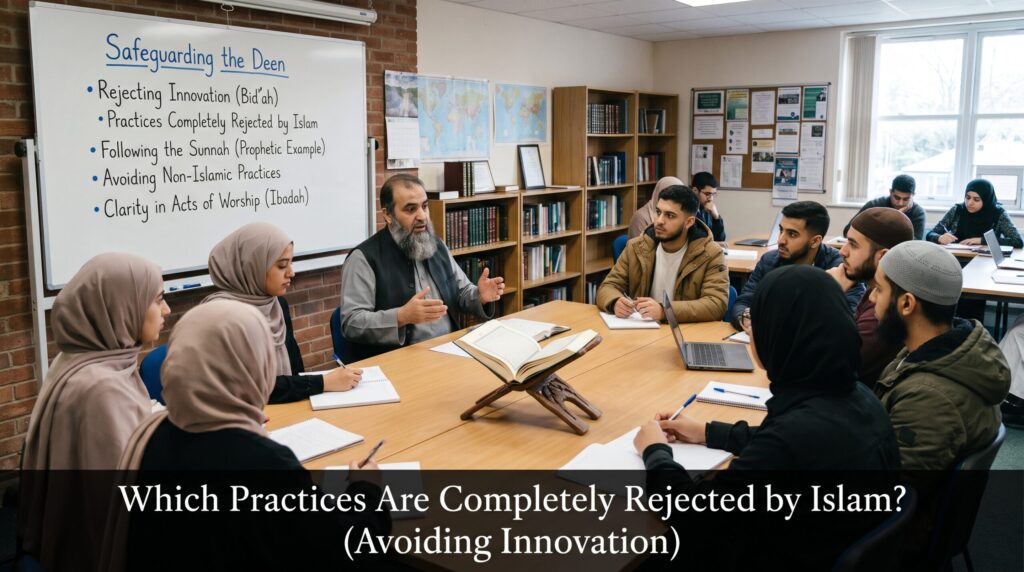
Which Practices Are Completely Rejected by Islam: Islam is a religion built upon absolute clarity, logic, and pure monotheism. Its foundation is the preserved word of the Creator, the Qur’an. However, throughout history, human beings have often complicated faith by introducing cultural traditions, superstitions, and newly invented rituals. These additions not only distort the original message but also lead to spiritual exploitation and division. According to the profound insights found in the document “Humanity By Quran,” Islam strictly rejects any practice that contradicts pure monotheism or adds unverified innovations to the religion. In this post, we will explore the specific activities and beliefs that Islam completely rejects, why avoiding religious innovation is crucial, and how staying connected to the Qur’an protects society from manipulation.
Inhoudsopgave
| Sectietitel | Belangrijke vragen beantwoord |
|---|---|
| The Core Principle: Follow What Has Been Revealed | Why is the Qur’an the ultimate standard for acceptable practices? |
| Religious Innovations (Bid’ah): The Danger of Adding to Faith | Why is inventing new acts of worship rejected in Islam? |
| Shirk and Intermediaries: Breaking the Pure Connection | Why does Islam forbid praying to the dead or using holy symbols? |
| Superstition and Fortune-Telling: The Illusion of the Unseen | What is the Islamic stance on astrology, omens, and palmistry? |
| Harming Others in the Name of Religion | Is it ever acceptable to cause injustice for a religious cause? |
| Disconnecting from the Root: Unacceptable Sects | What actions completely remove a group from the fold of Islam? |
The Core Principle: Follow What Has Been Revealed
To understand what Islam rejects, we must first understand what it accepts. The entire religion of Islam is rooted in submission to the One Unseen Creator, following the guidance perfectly preserved in the Qur’an, and understanding it through the practical example of Prophet Muhammad (peace be upon him).
If an action, ritual, or belief cannot be traced back to this pure root, it is not considered part of Islam. The Creator provided a complete, practical, and balanced system for humanity. Adding to it implies that the divine guidance was somehow incomplete, which is fundamentally untrue.
“Follow, [O mankind], what has been revealed to you from your Lord, and do not follow other than Him any allies. Little do you remember.” (Surah Al-A’raf 7:3)
Any practice that deviates from this clear command—whether driven by culture, personal desire, or historical influence—is not owned or approved by Islam, regardless of who performs it.
Religious Innovations (Bid’ah): The Danger of Adding to Faith
One of the most heavily rejected practices in Islam is Bid’ah, which translates to religious innovation. This refers to inventing and adding new acts of worship, rituals, or holy days that were never taught by the Qur’an or practiced by the Prophet.
Why is this so dangerous? As highlighted in “Humanity By Quran,” when people start inventing their own ways to worship, religion becomes a man-made system. It loses its divine purity. Over time, these innovations bury the original truth, leading to confusion and the creation of new, divided sects.
Islam is a religion of nature and simplicity. It does not require complex, newly invented ceremonies for a person to connect with the Creator. The prescribed disciplines (like the five daily prayers, fasting, and charity) are sufficient to purify the soul and balance society. Adding unnecessary rituals only creates a burden and opens the door for religious leaders to exploit followers.
Shirk and Intermediaries: Breaking the Pure Connection
The greatest injustice a human being can commit in Islam is shirk—associating partners with the Creator. Islam completely rejects the idea that any created being, living or dead, shares in the Creator’s power, knowledge, or authority.
“Humanity by Quran” explicitly lists several practices related to this that Islam will never accept:
- Praying to the Dead: Seeking help, wealth, or health from deceased saints, spirits, or graves.
- Using Intermediaries: Believing that you need a “holy person” or an angel to pass your prayers to Allah.
- Religious Symbols: Adopting signs, charms, or objects (like amulets) and believing they hold spiritual power or can protect you from harm.
The Creator is closer to us than our own thoughts and is completely free of needs. He does not require secretaries or VIP channels to hear our prayers. Creating intermediaries destroys the pure, direct connection between the human soul and its Maker and often leads to the financial exploitation of innocent, desperate people.
Superstition and Fortune-Telling: The Illusion of the Unseen
Human beings naturally fear the unknown, and this fear often drives them to seek answers about the future. However, Islam strictly rejects all forms of superstition and fortune-telling.
Practices such as astrology, reading horoscopes, palmistry, believing in omens, or seeking knowledge of the unseen through fortune-tellers are completely forbidden. According to “Humanity By Quran,” relying on these practices is useless and misleading. The future is a realm of the unseen that belongs exclusively to the Creator.
When people rely on fortune-tellers, they turn their trust away from the Creator and place it in false assumptions. This strips them of their personal responsibility and logic. Islam teaches humanity to use observation, reason, and planning in the present moment and to place ultimate trust (Tawakkul) only in Allah for what the future holds.
Harming Others in the Name of Religion
A truly profound principle found in “Humanity By Quran” is that Islam completely rejects any act that harms people unjustly in the name of religion.
True freedom and religion are meant to make you a “source of safety” for others. Any act that injures a human being’s life, dignity, wealth, safety, or mental well-being without absolute truth and justice is un-Islamic. Religion can never be used as a shield to justify oppression, terrorism, or the abuse of the vulnerable.
Furthermore, this principle extends to the animal kingdom. Islam rejects unnecessary animal sacrifice for rituals not sanctioned by the Qur’an or sacrifices made without a legitimate need (such as feeding people) or for protecting humans from danger.
“Allah has not appointed [such innovations as] a Bahirah or a Sa’ibah or a Wasila or a Ham, but those who disbelieve invent lies against Allah, and most of them do not use reason.” (Surah Al-Ma’idah 5:103)
Disconnecting from the Root: Unacceptable Sects
While diversity in understanding the Qur’an (like branches on a tree) is a natural part of human growth, completely disconnecting from the root is rejected.
Islam will never accept sects or groups that:
- Introduce false prophets after Prophet Muhammad (peace be upon him).
- Edit or introduce new holy books.
- Create laws contrary to the clear commands of the Qur’an.
These actions sever a group from true guidance. They distort the original message, mislead communities, and threaten moral stability. The Qur’an issues a severe warning to those who distort faith for worldly power or wealth:
“O you who have believed, indeed many of the scholars and the monks devour the wealth of people unjustly and avert [them] from the way of Allah…” (Surah At-Tawbah 9:34)
“Indeed, those who have divided their religion and become sects—you have nothing to do with them. Their affair is only with Allah.” (Surah Al-An’am 6:159)
By rejecting these innovations and strictly adhering to the Qur’an, humanity guarantees that the divine guidance remains pure, authentic, and beneficial for all future generations.
Begeleidingssectie
| Onderwerp / Concept | Veel voorkomende misvatting of onwetendheid | De praktische waarheid (gebaseerd op richtlijnen uit de Koran) |
|---|---|---|
| Religious Innovation (Bid’ah) | Adding new, beautiful rituals to the religion is a good thing because it shows extra love and devotion to God. | Adding new rituals (Bid’ah) implies the religion was incomplete. Islam rejects innovations because they distort pure guidance and lead to man-made systems. |
| Seeking Help from Saints | Praying to a deceased saint is just a way to show respect, and they will intercede for us because they were holy. | Islam strictly rejects using intermediaries. The Creator is all-hearing and demands we pray directly to Him. Praying to the dead is a form of Shirk (associating partners). |
| Fortune-Telling | Reading horoscopes or visiting palmists is just harmless entertainment to see what the future holds. | Islam forbids fortune-telling and astrology. Only the Creator knows the unseen future. Relying on superstitions misleads people away from logic and divine trust. |
Vrijwaring
De inzichten die in deze blogpost worden gedeeld, zijn bedoeld voor educatieve en reflectieve doeleinden, waarbij gebruik wordt gemaakt van de concepten uit de aangeleverde kennisbestanden en de islamitische leer. Ze zijn gericht op het bevorderen van harmonie, logisch denken en morele verantwoordelijkheid. Lezers worden aangemoedigd om kennis te zoeken, na te denken over de natuur en gekwalificeerde wetenschappers te raadplegen voor diepere theologische studies.
Een oprechte uitnodiging
Echt begrip komt voort uit directe reflectie en een open hart. Wij nodigen u van harte uit om de Heilige Koran minstens één keer in uw leven te lezen, in een taal die u volledig begrijpt. Laat je eigen geest de wijsheid, logica en diepe vrede observeren die deze de mensheid biedt.
Veelgestelde vragen (FAQ's)
1. What does “Bid’ah” mean in Islam? Bid’ah means religious innovation. It refers to inventing and practicing new acts of worship, rituals, or religious holidays that were never taught by the Qur’an or the Prophet Muhammad. Islam strictly rejects Bid’ah to maintain the purity of the faith.
2. Why does Islam forbid praying at graves or to saints? Islam is based on pure monotheism (Tawheed). The Creator is all-powerful and all-hearing. Praying to deceased saints or using them as intermediaries implies that the Creator needs a “middleman,” which is a severe injustice (Shirk) and completely rejected.
3. Is it allowed to use religious charms or amulets for protection? No. Adopting symbols, charms, or objects and believing they possess spiritual power to protect you from harm is rejected. Ultimate protection and power belong only to the One Unseen Creator.
4. What is the Islamic stance on fortune-telling and horoscopes? Islam strictly forbids fortune-telling, astrology, palmistry, and relying on omens. The future is unseen and known only to Allah. Seeking this knowledge from humans or stars is considered a major deviation from truth and logic.
5. Will Islam accept a new prophet after Prophet Muhammad? Absolutely not. Prophet Muhammad is the final messenger, and the Qur’an is the final, perfectly preserved book. Any group that claims a new prophet or introduces a new holy book is considered completely disconnected from the root of Islam.