Samenvatting van de inhoud
Every year, millions of Muslims travel to the holy city of Makkah to perform sacred pilgrimages: Hajj En Umrah. While both journeys involve visiting the Ka’bah and engaging in profound acts of devotion, they are fundamentally different in their legal status, timing, rituals, and spiritual scope. This comprehensive guide explains the core distinctions between Hajj and Umrah, highlights their practical and social wisdom through the Quran and authentic Sunnah, and addresses widespread misconceptions to help readers understand these sacred rites with clarity.
Inhoudsopgave
| Sectietitel | Belangrijke vragen beantwoord |
|---|---|
| 1. The Call to Makkah: Understanding Islamic Pilgrimage | Why do Muslims travel to Makkah, and what is the Ka’bah’s true role? |
| 2. What Is Hajj? The Pillar of Global Unity | What makes Hajj an obligatory pillar? When does it happen, and what are its key rites? |
| 3. What Is Umrah? The Minor Pilgrimage of Renewal | What is Umrah, when can it be performed, and how does it differ from Hajj? |
| 4. Hajj vs. Umrah: Side-by-Side Comparison | How do timing, duration, obligations, and rituals compare directly? |
| 5. Deeper Wisdom: Equality, Accountability, and the Human Design | How do these journeys strip worldly arrogance, reflect human equality, and mirror the afterlife? |
| 6. Guidance Section: Misconceptions and Unapproved Rites | What cultural misunderstandings, innovations, and errors should pilgrims avoid? |
| 7. Frequently Asked Questions (FAQs) | Quick answers to the most common practical and religious questions. |
1. The Call to Makkah: Understanding Islamic Pilgrimage
Travel has always shaped human understanding, trade, and civilization. In Islam, journeying to Makkah is not a tourist excursion or a ritual of nationalism; it is a profound physical and spiritual reset.
Central to this journey is the Ka’bah—the simple, cube-shaped sanctuary originally built by Prophet Ibrahim (Abraham) and his son Ismail (peace be upon them). A vital truth often misunderstood by observers is that Muslims do not worship the Ka’bah. The Ka’bah is a focal point of physical alignment (Qiblah) and a universal symbol of human unity. Just as planets maintain orderly orbits around a central gravitational center, the Ka’bah provides a singular point around which diverse human beings align their hearts and prayers to the One Unseen Creator alone.
The Quran calls believers to preserve this sanctuary purely for monotheistic devotion:
“And [mention] when we made the House a place of return for the people and [a place of] security. And take, [O believers], from the standing place of Abraham a place of prayer. And We charged Abraham and Ishmael, [saying], ‘Purify My House for those who perform Tawaf and those who are staying [there] for worship and those who bow and prostrate.'” — Surah Al-Baqarah (2:125)
Both Hajj and Umrah center on this sacred precinct, yet each fulfills a distinct purpose in the life of a believer.
2. What Is Hajj? The Pillar of Global Unity
Hajj is known as the “Major Pilgrimage” (Al-Hajj al-Akbar). It stands as the fifth pillar of Islam, representing an absolute religious obligation for every physically and financially capable adult Muslim at least once in their lifetime.
Timing and Universal Scope
Hajj cannot be completed at any random time of year. It is strictly tied to the designated days of the 12th month of the Islamic lunar calendar, Dhul-Hijjah (specifically between the 8th and the 12th or 13th days).
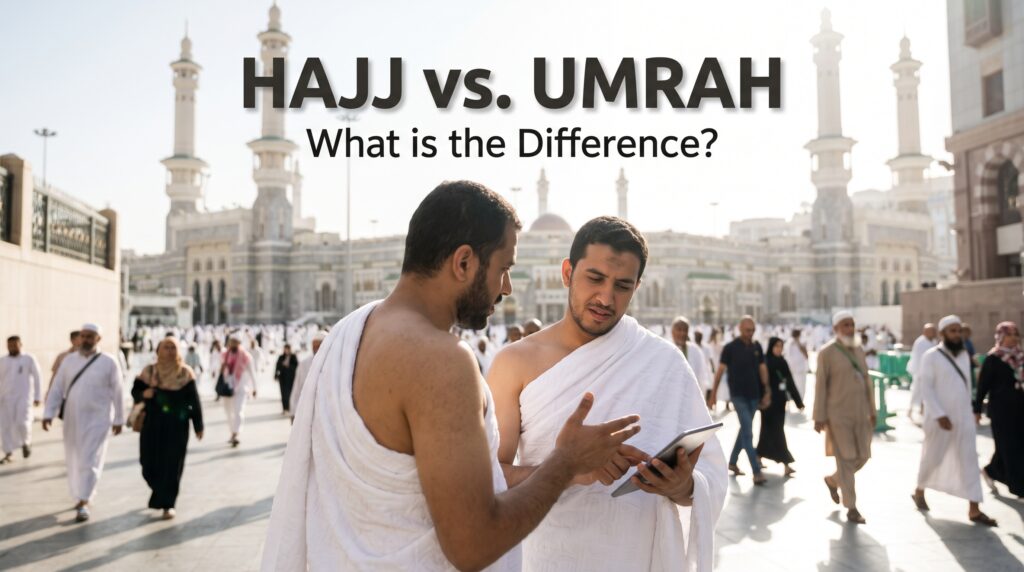
Because Hajj occurs simultaneously for all pilgrims, millions of men, women, and families from every corner of the globe converge upon Makkah at the exact same moment. This massive gathering creates an undeniable demonstration of human brotherhood and equality, where race, language, social class, and political power vanish beneath identical unstitched white sheets.
The Creator commands in the Quran:
“And proclaim to mankind the Hajj; they will come to you on foot and on every lean camel from every distant pass.” — Surah Al-Hajj (22:27)
“And [due] to Allah, from the people is a pilgrimage to the House—for whoever is able to find there a way. But whoever disbelieves—then indeed, Allah is free from the need of the worlds.” — Surah Aal ‘Imran (3:97)
Key Rites of Hajj
Hajj involves extensive physical stamina and distinct stages carried out over five to six consecutive days:
- Entering Ihram: A sacred state of spiritual intent, modesty, and peace marked by simple white garments.
- Day of Mina (8th Dhul-Hijjah): Pilgrims gather in tent encampments for prayer and reflection.
- The Day of Arafah (9th Dhul-Hijjah): The pinnacle of Hajj. Pilgrims stand on the plains of Arafat from midday until sunset, begging for forgiveness and mercy.
- Night in Muzdalifah: Resting under the open night sky and collecting small pebbles.
- Rami al-Jamarat (Stoning the Pillars): Symbolically rejecting the whispers of Satan, pride, and sin in Mina.
- Animal Sacrifice (Qurbani / Hady): Honoring Prophet Ibrahim’s willingness to sacrifice in complete surrender to the Creator.
- Tawaf al-Ifadah & Sa’i: Circling the Ka’bah seven times and walking between the hills of Safa and Marwah.
- Farewell Tawaf (Tawaf al-Wada): The final circling before returning home.
The spiritual weight of a sincere Hajj is unmatched:
“Whoever performs Hajj for Allah’s sake and does not commit obscenity or wickedness will return as free from sin as on the day his mother bore him.” — Sahih al-Bukhari (Hadith 1521)
3. What Is Umrah? The Minor Pilgrimage of Spiritual Renewal
Umrah is widely known as the “Lesser Pilgrimage.” While deeply sacred, beloved, and spiritually rewarding, it does not carry the status of a pillar of Islam.
Timing and Flexibility
Unlike Hajj, which occurs during specific calendar days, Umrah can be performed at any time during the year. Believers often undertake Umrah during the holy month of Ramadan, during annual vacations, or as a voluntary journey of personal repentance and devotion.
The Quran mentions both journeys together regarding completion:
“And complete the Hajj and ‘Umrah for Allah…” — Surah Al-Baqarah (2:196)
The Four Essential Steps of Umrah
Umrah is far shorter and physically simpler than Hajj. It does not involve standing at Arafat, staying in Mina or Muzdalifah, stoning the pillars, or slaughtering an animal. It consists of four basic rites that can usually be completed in just a few hours:
- Ihram: Entering the sacred state from designated boundary points (Mawaqit) with pure intention.
- Tawaf: Circling the Ka’bah seven times in a counterclockwise direction while praising Allah and making supplication.
- Sa’i: Walking seven times between the two historical hills of Safa and Marwah, commemorating the desperate search for water by Hajar (mother of Prophet Ismail).
- Halq or Taqseer: Shaving the head (recommended for men) or cutting a small lock of hair (for both men and women), marking the exit from Ihram.
The Prophet Muhammad (peace be upon him) highlighted the purifying nature of Umrah:
“An Umrah to another Umrah is an expiation for what is between them, and the accepted Hajj has no reward except Paradise.” — Sahih al-Bukhari (Hadith 1773), Sahih Muslim (Hadith 1349)
4. Hajj vs. Umrah: Side-by-Side Comparison
To clearly understand how these two acts of worship differ in rule, action, and commitment, the table below provides a direct comparison:
| Functie | Hajj (The Major Pilgrimage) | Umrah (The Minor Pilgrimage) |
|---|---|---|
| Status in Islamic Law | Fifth Pillar of Islam: obligatory once in a lifetime for those who are able (Fard ‘Ayn). | Sunnah Mu’akkadah (highly emphasized voluntary Sunnah / obligatory once according to some scholars, but non-pillar). |
| Prescribed Timing | Fixed strictly to the 8th–12th/13th of Dhul-Hijjah. | Any day of the year at any time. |
| Duration of Rites | Requires 5 to 6 full days of travel and encampments. | Completed within a few hours (typically 2 to 4 hours). |
| Key Rituals Included | Ihram, Tawaf, Sa’i, Standing at Arafat, Night at Muzdalifah, Camping in Mina, Stoning the Jamarat, and Animal Sacrifice. | Ihram, Tawaf, Sa’i, and Halq/Taqseer (hair cutting) only. |
| The Stand at Arafah | The foundational pillar—missing Arafah invalidates the entire Hajj. | Not part of Umrah at all. |
| Animal Sacrifice (Hady) | Required for most pilgrims (those performing Tamattu’ or Qiran Hajj). | Not required. |
| Fulfillment of Obligation | Fulfills the lifelong divine command of pilgrimage. | Does not replace or waive the obligatory duty of Hajj. |
5. Deeper Wisdom: Equality, Accountability, and the Human Design
Islam teaches that human beings are created physically weak, dependent on one another, and gifted with speech and free will to undergo an intentional trial on Earth. The disciplines of pilgrimage are designed to refine this trial by removing social arrogance and reminding the soul of accountability before the Creator.
1. The Stripping of Worldly Vanity
In daily life, clothing, titles, wealth, and status often separate human beings into artificial classes. During pilgrimage, every man must wear two pieces of unstitched white cloth, while women dress in simple, modest clothing without decorative displays.
A head of state, a wealthy merchant, a manual laborer, and an impoverished farmer stand shoulder to shoulder with identical posture. This visual reality shatters the illusion of superiority and teaches the heart a fundamental Quranic truth:
“O mankind, indeed, we have created you from male and female and made you peoples and tribes that you may know one another. Indeed, the most noble of you in the sight of Allah is the most righteous of you…” — Surah Al-Hujurat (49:13)
2. A Living Rehearsal of the Day of Judgment
When millions stand under the open sky on the plains of Arafat—covered in dust, with hands raised in collective tears, stripped of comfort—it provides a vivid miniature reflection of the Day of Resurrection. It reminds every person that one day, all humanity will be gathered before the One Unseen Creator without worldly possessions, where only sincerity, sound faith, and righteous deeds will carry weight.
3. Training the Tongue and Self-Control
Both Hajj and Umrah strictly forbid arguing, insults, boasting, and vulgar behavior during the state of Ihram. As speech is humanity’s most powerful tool, controlling the tongue under crowded and exhausting conditions trains the pilgrim in emotional maturity, patience (Sabr), and empathy.
6. Guidance Section: Misconceptions and Unapproved Rites
Because pilgrimage attracts believers from diverse cultural traditions, misunderstandings and invented practices often arise. The table below clarifies authentic guidance against common cultural errors:
| Misconception or Practice | Cultural Assumption | Quranic & Authentic Sunnah Guidance |
|---|---|---|
| Worshipping the Ka’bah or Black Stone | Assuming the Ka’bah itself possesses supernatural power or that the Black Stone (Hajar al-Aswad) can grant wishes. | The Ka’bah is strictly a physical direction for collective unity (Qiblah). The Black Stone is a symbolic marker from antiquity. Muslims worship only the Unseen Creator (Tawheed), never physical structures or stones. |
| Umrah Replaces Hajj | Assuming that performing multiple Umrahs, especially in Ramadan, excuses a person from performing Hajj. | While Umrah in Ramadan holds immense reward, it never waives the lifelong obligation of Hajj. Hajj remains a mandatory pillar for anyone with the means. |
| Going into Severe Debt for Pilgrimage | Believing one must borrow money or leave family dependents in poverty to complete Hajj. | Allah commands pilgrimage only for those who possess the genuine means (Istita’ah). Leaving dependents without basic financial security violates fundamental Islamic social laws. |
| The “Hajji” Title and Boasting | Using pilgrimage as a social achievement, demanding to be called “Hajji,” or recording ostentatious videos for social media. | Worship is judged by sincere intention (Ikhlas). Showing off (Riya) destroys spiritual rewards. Hajj is a discipline of humility, not a tool for community status. |
| Seeking Help from Graves or Intermediaries | Visiting historical graves in Makkah or Madinah to invoke the deceased or ask them for salvation and worldly needs. | The Quran strictly forbids calling upon any created being alongside Allah (Surah Yunus 10:18). Supplication (Dua) is an act of pure worship directed exclusively to the Living Creator. |
| Excessive Repeated Umrahs on a Single Trip | Exiting to Tan’eem repeatedly every day during a single stay to rack up numerous Umrahs for different relatives. | Neither the Prophet Muhammad (peace be upon him) nor his companions practiced back-to-back daily Umrahs on a single journey. The Sunnah emphasizes dedicating time to Tawaf, prayer, and deep personal reflection in the sacred mosque. |
7. Frequently Asked Questions (FAQs)
Q1: Can a person perform Umrah multiple times, but Hajj only once?
Yes. Hajj is obligatory only once in a lifetime for those who have the means. Umrah, being voluntary, can be performed as often as a person wishes throughout their life whenever they have the opportunity.
Q2: If I perform Umrah during Ramadan, do I still need to perform Hajj?
Yes. The Prophet (peace be upon him) mentioned that Umrah in Ramadan carries a reward equivalent to Hajj in merit, but it does not legally substitute for the obligatory fifth pillar of Hajj. If you possess the financial and physical capability, Hajj remains mandatory.
Q3: What is the single most important rite that separates Hajj from Umrah?
The presence at Arafat on the 9th day of Dhul-Hijjah. The Prophet Muhammad explicitly stated: “Hajj is Arafah” (Sunan Abi Dawud). If a pilgrim misses standing at Arafat during its designated hours, their Hajj is invalid. Umrah has no standing at Arafat.
Q4: Are women allowed to perform Hajj or Umrah alone?
Contemporary scholars and reliable juristic councils have clarified that a woman may travel for Hajj or Umrah with a reliable group of safe travelers if security is assured, aligning with the core objective of safety and dignity in travel.
Q5: Is animal sacrifice (Qurbani) part of Umrah?
No. An animal sacrifice is not part of standard Umrah rituals. It is only required during Hajj (for those performing the Tamattu’ or Qiran pilgrimage types) or as a penalty (Fidyah) if a pilgrim violates a restriction of Ihram.
Q6: Can I perform Hajj on behalf of a deceased or sick parent?
Yes, provided that you have already performed your own obligatory Hajj first. This practice (Hajj al-Badal) allows a person to honor their parents or relatives who passed away or are permanently unable to travel due to chronic illness or age.
Q7: Why is the state of Ihram so strict regarding behavior and scent?
Ihram strips away all external adornments—such as perfumes, trimmed hair, styled garments, and worldly disputes. It trains the human mind to enter complete mindfulness and peace, ensuring that focus is directed entirely inward toward repentance and divine consciousness.