Samenvatting van de inhoud
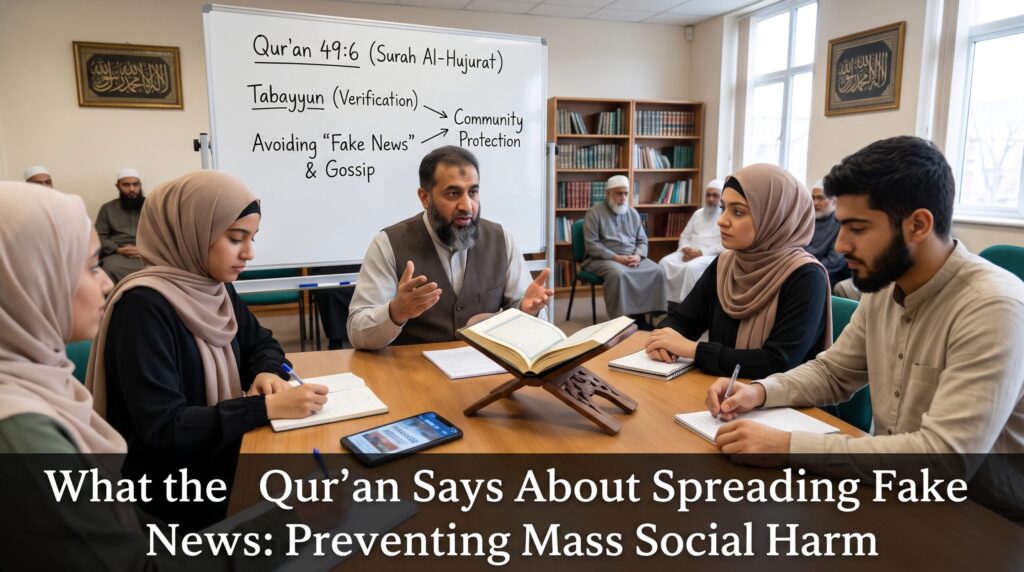
The Qur’an Says About Spreading Fake News: In our highly connected digital age, a single tap on a screen can send information across the globe in seconds. While this connectivity is a remarkable achievement, it has also given rise to one of the most destructive forces in modern society: the rapid spread of fake news and unverified information. Rumors, false claims, and manipulated news have the power to destroy reputations, spark panic, and tear apart the fabric of peaceful communities. Yet, the cure for this modern crisis was revealed over 1,400 years ago. According to the profound insights found in the document “Humanity By Quran,” the gift of speech and communication is a divine trust. In this post, we will explore what the Qur’an says about spreading unverified information, why accountability matters, and how Islamic ethics offer a perfect, logical framework to prevent mass social harm.
Inhoudsopgave
| Sectietitel | Belangrijke vragen beantwoord |
|---|---|
| The Superpower of Communication and Its Risks | Why is the human ability to communicate considered a divine trust? |
| The Dangers of Unverified News in Society | How does spreading false information destroy community trust? |
| The Divine Command: Investigate Before You Share | What is the exact Quranic method for handling incoming news? |
| The Psychology of Rumors and Social Responsibility | Why do we forward fake news, and how does it harm others? |
| Ultimate Accountability: The Invisible Record | Are we accountable for everything we share and forward? |
| Begeleidingssectie | How do practical Quranic truths counter modern misconceptions? |
| Een oprechte uitnodiging | Why should every person reflect on the Qur’an’s guidance? |
| Veelgestelde vragen (FAQ's) | What are the common questions about Islam, fake news, and communication? |
The Superpower of Communication and Its Risks
If we look at the natural world, animals communicate based on basic, immediate instincts—signaling hunger, fear, or a warning. They do not hold conversations about the past or the future, nor do they spread rumors. Humans, however, are entirely unique. We possess the profound ability to build complex thoughts, assign meanings to abstract concepts, and transfer knowledge across generations. As highlighted in the document “Humanity By Quran,” this unique gift of speech is the very foundation of human civilization. Because we are born physically weak and dependent, we rely on communication to build families, invent tools, and organize societies.
“He created man. He taught him speech.” (Surah Ar-Rahman 55:3-4)
However, this superpower is a double-edged sword. Just as words have the power to heal, inspire, and unite, they possess an equal capacity to deceive, divide, and destroy. Because we can communicate so powerfully, our words are not just empty sounds; they are seeds that grow in the minds of others. The misuse of this gift through lying or spreading falsehoods is one of the greatest threats to human stability.
The Dangers of Unverified News in Society
A healthy, functioning society operates on a single, invisible currency: trust. We trust that the food we buy is safe, that the laws will protect us, and that the information we receive is accurate. When fake news and unverified rumors are introduced into a community, this trust shatters. Fake news often targets people’s emotions—fear, anger, or outrage. Once an emotional response is triggered, logic takes a back seat, and people quickly forward information without checking its origin. This causes a chain reaction. A simple, unverified message can ruin a person’s dignity, destroy a family’s reputation, or incite mass panic and violence within a community. “Humanity By Quran” notes that bad language and unverified news have the ability to “fly in a powerful way.” They act as destructive forces that bypass physical boundaries, breaking down the psychological and social safety of a community. If society loses the ability to distinguish truth from falsehood, justice becomes impossible to maintain.
The Divine Command: Investigate Before You Share
The Creator, knowing the devastating potential of the human tongue and our capacity to misguide one another, provided a clear, timeless law to protect society from the harm of fake news. Long before the invention of social media, smartphones, or the internet, the Qur’an laid down the ultimate journalistic and ethical standard for handling information. It commands us to pause, restrain our emotional impulses, and verify the source and accuracy of whatever we hear before acting upon it or passing it along.
“O jullie die geloofd hebben, als er een ongehoorzame naar jullie toe komt met informatie, onderzoek het dan, opdat jullie niet uit onwetendheid een volk schade berokkenen en spijt krijgen van wat jullie gedaan hebben.” (Soera Al-Hujurat 49:6)
This single verse contains the cure for the modern epidemic of fake news. It warns us that sharing information blindly is not a harmless mistake; it is an act of ignorance that can inflict severe, irreversible harm on innocent people. True wisdom lies in verification, not in being the first to break the news.
The Psychology of Rumors and Social Responsibility
Why is it so tempting to share sensational news, even when we are not sure it is true? Psychologically, humans want to feel important, helpful, or connected. Sharing a shocking piece of news can give a person a temporary feeling of influence or attention. Sometimes, it is driven by hidden biases—we are quicker to believe and share fake news if it aligns with our existing prejudices against a certain group or individual.
Islam addresses this psychological weakness by urging believers to assume the best about others and to avoid unfounded suspicions.
“O jullie die geloven, vermijd veel aannames. Sommige aannames zijn inderdaad zonde. En bespioneer en laster elkaar niet...” (Soera Al-Hujurat 49:12)
When we allow assumptions to replace facts, we become tools for spreading injustice. Ethical communication requires immense self-discipline. We must filter what we consume and what we share through the lens of justice, recognizing that protecting the dignity and honor of our fellow human beings is a sacred duty.
Ultimate Accountability: The Invisible Record
The ultimate deterrent against spreading fake news is the realization of absolute accountability. In today’s digital world, people often hide behind anonymous profiles or assume that a simple “retweet” or “forward” carries no moral weight because they didn’t write the original message.
However, the Islamic perspective, as detailed in “Humanity By Quran,” teaches that life on earth is a meticulous testing ground. The Creator has established a flawless system where every action, intention, and shared word is permanently recorded.
“Hij zegt geen woord of er is een waarnemer bij hem in de buurt die klaarstaat om op te nemen.” (Soera Qaf 50:18)
Every time you forward an unverified message, you take ownership of its consequences. If that message harms someone’s business, breaks a marriage, or causes public unrest, you share in the burden of that injustice on the Day of Judgment. By living with the constant awareness of this divine accountability, a person naturally becomes highly disciplined, choosing to remain silent unless they can speak the undeniable truth.
Prophet Muhammad (peace be upon him) beautifully summarized this ethical standard by stating:
“It is enough of a lie for a person to narrate everything he hears.” (Sahih Muslim)
Begeleidingssectie
| Onderwerp / Concept | Veel voorkomende misvatting of onwetendheid | De praktische waarheid (gebaseerd op richtlijnen uit de Koran) |
|---|---|---|
| Sharing Information | I am just forwarding a message I received; I am not responsible if it turns out to be fake. | You are fully accountable for what you share. The Qur’an commands us to investigate news before spreading it, as forwarding lies makes you an active participant in the harm it causes. |
| Freedom of Expression | I have the freedom to say and post whatever I want, even if it is based on assumptions. | Freedom comes with heavy moral responsibility. Words are like seeds that impact society. The Qur’an strictly forbids acting on mere assumption, as it leads to sin and injustice. |
| Harmless Gossip | Discussing unverified rumors is just casual entertainment and doesn’t really hurt anyone. | Rumors destroy social trust and human dignity. Prophet Muhammad warned that simply repeating everything you hear is equivalent to lying, a major sin in Islam. |
Vrijwaring
De inzichten die in deze blogpost worden gedeeld, zijn bedoeld voor educatieve en reflectieve doeleinden, waarbij gebruik wordt gemaakt van de concepten uit de aangeleverde kennisbestanden en de islamitische leer. Ze zijn gericht op het bevorderen van harmonie, logisch denken en morele verantwoordelijkheid. Lezers worden aangemoedigd om kennis te zoeken, na te denken over de natuur en gekwalificeerde wetenschappers te raadplegen voor diepere theologische studies.
Een oprechte uitnodiging
Echt begrip komt voort uit directe reflectie en een open hart. Wij nodigen u van harte uit om de Heilige Koran minstens één keer in uw leven te lezen, in een taal die u volledig begrijpt. Laat je eigen geest de wijsheid, logica en diepe vrede observeren die deze de mensheid biedt.
Veelgestelde vragen (FAQ's)
1. What does the Qur’an say about receiving news from unreliable sources? The Qur’an explicitly commands believers in Surah Al-Hujurat (49:6) to investigate and verify any news brought by an unreliable or disobedient person. This is to prevent harming innocent people out of ignorance and later suffering deep regret.
2. Is forwarding a fake message considered a sin in Islam? Yes. If you forward a message without verifying its truth, and it turns out to be false or harmful, you bear the moral responsibility for spreading a lie. Prophet Muhammad (peace be upon him) said that narrating everything one hears is enough to make a person a liar.
3. Why is spreading rumors so dangerous to society? Rumors and fake news destroy the foundational trust required for a community to function. They create panic, ruin reputations, and spark unnecessary conflicts, unraveling the social fabric that keeps humanity safe and united.
4. How can I protect myself from spreading fake news? The best protection is self-discipline rooted in the fear of accountability. Pause before you share. Ask yourself: Is this true? Is this beneficial? Have I verified the source? If you are unsure, the safest and most ethical choice is silence.
5. Does accountability apply to what we do on the internet? Absolutely. The Islamic concept of accountability is universal. Every text, comment, forward, and shared post is a form of communication. Angels record every word we “utter” or transmit, and we will answer for our digital footprint on the Day of Judgment.