Samenvatting van de inhoud
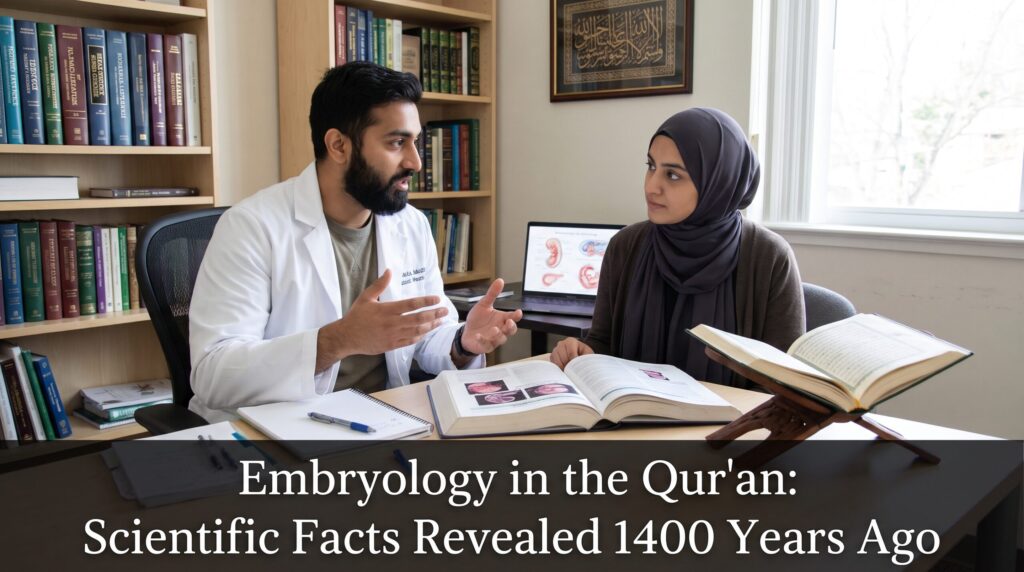
Embryology in the Qur’an: The development of a human being inside the womb is one of the most complex and awe-inspiring processes in nature. For centuries, the exact stages of this development remained a mystery to humanity, hidden in darkness and only revealed with the invention of modern microscopes. However, when we turn to the Qur’an, a text revealed 1,400 years ago in a desert environment, we find astonishingly precise descriptions of these embryonic stages. In this post, we will explore insights from the document “Humanity By Quran” to understand how the Qur’an accurately detailed the microscopic journey of human creation centuries before modern science, offering profound proof of its divine origin and the intelligent design of human life.
Inhoudsopgave
| Sectietitel | Belangrijke vragen beantwoord |
|---|---|
| The Mystery of the Womb | How did ancient people view human development before microscopes? |
| The Stages of Creation in the Qur’an | What specific embryonic stages does the Qur’an describe? |
| The Sequence of Senses: Hearing Before Sight | Does modern neuroscience agree with the Qur’an on sensory development? |
| Why Are These Facts in the Qur’an? | What is the purpose of including scientific realities in a spiritual book? |
| The Ultimate Proof of the Creator | How do these precise details prove the Qur’an’s divine authenticity? |
The Mystery of the Womb
Before the invention of the microscope and the advancement of modern embryology, human knowledge regarding how a baby develops inside the mother’s womb was extremely limited and often based on speculation. In 7th-century Arabia, where the Qur’an was revealed, there were no ultrasound machines, no advanced medical laboratories, and no scientific understanding of cellular biology.
The intricate, microscopic stages of human formation—from a single fertilized cell to a fully formed infant—were completely hidden from the human eye. According to the document “Humanity By Quran,” this lack of scientific tools makes the detailed descriptions found within the Qur’an not just remarkable but miraculous. The precision of these descriptions challenges the assumption that the Qur’an was merely the product of human observation or ancient mythology.
The Stages of Creation in the Qur’an
Modern embryology has established that a human fetus goes through highly specific, distinct stages of physical development. Remarkably, the Qur’an described these exact stages over a millennium ago using Arabic terminology that perfectly matches the visual and physical realities observed today under powerful microscopes.
Regarding this miraculous process, the Qur’an states:
“En we hebben de mens zeker geschapen uit een extract van klei. Vervolgens plaatsten we hem als een spermadruppel in een stevige behuizing. Vervolgens maakten we van de spermadruppel een vastzittend stolsel, en we maakten van het stolsel een klomp [van vlees]; en we maakten [van] de klomp botten, en we bedekten de botten met vlees; daarna ontwikkelden we hem tot een andere schepping. Zo gezegend is Allah, de beste van de scheppers.” (Soera Al-Mu’minun 23:12-14)
Let’s break down these stages as described in the Qur’an and confirmed by modern science:
- The Clinging Clot (Alaqah): The early embryo resembles a leech-like structure that clings to the wall of the uterus, drawing nourishment.
- The Lump of Flesh (Mudghah): The embryo then takes on the appearance of a chewed lump of flesh, complete with somites that resemble teeth marks.
- Bone Formation (Itham): The structural framework begins to form.
- Covering with Flesh (Lahm): The muscles then form and wrap around the developing skeletal structure.
Modern embryologists have marveled at this precise sequence, as it perfectly mirrors the biological reality discovered only recently.
The Sequence of Senses: Hearing Before Sight
The Qur’an does not only describe the physical stages of embryonic growth; it also details the neurological development of the human senses. Modern medical science and neuroscience have confirmed that a fetus develops its sense of hearing before its sense of sight. A baby can hear sounds from outside the womb while its eyes are still closed and developing.
The Qur’an accurately reflects this specific biological sequence, always mentioning the creation of hearing before vision:
“En Allah heeft jullie uit de baarmoeder van jullie moeders gehaald, zonder iets te weten, en Hij heeft voor jullie gehoor, visie en harten gemaakt zodat jullie dankbaar kunnen zijn.” (Soera An-Nahl 16:78)
How could a man living in the desert over 1,400 years ago accurately state the chronological development of human senses? This precise alignment with modern neuroscience is another profound sign of the Qur’an’s divine origin.
Why Are These Facts in the Qur’an?
It is crucial to understand that the Qur’an is not intended to be a science or biology textbook. As highlighted in “Humanity By Quran.pdf,” the Creator did not place these scientific facts in the Qur’an merely to teach humanity about embryology.
The Qur’an is a book of “signs” (Ayat). These profound scientific truths were included to serve as undeniable proof for the thinking mind across all generations. When a modern, educated human being reads these accurate descriptions recorded centuries before the invention of the necessary scientific tools, it shatters the idea that religion is just ancient superstition.
These signs are designed to awaken our inner compass (Fitrah). They invite us to reflect on the magnificent complexity of our own creation and recognize that we are not the product of a random, blind accident but the intentional design of a Supreme Creator.
“We zullen hen onze tekenen aan de horizon en in zichzelf laten zien, totdat het voor hen duidelijk wordt dat dit (de Koran) de waarheid is.” (Soera Fussilat 41:53)
The Ultimate Proof of the Creator
When we analyze the microscopic reality of human development, the theory of blind, accidental evolution falls short. The sheer complexity and perfect timing required to form a human being point directly to intelligent design.
The fact that the Qur’an detailed this exact process 1,400 years ago proves its authenticity as the preserved word of the Creator. It aligns perfectly with the laws of nature and biology, demonstrating that Islam is indeed the “Religion of Nature.”
Recognizing this truth is meant to guide humanity. If the Creator designed us with such precise care in the womb, it logically follows that our lives have a higher purpose. We are placed on this earth for a temporary moral test, and our profound design is a constant reminder of our ultimate accountability to the One who created us.
Begeleidingssectie
| Onderwerp / Concept | Veel voorkomende misvatting of onwetendheid | De praktische waarheid (gebaseerd op richtlijnen uit de Koran) |
|---|---|---|
| Source of the Qur’an | The Qur’an was written by borrowing scientific knowledge from ancient civilizations. | The Qur’an contains precise, microscopic details about embryology that were entirely unknown to humanity until the invention of modern scientific tools centuries later. |
| Doel van wetenschappelijke verzen | The Qur’an includes these facts to teach us biology. | The scientific facts in the Qur’an are “signs” designed to prove its divine origin and guide the human intellect toward recognizing the Creator’s intentional design. |
| Human Creation | Human life is just a biological accident resulting from random cellular division. | The flawless precision of embryonic development, as described in the Qur’an, points to an intelligent Supreme Creator who designed human life with deliberate purpose and care. |
Vrijwaring
De inzichten die in deze blogpost worden gedeeld, zijn bedoeld voor educatieve en reflectieve doeleinden, waarbij gebruik wordt gemaakt van de concepten uit de aangeleverde kennisbestanden en de islamitische leer. Ze zijn gericht op het bevorderen van harmonie, logisch denken en morele verantwoordelijkheid. Lezers worden aangemoedigd om kennis te zoeken, na te denken over de natuur en gekwalificeerde wetenschappers te raadplegen voor diepere theologische studies.
Een oprechte uitnodiging
Echt begrip komt voort uit directe reflectie en een open hart. Wij nodigen u van harte uit om de Heilige Koran minstens één keer in uw leven te lezen, in een taal die u volledig begrijpt. Laat je eigen geest de wijsheid, logica en diepe vrede observeren die deze de mensheid biedt.
Veelgestelde vragen (FAQ's)
1. Did the Qur’an describe human development before modern science? Yes, 1,400 years ago, the Qur’an accurately detailed the microscopic stages of human embryonic development—such as the clinging clot and the formation of bones and flesh—centuries before microscopes were invented.
2. What does the Qur’an say about the development of human senses? The Qur’an accurately states that the sense of hearing is created before the sense of sight, a specific biological sequence that has been fully confirmed by modern neuroscience.
3. Why are these scientific facts included in the Qur’an? These facts serve as divine “signs.” They provide undeniable proof to modern, thinking minds that the Qur’an is the authentic word of the Creator, as no human in the 7th century could have known such microscopic details.
4. Does this prove intelligent design? Yes. The perfect precision, complexity, and timing of human development in the womb strongly contradict the idea of random, blind chance, pointing directly to a deliberate design by a Supreme Creator.
5. How does this relate to the purpose of human life? Recognizing that we were created with such intricate care reminds us that our existence is not an accident. We are designed for a purpose, placed on earth for a moral test, and ultimately accountable to our Creator.