Content Summary
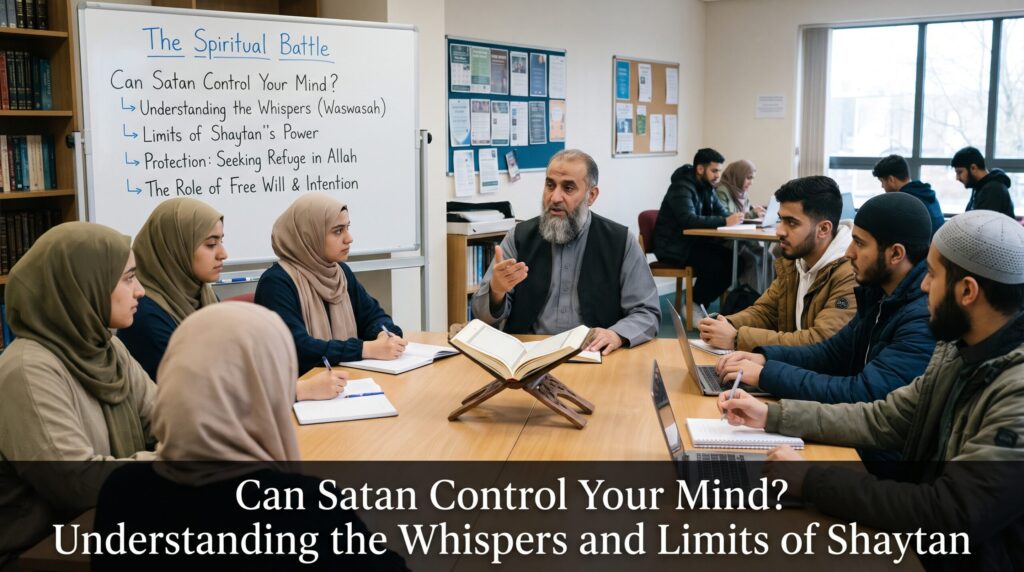
Can Satan Control Your Mind: When a person commits a terrible sin, makes a massive mistake, or falls into a destructive habit, it is common to hear the excuse, “The devil made me do it.” Throughout history and across various cultures, Satan (Shaytan) has been depicted as an all-powerful, terrifying force capable of possessing minds and forcing humans to commit evil acts. But how much power does he actually have? According to the profound and logical insights found in the document “Humanity By Quran,” the reality is entirely different. Islam teaches that Shaytan is an open enemy to humanity, yet his actual power is incredibly weak and strictly limited. In this post, we will explore the origin of Shaytan, the psychological reality of his “whispers,” and how understanding his true limits liberates the human mind from fear and false excuses.
Table of Contents
| Section Title | Key Questions Addressed |
|---|---|
| The Origin of Shaytan: Jinn, Not Angel | Was Satan an angel, and does he have free will? |
| The Illusion of Control: Can Satan Force You to Sin? | Does Shaytan have the power to control the human mind or body? |
| The Psychological Tactics: Whispers and Emotions | How does Satan manipulate human feelings and desires? |
| The Ultimate Defense: Sincerity and Remembrance | How can a person protect their mind and heart from Shaytan? |
The Origin of Shaytan: Jinn, Not Angel
To understand the limits of Shaytan, we must first understand what he is. A common cultural misconception, heavily influenced by other traditions, is that Satan is a “fallen angel” who rebelled against the Creator. Islam completely rejects this idea.
According to “Humanity by Quran,” angels are beings of pure obedience created from light; they do not possess free will and therefore cannot disobey the Creator. Shaytan, on the other hand, belongs to a completely different creation called the Jinn. Like humans, Jinn possess free will.
“And He created the jinn from a smokeless flame of fire.” (Surah Ar-Rahmān 55:15)
Shaytan was originally among the righteous, but when the Creator commanded him to bow to the first human, Adam, his free will was tested. Driven by an immense sense of superiority, pride, and ego, he refused.
“…He refused and was arrogant and became one of the disbelievers.” (Surah Al-Baqarah 2:34)
It was not divine force that made him evil; it was his own arrogant choice. Because of this, he became the eternal, open enemy of humanity, vowing to prove that humans are ungrateful and easily misguided.
“Indeed, Shayțān is to you an enemy, so take him as an enemy….” (Surah Fāţir 35:6)
The Illusion of Control: Can Satan Force You to Sin?
Because Shaytan is an invisible enemy, people often fear that he possesses the power to control human minds, hijack our bodies, or force us into committing sins against our will.
However, the Qur’an completely shatters this terrifying illusion. “Humanity By Quran” explicitly highlights that Shaytan is weak and entirely powerless when it comes to physical or mental control. He does not have a remote control to your brain. He cannot force your hand to steal, nor can he force your tongue to lie.
“…Indeed, the plot of Shayțān is weak.” (Surah An-Nisa’ 4:76)
The Creator, in His perfect justice, did not give an invisible enemy absolute authority over human beings. If Shaytan could force us to sin, then holding humans accountable on the Day of Judgment would be entirely unjust. Instead, the Qur’an clarifies his strict limits:
“He has no authority over those who believe and rely upon their Lord.” (Surah An-Nahl 16:99)
Shaytan’s power is restricted entirely to suggestion. He is a deceiver, not a controller. If a human being commits a sin, it is because their own inner self (nafs) chose to accept the suggestion and act upon it.
The Psychological Tactics: Whispers and Emotions
If Shaytan cannot control us, how does he mislead millions of people? His primary weapon is psychological manipulation through “whispers” (waswasah).
“Humanity by Quran” explains that Shaytan’s tactic is to trigger our natural human emotions—such as fear, pride, desire, anger, and jealousy. He operates like a negative voice in the back of your mind, planting seeds of doubt and false hope.
“From the evil of the whisperer who withdraws.” (Surah An-Nās 114:4)
When you are about to give to charity, he whispers the fear of poverty to make you greedy. When you are angry, he whispers the desire for revenge to make you unjust. He makes harmful deeds look beautiful and easy, while making righteous deeds look difficult and burdensome.
“Satan threatens you with poverty and commands you to immorality….” (Surah Al-Baqarah 2:268)
“…Satan made their deeds appear beautiful to them…” (Surah An-Naml 27:24)
He studies human weaknesses and approaches us from every angle—from the front, behind, right, and left—trying to arouse sinful desires and command us to alter the pure creation of Allah. But it is vital to remember: a whisper is just a whisper. It only gains power if you choose to listen to it and act upon it.
The Ultimate Defense: Sincerity and Remembrance
Because Shaytan’s only weapon is the whisper, defeating him does not require physical strength or complex rituals; it requires mental clarity, sincerity, and remembrance of the Creator.
When a person centralizes their life around the One Unseen Creator, Shaytan’s whispers lose their volume. A mind filled with the remembrance of Allah leaves no empty space for the deceptions of Satan. “Humanity By Quran” notes that Shaytan himself admitted his absolute inability to manipulate those who are truly sincere.
“…Indeed, I will mislead them all except Your sincere servants.” (Surah Şād 38:82-83)
“Indeed, my [true] servants—there is for you no authority over them, except those who follow you of the deviators.” (Surah Al-Hijr 15:42)
The ultimate defense against Shaytan is to recognize his tactics and immediately seek refuge in the Creator. When anger flares, or a sinful desire suddenly feels overwhelming, a conscious believer recognizes it as a whisper, ignores it, and turns to Allah. For those with faith and awareness, Shaytan remains a defeated deceiver whose tricks vanish instantly in the light of truth and sincerity.
Guidance Section
| Topic / Concept | Common Misconception or Ignorance | The Practical Truth (Based on Quranic Guidance) |
|---|---|---|
| Satanic Control | Satan has the power to possess my mind, control my actions, and force me to commit sins. | Satan’s plot is incredibly weak. He has absolutely no authority to control you; he can only whisper suggestions. You have free will and are fully responsible for your choices. |
| Origin of Satan | Satan was originally an angel of God who fell from heaven because he rebelled. | Angels do not have free will and cannot rebel. Satan (Shaytan) is a Jinn, created from smokeless fire, who chose to disobey the Creator out of pure arrogance and ego. |
| Bad Thoughts | Having bad thoughts or sudden sinful urges means my heart is evil and corrupt. | Whispers (bad thoughts) are external attacks from Shaytan trying to trigger your emotions. Recognizing them and refusing to act on them is a profound sign of a strong, sincere faith. |
Disclaimer
The insights shared in this blog post are intended for educational and reflective purposes, drawing upon the concepts from the provided knowledge files and Islamic teachings. They aim to promote harmony, logical thinking, and moral responsibility. Readers are encouraged to seek knowledge, reflect upon nature, and consult qualified scholars for deeper theological studies.
A Sincere Invitation
True understanding comes from direct reflection and an open heart. We warmly invite you to read the Holy Quran at least once in your lifetime, in a language you fully understand. Let your own mind observe the wisdom, logic, and profound peace it offers to humanity.
Frequently Asked Questions (FAQs)
1. Is Satan an angel or a Jinn in Islam? In Islam, Satan (Shaytan) is a Jinn. According to the Qur’an, Jinn are created from smokeless fire and possess free will. Angels are created from light, do not have free will, and cannot disobey the Creator.
2. Can Shaytan force me to do something bad? No. The Qur’an clearly states that Shaytan’s plot is weak and he has no authority over human beings. He cannot force you to act; he can only suggest or “whisper” evil ideas. The ultimate choice to act always rests with your own free will.
3. How does Shaytan try to misguide people? He uses psychological tactics. As mentioned in “Humanity by Quran,” he triggers natural human emotions like fear, poverty, pride, anger, and jealousy. He makes sins appear beautiful and promises false hopes to distract people from the truth.
4. What should I do when I experience bad whispers or thoughts? Do not panic or feel that you are an evil person. Recognize that it is merely a whisper from Shaytan. The Islamic response is to ignore the thought, seek refuge in Allah (saying A’udhu billahi minash-shaytanir-rajim), and distract yourself with positive, righteous actions.
5. Does Shaytan have power over sincere believers? No. The Qur’an states that Shaytan himself admitted he has no power or authority over Allah’s sincere servants. When a person relies entirely on the Creator and lives with sincere intentions, Shaytan’s whispers are rendered completely ineffective.