Content Summary
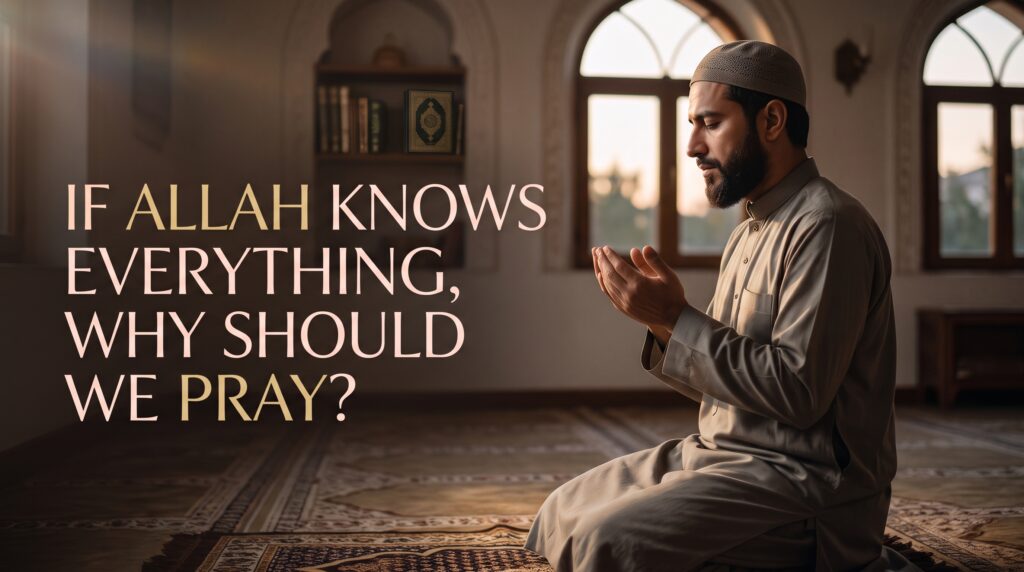
If Allah Knows Everything, Why Should We Pray?: Many thoughtful people wonder why prayer is necessary if Allah is All-Knowing and already aware of every thought, need, and future event. In Islam, prayer is never meant to inform Allah or fulfill any need of His—rather, it is a practical system of mental discipline, emotional peace, gratitude, and self-purification designed entirely for human benefit and social balance.
Table of Contents
| Section Title | Key Questions Addressed |
|---|---|
| Does Allah Need Our Prayers to Know What We Want? | If Allah is All-Knowing and Free of all need, why does He command us to pray? Does prayer inform Allah, or does it awaken us? |
| The True Meaning of Worship: Human Discipline, Not Divine Need | How do daily prayer (Salah) and personal supplication (Dua) regulate our daily routine, mental health, and moral character? |
| If the Future Is Already Known, Why Does Asking Matter? | How does prayer fit into a life designed as a test of human choice, intention, and effort when the future is hidden from us? |
| Guidance: Correcting Common Misconceptions About Prayer | What are the most common misunderstandings and unauthentic practices surrounding prayer and calling upon Allah? |
| Frequently Asked Questions (FAQs) | Why do some prayers seem unanswered? Does prayer replace hard work? Can we ask intermediaries instead of praying directly to Allah? |
Does Allah Need Our Prayers to Know What We Want?
It is completely natural for a logical mind to ask: If Allah created the universe and already knows every secret in my heart, what is the point of asking Him for anything?
To answer this clearly, we must first understand the difference between the Creator and His creation. Allah does not ask human beings to pray because He lacks information. His knowledge covers every atom, intention, and event across time and space at every single moment. As the Quran states:
“And with Him are the keys of the unseen; none knows them except Him. And He knows what is on the land and in the sea. Not a leaf falls, but that He knows it.” — Surah Al-An’am (6:59)
Furthermore, Allah is completely free of all need. Whether every person on earth prays day and night or turns away completely, it adds nothing to His majesty and takes nothing away from His power. Human beings, however, are created physically weak and dependent on their environment, their communities, and their Creator for survival, clarity, and inner peace.
“O mankind, you are the ones who stand in need of Allah, while Allah is Free of all need, the Praiseworthy.” — Surah Fatir (35:15)
“If you disbelieve, then indeed Allah is free of need of you… But if you are grateful, He approves it for you.” — Surah Az-Zumar (39:7)
Therefore, prayer is not an informational briefing for Allah. It is a lifeline for the human being. When you pray, you are not informing the Creator of your problems; you are acknowledging your true reality—that you are a limited creation relying on an Unlimited, All-Wise Sustainer.
The True Meaning of Worship: Human Discipline, Not Divine Need
In Islam, worship (‘Ibadah) is not a set of empty rituals or a transaction with the Creator. Every command in the Quran is built around human benefit, personal self-control, and social harmony. True worship means living with gratitude and patience while seeking forgiveness for our mistakes with humility.
In daily life, prayer works through two complementary practices: Salah (the five daily structured prayers) and Dua (personal supplication and inner dialogue).
Salah: A Daily Regulation System for Mind and Society
Human beings easily become overwhelmed by work pressure, financial stress, and emotional distractions. The five daily prayers (Fajr, Dhuhr, ‘Asr, Maghrib, and ‘Isha) are aligned with the natural cycles of the day—dawn, midday, late afternoon, sunset, and night—keeping human life in harmony with nature.
- Time Management and Mental Reset: Pausing daily tasks five times a day prevents burnout, lowers anxiety, and realigns your focus with your higher purpose.
- Moral Self-Control: Regular prayer trains conscience and self-discipline so you avoid harming yourself or others.
- Unity and Equality: Facing one shared direction (the Ka’bah—a symbol of central alignment, not an object of worship) and standing shoulder-to-shoulder removes ego, status, and social division.
The Quran highlights this practical protective effect of prayer:
“Indeed, prayer prohibits immorality and wrongdoing.” — Surah Al-Ankabut (29:45)
Dua: Inner Dialogue and Emotional Clarity
While Salah structures your daily schedule, Dua is your direct, personal conversation with the Unseen Creator. Consider two people facing the exact same financial or family crisis:
- The person who does not pray carries the entire psychological weight alone. Without a higher anchor, thoughts scatter, worry multiplies, and decisions often become rushed or driven by panic.
- The person who prays turns to Allah with honesty, asks for guidance, and places trust (Tawakkul) in divine wisdom. Even before external circumstances change, their heart gains calm, clarity, and resilience.
“Surely, in the remembrance of Allah do hearts find peace.” — Surah Ar-Ra’d (13:28)
“And your Lord says, ‘Call upon Me; I will respond to you.'” — Surah Ghafir (40:60)
Prayer transforms the inner world of the believer, giving them the emotional stability needed to make wise, practical decisions.
If the Future Is Already Known, Why Does Asking Matter?
Another common question is how prayer fits into Allah’s knowledge of the future. While Allah knows everything that will happen, the future remains completely hidden from human beings. None of us knows what will happen in the next hour or what we will earn tomorrow:
“No soul knows what it will earn tomorrow, and no soul knows in what land it will die.” — Surah Luqman (31:34)
This hidden future is precisely what makes life on earth a real and meaningful test of human choice, intention (niyyah), and character:
“[He] who created death and life to test you as to which of you is best in deed—and He is the Exalted in Might, the Forgiving.” — Surah Al-Mulk (67:2)
Life is not a test of predicting outcomes; it is a test of how you respond within your limited knowledge and strength. Choosing to pray is a conscious act of character that shapes your response in three ways:
- It Protects Against Arrogance: When people forget Allah, they begin to imagine they are completely self-sufficient, leading to pride and moral carelessness: “And do not be like those who forgot Allah, so He made them forget their own souls.” — Surah Al-Hashr (59:19)
- It Cultivates Sincere Effort and Patience: Islam never teaches people to sit idle and only pray. Rather, prayer works alongside practical hard work, planning, and patience:”And seek help through patience and prayer, and indeed, it is difficult except for the humbly submissive [to Allah].” — Surah Al-Baqarah (2:45)
- It Purifies Your Intentions: Speaking honestly to Allah forces you to examine what you are asking for—ensuring your goals are ethical, fair, and beneficial to others.
Guidance: Correcting Common Misconceptions About Prayer
Over time, cultural habits and misunderstandings have clouded the pure, straightforward purpose of prayer in Islam. The table below clarifies common misconceptions using direct Quranic guidance:
| Misconception or Practice | Why It Is Incorrect | Authentic Quranic Guidance |
|---|---|---|
| Prayer is meant to inform Allah of our needs. | Assumes the Creator is unaware of human struggles until we speak. | Allah knows every leaf that falls and every secret in the heart (Surah Al-An’am 6:59). Prayer is for our humility and awareness. |
| Asking saints, graves, or intermediaries to carry prayers to Allah. | Creates false barriers between the Creator and creation, weakening personal accountability. | Islam strictly forbids praying through intermediaries. Believers must call upon Allah directly (Surah Yunus 10:18). |
| Prayer replaces practical effort, planning, and hard work. | Encourages laziness and neglects human responsibility in the physical world. | Humans are accountable for their effort and must combine sincere action with patience and prayer (Surah Al-Baqarah 2:45). |
| Treating prayer as a demand where Allah owes immediate results. | Reduces worship to a commercial transaction rather than trust in divine wisdom. | We ask with sincerity and humility, while Allah responds according to what is truly best for us (Surah Ghafir 40:60). |
| Performing Salah as a rushed, mindless physical routine. | Turns a transformative daily discipline into a hollow habit without moral growth. | True prayer purifies intentions, builds self-control, and prevents wrongdoing (Surah Al-Ankabut 29:45). |
Frequently Asked Questions (FAQs)
1. If Allah already knows what is in my heart, do I need to pray out loud?
No, you do not need to speak loudly for Allah to hear you. Allah knows your silent thoughts and unspoken feelings. The Quran advises remembering Allah within yourself in humility and without loudness (Surah Al-A’raf 7:205). Putting your thoughts into clear, humble words during Dua simply helps you reflect honestly and organize your mind.
2. Why do some sincere prayers seem to go unanswered?
Because human knowledge is limited, we often ask for things that look good on the surface but could harm us in the long run. When you call upon Allah sincerely, He responds with complete wisdom—either by granting what you asked for, protecting you from an unseen harm, or rewarding you with something far better in this life or the Hereafter.
3. Does praying change what is already written?
Allah’s infinite knowledge already includes your free-will choices, your sincere efforts, and your prayers. Choosing to pray, repent, and strive for good is the very means through which positive change enters your life. Despair and inaction close doors, whereas sincere prayer and effort open new paths of mercy.
4. What is the difference between Salah and Dua in Islam?
Salah is the structured, five-times-daily prayer that regulates your daily schedule, cleanliness, physical posture, and mindfulness. Dua is personal, unstructured supplication where you speak to Allah directly in your own words at any moment of the day or night to seek guidance, relief, or forgiveness.
5. Can I ask a religious scholar, saint, or shrine to pray on my behalf instead of praying myself?
While asking a fellow living believer to make Dua for you alongside your own prayers is normal, relying on saints, graves, spirits, or human intermediaries to reach Allah is completely rejected in Islam. Every human being has a direct, personal connection with Allah without any middleman.
6. How can I make my daily prayers feel meaningful instead of mechanical?
Slow down your movements, understand the meaning of the Arabic verses you recite, and enter prayer with two core feelings: gratitude for the blessings you already enjoy, and humility in seeking forgiveness for your shortcomings.


 English
 Bengali
 Chinese
 Dutch
 French
 German
 Greek
 Hindi
 Indonesian
 Italian
 Japanese
 Korean
 Marathi
 Latin
 Portuguese
 Russian
 Spanish
 Swahili
 Telugu
 Vietnamese