Content Summary
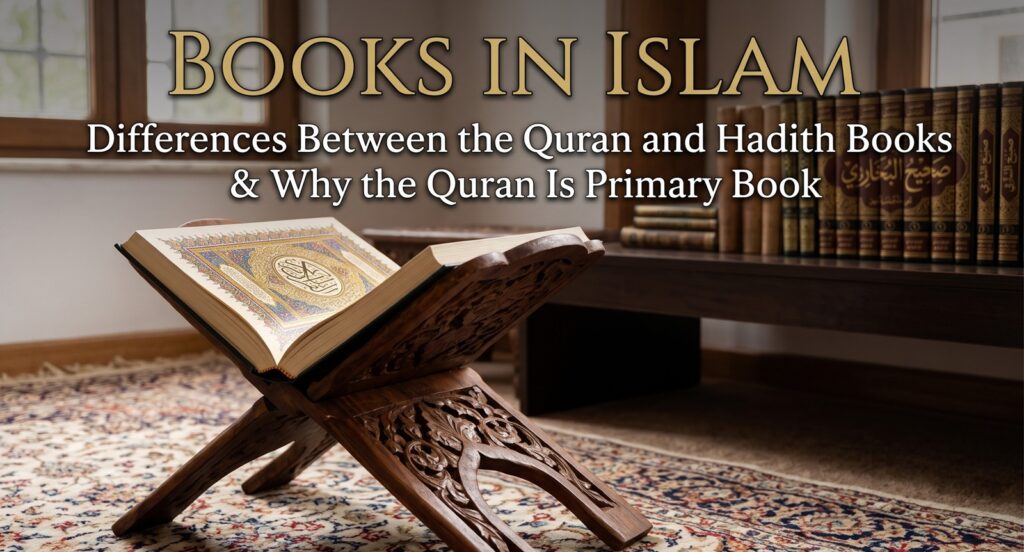
Understanding the books in Islam is essential for anyone seeking clear, logical insight into Islamic faith and daily practice. While both the Holy Quran and Hadith books are deeply respected by Muslims, they do not hold the same origin, preservation, or authority. In this guide, we examine the core differences between the Quran and Hadith collections, explain why the Quran stands as the primary and most important book in Islam, and clarify how Hadith books serve as valuable secondary guidance.
Table of Contents
| Section Title | Key Questions Addressed |
| Understanding the Two Main Books in Islam | What are the Holy Quran and Hadith books? How do they guide human life? |
| Key Differences Between the Quran and Hadith Books | How do the Quran and Hadith differ in authorship, preservation, and authority? |
| Why Is the Quran More Important Than Hadith Books? | Why does the Quran hold supreme status? How was it uniquely preserved? |
| What Is the Proper Role of Hadith Books in Islam? | If the Quran is primary, why do Muslims still study Hadith collections? |
| Guidance Section: Clarifying Common Misconceptions | What common misunderstandings and innovations arise when people confuse Islamic texts? |
| Frequently Asked Questions (FAQs) | Were Hadith books written during the Prophet’s life? What if a report conflicts with the Quran? |
Understanding the Two Main Books in Islam
Islamic knowledge rests upon two distinct categories of books:
- The Holy Quran (The Primary Book): The direct, literal Word of Allah (the One Unseen Creator), revealed to Prophet Muhammad (peace be upon him) as a complete and universal guide for all humanity.
- Hadith Books (The Secondary Books): Historical collections compiled by dedicated scholars after Prophet Muhammad’s lifetime, recording his sayings, daily actions, practical judgments, and moral character.
“And We have sent down to you the Book as clarification for all things and as guidance and mercy and good tidings for the Muslims.” — Surah An-Nahl (16:89)
Key Differences Between the Quran and Hadith Books
Although both texts are part of Islamic learning, treating them as identical in rank causes confusion. Islamic scholarship maintains a clear hierarchy: the Quran is the unchangeable foundation, while Hadith books provide historical and practical context.
| Feature | The Holy Quran (Primary Book) | Hadith Books (Secondary Books) |
| Origin & Authorship | Direct, literal Word of the Creator with zero human authorship. | Compiled by human scholars generations after the Prophet’s lifetime. |
| Preservation | Divinely guaranteed word-for-word preservation for over 1,400 years. | Verified through careful chains of narration, but not guaranteed word-for-word. |
| Level of Authority | Primary and supreme authority; the final criterion (Furqan) over all matters. | Secondary guidance; respected and useful, but subordinate to the Quran. |
| Purpose & Scope | Establishes core beliefs, universal laws, ethics, and life’s purpose for all eras. | Shows how the Prophet practically lived and applied Quranic teachings. |
| Handling Doubts | Used as the ultimate standard to judge and resolve all religious questions. | Accepted only when consistent with the clear principles of the Quran. |
Why Is the Quran More Important Than Hadith Books?
In Islam, the Quran holds an unmatched position above every other book. Five logical and scriptural reasons explain why the Quran is far more important than Hadith collections:
1. Direct Word of the Creator vs. Human Compilation
The Quran contains the exact words revealed by Allah without a single word added by Prophet Muhammad or his companions. By contrast, Hadith books were gathered, filtered, and written down by human scholars after the Prophet passed away. While those scholars worked with immense sincerity, human compilation can never equal direct divine revelation.
2. Unmatched 1,400-Year Word-for-Word Preservation
Prophet Muhammad (peace be upon him) took personal responsibility for delivering the Quran’s exact Arabic wording and ensuring his companions memorized and recorded it accurately. Unlike any other book in human history, the Quran has remained completely unchanged through four layers of protection:
- Mass Memorization (Hifz): Millions of people across every generation have memorized the entire Quran word-for-word.
- Oral Transmission: The text has been passed mind-to-mind from teacher to student with strict accuracy.
- Early Written Records: Verses were written down during the Prophet’s lifetime and compiled into a unified text immediately afterward.
- Internal Consistency: Repeated and matching verses reinforce one another throughout the book, making any addition or deletion immediately noticeable.
“Indeed, it is We who sent down the Qur’an, and indeed, We will be its Guardian.” — Surah Al-Hijr (15:9)
“Allah has sent down the best statement: a Book consistent in its parts, often repeated. The skins of those who fear their Lord shiver from it; then their skins and hearts soften to the remembrance of Allah…” — Surah Az-Zumar (39:23)
3. The Final Criterion (Furqan) and Root of Unity
The Quran is the supreme standard against which every belief, cultural practice, and historical report must be weighed:
“And We have revealed to you, [O Muhammad], the Book in truth, confirming that which preceded it of the Scripture and as a criterion over it…” — Surah Al-Ma’idah (5:48)
Think of Islam as a great tree. The Holy Quran is its deep, unshakable root, while different schools of thought are branches. As long as every branch remains connected to the root—the Quran—the community stays united in core truth. Disconnecting from the Quran leads to division and error.
4. Perfect Harmony with Nature (Fitrah)
Because the Creator of the universe is also the Author of the Quran, its teachings naturally match the laws of creation, human psychology, speech ethics, and family stability. The more a book mirrors truth and balance in nature, the clearer its divine origin becomes:
“We will show them Our signs in the horizons and within themselves until it becomes clear to them that it is the truth…” — Surah Fussilat (41:53)
5. The Prophet’s Direct Instruction to Rely on the Quran
Prophet Muhammad commanded his followers to invite people to truth using the Quran’s exact wording. He entrusted future scholars to answer new challenges primarily through the Quran—because its wording is divinely protected—and warned against letting secondary sources contradict or overshadow it.
What Is the Role of Hadith Books in Islam?
Recognizing that the Quran is supreme does not mean ignoring Hadith books. Rather, scholars compiled Hadith collections in direct obedience to the Quran’s own instruction to look at Prophet Muhammad as a practical role model:
“Indeed, in the Messenger of Allah you have an excellent example for whoever has hope in Allah and the Last Day and remembers Allah often.” — Surah Al-Ahzab (33:21)
When kept in their proper secondary place, Hadith books serve three valuable functions:
- Practical Demonstration: Showing how the Prophet applied Quranic principles of justice, kindness, and patience in daily life and leadership.
- Clarification of Worship Details: Illustrating practical routines commanded in the Quran, such as how to perform the five daily prayers (Salah).
- Preserving Moral Character: Recording his noble manners so believers can follow his living example.
Guidance Section: Clarifying Common Misconceptions
When people blur the boundary between the Quran and secondary texts, cultural customs and unverified ideas can replace true divine guidance. The table below clarifies common misunderstandings.
| Common Misconception | Reality According to the Quran & Logic | Practical Guidance |
| Hadith books carry the exact same authority as the Quran. | The Quran is the direct, preserved Word of Allah, whereas Hadith books are secondary scholarly records of the Prophet’s life. | Always anchor your faith in the Quran first, and use Hadith to understand how the Prophet lived its message. |
| Religious innovations (Bid’ah) and intermediaries bring people closer to Allah. | The Quran commands pure worship of the One Unseen Creator alone without human intermediaries, grave-worship, or invented rituals. | Reject cultural superstitions and invented acts of worship that have no basis in the Quran or the Prophet’s practice. |
| New prophets or updated holy books can appear for modern times. | Prophethood concluded with Prophet Muhammad, and the Quran is permanently preserved for all generations. | Reject any claim of new prophets or scriptures, as they create division and pull people away from preserved truth. |
| A historical report must be accepted even if it clashes with the Quran. | Nothing can override the clear text of the Quran, which is the supreme criterion (Furqan). | Evaluate every secondary report in light of the Quran’s clear principles of justice, monotheism, and truth. |
“Follow, [O mankind], what has been revealed to you from your Lord and do not follow other than Him any allies. Little do you remember.” — Surah Al-A’raf (7:3)
Frequently Asked Questions (FAQs)
1. What is the main difference between the Quran and Hadith books? The Holy Quran is the direct, literal Word of Allah revealed to Prophet Muhammad and preserved word-for-word for over 1,400 years. Hadith books are secondary historical collections compiled by scholars after the Prophet’s lifetime to record his sayings, actions, and character.
2. Why is the Quran more important than Hadith books? The Quran is more important because it has zero human authorship, carries a divine guarantee of word-for-word preservation, aligns completely with natural law, and serves as the supreme criterion (Furqan) by which all other sources are judged.
3. How has the Quran remained unchanged for over 1,400 years? The Quran has been continuously memorized cover-to-cover by millions of people in every generation, passed down orally from teacher to student, preserved in early written records, and protected internally by consistent, mutually reinforcing verses.
4. Were Hadith books written during the lifetime of Prophet Muhammad? No. During his lifetime, Prophet Muhammad focused on ensuring the Quran was memorized and written down accurately without being mixed with human words. Formal Hadith books were gathered and verified by scholars generations later.
5. What happens if a Hadith report appears to contradict the Quran? Because the Quran is the supreme and divinely protected standard, any secondary report that clearly contradicts the core principles or verses of the Quran cannot override it. Scholars evaluate reports against the Quran to maintain clarity and truth.
6. Why do Muslims still need Hadith books if the Quran is complete? The Quran establishes all foundational beliefs, moral laws, and principles, while also commanding believers to follow Prophet Muhammad’s example (Surah Al-Ahzab 33:21). Hadith books show how the Prophet practically demonstrated Quranic teachings—such as prayer routines, family care, and ethical leadership—in real life.

 English
 Bengali
 Chinese
 Dutch
 French
 German
 Greek
 Hindi
 Indonesian
 Italian
 Japanese
 Korean
 Marathi
 Latin
 Portuguese
 Russian
 Spanish
 Swahili
 Telugu
 Vietnamese