Content Summary
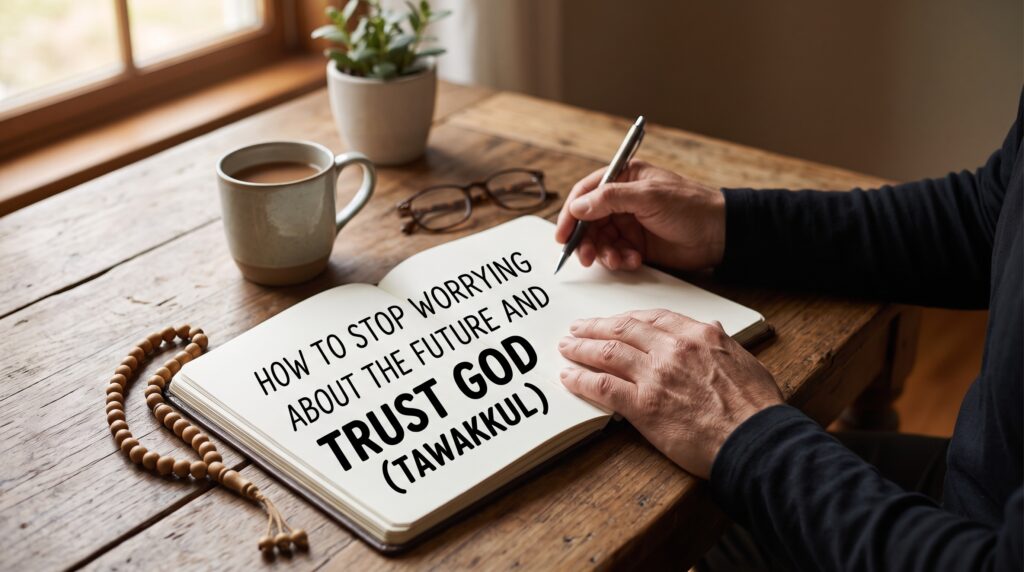
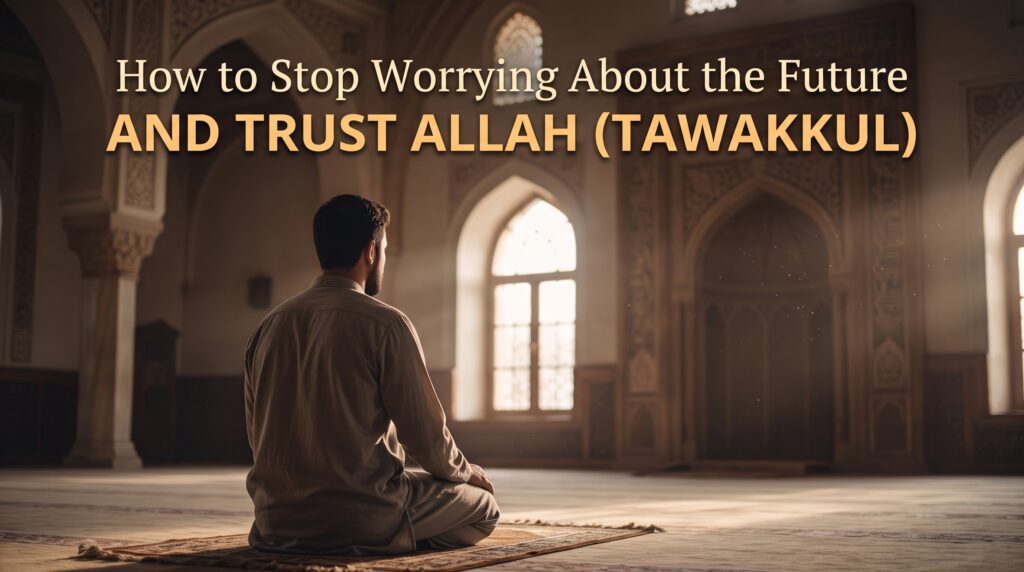
How to Stop Worrying About the Future and Trust Allah: Worrying about tomorrow is one of the most common sources of human stress, yet no human being has the power to see even a single second into the future. In Islam, this uncertainty is not a flaw in life—it is an intentional part of our earthly test. This guide explains the logical wisdom behind a hidden future, clarifies the true meaning of Tawakkul (combining sincere effort with complete reliance on Allah), and offers practical daily steps to replace overthinking with lasting inner peace.
Table of Contents
| Section Title | Key Questions Addressed |
|---|---|
| Why Do Humans Worry So Much About the Future? | Why can’t humans predict tomorrow, and why does trying to control every outcome create anxiety? |
| The Divine Wisdom Behind a Hidden Future | If Allah knows everything, why did He keep the future hidden from us? |
| Understanding True Tawakkul: Effort Paired With Trust | Does trusting Allah mean waiting passively, or does it require active planning and work? |
| 5 Practical Steps to Stop Overthinking Tomorrow | What daily habits help calm fear, overcome negative whispers, and build mental peace? |
| Guidance Section: Common Misconceptions About Fate and Tawakkul | What common myths or unapproved practices distort a believer’s trust in Allah? |
| Frequently Asked Questions (FAQs) | How do planning, financial stress, delays, and daily Dua fit into trusting Allah? |
Why Do Humans Worry So Much About the Future?
Human beings are uniquely gifted with memory of the past, awareness of the present, and the ability to think ahead. While planning is healthy, anxiety begins when we demand certainty about things beyond our control.
Logically, no creature can ever predict the future with certainty because every event in the universe is connected through countless chains of cause and effect. Imagine an athlete training for a major race: while jogging, a stray dog suddenly barks, startling him and causing an injury that makes him miss the competition. To have predicted that single moment, someone would have needed to know why the dog barked, what frightened it earlier, the weather patterns behind the thunder that scared it, and millions of other interconnected variables. Only the Creator of the universe sees and manages that entire web of reality.
The Quran reminds us clearly of our human limits and Allah’s complete knowledge:
“Indeed, Allah [alone] has knowledge of the Hour and sends down the rain and knows what is in the wombs. And no soul perceives what it will earn tomorrow, and no soul perceives in what land it will die. Indeed, Allah is Knowing and Acquainted.” — Surah Luqman (31:34)
“And with Him are the keys of the unseen; none knows them except Him. And He knows what is on the land and in the sea. Not a leaf falls, but that He knows it.” — Surah Al-An’am (6:59)
When we accept that tomorrow belongs strictly to Allah, we release the impossible burden of trying to manage the entire universe inside our minds.
The Divine Wisdom Behind a Hidden Future
Have you ever wondered why Allah hid the future from us instead of showing us how our lives will turn out? The answer lies in the very purpose of human existence.
Life on Earth is not designed as a place of final results; it is a temporary, purposeful testing ground where our choices, intentions, and responses are recorded. If you already knew the exact outcome of every struggle, patience would require no strength, sincerity would require no courage, and prayer would lose its humility. What looks like a setback today might protect you from a hidden harm tomorrow, and what looks like an easy gain might carry a difficult trial.
“[He] who created death and life to test you [as to] which of you is best in deed—and He is the Exalted in Might, the Forgiving.” — Surah Al-Mulk (67:2)
“Allah does not burden any soul beyond its capacity.” — Surah Al-Baqarah (2:286)
Because Allah never places a responsibility on you that exceeds your strength, every uncertain situation is an opportunity to respond with integrity, patience, and faith rather than panic.
Understanding True Tawakkul: Effort Paired With Trust
A major reason people feel stuck in worry is that they misunderstand Tawakkul (trust in Allah). True Tawakkul is not passive wishful thinking; it is the balance between doing everything within your human capacity and leaving the final result to the One who controls all affairs.
The universe operates on clear, fair laws established by the Creator: there is no harvest without planting, and no meaningful growth without sincere effort. At the same time, Allah has created everything in pairs—meaning every difficulty carries an opening of relief attached to it.
“And that there is not for man except that [good] for which he strives, and that his effort is going to be seen—then he will be recompensed for it with the fullest recompense.” — Surah An-Najm (53:39–41)
“For indeed, with hardship [will be] ease. Indeed, with hardship [will be] ease.” — Surah Ash-Sharh (94:5–6)
“And whoever relies upon Allah—then He is sufficient for him.” — Surah At-Talaq (65:3)
When you plan wisely, work honestly, and then place the outcome in Allah’s hands, you gain the best of both worlds: productive action today and emotional freedom from tomorrow’s worries.
5 Practical Steps to Stop Overthinking Tomorrow
Overcoming chronic worry requires training both your mindset and your daily routine. Here are five practical principles to ground your heart:
1. Anchor Yourself in the Present Moment
The past has already closed, and the future has not yet arrived. The only time in which you can actually make a choice, correct a mistake, or plant a good seed is right now. Ask yourself: Is there a practical step I can take today? If yes, take it with wisdom. If not, accept the situation patiently and let it go.
2. Recognize the Source of Fear and Panic
Fear of future poverty, failure, or loss is one of the primary tools Shaytan uses to weaken a believer’s confidence and push them toward rash decisions. Yet his influence is nothing more than a whisper—he holds zero authority over a heart anchored in Allah.
“Satan threatens you with poverty and commands you to immorality, while Allah promises you forgiveness from Him and bounty.” — Surah Al-Baqarah (2:268)
“Indeed, there is for him no authority over those who have believed and rely upon their Lord.” — Surah An-Nahl (16:99)
3. Make Dua and Remembrance a Daily Routine
Dua is not a last resort for emergencies; it is a daily conversation with the Creator that steadies scattered thoughts. When you carry your burdens alone, stress multiplies. When you share them with Allah in sincerity, your mind regains clarity.
“Unquestionably, by the remembrance of Allah, hearts are assured.” — Surah Ar-Ra’d (13:28)
4. Protect Your Peace Through Gratitude (Shukr)
Worry focuses entirely on what might go wrong tomorrow, blinding you to what is already working today. Gratitude shifts your focus back to the blessings you currently hold—your health, mind, family, and opportunities—and invites Allah’s continued support.
“And [remember] when your Lord proclaimed, ‘If you are grateful, I will surely increase you [in favor]…'” — Surah Ibrahim (14:7)
5. Live for the Creator, Not External Outcomes
People who live solely for worldly validation or others’ approval live in constant anxiety because circumstances and opinions always shift. When your primary goal is pleasing Allah through honest, ethical actions, your inner peace remains intact regardless of whether an external plan succeeds or changes direction.
Guidance Section: Common Misconceptions About Fate and Tawakkul
Many people struggle with anxiety—or fall into un-Islamic habits—because of misunderstandings about destiny and trust. The table below clarifies common misconceptions using Quranic principles:
| Misconception or Practice | Why It Is Flawed | True Quranic Guidance |
|---|---|---|
| Passive Tawakkul (Waiting without working) | Assuming that trusting Allah means avoiding planning, saving, or putting in effort leads to neglect and avoidable hardship. | Allah commands sincere striving alongside reliance; you are rewarded for your effort while Allah manages the outcome (Surah An-Najm 53:39). |
| Checking horoscopes, palmistry, or fortune-tellers | Trying to reduce anxiety by reading zodiac signs, palms, or predictions relies on guesswork and psychological manipulation. | Knowledge of the unseen belongs strictly to Allah alone, and seeking divination is forbidden (Surah Al-Jinn 72:26; Surah Al-Ma’idah 5:3). |
| “Everything is written, so my choices don’t matter.” | Confusing Allah’s foreknowledge with a lack of free will removes personal responsibility and leads to hopelessness. | Events are within Allah’s knowledge, but your intentions and efforts are freely chosen and recorded for accountability. |
| Relying on lucky charms, objects, or human intermediaries | Believing that rings, stones, symbols, or shrines can secure future luck shifts trust away from the Creator. | True believers ask Allah directly without intermediaries, knowing that He alone is sufficient for His servants (Surah At-Talaq 65:3). |
Frequently Asked Questions (FAQs)
1. What does Tawakkul actually mean in simple words?
Tawakkul means doing your honest best in the present moment with the knowledge, skills, and resources Allah has given you, while trusting His wisdom completely with the final outcome—whether it turns out as you hoped or takes a different path.
2. Is it a lack of faith to feel anxious or plan for the future?
No. Experiencing natural human concern and planning responsibly for your family, health, or finances is wise and encouraged. Anxiety only becomes harmful when fear paralyzes your actions or makes you doubt Allah’s mercy and care.
3. How can I stop overthinking when facing financial or career uncertainty?
Separate what you can control from what you cannot. Update your skills, apply for opportunities, manage your spending wisely, and pray sincerely. Once you have fulfilled your daily effort, remind yourself that sustenance is guaranteed by Allah, not by any single employer or market.
4. Why does Allah test believers with delays and hardships?
Delays and difficulties are not signs that Allah has abandoned you. Rather, they refine your patience, deepen your sincerity, and often redirect you away from paths that would have harmed you in ways you could not see.
5. Does Islam allow astrology or predicting the future to feel prepared?
No. Astrology, horoscopes, tarot cards, and fortune-telling are rejected in Islam because no created being possesses knowledge of the unseen. Relying on such claims distracts the mind from practical reasoning and true trust in Allah.
6. How does daily Dua help calm fear about tomorrow?
Dua shifts the weight of worry off your shoulders. By acknowledging that you are dependent on an All-Knowing, Most Merciful Creator, your nervous system slows down, your thoughts become clearer, and despair is replaced with hope.

 English
 Bengali
 Chinese
 Dutch
 French
 German
 Greek
 Hindi
 Indonesian
 Italian
 Japanese
 Korean
 Marathi
 Latin
 Portuguese
 Russian
 Spanish
 Swahili
 Telugu
 Vietnamese