Content Summary
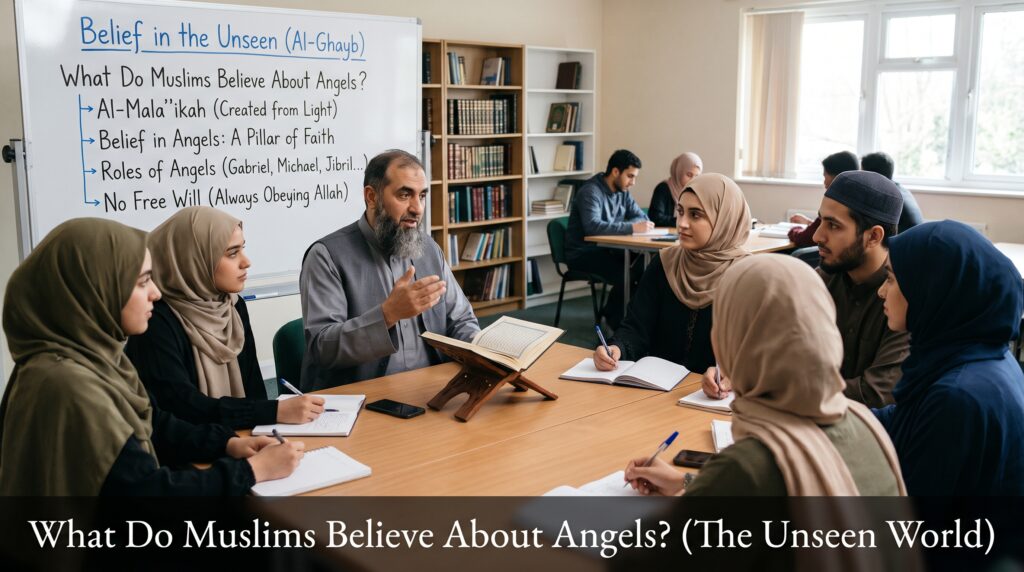
What Do Muslims Believe About Angels: When we look at the universe, our eyes can only see the physical reality—stars, planets, nature, and other living creatures. But is this physical world all that exists? According to the deep insights in the document “Humanity By Quran,” Islam teaches that the universe is far more expansive than what our limited human senses can perceive. A core part of this reality is the “Unseen World,” which includes the existence of angels. But what exactly are angels in Islam? Do they have free will? What is their relationship with human beings? In this post, we will explore the Islamic belief in angels, their crucial role in divine accountability, and why believing in this unseen reality brings deep balance and purpose to human life.
Table of Contents
| Section Title | Key Questions Addressed |
|---|---|
| The Unseen World: Beyond Human Perception | Why does Islam require belief in a world we cannot see? |
| What Are Angels in Islam? Beings of Pure Obedience | How are angels different from human beings? |
| The Role of Angels: Messengers and Guardians | How do angels interact with the physical world and prophets? |
| Accountability: The Recording Angels | Who is writing the record of our daily choices and actions? |
| Why Believing in Angels Matters | How does belief in angels shape a person’s moral character? |
The Unseen World: Beyond Human Perception
Human beings rely heavily on their senses. We trust what we can see, hear, and touch. However, “Humanity By Quran” highlights a profound logical truth: human knowledge and perception are strictly limited to our environment. There are many things we cannot see—like gravity, Wi-Fi signals, or the human mind—yet we know they exist because of their effects.
In Islam, the physical universe is only a fraction of creation. The Creator has also designed an “Unseen World” (Al-Ghayb). True faith begins with the humility to accept that our limited human senses cannot encompass all of reality. The Qur’an establishes this as the very foundation of guidance:
“This is the book about which there is no doubt, a guidance for those conscious of Allah. Who believe in the unseen, establish prayer, and spend out of what We have provided them.” (Surah Al-Baqarah 2:2-3)
Believing in the unseen—which includes the Creator, the Day of Judgment, and the Angels—protects the human mind from arrogance. It reminds us that there is a higher, perfect system operating behind the scenes of our daily lives.
What Are Angels in Islam? Beings of Pure Obedience
To understand angels (Mala’ikah) in Islam, we must contrast them with human beings. Humans were created with a physical body, desires, and most importantly, free will. We have the choice to obey or disobey the Creator.
Angels, on the other hand, are entirely different. They are created from light. They do not possess physical human needs like hunger, thirst, or fatigue. Most importantly, angels do not have free will in the way humans do. They are beings of pure, flawless obedience. They never disobey the Creator’s commands and are constantly engaged in carrying out the precise duties assigned to them in the universe.
Because they lack the capacity to sin, there is no concept of a “fallen angel” in Islam. (Satan, or Shaytan, is not an angel in Islamic theology; he is a Jinn, a different creation made of smokeless fire who possesses free will and chose arrogance). Angels are pure, honorable servants of the One Unseen Creator.
The Role of Angels: Messengers and Guardians
Angels are not passive beings; they are the active implementers of the Creator’s will throughout the universe. They manage the natural forces, protect individuals, and serve as the essential link between the Unseen Creator and the physical world.
One of their most critical roles in human history was delivering divine guidance. As noted in “Humanity By Quran,” the Creator sent guidance by angels to chosen individuals (Prophets) to guide humans. The Angel Jibril (Gabriel) is revered as the Chief of the Angels, entrusted with the monumental task of delivering the words of the Creator—including the Qur’an—to the Prophet Muhammad (peace be upon him) and the earlier scriptures to previous prophets.
They serve as a flawless, incorruptible channel of truth, ensuring that the divine message reaches humanity exactly as the Creator intended.
Accountability: The Recording Angels
Perhaps the most practical and sobering reality of angels in the daily life of a human being is their role in accountability. “Humanity By Quran” emphasizes that life on Earth is a highly organized testing ground. Every single choice, response, and spoken word is being recorded for the Day of Judgment.
This recording is not metaphorical; it is an active, literal process carried out by assigned angels. Every human being is accompanied by unseen observing angels who document their deeds with absolute precision and perfect justice.
“Not a word does he utter but that there is an observer near him ready [to record].” (Surah Qaf 50:18)
Understanding this unseen reality completely transforms a person’s behavior. When you truly internalize that noble angels are witnessing and recording your actions—even when you are entirely alone in a dark room—you develop profound self-control. This belief in recording angels is the ultimate deterrent against hidden corruption, backbiting, and injustice. It forces a human being to align their private life with their public morality.
Why Believing in Angels Matters
Believing in angels is not an optional part of Islam; it is a mandatory pillar of faith. The Qur’an makes it clear that true righteousness is deeply tied to accepting this unseen reality.
“Righteousness is not that you turn your faces toward the east or the west, but true righteousness is in one who believes in Allah, the Last Day, the angels, the Book, and the prophets…” (Surah Al-Baqarah 2:177)
Why is it so crucial? Because rejecting the existence of angels means rejecting the delivery system of the Qur’an itself. If you do not believe in the angelic messenger (Jibril), you cannot logically trust the message he delivered.
Furthermore, believing in angels reminds us that we are never truly alone. The universe is teeming with pure, obedient servants of Allah who bring peace, record justice, and maintain the flawless order of the cosmos. It shifts the human perspective from a lonely, materialistic worldview to one filled with divine purpose, ultimate accountability, and awe for the Creator’s magnificent design.
Guidance Section
| Topic / Concept | Common Misconception or Ignorance | The Practical Truth (Based on Quranic Guidance) |
|---|---|---|
| Nature of Angels | Angels have free will, can make mistakes, or can rebel against God (the concept of “fallen angels”). | Angels are beings of light created with absolute obedience. They have no free will to disobey the Creator. Satan (Shaytan) is a Jinn with free will, not an angel. |
| The Unseen World | If science cannot prove the physical existence of angels, they must be mythical creatures. | Human senses and science are limited to the physical environment. The Qur’an logically invites us to believe in the Unseen, as the physical world is only a fraction of reality. |
| Hidden Actions | What I do in private, when no other human is watching, has no consequences and remains a secret forever. | You are never truly unseen. Recording angels are always present, meticulously documenting every word and action for ultimate justice on the Day of Accountability. |
Disclaimer
The insights shared in this blog post are intended for educational and reflective purposes, drawing upon the concepts from the provided knowledge files and Islamic teachings. They aim to promote harmony, logical thinking, and moral responsibility. Readers are encouraged to seek knowledge, reflect upon nature, and consult qualified scholars for deeper theological studies.
A Sincere Invitation
True understanding comes from direct reflection and an open heart. We warmly invite you to read the Holy Quran at least once in your lifetime, in a language you fully understand. Let your own mind observe the wisdom, logic, and profound peace it offers to humanity.
Frequently Asked Questions (FAQs)
1. What are angels made of in Islam? In Islamic theology, angels are created from pure light (Nur). This distinguishes them from human beings, who are created from clay/earth, and the Jinn (like Satan), who are created from smokeless fire.
2. Do angels have free will like humans? No. Humans and Jinn were given the unique gift of free will, meaning they can choose to obey or disobey. Angels do not have free will; they are inherently programmed to perfectly obey and worship the Creator without hesitation or fatigue.
3. Who is the most important angel in Islam? The Angel Jibril (Gabriel) is considered the chief of the angels. His specific and monumental duty was to serve as the holy messenger, delivering the Creator’s revelations and scriptures to the chosen human prophets throughout history.
4. How do angels affect my daily life? Every human being is accompanied by recording angels who document every single word and deed. This reality serves as a constant reminder to practice ethical communication, honesty, and justice, knowing that our “unseen” actions are being perfectly recorded for the Day of Judgment.
5. Can humans become angels when they die? No. This is a common cultural myth, but it has no basis in Islam. Humans and angels are two completely separate and distinct creations. A human soul remains a human soul after death, awaiting the Day of Judgment based on the record compiled by the angels.