Content Summary
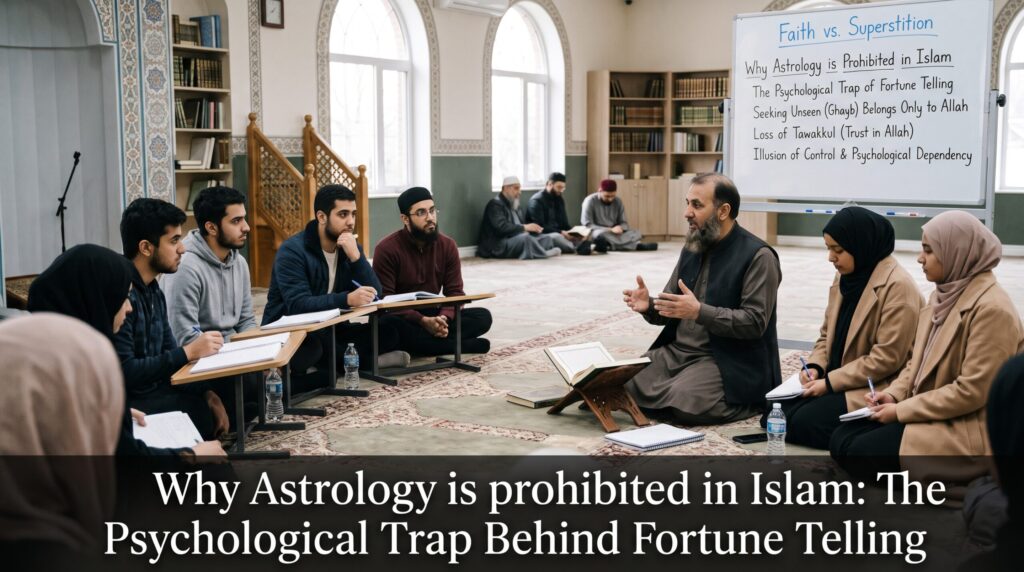
Why Astrology is Prohibited in Islam: Human beings have an innate desire to feel secure about what lies ahead. This deep-rooted anxiety about the unknown often drives people to seek answers through astrology, horoscopes, palmistry, and fortune-telling. While these practices might seem like harmless entertainment or comforting guidance, they actually pull humanity away from logic, personal responsibility, and true faith. According to the profound insights found in the document “Humanity By Quran,” no creature has the power to predict the future. In this post, we will explore why astrology is strictly prohibited in Islam, how fortune-telling operates as a clever psychological trap, and why embracing the hidden nature of the future is essential for a peaceful and purposeful life.
Table of Contents
| Section Title | Key Questions Addressed |
|---|---|
| The Limits of Human Knowledge | Why is it impossible for any human being to predict the future? |
| The Chain of Unseen Causes | Why does forecasting the future require divine, infinite knowledge? |
| The Psychological Trap of Fortune Telling | How do astrologers and horoscopes actually manipulate the mind? |
| Why Astrology is Prohibited in Islam | What does the Qur’an say about seeking knowledge of the unseen? |
| The Beauty of the Hidden Future | Why is not knowing what happens tomorrow actually a divine blessing? |
The Limits of Human Knowledge
As human beings, our knowledge is entirely dependent on our environment and our senses. We learn through observation, experience, and reasoning. Because our experiences are limited to the present and the past, our ability to forecast the future is also strictly limited.
Science can estimate possibilities—like predicting tomorrow’s weather based on wind patterns or calculating probabilities—but it can never guarantee exact outcomes. Why? Because science relies on the physical data available in the present moment, which is always incomplete.
“Humanity By Quran” provides a brilliant, logical example: Imagine a man who has trained hard for a race. While he is running, a dog suddenly barks, startling him. The man falls, injures his leg, and misses his highly anticipated competition. If the man had known the dog was going to bark, he could have avoided the accident—but he couldn’t have known. Perhaps the dog barked out of fear because it recently experienced a lightning strike. To predict this man’s exact future, a fortune-teller would need to know the entire history of the dog, the weather patterns that caused the lightning, and countless other interconnected events. This level of knowledge is impossible for any created being.
The Chain of Unseen Causes
Everything in the universe is linked through infinite chains of cause and effect. A single event is the result of millions of tiny, unseen variables interacting at the exact same moment. No creature can fully know or control these variables because no creature can step outside the limits of the environment in which they live.
To predict the future perfectly, someone would need complete knowledge of everything in the universe, complete control over every atom, and infinite time to calculate every possible outcome. These attributes belong solely to the One Unseen Creator.
The Qur’an explicitly states that certainty about the future rests only with Allah:
“And with Him are the keys of the unseen; none knows them except Him. And He knows what is on the land and in the sea. Not a leaf falls, but that He knows it. And no grain is there within the darknesses of the earth, and no moist or dry [thing], but that it is [written] in a clear record.” (Surah Al-An’am 6:59)
“….No soul knows what it will earn tomorrow, and no soul knows in what land it will die….” (Surah Luqman 31:34)
Therefore, any human being who claims to know the unseen future is either deeply misguided or intentionally deceiving others.
The Psychological Trap of Fortune Telling
If fortune-telling is impossible, why do so many people believe in astrology and horoscopes? The answer lies in human psychology.
“Humanity By Quran” reveals that future prediction operates almost entirely as a psychological influence rather than genuine foresight. When you visit a palmist or read a horoscope, the predictor provides broad, generalized statements or strategic claims based on basic human desires and fears.
Once you hear this prediction, it shapes your mindset. You begin to unconsciously adjust your behavior, decisions, and focus to align with what you were told. If the horoscope says, “You will find a financial opportunity today,” you will actively look for one. When that success eventually occurs through your own effort and awareness, you wrongly attribute it to the stars or the fortune-teller.
This is a dangerous psychological trap. It strips people of their logic and their personal responsibility. Instead of relying on their own hard work, planning, and trust in the Creator, they become emotionally dependent on false predictions. It reinforces superstition and motivates others to follow an illusion.
Why Astrology is Prohibited in Islam
Because it contradicts logic, relies on deception, and destroys trust in the Creator, Islam strictly prohibits all forms of fortune-telling, divination, palmistry, and astrology.
When a person relies on the stars or a fortune-teller to guide their life decisions, they are committing a grave injustice to their own intellect and their faith. They are turning their trust (Tawakkul) away from the Creator—the only One who actually controls destiny—and placing it into the hands of powerless planets or manipulative individuals.
“…Forbidden are divination, fortune-telling, and practices that mislead people away from Allah’s guidance….” (Surah Al-Ma’idah 5:3)
“(He Alone is) the Knower of the unseen, and He does not disclose His unseen to anyone, except to a messenger whom He has chosen….” (Surah Al-Jinn 72:26-27)
Islam teaches that humanity must focus on the present reality. We are commanded to use our reason, observe the world, plan our actions responsibly, and place our ultimate reliance solely on Allah. Seeking certainty in the unseen through unverified, human-made methods is a deviation from the pure religion of nature.
The Beauty of the Hidden Future
While not knowing the future can sometimes feel frightening, it is actually one of the greatest blessings of human life. In fact, it is the very feature that makes our existence meaningful.
If we knew the exact outcome of every choice we made, free will would not truly exist. We would be acting out a pre-written script without any real effort or sincerity. Because the future is hidden, every decision you make today—choosing to be honest, working hard through a struggle, or showing patience during a hardship—carries profound moral weight.
The hidden future forces us to live in the present. It compels us to trust the Creator’s wisdom, seek His guidance through prayer (Dua), and continuously strive to improve ourselves. The test of life is not about knowing what happens tomorrow; it is about how ethically and sincerely we respond to the situations we face today.
Guidance Section
| Topic / Concept | Common Misconception or Ignorance | The Practical Truth (Based on Quranic Guidance) |
|---|---|---|
| Horoscopes and Astrology | Reading horoscopes is just harmless fun and gives me good advice on how to handle my week. | Astrology relies on psychological manipulation. It is strictly prohibited in Islam because it misleads people away from logic, personal effort, and reliance on the Creator. |
| Predicting the Future | Some people have a special “gift” or spiritual sight that allows them to see what will happen tomorrow. | No created being knows the unseen future. Infinite chains of cause and effect are known only to Allah. Claims of fortune-telling are based on guesswork and deception. |
| Fear of the Unknown | I need to know what the future holds so I can protect myself and find peace of mind. | True peace comes from trusting the Creator (Tawakkul) and focusing on present actions. The future is intentionally hidden so that our choices and free will form a meaningful moral test. |
Disclaimer
The insights shared in this blog post are intended for educational and reflective purposes, drawing upon the concepts from the provided knowledge files and Islamic teachings. They aim to promote harmony, logical thinking, and moral responsibility. Readers are encouraged to seek knowledge, reflect upon nature, and consult qualified scholars for deeper theological studies.
A Sincere Invitation
True understanding comes from direct reflection and an open heart. We warmly invite you to read the Holy Quran at least once in your lifetime, in a language you fully understand. Let your own mind observe the wisdom, logic, and profound peace it offers to humanity.
Frequently Asked Questions (FAQs)
1. Why is astrology prohibited in Islam? Astrology is prohibited because it claims knowledge of the unseen future, which belongs exclusively to Allah. It relies on guesswork and psychological manipulation, drawing people away from logic, personal responsibility, and pure trust in the Creator.
2. Can scientists or astrologers predict the future? Science can estimate possibilities (like weather forecasting) based on current physical data, but it cannot guarantee exact outcomes. Astrologers cannot predict the future at all; they use broad psychological statements to manipulate a person’s behavior and mindset.
3. What does “Humanity By Quran” say about fortune-telling? It explains that fortune-telling is a psychological trap. A predictor makes a broad claim, the listener unconsciously adjusts their behavior to fulfill it, and when success happens through their own effort, they falsely credit the prediction instead of their hard work.
4. Why doesn’t Allah reveal the future to us? If humans knew the exact outcome of every event, our free will would be compromised, and life would no longer be a meaningful test. The hidden nature of the future ensures that our daily choices, patience, and faith remain sincere.
5. How should a Muslim handle anxiety about the future? Instead of turning to horoscopes or fortune-tellers, a Muslim is encouraged to focus on the present moment, make responsible plans, and place their complete trust (Tawakkul) in Allah through prayer (Dua), knowing that the Creator is the best of planners.