Content Summary
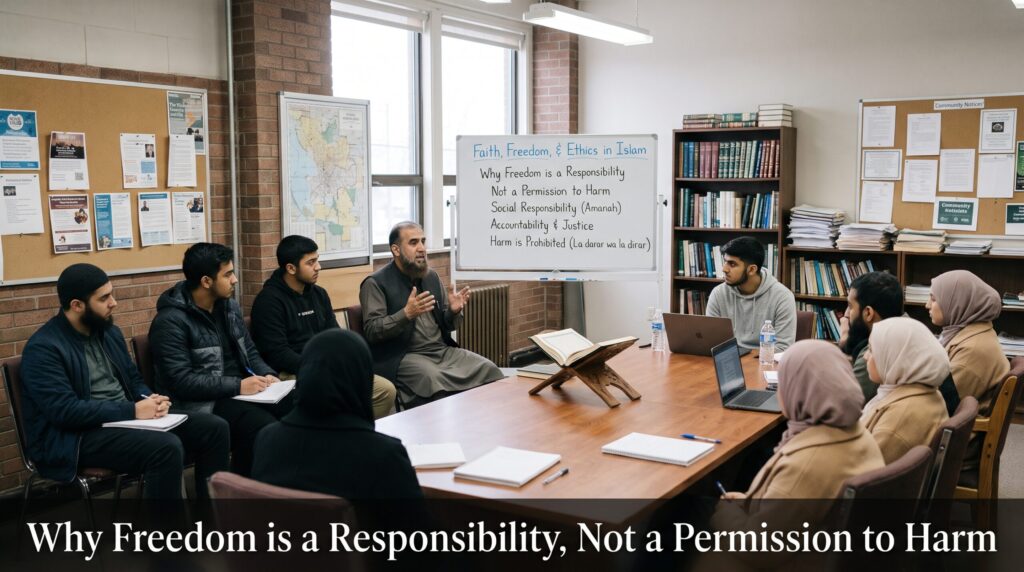
Why Freedom Is a Responsibility: In the modern world, the concept of “freedom” is often celebrated as the ultimate goal of human existence. It is frequently defined as the absolute right to do whatever one desires, whenever one wants, as long as it satisfies personal cravings. However, when we examine this definition through the lens of logic, social stability, and divine wisdom, a critical flaw emerges. Absolute freedom without boundaries quickly turns into oppression and chaos. According to the profound insights found in the document “Humanity By Quran,” freedom in Islam is not a license to follow blind desires; it is a sacred responsibility. In this post, we will explore why true freedom means becoming a source of safety for others, how accountability balances our choices, and why living by divine principles protects society from the harm of unchecked human ego.
Table of Contents
| Section Title | Key Questions Addressed |
|---|---|
| The Modern Illusion of Absolute Freedom | Does doing whatever we want truly make us free, or does it make us slaves to our desires? |
| Freedom as a Divine Trust | How does Islam define the gift of free will and human choice? |
| Being a Source of Safety: The Mark of a Free Soul | What does it mean to be a truly free and noble person in society? |
| The Boundaries of Freedom: Protecting Humanity | Why are divine laws necessary to regulate our freedom? |
| Accountability: The Ultimate Balance | How does the Day of Judgment ensure our freedom is used justly? |
The Modern Illusion of Absolute Freedom
Today, society often promotes a version of freedom that is entirely self-centered. The prevailing message is that an individual should be free from all restrictions, moral codes, and religious boundaries in order to find true happiness.
However, when people live solely to satisfy their own egos, wealth, or physical cravings, they do not become free; they become slaves to their desires. “Humanity By Quran” points out that living only for oneself brings temporary pleasure but often results in long-term emptiness, injustice, and guilt. When everyone in a society exercises “absolute freedom” without a shared moral compass, the strong inevitably exploit the weak, and society fractures.
“Have you seen the one who takes his desires as his god? Allah has left him astray knowingly and sealed his hearing and his heart…” (Surah Al-Jathiyah 45:23)
True freedom is not the absence of rules; it is the presence of justice. It is the ability to rise above basic animal instincts and make conscious, moral choices that benefit both the individual and humanity.
Freedom as a Divine Trust
Unlike animals, which operate on pre-programmed survival instincts, human beings were created with a unique and powerful gift: free will. We have the ability to choose our words, our actions, and our beliefs.
However, as highlighted in “Humanity by Quran,” this freedom is a massive divine trust. Because we have the power to choose, we also have the power to cause immense harm or immense good. The Creator gave us free will so we could act recklessly, but so our choice to do good, to seek truth, and to be just would carry actual moral weight.
Life is a well-organized testing ground. The freedom we possess is the very mechanism of this test. We are free to choose our path, but we are not free from the consequences of those choices. Recognizing this trust shifts our perspective: freedom is no longer about “what can I get away with?” but rather “how can I use my choices to fulfill my purpose?”
Being a Source of Safety: The Mark of a Free Soul
What does a truly successful, free human being look like? According to the practical wisdom in “Humanity by Quran,” a meaningful life is measured by how safe others feel around you.
Freedom is the responsibility to be a source of safety and value. A noble person does not use their freedom to manipulate, backbite, or cheat. When you are truly free, people’s minds, lives, dignity, wealth, health, and futures are safe from your tongue and your hands.
“…[thus] you do no wrong, nor are you wronged.” (Surah Al-Baqarah 2:279)
“The recompense of an injury is an injury equal to it. But whoever forgives and makes peace, his reward is with Allah…” (Surah Ash-Shura 42:40)
Your presence should bring peace, not fear. Your words should heal, not wound. If your expression of “freedom” causes emotional harm, damages someone’s reputation, or creates financial injustice, you have crossed the line from freedom into oppression. True liberation is found in mastering your own ego so that you can protect others.
The Boundaries of Freedom: Protecting Humanity
To ensure that one person’s freedom does not destroy another person’s safety, boundaries are essential. This is why divine law exists. Religion is not a set of chains designed to hold humanity back; it is a system of social ethics and justice designed to keep society functioning in a balanced way.
For example, Islam gives us the freedom of speech but places a strict boundary against mockery, backbiting, and spreading fake news.
“…And speak to people good words…” (Surah Al-Baqarah 2:83)
Islam gives us the freedom to earn wealth but places a strict boundary against interest, fraud, and exploitation. These boundaries do not restrict human progress; they secure it. By adhering to the natural laws and ethical limits set by the Creator, we ensure that our personal freedom never becomes a weapon against the vulnerable.
Accountability: The Ultimate Balance
The concept of freedom is entirely incomplete without the concept of accountability. If humans are free to do whatever they want, and death brings absolute nothingness, then there is no ultimate justice for the tyrant who abused his freedom, nor is there reward for the righteous person who restricted their own desires to help others.
“Humanity by Quran” emphasizes that accountability is the anchor of a balanced life. Every choice we make using our free will is meticulously recorded.
“Whoever does an atom’s weight of good will see it, and whoever does an atom’s weight of evil will see it.” (Surah Az-Zalzalah 99:7-8)
When a person internalizes that they will stand before the One Unseen Creator to answer for how they used their freedom, their behavior transforms. The fear of accountability and the hope for divine mercy discipline the soul. It ensures that we use our freedom responsibly, making choices that build a peaceful world today and secure an eternal reward tomorrow.
Guidance Section
| Topic / Concept | Common Misconception or Ignorance | The Practical Truth (Based on Quranic Guidance) |
|---|---|---|
| The Definition of Freedom | Freedom means I have the absolute right to do whatever my heart desires without any restrictions. | True freedom is a responsibility. Following blind desires makes you a slave to your ego. Freedom is the ability to make conscious, just choices that align with divine truth. |
| Personal Boundaries | My actions only affect me, so as long as it’s my life, I can live it however I want. | Human actions are interconnected. Your choices act as seeds that impact society. Freedom is not a permission to harm others emotionally, financially, or physically. |
| Religious Laws | Divine laws and religious rules are just outdated restrictions designed to stop people from enjoying life and being free. | Divine laws are practical boundaries designed to protect human dignity, establish justice, and prevent individuals from oppressing one another in the name of “freedom.” |
Disclaimer
The insights shared in this blog post are intended for educational and reflective purposes, drawing upon the concepts from the provided knowledge files and Islamic teachings. They aim to promote harmony, logical thinking, and moral responsibility. Readers are encouraged to seek knowledge, reflect upon nature, and consult qualified scholars for deeper theological studies.
A Sincere Invitation
True understanding comes from direct reflection and an open heart. We warmly invite you to read the Holy Quran at least once in your lifetime, in a language you fully understand. Let your own mind observe the wisdom, logic, and profound peace it offers to humanity.
Frequently Asked Questions (FAQs)
1. How does Islam define true freedom? In Islam, true freedom is liberation from being a slave to human desires, materialism, and societal pressure. It is achieved by submitting to the One Unseen Creator, which brings inner peace, self-discipline, and a profound sense of moral responsibility.
2. Why is freedom considered a responsibility? Because humans possess free will, our choices have real consequences. “Humanity by Quran” teaches that we are responsible for ensuring our actions do not harm others. Freedom is the divine trust to choose justice, kindness, and truth.
3. Does following religious rules take away my freedom? No, it defines and protects it. A society without rules falls into chaos, where the strong oppress the weak. Divine laws are protective boundaries that ensure your freedom does not infringe upon the safety and dignity of someone else.
4. What does it mean to be a “source of safety”? Being a source of safety means that people trust you. It means their dignity, wealth, and emotions are secure from your words and actions. It is the highest ethical standard for a free and responsible human being in Islam.
5. How does the Day of Judgment relate to human freedom? The Day of Judgment is the ultimate balance of free will. Since we are free to make choices in this life, absolute justice demands that we are held accountable for those choices in the afterlife, ensuring that every act of good or harm is perfectly compensated.