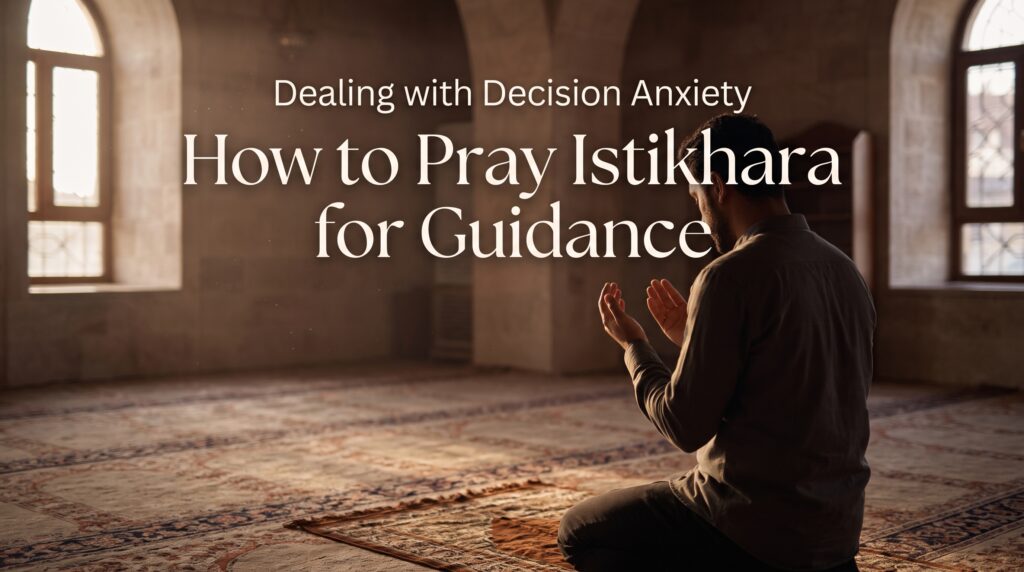
Content Summary
Dealing with Decision Anxiety: Making major life decisions—whether about a career move, marriage, business, or relocation—often triggers intense overthinking and fear of regret. From a logical and spiritual perspective, decision anxiety happens when humans try to control an unseen future with limited knowledge. This guide explains how praying Istikhara (seeking goodness from the One Unseen Creator) bridges rational planning with deep inner peace, freeing your mind from paralysis and empowering you to move forward with clarity.
Table of Contents
| Section Title | Key Questions Addressed |
|---|---|
| Understanding Decision Anxiety Through Human Nature | Why do humans struggle with overthinking, and how is uncertainty tied to our purpose? |
| What Is Istikhara, and How Does It Relieve Overthinking? | What does Istikhara actually mean, and how does relying on the Creator calm the mind? |
| Step-by-Step Guide: How to Pray Istikhara Properly | How do you combine logical research with the authentic method of praying Istikhara? |
| Guidance Section: Common Misconceptions Around Istikhara | Do you need to see a dream, and why should you never ask others to pray Istikhara for you? |
| Frequently Asked Questions (FAQs) | Can you pray in your own language, and how do you recognize Allah’s guidance? |
Understanding Decision Anxiety Through Human Nature
Every human being is gifted with free will, intellect, and the responsibility to make choices. Yet, alongside this freedom, humans are created with limited strength and limited knowledge. You can analyze facts, weigh pros and cons, and learn from past experiences, but you cannot see even a single second into the future.
When you stand at a major crossroads, your mind naturally tries to calculate every possible outcome to protect you from pain or failure. However, because every event in the universe is connected through infinite chains of cause and effect, trying to guarantee a perfect outcome on your own leads straight to mental exhaustion and decision anxiety.
The Quran reminds us of this fundamental human boundary:
“Indeed, Allah [alone] has knowledge of the Hour and sends down the rain and knows what is in the wombs. And no soul perceives what it will earn tomorrow, and no soul perceives in what land it will die. Indeed, Allah is Knowing and Acquainted.” — Surah Luqman (31:34)
Life on earth is intentionally designed as a test of sincerity, effort, and moral choice—not a test of predicting the future. Often, a path that looks attractive on the surface carries hidden harm, while an opportunity we hesitate to take holds immense long-term benefit. As the Quran states:
“…But perhaps you hate a thing, and it is good for you; and perhaps you love a thing, and it is bad for you. And Allah knows, while you know not.” — Surah Al-Baqarah (2:216)
Recognizing that you are not meant to know the unseen is the first step toward releasing the weight of perfectionism.
What Is Istikhara, and How Does It Relieve Overthinking?
In Islam, Istikhara literally means “seeking goodness” or asking the One Unseen Creator to guide you toward what is best for your life and your faith. It is a direct, personal dialogue with Allah—the only One who possesses complete knowledge of what was, what is, and what will be.
“And with Him are the keys of the unseen; none knows them except Him. And He knows what is on the land and in the sea. Not a leaf falls, but that He knows it. And no grain is there within the darknesses of the earth, and no moist or dry [thing], but that it is [written] in a clear record.” — Surah Al-An’am (6:59)
Decision anxiety thrives when you carry the entire burden of an unknown outcome on your own shoulders. Istikhara shifts that burden. Instead of begging for a specific result based on your limited perspective, you ask the All-Knowing Creator to open the door if the choice is good for you or gently close it if it will bring you harm.
When you anchor your heart in sincere prayer and remembrance, worry gives way to emotional stability:
“Those who have believed and whose hearts are assured by the remembrance of Allah. Unquestionably, by the remembrance of Allah, hearts are assured.” — Surah Ar-Ra’d (13:28)
Step-by-Step Guide: How to Pray Istikhara Properly
While the Quran establishes the core principles of direct supplication (Dua), consultation, and reliance on Allah (Tawakkul), authentic Hadith collections preserve the practical method of Istikhara taught by Prophet Muhammad (peace be upon him) to his companions.
Narrated Jabir ibn ‘Abdullah (may Allah be pleased with him): The Prophet (peace be upon him) used to teach us to seek Allah’s counsel (Istikhara) in all matters, just as he used to teach us a Surah from the Quran. — Sahih al-Bukhari, Hadith 1162
Follow these four practical steps to perform Istikhara with clarity and logic:
1. Do Your Research and Consult Wise People (Shura)
Istikhara does not replace rational thinking. Before praying, gather accurate information, evaluate your responsibilities, and seek advice from trustworthy, experienced people. The Quran pairs thoughtful consultation directly with trust in Allah:
“…And consult them in the matter. And when you have decided, then rely upon Allah. Indeed, Allah loves those who rely [upon Him].” — Surah Aal-‘Imran (3:159)
2. Perform Two Voluntary Units of Prayer (Rak’ahs)
In a state of ritual purity (Wudu), perform two voluntary units (Rak’ahs) of prayer outside of the obligatory daily prayers at any permissible time of day or night. Focus your mind on humility and gratitude.
3. Recite the Istikhara Supplication (Dua). Sincerely
After completing the two Rak’ahs, raise your hands and praise Allah with humility. Then recite the authentic supplication of Istikhara (in Arabic or in your own language if you do not yet know the Arabic text), naming your specific decision:
“O Allah, I seek Your guidance [in making a choice] by virtue of Your knowledge, and I seek ability by virtue of Your power, and I ask You of Your great bounty. You have power, I have none. And you know, I know not. You are the Knower of hidden things. O Allah, if in Your knowledge, this matter (mention your specific decision) is good for me in my religion, my livelihood, and my affairs, then ordain it for me, make it easy for me, and bless it for me. And if in Your knowledge it is bad for me in my religion, my livelihood, and my affairs, then turn me away from it, and turn it away from me, and ordain for me the good wherever it may be, and make me content with it.” — Sahih al-Bukhari, Hadith 1162
4. Take Practical Action and Trust the Outcome
After praying, do not sit idle waiting for a mystical sign. Pick the most reasonable option based on your research and take the first practical step forward. If the path is good for you, Allah will facilitate it and bring ease; if it is harmful, obstacles will naturally redirect you.
“…And whoever relies upon Allah—then He is sufficient for him. Indeed, Allah will accomplish His purpose…” — Surah At-Talaq (65:3)
Guidance Section: Common Misconceptions Around Istikhara
Over time, cultural habits and unverified traditions have surrounded Istikhara with confusion. The table below clarifies common misconceptions against pure Quranic principles and authentic Prophetic practice:
| Common Misconception or Innovation | Why It Contradicts Quran & Sunnah | Correct Islamic Guidance |
|---|---|---|
| Waiting for a dream or seeing colors (green/white) | Neither the Quran nor authentic Hadiths require a dream as proof of guidance. Relying on dreams often increases anxiety when none occur. | Guidance appears through real-world facilitation—your heart feels inclined, doors open smoothly, or clear obstacles block a harmful path. |
| Asking a saint, scholar, or elder to “do Istikhara” for you | Islam rejects spiritual intermediaries. Every believer has a direct, personal connection with the Unseen Creator without needing a middleman. | Pray for Istikhara yourself. You may ask others for practical advice (Shura) or general prayers, but the Istikhara prayer is yours alone. |
| Treating Istikhara like fortune-telling or opening random Quran pages | Seeking the unseen through omens, astrology, or random page-flipping is forbidden superstition, not worship. | Istikhara is a humble request for Allah’s blessing and protection—not a tool to predict tomorrow’s hidden events. |
| Praying Istikhara for clearly prohibited (Haram) or mandatory (Fard) acts | Divine law already defines what is obligatory and what is harmful; asking whether to obey or disobey Allah is illogical. | Pray Istikhara only for permissible (Mubah) life choices—such as a job offer, marriage proposal, business venture, or move. |
Frequently Asked Questions (FAQs)
1. Can I pray Istikhara in English or my native language? Yes. While reciting the authentic Arabic words is recommended, Allah understands every language and knows what is in your heart. You can recite the supplication in your own language with full sincerity and clarity.
2. How do I know if my Istikhara has been answered? An answered Istikhara is seen in real life, not necessarily in feelings or dreams. Once you take steps toward the decision, pay attention to how events unfold: if it is good for you, circumstances align smoothly; if it is not, delays or clear roadblocks turn you away from it.
3. How many times should I pray Istikhara for the same decision? You only need to pray it once with sincere focus. However, if you still feel uncertain or have not yet reached a point of action, you may repeat the prayer as many times as you wish while continuing your practical research.
4. Can I make the Istikhara Dua without praying two Rak’ahs? If you are unable to pray voluntary Rak’ahs—such as a woman during her monthly cycle or someone facing an urgent, immediate decision—you can recite the Istikhara supplication directly as a Dua at any time.
5. What if a door closes after I pray Istikhara and I feel disappointed? Remember that you specifically asked Allah to turn the matter away if it held hidden harm for your faith, livelihood, or future. Accepting a closed door with patience and gratitude protects you from unseen regret.
6. Can I pray Istikhara before accepting or declining a marriage proposal? Yes, marriage is one of the most important decisions where Istikhara is strongly encouraged—after you have conducted proper background checks, family consultation, and thoughtful evaluation.

![Why is Life Not Perfect? Understanding the Design of Effort and Growth 5 Why is Life Not Perfect? Understanding the Design of Effort and Growth Content Summary Many people wonder why life is filled with challenges, limitations, and unanswered questions instead of effortless perfection. Through simple logic, observation of human nature, and timeless Quranic wisdom, this article explains that life on Earth was never meant to be a finished paradise. Instead, it is an intentional testing ground where human limitations, uncertainty, and daily effort work together to build character, resilience, cooperation, and lasting spiritual growth. Table of Contents Section Title Key Questions Addressed The Purpose Behind an Imperfect World Why isn't life on Earth effortlessly perfect? What is the true purpose of human existence? How Human Design Sparks Cooperation and Innovation Why were humans created physically weaker than many animals? How do our limitations drive growth? Why Uncertainty and Hardship Are Essential for Growth Why is the future hidden from us? How do struggles and changing circumstances shape human character? The Law of Effort, Intention, and Daily Habits How does sincere striving lead to success? What role do gratitude and repentance play when we make mistakes? Guidance: Common Misconceptions About Life's Struggles What common myths distort how people view hardship, mistakes, and an uncertain future? Frequently Asked Questions (FAQs) Clear answers to common questions about destiny, hardship, effort, and inner peace. The Purpose Behind an Imperfect World Almost every human being asks the same question at some point: If a Wise and Merciful Creator designed this universe, why is life so full of struggle, loss, and imperfection? The answer becomes clear when we look at what Earth is actually designed to be. Life in this world is not a final destination of endless comfort; rather, it is a temporary, purposeful testing ground. If life were completely painless, predictable, and effortless, human beings would never have a reason to think deeply, choose between right and wrong, show compassion, or develop inner strength. In the Quran, the Creator clearly explains the reason behind life and death: "He who created death and life to test you as to which of you is best in deed—and He is the Exalted in Might, the Forgiving." — Surah Al-Mulk (67:2) Imperfection in our surroundings is not a flaw in creation—it is the exact condition required for moral choice. Furthermore, human life is inherently tied to exertion and perseverance from beginning to end: "We have certainly created man in hardship." — Surah Al-Balad (90:4) When we stop expecting this temporary world to function like eternal paradise, our perspective shifts. Challenges stop looking like random accidents and start making sense as opportunities to prove our sincerity, patience, and integrity. How Human Design Sparks Cooperation and Innovation If you observe nature closely, you will notice something remarkable. Almost every animal enters the world equipped with everything it needs to survive in its environment. A cat does not need shoes, woven clothing, shelter-building tools, or cooked meals to endure the weather. Animals rely primarily on built-in physical strength and instinct. Human beings, however, were designed differently. Compared to many creatures, humans enter the world physically vulnerable and require years of care just to stand on their own. The Quran highlights this intentional aspect of our creation: "Allah wants to lighten for you [your difficulties]; and mankind was created weak." — Surah An-Nisa (4:28) Yet alongside this physical vulnerability, humans were given an extraordinary gift that no other earthly creature possesses: "He created man, [and] taught him speech." — Surah Ar-Rahman (55:3-4) Why Weakness Plus Speech Creates Growth This combination—a physically dependent body paired with advanced speech, memory, and reasoning—is the secret behind human civilization: Vulnerability creates interdependence: Because we cannot survive alone in harsh environments, we need families, communities, trade, shelter, and mutual support. Speech enables shared learning: Unlike animals that rely on short-term sensory instinct, humans attach words to experiences, store complex thoughts, write knowledge down, and pass wisdom to future generations. Necessity drives invention: Every tool, home, medicine, and technology exists because human beings had to overcome a limitation through thought and teamwork. If humans had been created physically invincible and completely self-sufficient, there would be no reason to cooperate, invent, teach, or care for one another. Our physical limits are the very sparks that ignite human intelligence and social unity. Why Uncertainty and Hardship Are Essential for Growth Another reason life feels imperfect is that we have zero control over tomorrow. No matter how much technology or data humanity gathers, no person knows what will happen in the next minute. The Quran reminds us of this universal boundary: "No soul knows what it will earn tomorrow, and no soul knows in what land it will die." — Surah Luqman (31:34) This hidden future is essential for real growth. If you already knew the exact outcome of every choice, courage, trust, and patience would lose all meaning. Because tomorrow is unseen, every decision you make today genuinely reflects your character and intentions. Ease and Difficulty Work in Pairs Life moves through changing seasons—youth and old age, health and illness, gain and loss. Both comfort and struggle serve as examinations of the human heart: "Every soul will taste death. And We test you with evil and with good as a trial. And to Us you will all return." — Surah Al-Anbiya (21:35) Crucially, hardship is never meant to crush the human spirit. Every difficulty is measured against our inner capacity, and relief is woven directly alongside struggle: "Allah does not burden any soul beyond its capacity." — Surah Al-Baqarah (2:286) "So surely, with hardship comes ease. Indeed, with hardship comes ease." — Surah Ash-Sharh (94:5-6) When you face an obstacle calmly, your mind learns problem-solving, your ego softens into humility, and your heart discovers resilience you never knew you had. The Law of Effort, Intention, and Daily Habits In a world designed for growth, wishful thinking alone produces nothing. Human progress operates on a clear, fair law of cause and effect: you receive the fruit of what you sincerely work toward. "And that man will have nothing except what he strives for, and his effort will be seen, then he will be fully rewarded for it." — Surah An-Najm (53:39-41) Practical Principles for Navigating an Imperfect Life Focus on Intention Over Outcomes: You cannot always control external results, but you have complete control over why you act. Events test your circumstances, while your intention defines your moral worth. Plant Good Daily Seeds: Every small action is like a seed. Repeated honesty, patience, and kindness grow into strong, rooted character, just as good words bring lasting benefit: "Have you not considered how Allah presents an example: a good word is like a good tree—its root firm and its branches in the sky. It gives its fruit at all times by the permission of its Lord." — Surah Ibrahim (14:24-25) Protect Blessings Through Gratitude: Health, time, intelligence, and opportunities grow when appreciated and used responsibly, while carelessness causes them to fade: "...If you are grateful, I will surely increase you..." — Surah Ibrahim (14:7) Learn From Mistakes Without Despair: Because humans enter the world without innate knowledge and learn step by step, making mistakes is natural. Imperfection does not mean hopelessness; sincere correction turns past errors into future wisdom: "Except for those who repent, believe, and do righteous deeds—for them Allah will replace their bad deeds with good deeds. And Allah is ever Forgiving, Merciful." — Surah Al-Furqan (25:70) Guidance: Common Misconceptions About Life's Struggles When people misunderstand why life is imperfect, they often fall into despair, blame, or unhelpful habits. The table below clarifies common misconceptions using Quranic wisdom and practical logic. Common Misconception / Ignorance Quranic Reality & Logical Truth "Hardship means the Creator is angry with me or has abandoned me." Both ease and hardship are natural tests of character (Surah Al-Anbiya 21:35). Struggles build patience, clarify priorities, and unlock hidden ease (Surah Ash-Sharh 94:5-6). "True success means achieving a problem-free, effortless life on Earth." Earth is a temporary testing ground for effort and moral growth (Surah Al-Mulk 67:2). Complete, effortless perfection belongs only to the eternal Hereafter. "Consulting horoscopes, palmists, or fortune-tellers can remove life's uncertainty." No created being knows tomorrow (Surah Luqman 31:34). Relying on guesswork distracts from practical planning, sincere effort (Surah An-Najm 53:39), and prayerful trust. "If I make repeated mistakes, I am permanently ruined and cannot change." Humans are lifelong learners who naturally stumble. Sincere repentance and corrected action wipe away past stains and transform character (Surah Al-Furqan 25:70). Frequently Asked Questions (FAQs) 1. Why didn't the Creator make human beings physically stronger like other animals? Humans were created physically dependent so they would rely on cooperation, family bonds, and intelligence rather than brute force. Combined with the gift of speech and reasoning, this vulnerability motivated humanity to build communities, invent tools, and share knowledge across generations. 2. If everything is known by the Creator, why does my daily effort still matter? While the Creator has complete knowledge of all things, the future remains hidden from you. Because you do not know tomorrow, your choices, intentions, and efforts today are completely real and voluntary. You are judged by how sincerely you strive within your knowledge and capacity, not by outcomes beyond your control. 3. Does experiencing pain or delay mean I am failing in life? No. Delays, obstacles, and pain are natural parts of human growth—just as muscles only strengthen under resistance. In Quranic wisdom, hardship is always paired with ease and serves to purify your intentions, teach patience, and prepare you for greater responsibility. 4. How should I respond when I feel overwhelmed by life's problems? Start by focusing on the present moment rather than replaying past regrets or worrying about an unknown future. Break the problem into what is within your control, take practical steps with patience, ask the Creator for guidance through sincere prayer (Dua), and trust that no soul is burdened beyond what it can bear. 5. Why do good people also face difficult trials? Trials are not exclusively punishments; they are often instruments of elevation and purification. Even the greatest prophets and most righteous people faced severe hardships so their patience, gratitude, and trust in truth could shine as examples for others. 6. What is the single best mindset for living peacefully in an imperfect world? Live with gratitude for what you have, sincerity in what you do today, kindness toward others, and humility when you make mistakes. When you view every situation—good or difficult—as an opportunity to do what is right, inner peace replaces frustration.](https://islamforeveryone.org/wp-content/uploads/2026/11/Why-is-Life-Not-Perfect-Understanding-the-Design-of-Effort-and-Growth-1024x572.jpg)