Samenvatting van de inhoud
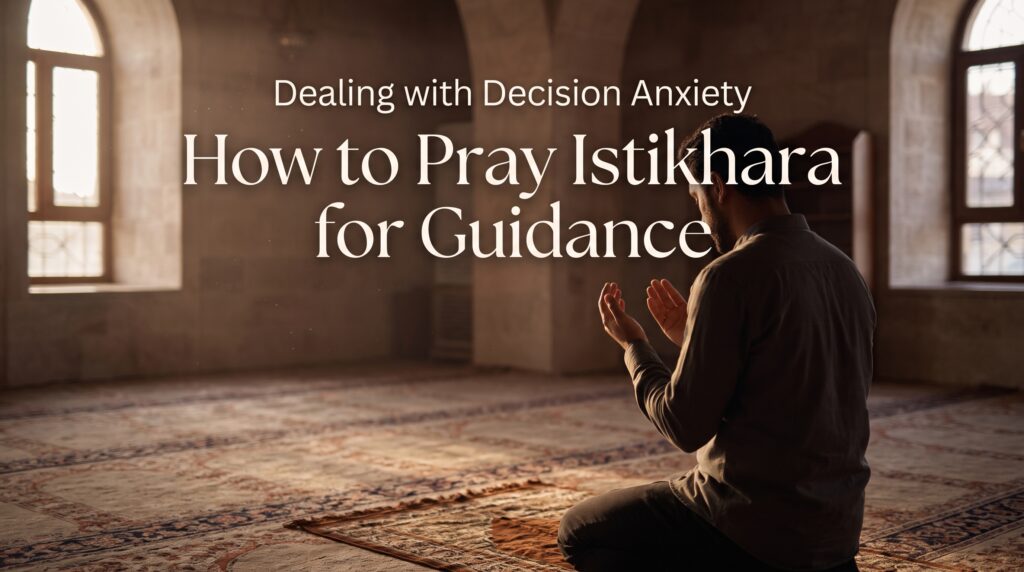
Dealing with Decision Anxiety: Making major life decisions—whether about a career move, marriage, business, or relocation—often triggers intense overthinking and fear of regret. From a logical and spiritual perspective, decision anxiety happens when humans try to control an unseen future with limited knowledge. This guide explains how praying Istikhara (seeking goodness from the Eén onzichtbare Schepper) bridges rational planning with deep inner peace, freeing your mind from paralysis and empowering you to move forward with clarity.
Inhoudsopgave
| Sectietitel | Belangrijke vragen beantwoord |
|---|---|
| Understanding Decision Anxiety Through Human Nature | Why do humans struggle with overthinking, and how is uncertainty tied to our purpose? |
| What Is Istikhara, and How Does It Relieve Overthinking? | What does Istikhara actually mean, and how does relying on the Creator calm the mind? |
| Step-by-Step Guide: How to Pray Istikhara Properly | How do you combine logical research with the authentic method of praying Istikhara? |
| Guidance Section: Common Misconceptions Around Istikhara | Do you need to see a dream, and why should you never ask others to pray Istikhara for you? |
| Veelgestelde vragen (FAQ's) | Can you pray in your own language, and how do you recognize Allah’s guidance? |
Understanding Decision Anxiety Through Human Nature
Every human being is gifted with free will, intellect, and the responsibility to make choices. Yet, alongside this freedom, humans are created with limited strength and limited knowledge. You can analyze facts, weigh pros and cons, and learn from past experiences, but you cannot see even a single second into the future.
When you stand at a major crossroads, your mind naturally tries to calculate every possible outcome to protect you from pain or failure. However, because every event in the universe is connected through infinite chains of cause and effect, trying to guarantee a perfect outcome on your own leads straight to mental exhaustion and decision anxiety.
The Quran reminds us of this fundamental human boundary:
“Inderdaad, Allah [alleen] heeft kennis van het Uur en laat de regen neerdalen en weet wat zich in de baarmoeder bevindt. En geen enkele ziel beseft wat hij morgen zal verdienen, en geen enkele ziel beseft in welk land hij zal sterven. Voorwaar, Allah is Alwetend en Alwetend.” — Soera Loekman (31:34)
Life on earth is intentionally designed as a test of sincerity, effort, and moral choice—not a test of predicting the future. Often, a path that looks attractive on the surface carries hidden harm, while an opportunity we hesitate to take holds immense long-term benefit. As the Quran states:
“…But perhaps you hate a thing, and it is good for you; and perhaps you love a thing, and it is bad for you. And Allah knows, while you know not.” — Surah Al-Baqarah (2:216)
Recognizing that you are not meant to know the unseen is the first step toward releasing the weight of perfectionism.
What Is Istikhara, and How Does It Relieve Overthinking?
In Islam, Istikhara literally means “seeking goodness” or asking the One Unseen Creator to guide you toward what is best for your life and your faith. It is a direct, personal dialogue with Allah—the only One who possesses complete knowledge of what was, what is, and what will be.
“And with Him are the keys of the unseen; none knows them except Him. And He knows what is on the land and in the sea. Not a leaf falls, but that He knows it. And no grain is there within the darknesses of the earth, and no moist or dry [thing], but that it is [written] in a clear record.” — Soera Al-An’am (6:59)
Decision anxiety thrives when you carry the entire burden of an unknown outcome on your own shoulders. Istikhara shifts that burden. Instead of begging for a specific result based on your limited perspective, you ask the All-Knowing Creator to open the door if the choice is good for you or gently close it if it will bring you harm.
When you anchor your heart in sincere prayer and remembrance, worry gives way to emotional stability:
“Those who have believed and whose hearts are assured by the remembrance of Allah. Unquestionably, by the remembrance of Allah, hearts are assured.” — Soera Ar-Ra’d (13:28)
Step-by-Step Guide: How to Pray Istikhara Properly
While the Quran establishes the core principles of direct supplication (Dua), consultation, and reliance on Allah (Tawakkul), authentic Hadith collections preserve the practical method of Istikhara taught by Prophet Muhammad (peace be upon him) to his companions.
Narrated Jabir ibn ‘Abdullah (may Allah be pleased with him): The Prophet (peace be upon him) used to teach us to seek Allah’s counsel (Istikhara) in all matters, just as he used to teach us a Surah from the Quran. — Sahih al-Bukhari, Hadith 1162
Follow these four practical steps to perform Istikhara with clarity and logic:
1. Do Your Research and Consult Wise People (Shura)
Istikhara does not replace rational thinking. Before praying, gather accurate information, evaluate your responsibilities, and seek advice from trustworthy, experienced people. The Quran pairs thoughtful consultation directly with trust in Allah:
“…And consult them in the matter. And when you have decided, then rely upon Allah. Indeed, Allah loves those who rely [upon Him].” — Surah Aal-‘Imran (3:159)
2. Perform Two Voluntary Units of Prayer (Rak’ahs)
In a state of ritual purity (Wudu), perform two voluntary units (Rak’ahs) of prayer outside of the obligatory daily prayers at any permissible time of day or night. Focus your mind on humility and gratitude.
3. Recite the Istikhara Supplication (Dua). Sincerely
After completing the two Rak’ahs, raise your hands and praise Allah with humility. Then recite the authentic supplication of Istikhara (in Arabic or in your own language if you do not yet know the Arabic text), naming your specific decision:
“O Allah, I seek Your guidance [in making a choice] by virtue of Your knowledge, and I seek ability by virtue of Your power, and I ask You of Your great bounty. You have power, I have none. And you know, I know not. You are the Knower of hidden things. O Allah, if in Your knowledge, this matter (mention your specific decision) is good for me in my religion, my livelihood, and my affairs, then ordain it for me, make it easy for me, and bless it for me. And if in Your knowledge it is bad for me in my religion, my livelihood, and my affairs, then turn me away from it, and turn it away from me, and ordain for me the good wherever it may be, and make me content with it.” — Sahih al-Bukhari, Hadith 1162
4. Take Practical Action and Trust the Outcome
After praying, do not sit idle waiting for a mystical sign. Pick the most reasonable option based on your research and take the first practical step forward. If the path is good for you, Allah will facilitate it and bring ease; if it is harmful, obstacles will naturally redirect you.
“…And whoever relies upon Allah—then He is sufficient for him. Indeed, Allah will accomplish His purpose…” — Soera At-Talaq (65:3)
Guidance Section: Common Misconceptions Around Istikhara
Over time, cultural habits and unverified traditions have surrounded Istikhara with confusion. The table below clarifies common misconceptions against pure Quranic principles and authentic Prophetic practice:
| Veel voorkomende misvatting of innovatie | Why It Contradicts Quran & Sunnah | Correct Islamic Guidance |
|---|---|---|
| Waiting for a dream or seeing colors (green/white) | Neither the Quran nor authentic Hadiths require a dream as proof of guidance. Relying on dreams often increases anxiety when none occur. | Guidance appears through real-world facilitation—your heart feels inclined, doors open smoothly, or clear obstacles block a harmful path. |
| Asking a saint, scholar, or elder to “do Istikhara” for you | Islam rejects spiritual intermediaries. Every believer has a direct, personal connection with the Unseen Creator without needing a middleman. | Pray for Istikhara yourself. You may ask others for practical advice (Shura) or general prayers, but the Istikhara prayer is yours alone. |
| Treating Istikhara like fortune-telling or opening random Quran pages | Seeking the unseen through omens, astrology, or random page-flipping is forbidden superstition, not worship. | Istikhara is a humble request for Allah’s blessing and protection—not a tool to predict tomorrow’s hidden events. |
| Praying Istikhara for clearly prohibited (Haram) or mandatory (Fard) acts | Divine law already defines what is obligatory and what is harmful; asking whether to obey or disobey Allah is illogical. | Pray Istikhara only for permissible (Mubah) life choices—such as a job offer, marriage proposal, business venture, or move. |
Veelgestelde vragen (FAQ's)
1. Can I pray Istikhara in English or my native language? Yes. While reciting the authentic Arabic words is recommended, Allah understands every language and knows what is in your heart. You can recite the supplication in your own language with full sincerity and clarity.
2. How do I know if my Istikhara has been answered? An answered Istikhara is seen in real life, not necessarily in feelings or dreams. Once you take steps toward the decision, pay attention to how events unfold: if it is good for you, circumstances align smoothly; if it is not, delays or clear roadblocks turn you away from it.
3. How many times should I pray Istikhara for the same decision? You only need to pray it once with sincere focus. However, if you still feel uncertain or have not yet reached a point of action, you may repeat the prayer as many times as you wish while continuing your practical research.
4. Can I make the Istikhara Dua without praying two Rak’ahs? If you are unable to pray voluntary Rak’ahs—such as a woman during her monthly cycle or someone facing an urgent, immediate decision—you can recite the Istikhara supplication directly as a Dua at any time.
5. What if a door closes after I pray Istikhara and I feel disappointed? Remember that you specifically asked Allah to turn the matter away if it held hidden harm for your faith, livelihood, or future. Accepting a closed door with patience and gratitude protects you from unseen regret.
6. Can I pray Istikhara before accepting or declining a marriage proposal? Yes, marriage is one of the most important decisions where Istikhara is strongly encouraged—after you have conducted proper background checks, family consultation, and thoughtful evaluation.

 English
 Bengali
 Chinese
 Dutch
 French
 German
 Greek
 Hindi
 Indonesian
 Italian
 Japanese
 Korean
 Marathi
 Latin
 Portuguese
 Russian
 Spanish
 Swahili
 Telugu
 Vietnamese