Content Summary
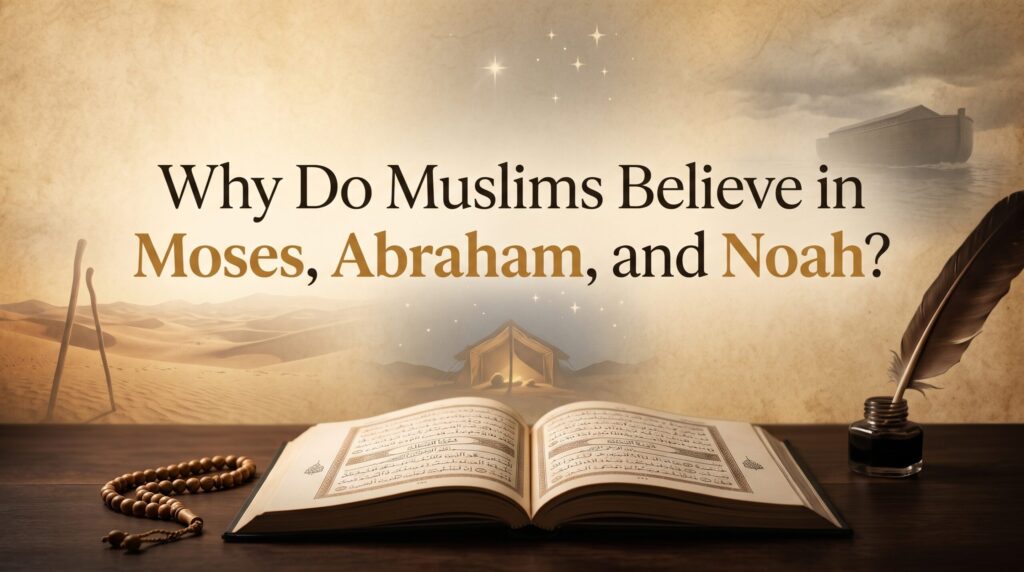
Why Do Muslims Believe in Moses, Abraham, and Noah? Many people view world religions as isolated or opposing traditions. However, in Islam, belief in prophets like Noah (Nuh), Abraham (Ibrahim), and Moses (Musa) is not optional—it is a core article of faith. This article explains the logical and divine connection between these great figures and the Islamic message. By exploring the concept of one united human family, the shared call to pure monotheism (Tawhid), and the human need for moral guidance, we reveal why honoring every true prophet is fundamental to a balanced, purposeful life.
Table of Contents
| Title | Key Questions Addressed |
|---|---|
| One Creator, One Human Family, One Message | Did Islam begin with Prophet Muhammad? Why did humanity diverge into different groups? |
| The Unbroken Chain: Noah, Abraham, and Moses | What role did Noah, Abraham, and Moses play in human history and Islamic theology? |
| Why Rejecting One Prophet Means Rejecting All | Can a Muslim accept Muhammad while denying Moses or Abraham? What does the Quran command? |
| Practical Lessons from the Prophets for Modern Life | How do their struggles help us navigate today’s moral, personal, and social challenges? |
| Guidance Section: Common Misconceptions | What are the major misunderstandings regarding Muslims and earlier prophets? |
| Frequently Asked Questions (FAQs) | Quick, clear answers to common questions about Islam and earlier messengers. |
One Creator, One Human Family, One Message
To understand why Muslims believe in Noah, Abraham, and Moses, we must first look at human origins and the purpose of life on Earth. Humans were created with a delicate balance: a physically weak body that depends on shelter, clothing, and cooperation, alongside the unique gift of speech and intellect. This design makes human life an intentional test of free will, moral choices, and accountability.
In the beginning, humanity was not fragmented into warring factions or contradictory beliefs. The Creator formed humanity as a single community united under one fundamental truth: acknowledging the One Unseen Creator and living justly.
“Mankind was [of] one religion [community]. And Allah sent the prophets as bringers of good tidings and warners and sent down with them the Book in truth to judge between the people concerning that in which they differed…” — Surah Al-Baqarah (2:213)
As generations multiplied, spread across diverse geographic terrains, and formed distinct cultures, divisions emerged. These divisions did not occur due to a lack of evidence. Rather, they arose because people allowed ego, pride, tribal rivalry, and personal greed to alter the original teachings.
Whenever communities drifted away from natural truth (fitrah), the Creator sent chosen messengers with divine revelation. Their goal was never to invent a new philosophy or build personal followings. It was always to call people back to the same foundation: direct worship of the One Creator without partners or intermediaries, fair social laws, and awareness of the final Day of Accountability.
The Unbroken Chain: Noah, Abraham, and Moses
Islam does not view prophets as competitors. Instead, they are seen as brothers in a continuous line of teachers, each building upon the same universal foundation for the survival and spiritual uplift of humanity.
“The prophets are paternal brothers; their mothers are different, but their religion is one.” — Sahih al-Bukhari (3442)
1. Noah (Nuh): The Archetype of Patience and Renewal
Noah faced a society steeped in corruption, idol worship, and stubborn arrogance. For centuries, he called his people to abandon man-made statues and return to the One True Provider. His mission demonstrates that truth is not measured by popularity or social status. Noah established the standard of unwavering trust in divine wisdom and taught that community survival relies on spiritual purity and ethical integrity.
2. Abraham (Ibrahim): The Father of Pure Monotheism
Abraham is central to Islamic faith. When his people worshipped celestial bodies and carved idols, Abraham used reason, observation, and sound logic to demonstrate that created, changing things cannot be divine. He stood alone against political tyranny and social pressure, submitting his heart fully to the Creator.
The Quran makes it clear that Abraham did not belong to any later sectarian label; he represented the pure, natural orientation toward the Creator:
“Abraham was neither a Jew nor a Christian, but he was one inclining toward truth, a Muslim [submitting to Allah]. And he was not of the polytheists.” — Surah Aal-‘Imran (3:67)
In Islam, the word “Muslim” is not merely an ethnic or historical label—it describes anyone who sincerely submits their will to the One Creator. In that universal sense, Noah, Abraham, and Moses were all Muslims.
3. Moses (Musa): Standing for Justice Against Tyranny
Moses was sent to Pharaoh, one of the most oppressive rulers in history, to rescue the Children of Israel from slavery. Moses was given the Torah (Tawrat), which contained clear moral laws, civil justice, and divine guidance.
Moses’ mission demonstrates that true faith cannot stay silent in the face of tyranny, systemic exploitation, and cruelty. His life is recounted extensively in the Quran to teach believers how to stay humble, courageous, and disciplined during trials.
Why Rejecting One Prophet Means Rejecting All
In Islamic theology, faith is an indivisible whole. A person cannot pick and choose which prophets to accept based on cultural bias or tribal loyalty. To reject Moses, Abraham, or Noah is to reject the very Creator who sent them.
“Say, [O believers], ‘We have believed in Allah and what has been revealed to us and what has been revealed to Abraham and Ishmael and Isaac and Jacob and the descendants and what was given to Moses and Jesus and what was given to the prophets from their Lord. We make no distinction between any of them, and we are Muslims [in submission] to Him.'” — Surah Al-Baqarah (2:136)
The Quran explicitly warns against creating artificial distinctions among the messengers:
“Indeed, those who disbelieve in Allah and His messengers and wish to make a distinction between Allah and His messengers and say, ‘We believe in some and disbelieve in others,’ and wish to adopt a way in between—those are the disbelievers, truly…” — Surah An-Nisa (4:150-151)
Prophet Muhammad did not arrive to invalidate the truth taught by Moses or Abraham. Rather, he came as the final confirmation (Musaddiq) and the Seal of the Prophets (Khatam an-Nabiyyin), delivering the Quran as a preserved criterion to restore and safeguard the pure message of monotheism for all of humanity.
Practical Lessons from the Prophets for Modern Life
The lives of Noah, Abraham, and Moses are not ancient myths; they are practical guides for daily human conduct.
- Logic over Blind Tradition: Abraham taught humanity to question inherited cultural myths and examine the natural world. True faith must align with sound intellect, observation, and natural balance.
- Courage in Ethical Speech: Moses demonstrated that words must be spoken with truth and clarity, even when confronting absolute power. Speech is a divine trust, and using it for justice protects the vulnerable.
- Patience during Solitude: Noah illustrated that holding onto values during widespread moral confusion requires deep inner discipline. Doing what is right does not depend on immediate validation from others.
- Protection of Future Generations: All prophets emphasized safeguarding the family system, training children in accountability, and leaving a legacy of fairness rather than inherited bias.
Guidance Section: Common Misconceptions
| Misconception | Quranic & Logical Reality | Root Cause of Error |
|---|---|---|
| “Islam is a new religion founded in the 7th century by Muhammad.” | Islam (submission to the Creator) is the original way of life revealed to all prophets, beginning with Adam. Muhammad was the final messenger, not the founder of an unprecedented faith. | Confusing the final era of revelation with the origin of the divine message itself. |
| “Muslims worship a different God than the prophets of the Bible.” | Muslims worship the exact same Creator of Noah, Abraham, and Moses—the One Unseen God (Allah), who possesses all power and has no partners, rivals, or children. | Linguistic misunderstandings; Allah is simply the Arabic word for the One True God. |
| “Muslims prefer Muhammad and disregard earlier prophets.” | Believing in Moses, Abraham, Jesus, and Noah is mandatory for every Muslim. Denying any one of them invalidates a Muslim’s faith entirely. | Viewing prophethood as a nationalistic or tribal competition rather than a single divine mission. |
| “Honoring prophets means taking them as intermediaries or divine partners.” | All prophets were human beings chosen to convey divine instruction. Honoring them means following their moral examples, never worshipping them or praying through them. | The historical human tendency to deify righteous leaders or invent holy symbols and mediators. |
Frequently Asked Questions (FAQs)
1. Why do Muslims say “Peace be upon him” after mentioning Moses or Abraham?
Muslims invoke peace and blessings upon all prophets as an expression of deep respect and gratitude for their sacrifices in delivering divine guidance to humanity.
2. Is Moses mentioned in the Quran?
Yes. Moses (Musa) is the most frequently mentioned prophet by name in the Quran (mentioned over 130 times). His story provides extensive lessons on leadership, humility, reliance on God, and perseverance.
3. How does the Quran view the Torah given to Moses?
The Quran explicitly acknowledges that the original Torah (Tawrat) revealed to Moses was a divine scripture filled with guidance and light. Muslims respect its original revelation while relying on the Quran as the final, fully preserved criterion.
4. What is the Islamic view of the Ark of Noah?
The Quran confirms that Noah built the Ark under divine instruction to preserve the believers and pairs of living creatures from the flood, serving as an enduring sign of divine mercy and judgment.
5. Why was Prophet Muhammad needed if earlier prophets were already sent?
Earlier messages were primarily sent to specific nations or historical eras, and over centuries, their texts suffered alterations, translations, or loss. The final messenger was sent with a universally preserved book—the Quran—to provide a permanent, uncorrupted standard for all remaining generations.
6. Can a person be a Muslim without believing in Abraham?
No. Belief in Abraham, his pure monotheism, and his role in building the Kaaba alongside his son Ishmael is an essential article of Islamic faith.
 English
 Bengali
 Chinese
 Dutch
 French
 German
 Greek
 Hindi
 Indonesian
 Italian
 Japanese
 Korean
 Marathi
 Latin
 Portuguese
 Russian
 Spanish
 Swahili
 Telugu
 Vietnamese