Content Summary
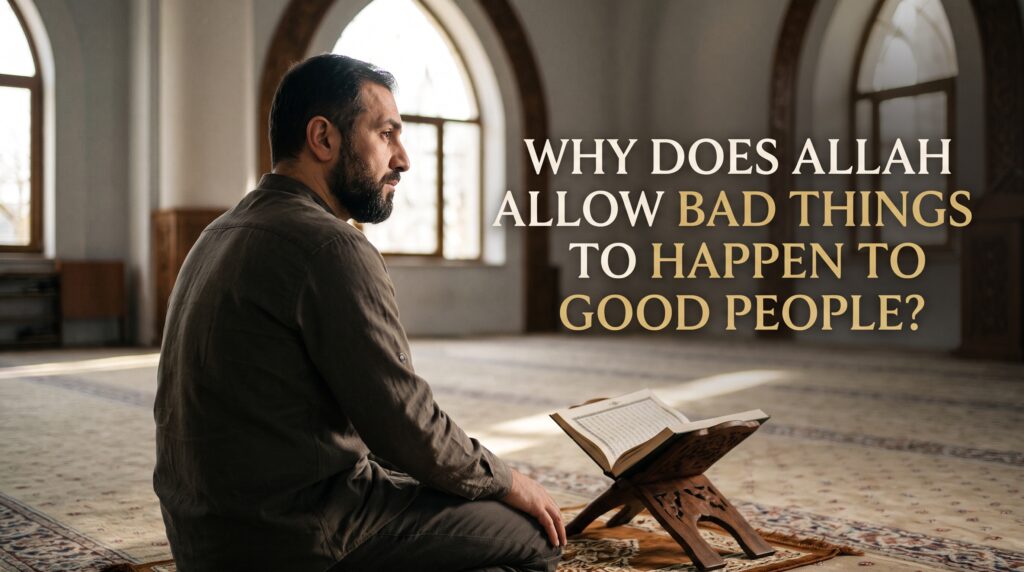
Why Does Allah Allow Bad Things to Happen to Good People?: Seeing kind, honest, and faithful people face sickness, loss, or injustice while wrongdoers seem to live comfortably is one of life’s hardest questions. From a logical and Quranic perspective, Earth is not designed as a place of final reward—it is a temporary testing ground where free will, human choices, and inner intentions are measured. In this article, we explore how human free will, unseen divine wisdom, paired ease, and the promise of complete justice on the Day of Judgment provide clear, comforting answers to why hardship touches good people.
Table of Contents
| Section Title | Key Questions Addressed |
|---|---|
| 1. Earth Is a Testing Ground, Not Paradise | Why is life filled with trials instead of constant comfort? Is this world meant to be a place of final perfection? |
| 2. How Human Free Will and Social Life Create Hardship | Why doesn’t Allah immediately stop bad people from harming innocent ones? How does free will relate to suffering? |
| 3. Limited Human Vision vs. Allah’s Infinite Wisdom | Can a painful event protect us from unseen harm? Why can’t humans see the full picture behind every hardship? |
| 4. The Purpose of Pain: Intention, Capacity, and Paired Ease | What is Allah actually testing during a crisis? Does Allah ever burden a soul beyond what it can handle? |
| 5. The Day of Judgment: Where Complete Justice Is Established | How will good people be compensated for unfair suffering? Where does true accountability happen? |
| 6. Guidance Section: Common Misconceptions About Suffering | Does hardship mean Allah is angry with you? What false beliefs and practices should believers avoid during difficult times? |
| 7. Practical Ways to Respond When Facing Hardship | How should a believer react to pain and loss in the present moment? What habits bring inner peace during a crisis? |
| 8. Frequently Asked Questions (FAQs) | Clear answers to common questions about suffering, prayer, fate, and Allah’s mercy. |
1. Earth Is a Testing Ground, Not Paradise
To understand why bad things happen to good people, we first need to understand the true purpose of life on Earth. Many people assume that if Allah is merciful and just, good people should live completely free from pain, loss, and struggle. However, the Quran explains that this world is not Paradise—it is a temporary, carefully organized testing ground designed to reveal human character and choices.
Unlike animals that live purely by instinct, human beings were created with intellect, the gift of speech, moral awareness, and free will. We are placed on Earth for a limited time so our actions, words, and inner choices can be recorded. Good people are not exempt from this test; in fact, sincere believers are often tested deeply so their patience, honesty, and trust in Allah can shine through.
“He who created death and life to test you as to which of you is best in deed—and He is the Exalted in Might, the Forgiving.” — Surah Al-Mulk (67:2)
Life is intentionally balanced with both ease and struggle. Comfort tests whether we remain grateful and humble, while hardship tests whether we remain patient, truthful, and reliant on our Creator.
“Every soul will taste death. And we test you with evil and with good as a trial, and to us you will be returned.” — Surah Al-Anbiya (21:35)
2. How Human Free Will and Social Life Create Hardship
A large share of human suffering does not come directly from nature—it comes from the choices of other human beings. Allah created humans physically dependent on one another so we would build families, communities, and societies through cooperation and communication. Because our lives are deeply interconnected, one person’s choice inevitably affects others around them.
During this earthly test, Allah keeps His presence unseen and does not force human beings into obedience. If Allah were to forcefully stop every person from lying, cheating, or harming an innocent neighbor, genuine free will would disappear. Without the real freedom to choose between right and wrong, the test of life would lose its meaning, and no one could fairly be rewarded for choosing goodness.
Instead, Allah grants humans temporary freedom to act while appointing noble watchers to record every word, intention, and deed for final judgment.
“No soul bears the burden of another.” — Surah Al-An’am (6:164)
When an innocent person is harmed by someone else’s injustice, the wrongdoer carries the sin of that oppression, while the patient believer earns immense reward and elevation with Allah.
3. Limited Human Vision vs. Allah’s Infinite Wisdom
We Only See the Present Moment
Human knowledge is strictly limited to past memories and the present moment. We do not know even one second of what will happen tomorrow, nor can we see the infinite web of cause and effect connecting every event in the universe.
“…No soul knows what it will earn tomorrow, and no soul knows in what land it will die…” — Surah Luqman (31:34)
Consider a simple everyday example: imagine a runner training for an important race who is suddenly startled by a barking dog, trips, and injures his leg. At that moment, missing the race feels like a terrible misfortune. Yet that single event is connected to countless unseen causes—perhaps the dog barked out of fear from distant thunder, and perhaps missing that race protected the runner from a far greater danger ahead.
Because humans only see a tiny fragment of reality, we often judge an event as “bad” when, in Allah’s complete knowledge, it is protecting us, redirecting us, or preparing us for something far better.
4. The Purpose of Pain: Intention, Capacity, and Paired Ease
Life Tests Our Intention and Response
In life, we do not control every external event, because outcomes belong to Allah’s broader design. What we do control is our intention (niyyah) and our response. Hardship acts like a mirror that purifies the heart, strips away arrogance, builds empathy for others, and reveals who we truly are when comfort is removed.
“And we will surely test you with something of fear and hunger and a loss of wealth and lives and fruits, but give good tidings to the patient.” — Surah Al-Baqarah (2:155)
Two Divine Promises During Every Trial
Allah never abandons a sincere soul in pain. Two clear divine laws govern every difficulty a human being experiences:
- No Soul Is Overloaded Beyond Capacity: Allah knows the exact emotional, mental, and physical limits of every person He created.
- Ease Is Always Paired with Hardship: Just as night is paired with day, Allah has designed every struggle with a hidden opening of relief attached to it.
“Allah does not burden a soul beyond that it can bear…” — Surah Al-Baqarah (2:286)
“For indeed, with hardship [will be] ease. Indeed, with hardship [will be] ease.” — Surah Ash-Sharh (94:5-6)
5. The Day of Judgment: Where Complete Justice Is Established
If this short earthly life were the end of human existence, then watching good people suffer without immediate relief would indeed feel incomplete. That is why belief in the Day of Judgment is essential to understanding Allah’s absolute justice.
In this world, events occur to test our choices. In the Hereafter, complete justice is delivered. Not a single tear, silent act of patience, or atom’s weight of injustice is ever forgotten or lost.
“Every soul will taste death, and you will only be given your [full] compensation on the Day of Resurrection…” — Surah Aal-Imran (3:185)
On that day, every oppressor will answer for the harm they caused, and every patient, righteous person will be rewarded far beyond anything they lost in this temporary life.
“And we place the scales of justice for the Day of Resurrection, so no soul will be treated unjustly at all. And if there is [even] the weight of a mustard seed, we will bring it forth, and sufficient are we as accountants.” — Surah Al-Anbiya (21:47)
6. Guidance Section: Common Misconceptions About Suffering in Islam
During painful moments, misunderstandings about faith—or turning to practices outside the Quran and authentic Sunnah—can deepen emotional distress. The table below clarifies common misconceptions with pure Quranic guidance:
| Common Misconception | Why It Is Misleading | Pure Quranic & Logical Guidance |
|---|---|---|
| Hardship means Allah hates you or is punishing you. | It leads good people to despair and feel abandoned by their Creator during crises. | Trials are a natural part of life’s test for everyone, including the most righteous people. Hardship refines character and elevates rank when met with patience. |
| Good people deserve a completely pain-free life on Earth. | It confuses this temporary testing ground with the eternal reward of Paradise. | Earth is built for effort, learning, and moral choice. Permanent comfort and complete peace are reserved for the Hereafter. |
| Turning to fortune-tellers, charms, or horoscopes removes bad luck. | It misleads people away from trusting Allah’s wisdom and encourages superstition. | Only Allah holds knowledge of the unseen and control over all affairs. Seeking answers from palmists or fortune-tellers is forbidden and useless. |
| Asking saints, graves, or intermediaries will solve hardships faster. | It weakens direct connection with Allah and contradicts pure monotheism (Tawhid). | Allah is always near and hears every sincere call directly without any human or spiritual intermediary. |
7. Practical Ways to Respond When Facing Hardship
While we cannot always prevent painful events, we have full control over how we respond in the present moment. Here are practical, faith-grounded steps to navigate difficult times with clarity and peace:
- Live in the Present Moment: Do not trap your mind by endlessly replaying past pain or worrying about an unseen future. Focus on what good, practical step you can take today.
- Call Upon Allah Directly Through Dua: Sincere, quiet prayer calms anxious thoughts, steadies the heart, and connects your limited strength to Allah’s infinite mercy.
- Reject Whispers of Despair: During hardship, Shaytan whispers fear, anger, and hopelessness to weaken your faith—yet he has zero power over those who trust in Allah.
- Remain a Source of Safety for Others: Even when you are hurting, refuse to pass that pain onto innocent people through harsh words, unfairness, or bitterness.
“Unquestionably, by the remembrance of Allah hearts are assured.” — Surah Ar-Ra’d (13:28)
“And your Lord says, ‘Call upon Me; I will respond to you…'” — Surah Ghafir (40:60)
“Indeed, there is for him [Satan] no authority over those who have believed and rely upon their Lord.” — Surah An-Nahl (16:99)
8. Frequently Asked Questions (FAQs)
1. Does suffering mean Allah has forgotten me?
No. Allah knows every detail in the universe, down to a single leaf falling. Hardship is never a sign of neglect; rather, it is a test where your patience and sincerity are recorded for immense reward.
2. Why do some dishonest or cruel people seem to live comfortable lives?
Wealth, power, and ease are also tests. If someone uses their blessings for arrogance and injustice, those very blessings become evidence against them on the Day of Judgment.
3. Can prayer (Dua) really change a difficult situation?
Yes. Calling upon Allah sincerely brings immediate inner peace, opens doors to wise solutions, and invites Allah’s mercy and relief according to His perfect wisdom and timing.
4. Why do innocent children or kind people experience sickness or loss?
This world operates under natural laws of biology and cause-and-effect as part of a temporary testing environment. Any pain experienced in this brief life is completely healed and compensated with eternal joy in the Hereafter.
5. Is it sinful to feel sad or cry when bad things happen?
Not at all. Sadness and grief are natural human emotions. True patience (Sabr) means avoiding despair, refraining from blaming Allah unfairly, and continuing to do what is right despite feeling pain.
6. How can I find peace when I do not understand why something happened?
Remind yourself that human vision is limited to the present moment while Allah’s wisdom encompasses everything. Focusing on what you can control today—your intention, character, and good deeds—frees your heart from overthinking the unseen.

 English
 Bengali
 Chinese
 Dutch
 French
 German
 Greek
 Hindi
 Indonesian
 Italian
 Japanese
 Korean
 Marathi
 Latin
 Portuguese
 Russian
 Spanish
 Swahili
 Telugu
 Vietnamese