Content Summary
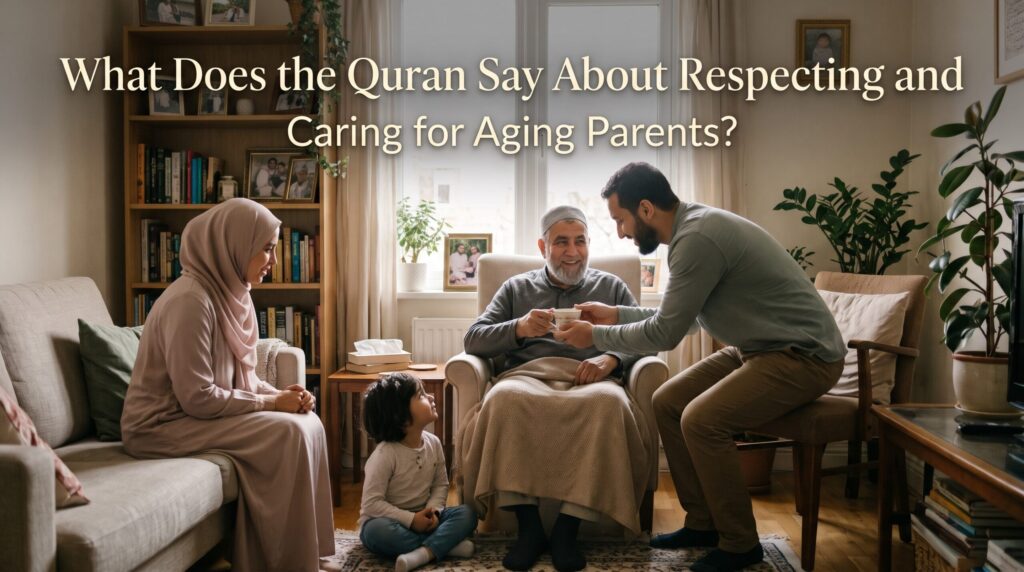
What Does the Quran Say About Respecting and Caring for Aging Parents? Old age is a profound phase of human life where physical strength declines and emotional vulnerability heightens. In contemporary society, aging parents are frequently marginalized, viewed as financial or logistical burdens, or relegated to institutional care. The Holy Quran provides an entirely different paradigm. This guide examines the Quranic instructions on honoring, serving, and speaking to aging parents. Grounded in the reality of human dependency, the ethics of gentle communication, and ultimate accountability before the Creator, this post details practical and spiritual strategies to fulfill this sacred duty with patience and dignity.
Table of Contents
| Section Title | Key Questions Addressed |
|---|---|
| 1. The Divine Connection: Worshiping Allah and Honoring Parents | Why is kindness to parents placed directly alongside the worship of One Creator in the Quran? |
| 2. The Reversal of Vulnerability: The Human Lifecycle | How does the Quran describe the biological cycle of weakness, and why does old age require deep empathy? |
| 3. The Ethics of Daily Speech: The Command of “Not Even ‘Uff'” | What are the precise verbal and psychological rules for speaking to elderly parents according to Surah Al-Isra? |
| 4. Emotional Anchoring and Practical Mercy: Lowering the Wing of Humility | What practical actions and internal attitudes does Islam mandate for elderly care? |
| 5. Navigating Difficult Dynamics: Boundaries, Disagreements, and Sincere Dua | How should an adult child handle complex parental behavior or differing religious beliefs? |
1. The Divine Connection: Worshiping Allah and Honoring Parents
In the Quranic worldview, honoring one’s parents (Birr al-Walidayn) is not treated as a casual social recommendation or an optional cultural courtesy. It is elevated to the level of a primary religious obligation, placed immediately after the direct worship of Allah (Tawheed).
The Creator states with supreme clarity:
“And your Lord has decreed that you not worship except Him, and to parents, good treatment. Whether one or both of them reach old age [while] with you, say not to them [so much as], ‘uff,’ and do not repel them but speak to them a noble word.”
— Surah Al-Isra (17:23)
This pairing is repeated across multiple chapters of the Quran:
“And [recall] when we took the covenant from the Children of Israel, [enjoining upon them]: ‘Do not worship except Allah; and to parents do good…'”
— Surah Al-Baqarah (2:83)
“Worship Allah and associate nothing with Him, and to parents do good…”
— Surah An-Nisa (4:36)
Why Is Parental Care Tied to Pure Monotheism?
Belief in One Unseen Creator is the root of all moral order and personal accountability. Just as our existence is owed initially to the Creator who fashioned us from nothing, our earthly survival was facilitated by the selfless, exhausting efforts of our parents.
By linking His rights directly with the rights of parents, Allah establishes that a person cannot possess genuine faith or moral integrity while remaining ungrateful, indifferent, or harsh toward the human beings who nurtured them into adulthood. Gratitude to the Creator naturally produces gratitude to those through whom His care was delivered.
2. The Reversal of Vulnerability: The Human Lifecycle
Human beings are uniquely designed. Unlike many animals that stand, feed, and run within hours of birth, the human child enters the world in total physical weakness, relying entirely on the constant sacrifice of its mother and father for years.
As decades pass, the laws of biology take effect. The strong adult who was once a helpless baby watches their once-powerful parents transition into frailty, cognitive exhaustion, and physical reliance.
The Quran documents this natural human progression:
“Allah is the one who created you from weakness, then made you after weakness strength, then made you after strength weakness and white hair. He creates what He wills, and He is the Knowing, the Competent.”
— Surah Ar-Rum (30:54)
Allah reminds adult children of the immense maternal toll that began their lives:
“And we have enjoined upon man [care] for his parents. His mother carried him, [increasing her] in weakness upon weakness, and his weaning is in two years. Be grateful to Me and to your parents; to Me is the [final] destination.”
— Surah Luqman (31:14)
“And we have enjoined upon man, to his parents, good treatment. His mother carried him with hardship and gave birth to him with hardship…”
— Surah Al-Ahqaf (46:15)
The Test of the Full Circle
Caring for aging parents is not merely a logistical arrangement; it is an existential mirror. You are required to care for them in their state of declining strength, just as they cared for you when you were powerless.
However, there is a profound psychological difference between the two stages:
- When parents care for a baby: They care for an infant with joy, looking forward to that child’s growing strength, future potential, and independence.
- When children care for aging parents: They care for individuals whose physical and mental capacities may be declining day by day.
Because this second phase requires selfless stamina without worldly return, Allah rewards it with the highest station in the Hereafter.
The Prophet Muhammad ﷺ warned:
“May he be disgraced, may he be disgraced, may he be disgraced.” It was said, “Who, O Messenger of Allah?” He replied, “He whose parents, one or both of them, reach old age during his lifetime, and he does not enter Paradise [through serving them].”
— Sahih Muslim (Hadith 2551)
3. The Ethics of Daily Speech: The Command of “Not Even ‘Uff'”
Human speech is an immense power. Words are not empty sounds; they act like seeds planted in the memory and emotions of others. While young people often process harshness with resilience, the aging mind is fragile. Elderly parents frequently fear becoming useless, unloved, or a nuisance to their children.
Recognizing this delicate psychological state, the Quran lays down strict communication boundaries:
“…Whether one or both of them reach old age [while] with you, say not to them [so much as] ‘uff,’ and do not repel them but speak to them a noble word.”
— Surah Al-Isra (17:23)
Deconstructing the Word “Uff”
The Arabic syllable “Uff” represents the smallest conceivable expression of irritation, resentment, or impatience—a heavy sigh, an eye roll, a dismissive wave of the hand, or a tone indicating that their request is an exhausting inconvenience.
If the Creator has strictly prohibited a subtle sigh of annoyance, consider how severe the transgression is when an adult child:
- Raises their voice in frustration at repeated questions.
- Uses sarcastic, mocking, or condescending language.
- Scolds an aging parent for memory lapses or physical slowness.
- Threatens abandonment or complains about the cost of their medication.
The Standard of “Qawlan Karima” (A Noble Word)
Instead of impatience, Allah commands believers to speak Qawlan Karima—words of honor, gentleness, respect, and dignity.
To practice this daily:
- Never correct them aggressively: If an elderly parent misremembers an event or repeats a story, listen with patience rather than bluntly pointing out their decline.
- Affirm their worth: Solicit their advice and consult them in family decisions, assuring them that their wisdom remains foundational to the home.
- Control vocal pitch: Speak in a calm, deferential tone that communicates safety rather than intimidation.
4. Emotional Anchoring and Practical Mercy: Lowering the Wing of Humility
Kindness to parents is an active posture, not a passive sentiment. The Quran uses vivid imagery to illustrate the emotional and physical attitude an adult child must adopt toward aging parents:
“And lower to them the wing of humility out of mercy and say, ‘My Lord, have mercy upon them as they brought me up [when I was] small.'”
— Surah Al-Isra (17:24)
The phrase “lower the wing of humility” (Janah adh-dhull) is a metaphor drawn from nature. It depicts a large bird tenderly lowering its wings to protect, warm, and shield its defenseless chicks. The adult child, regardless of their social status, corporate authority, or wealth, is commanded to completely dismantle their ego and place their strength at the service of their parents.
Prioritizing Parental Dignity
The Sunnah of the Prophet Muhammad ﷺ provides clear, practical examples of how this humility is realized:
A man came to the Prophet ﷺ asking:
“O Messenger of Allah, who among the people is most worthy of my good companionship?” The Prophet replied, “Your mother.” The man asked, “Then who?” The Prophet replied, “Then your mother.” The man asked, “Then who?” The Prophet replied, “Then your mother.” The man asked, “Then who?” The Prophet replied, “Then your father.”
— Sahih al-Bukhari (Hadith 5971), Sahih Muslim (Hadith 2548)
When another individual sought permission to leave his home for military defense, the Prophet ﷺ asked him:
“‘Are your parents alive?’ The man replied, ‘Yes.'” The Prophet said, “Then strive in their service.”
— Sahih al-Bukhari (Hadith 5972), Sahih Muslim (Hadith 2549)
Actionable Responsibilities of Care
- Financial Protection: It is the duty of the capable adult child to cover the food, shelter, medical treatment, and personal needs of aging parents without making them feel like charity cases.
- Physical Comfort: Assisting with mobility, meals, hygiene, and doctor visits must be performed with cheerfulness, never with begrudging reluctance.
- Relieving Guilt: Elderly parents often apologize for needing assistance. A righteous child continuously reassures them: “Everything I have is yours, and serving you is my honor.”
5. Navigating Difficult Dynamics: Boundaries, Disagreements, and Sincere Dua
Real life presents complex family situations. Some adult children face parents who are emotionally volatile, controlling, or hold differing religious convictions. Others carry deep emotional wounds from childhood negligence.
How does the Quran instruct believers to respond under such circumstances?
When Parents Command What Contradicts Truth
The Quran establishes a clear standard: obedience to the Creator takes precedence over obedience to creation. However, even if parents urge a child to abandon faith or commit an injustice, the obligation of worldly kindness remains intact.
Allah states:
“And if they strive to make you associate with Me that of which you have no knowledge, do not obey them but accompany them in [this] world with appropriate kindness and follow the way of those who turn back to Me [in repentance]…”
— Surah Luqman (31:15)
Notice the balance:
- In matters of belief and moral transgression: You do not obey.
- In matters of earthly care, medical needs, and everyday kindness: You remain devoted, respectful, and gentle.
Belief in divine accountability reminds us that we do not honor our parents merely because of their personal perfection; we honor them because of the Creator’s explicit command.
The Lifelong Lifeline: Dua (Supplication)
Even the most attentive care cannot heal all physical decay or eliminate every sorrow of old age. Therefore, the ultimate gift an adult child offers their parents is sincere supplication.
The Quran teaches the permanent prayer:
“Rabbi irhamhuma kama rabbayani saghira”
(“My Lord, have mercy upon them as they brought me up [when I was] small.”)
— Surah Al-Isra (17:24)
The Prophet Muhammad ﷺ affirmed that this bond transcends death:
“When a person dies, all their deeds come to an end except three: continuous charity (Sadaqah Jariyah), beneficial knowledge, or a righteous child who prays for them.”
— Sahih Muslim (Hadith 1631)
Guidance Section: Cultural Misconceptions vs. Quranic Truth
| Area | Misconception / Cultural Habit | True Islamic & Quranic Perspective |
|---|---|---|
| Nature of the Duty | Treating elderly care as optional charity or an inheritance negotiation among siblings. | Caring for parents is a non-negotiable obligation commanded alongside Tawheed. Denying them care or abusing them (‘Uquq) is categorized among the major sins in Islam. |
| Material vs. Emotional | Believing that paying for medical bills or hiring outside caregivers relieves an adult child of personal, emotional duty. | While financial support is essential, the Quran focuses heavily on speech, personal humility, touch, and presence. Money cannot replace gentle words and emotional presence. |
| Justifying Irritation | Claiming that when parents become stubborn, demanding, or repetitive, reacting with annoyance or sharp words is understandable. | The Quran explicitly prohibits saying even “Uff” (sighing with irritation). The test of old age is specifically designed to measure an adult child’s patience under pressure. |
| Blind Obedience vs. Kindness | Believing that honoring parents requires complying with demands that harm one’s spouse, break religious laws, or perpetrate injustice. | Obedience to parents is limited by the boundaries of Allah. Injustice is never permitted. One must decline unlawful demands firmly and calmly, while maintaining gentle and respectful personal treatment. |
Disclaimer
This article is prepared for spiritual, ethical, and educational reflection based on the Holy Quran and authentic Sunnah. It does not constitute a formal legal ruling (Fatwa), nor does it serve as medical or psychiatric advice for managing specialized geriatric illnesses such as severe dementia, Alzheimer’s disease, or chronic mental disorders.
An Invitation to Reflect
The verses of the Quran concerning family, speech, and human vulnerability are not mere historical texts; they are living blueprints for human tranquility and social preservation. We invite every son, daughter, parent, and thinker to open the Holy Quran and read it with reflection in your own native language at least once in your life. Observe how its guidance protects the dignity of the weak and anchors our temporary lives in eternal purpose.
Frequently Asked Questions (FAQs)
1. What is the specific meaning of the word “Uff” in Surah Al-Isra?
“Uff” is an onomatopoeic Arabic expression representing the sound of blowing dust away or emitting a short sigh of discontent. In Islamic jurisprudence and Quranic exegesis, it represents the absolute baseline of disrespect. By forbidding “Uff,” the Quran establishes that all greater expressions of anger, shouting, or insult are strictly prohibited.
2. How should an adult child act if a parent was abusive or neglectful in the past?
Islam acknowledges human pain and does not require you to expose yourself or your family to ongoing physical or severe psychological harm. Believers in such situations should maintain necessary boundaries to ensure safety, while continuing to fulfill essential physical needs, speaking with basic respect, avoiding vindictive retaliation, and making regular Dua for their parents’ guidance and forgiveness.
3. Does Islam permit placing an elderly parent in an assisted living facility or nursing home?
The clear Quranic norm is for aging parents to live with their children, surrounded by family (“Whether one or both of them reach old age [while] with you…”). Placing an elderly parent in a facility solely out of personal inconvenience or lack of interest contradicts the spirit of Quranic mercy. However, if specialized 24/7 medical supervision is required that family members cannot safely provide, utilizing professional medical facilities while remaining daily, active visitors and emotional caregivers is permissible out of medical necessity.
4. How can I honor and care for my parents after they have passed away?
According to authentic Hadiths, you can benefit your deceased parents by:
- Making constant Dua for their forgiveness and mercy.
- Giving continuous charity (Sadaqah Jariyah) in their name.
- Fulfilling their lawful debts, vows, or unfulfilled religious obligations (such as missed Hajj, if applicable).
- Maintaining ties of kinship with their relatives and honoring their lifelong friends.
5. Why is the mother given threefold emphasis over the father in the Hadith on companionship?
Islamic scholars, including Imam Ibn Hajar, explain that this threefold emphasis acknowledges the unique and irreversible difficulties borne exclusively by the mother: pregnancy (weakness upon weakness), the pain of labor and delivery, and the intense physical demands of early nursing and care. The father is honored immediately following for his protective leadership, financial maintenance, and lifelong guidance.
6. Can an adult child disagree with parents regarding personal choices like career or marriage?
Yes. Islam does not grant parents the authority to force a child into an unwanted marriage or dictate every permissible career choice. An adult child has individual legal and moral agency. However, when expressing disagreements or choosing a different path, the child must communicate with total humility, avoiding arrogance, harshness, or disrespect.