Content Summary
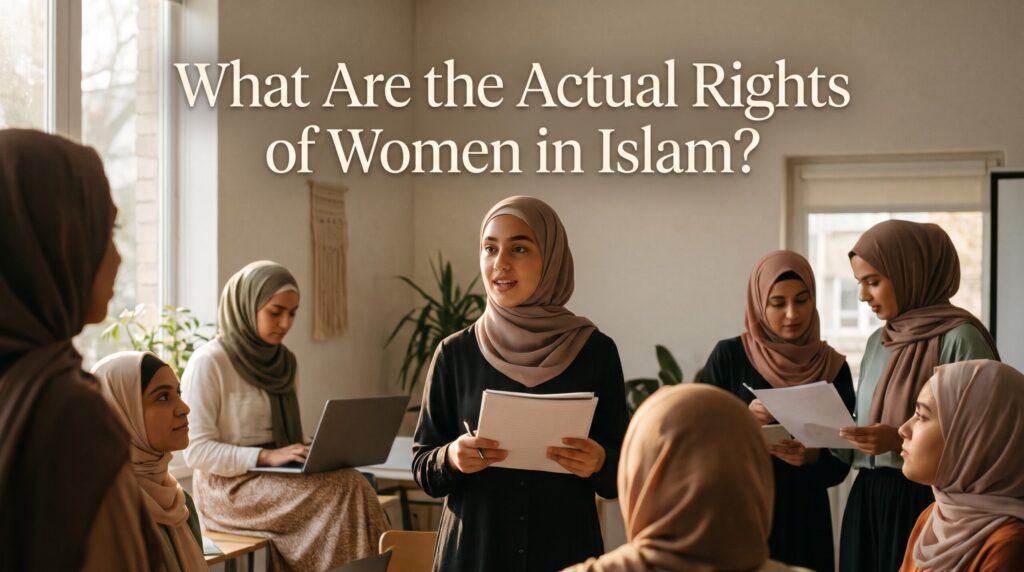
What Are the Actual Rights of Women in Islam? A Complete Guide to Legal, Financial, and Moral Dignity: Public discourse frequently treats the rights of women in Islam with suspicion or misunderstanding, often confusing tribal cultural practices with divine law. In reality, Islamic revelation introduced a revolutionary framework of female legal personhood, independent wealth ownership, marital self-determination, and spiritual parity over fourteen centuries ago. This article provides a comprehensive, logical examination of the actual rights guaranteed to women in Islam, grounded in the Holy Qur’an, authentic prophetic traditions, and the principles of natural balance and human dignity.
Table of Contents
| Section Title | Key Questions Addressed |
|---|---|
| 1. Spiritual Parity: Moral Accountability and Divine Worth | Does Islam view the female soul as equal to the male? How does divine justice measure personal worth? |
| 2. Absolute Financial Autonomy and Economic Protection | Can a Muslim woman own wealth independently? Why is financial maintenance placed entirely on men? |
| 3. Marital and Reproductive Rights: Consent, Mahr, and Divorce | What rights does a woman have in entering or ending a marriage? How is the reproduction cycle safeguarded? |
| 4. Intellectual, Civic, and Social Agency | Is seeking education obligatory for women? What role do women play as moral leaders and community allies? |
1. Spiritual Parity: Moral Accountability and Divine Worth
To understand the rights of women in Islam, one must begin with the spiritual foundation. The Qur’an establishes that men and women share the exact same human origin, created from a single soul (Nafs Wahidah):
“O mankind, fear your Lord, who created you from a single soul and created from it its mate and dispersed from both of them many men and women…”
— Surah An-Nisa (4:1)
In Islamic theology, women do not bear the stigma of “original sin.” The Qur’an records that both Adam and Eve were collectively tempted, both fell short, both turned sincerely in repentance (Tawbah), and both were completely forgiven by Allah. A woman’s spiritual value is neither secondary nor derived through a male relative.
The Measure of Worth: Taqwa
Superiority before the Creator is never defined by biological gender, wealth, or ethnic background. The sole standard of honor is Taqwa (moral integrity, God-consciousness, and righteous conduct):
“O mankind, indeed We have created you from male and female and made you peoples and tribes that you may know one another. Indeed, the most noble of you in the sight of Allah is the most righteous of you. Indeed, Allah is Knowing and Acquainted.”
— Surah Al-Hujurat (49:13)
Every woman stands before Allah as an independent moral agent. She will be tested by her own choices, intentions, and deeds, and she will receive the full reward for her righteousness:
“And whoever does righteous deeds, whether male or female, while being a believer—they will enter Paradise and will not be wronged, [even as much as] the speck on a date seed.”
— Surah An-Nisa (4:124)
2. Absolute Financial Autonomy and Economic Protection
Centuries before modern legal systems recognized married women as independent economic persons, Islamic law established that a woman’s financial identity is complete, permanent, and sovereign.
Independent Property and Earnings
A Muslim woman has the full legal right to earn income, buy and sell real estate, operate businesses, sign legal contracts, and manage investments without requiring the permission, oversight, or co-signature of her father, husband, or brother.
The Qur’an explicitly protects her personal economic acquisitions:
“For men is a share of what they have earned, and for women is a share of what they have earned. And ask Allah of His bounty. Indeed, Allah is ever, of all things, Knowing.”
— Surah An-Nisa (4:32)
The Asymmetry of Financial Responsibility (Nafaqah)
While women enjoy absolute autonomy over their wealth, Islamic law intentionally relieves them of the legal obligation to fund the family household. The financial burden rests entirely upon men:
“Men are the protectors and maintainers of women because Allah has given one more [strength/favor] than the other and because they support them from their wealth…”
— Surah An-Nisa (4:34)
This creates an economic shelter for women:
| Financial Domain | The Husband’s / Father’s Obligation | The Woman’s / Wife’s Right |
|---|---|---|
| Household Expenses | 100% mandatory (housing, food, clothing, healthcare, education). | 0% mandatory legal obligation. |
| Personal Earnings & Assets | Obligated to share and provide for the entire household. | 100% private property; any contribution she makes is counted as voluntary charity (Sadaqah). |
| Inheritance Share | Obligated to distribute and spend upon dependents. | Retained as pure personal capital without maintenance liabilities. |
| Legal Surname | Passed to children for lineage tracing. | Retained permanently; a woman never changes her maiden name upon marriage. |
By keeping a woman’s wealth completely separate from her husband’s, Islam protects women from financial coercion, exploitation, and dependency.
3. Marital and Reproductive Rights: Consent, Mahr, and Divorce
In Islam, marriage (Nikah) is not an indissoluble sacrament, nor is it a transfer of ownership between father and groom. It is a formal, transparent civil contract (Mithaq) requiring explicit terms, mutual consent, and legal accountability.
1. The Right of Unconditional Consent
A woman cannot be married against her will under any circumstances. Her explicit, voluntary consent is a mandatory legal condition (Shart) for a valid marriage contract.
The Prophet Muhammad ﷺ explicitly declared:
“A previously married woman shall not be married until she is consulted, and a virgin shall not be married until her consent is sought.” They said: “O Messenger of Allah, how is her consent?” He said: “Her silence [or spoken assent].”
— Sahih al-Bukhari (5136)
If a woman is coerced into marriage by cultural pressure or parental force, the contract is legally void (Batil) under authentic Shariah, and an Islamic court is obligated to annul it upon her request.
2. The Right to the Bridal Gift (Mahr)
Upon marriage, the groom must give the bride a mandatory financial gift known as the Mahr.
“And give the women [upon marriage] their bridal gifts graciously. But if they give up willingly to you anything of it, then take it in satisfaction and ease.”
— Surah An-Nisa (4:4)
The Mahr is not a “bride price” paid to the parents; it is the exclusive property of the woman herself. It provides her with immediate financial liquidity and personal independence at the start of the union.
3. The Right to Dignified Exit: Divorce and Khula’
Islam recognizes that living in emotional distress, incompatibility, or domestic cruelty damages human mental health and corrupts the domestic environment. Just as a man may initiate divorce (Talaq), a woman possesses legal mechanisms to terminate an unhappy marriage:
- Khula’ (Wife-Initiated Dissolution): A woman can initiate the dissolution of the marriage if she feels incompatibility or aversion toward her husband, even without having to prove abuse or negligence, typically by returning the Mahr.
- Faskh (Judicial Dissolution): An Islamic judge dissolves the marriage immediately if the husband commits physical abuse, fails to provide basic financial support (Nafaqah), deserts the marital home, or causes harm.
The Qur’an commands that all marital interactions—whether remaining together or separating—must be conducted with honor and grace:
“…Then, either keep [her] in an acceptable manner or release [her] with good treatment…”
— Surah Al-Baqarah (2:229)
4. Intellectual, Civic, and Social Agency
A widespread cultural myth suggests that Islam confines women to silent domesticity, denying them intellectual and social development. Authentic Islamic history and scripture prove the complete opposite.
The Obligation to Seek Knowledge
Islam makes intellectual development an unconditional obligation for both sexes:
“Seeking knowledge is an obligation upon every Muslim.”
— Sunan Ibn Majah (224)
Because the Arabic term Muslim in this legal text is grammatically inclusive, education is not a male privilege—it is an individual duty (Fard Ayn).
Historically, Muslim women were scholars of jurisprudence, transmitters of Hadith, physicians, educators, and administrators. Aisha bint Abi Bakr was one of the foremost jurists and scholars of the early Islamic world, and Fatima al-Fihri founded the University of al-Qarawiyyin in 859 CE—the oldest continually operating degree-granting university in the world.
Social Guardianship and Moral Alliance
The Qur’an designates men and women as civic and moral partners in building a just society:
“The believing men and believing women are allies of one another. They enjoin what is right and forbid what is wrong and establish prayer and give zakah and obey Allah and His Messenger. Those—Allah will have mercy upon them. Indeed, Allah is Exalted in Might and Wise.”
— Surah At-Tawbah (9:71)
Men and women are Awliya (mutual protectors and allies). Both share the social responsibility to speak truth, challenge corruption, encourage justice, and contribute to the well-being of the broader community.
Supreme Honor in Motherhood
Islam assigns the maternal role the highest social honor and emotional reverence in human civilization. The biological load of gestation, childbirth, and nursing is matched by unparalleled ethical status:
A man came to the Messenger of Allah ﷺ and asked: “O Messenger of Allah, who among people is most deserving of my good companionship?” He replied: “Your mother.” The man asked: “Then who?” He replied: “Your mother.” The man asked: “Then who?” He replied: “Your mother.” The man asked: “Then who?” He replied, “Then your father.”
— Sahih al-Bukhari (5971)
By elevating the mother three times above the father in terms of devotion and companionship, Islam establishes that the physical sacrifices of motherhood are recognized with the highest earthly honor.
Guidance Section: Correcting Common Misconceptions
| Misconception / Cultural Innovation | Root Ignorance Behind It | Qur’anic & Authentic Sunnah Correction |
|---|---|---|
| “Islamic law allows forced marriages.” | Patriarchal customs prioritizing family pride, tribal alliances, or money over individual consent. | Forced marriage is strictly prohibited and legally invalid. The Prophet ﷺ explicitly invalidated marriages that took place without the bride’s free consent (Sahih al-Bukhari 5136, 5138). |
| “A woman’s earnings belong to her husband.” | Importing pre-modern property concepts (such as coverture) into Islamic jurisprudence. | A woman’s wealth is entirely hers (Surah An-Nisa 4:32). A husband cannot take a single cent without her explicit, cheerful permission (Surah An-Nisa 4:4). |
| “Islam discourages the education of women.” | Fear of female empowerment rooted in regional illiteracy and tribal traditions. | Seeking knowledge is an obligatory duty for every Muslim (Sunan Ibn Majah 224). Denying girls an education violates basic Islamic commandments. |
| “A Muslim woman cannot initiate a divorce.” | Cultural taboos that stigmatize divorce and deny women access to legal arbitration. | Islam established the right of Khula’ (wife-initiated divorce) and Faskh (court annulment) to ensure women are never trapped in unviable or harmful unions (Surah Al-Baqarah 2:229). |
Disclaimer
This article is written for educational, philosophical, and moral clarification based on the Holy Qur’an and authentic prophetic teachings. It does not replace individualized legal decrees (fatwas) or legal counsel for marital disputes, divorce proceedings, or inheritance distribution, which require consultation with qualified Islamic jurists and local legal professionals.
An Invitation to Reflect
The Creator who fashioned humanity endowed men and women with equal spiritual dignity, distinct physiological gifts, and complementary societal duties. His laws were revealed not to oppress, but to liberate the human soul from exploitation, tyranny, and societal decay.
We invite every reader—regardless of your faith, background, or personal worldview—to pick up the Holy Qur’an and read it with reflection and an open heart at least once in your life in your own language. Examine its balanced legal protections, observe its deep defense of human dignity, and experience the clarity that comes from aligning life with divine truth.
Frequently Asked Questions (FAQs)
1. Does a Muslim woman have to change her last name after marriage?
No. In Islam, a woman permanently retains her father’s family surname. Taking a husband’s last name is a Western legal custom with no basis in Islamic jurisprudence. Keeping her own name signifies that she remains an autonomous legal entity, retaining her independent lineage and identity.
2. What is the difference between Khula’ and Talaq?
Talaq is a divorce initiated by the husband, where he bears financial responsibilities and forfeits claims to gifts given. Khula’ is a divorce initiated by the wife, allowing her to dissolve the marriage if she feels incompatibility or emotional aversion, typically by returning the Mahr to release the contract fairly.
3. Can a Muslim woman own a business or work outside the home?
Yes. A Muslim woman has full legal authority to own businesses, manage real estate, and pursue employment, provided the work is ethical (Halal) and respects Islamic moral boundaries. The Prophet’s ﷺ first wife, Khadijah, was one of the most prominent merchants in Arabia.
4. Why do daughters inherit half of a son’s share in certain family structures?
Islamic inheritance is balanced against financial obligations, not human worth. A brother is legally obligated by divine law to spend his wealth providing housing, food, and care for his mother, sisters, wife, and children. The sister’s share is 100% pure personal savings, as she has zero mandatory financial obligations toward anyone. Furthermore, in several other inheritance scenarios, women inherit equally or more than men.
5. What legal rights does a mother have regarding child custody?
In Islamic jurisprudence, maternal custody (Hadanah) is prioritized during the child’s tender early years because mothers are naturally suited for nurturing and emotional bonding. Even while the child is in maternal custody, the father remains 100% financially responsible for all living, healthcare, and educational expenses.
6. Does Islam tolerate domestic abuse?
No. Domestic violence, cruelty, and emotional abuse are strictly forbidden. The Qur’an commands men to “live with them in kindness” (Surah An-Nisa 4:19). The Prophet Muhammad ﷺ never struck a woman, servant, or child, and explicitly commanded: “Do not strike the female servants of Allah” (Sunan Abi Dawud 2146).