Content Summary
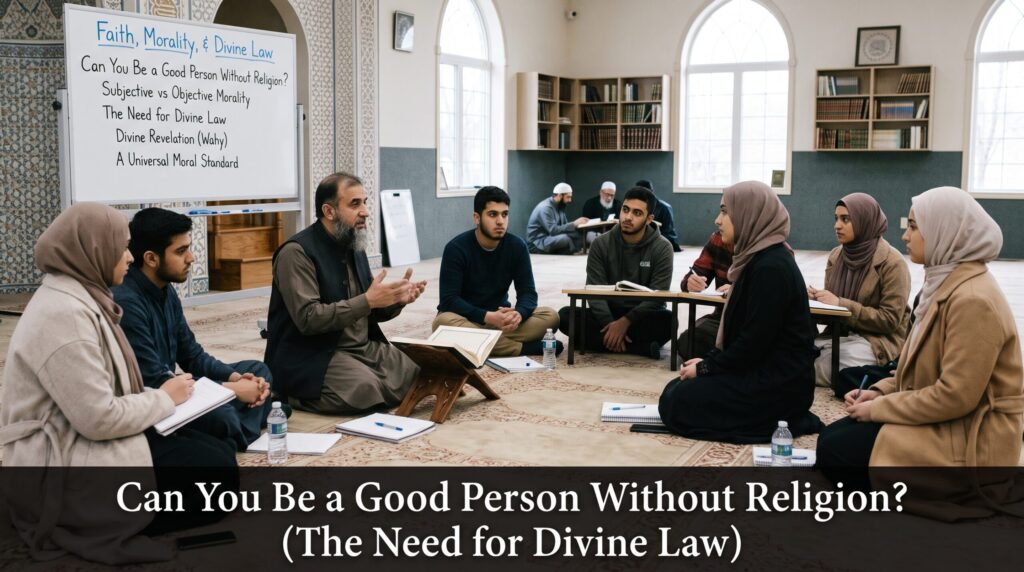
Can You Be a Good Person Without Religion: In today’s modern era, a very common question is often raised: “Can you be a good person without religion?” Many people believe that human empathy, logic, and a personal moral compass are entirely sufficient to build a good life and a peaceful society. They argue that as long as you do not harm anyone, organized religion and divine laws are unnecessary. However, when we examine this idea through logic and the deep insights provided in the document “Humanity By Quran,” we uncover a critical flaw in relying solely on human-defined morality. In this post, we will explore why a personal moral compass without an absolute divine anchor eventually leads to confusion, why accountability is essential for true justice, and why divine law is the ultimate requirement for a balanced human society.
Table of Contents
| Section Title | Key Questions Addressed |
|---|---|
| The Illusion of a Personal Moral Compass | Can individuals define right and wrong on their own? |
| The Danger of Relative Morality | What happens to society when morality shifts with human desires? |
| The Invisible Test: Doing Good When Unseen | Why is human empathy insufficient without divine accountability? |
| Why Humanity Needs Divine Law | Is religion just about rituals, or is it a complete social system? |
| Ultimate Justice: The Anchor of Human Goodness | How does the Day of Judgment enforce true goodness? |
The Illusion of a Personal Moral Compass
It is absolutely true that human beings are born with an innate sense of right and wrong. Islam calls this the Fitrah—the natural, pure disposition that recognizes fairness, compassion, and the existence of a Creator. Because of this natural compass, many atheists and people without religion perform wonderful acts of charity, kindness, and justice.
However, relying only on this personal compass poses a massive social problem. As highlighted in “Humanity By Quran,” every person has a free mind shaped by different cultures, personal desires, and life circumstances. If there is no universal, divine standard, then each person gets to define what “good” is in their own way.
For one person, “good” might mean sharing wealth. For another, “good” might mean hoarding wealth to protect their family, even if it exploits others. Without a shared moral framework provided by a Higher Power, human society loses its unified definition of justice. The resulting clash of personal morals leads to confusion, imbalance, and inevitable conflict.
The Danger of Relative Morality
When morality is detached from the Creator, it becomes “relative.” This means that right and wrong change based on the situation, personal benefit, or the current mood of society.
“Humanity by Quran” warns about the social outcomes of the non-believer’s worldview. Without belief in the Creator and accountability in the afterlife, life easily becomes centered purely on personal benefit, pleasure, or power. Morality shifts with desire. If an action brings financial gain or social power, a person might justify it as “good,” even if it secretly harms others.
“Have you seen the one who takes his desires as his god? Allah has left him astray knowingly and sealed his hearing and his heart…” (Surah Al-Jathiyah 45:23)
When a society decides that human intellect alone dictates the law, laws can be manipulated by the strong to oppress the weak. History has repeatedly shown that when human beings create their own moral laws based on “survival of the fittest” or pure materialism, it often results in the justification of selfishness, exploitation, and profound injustice.
The Invisible Test: Doing Good When Unseen
Human empathy and secular laws have severe limits. A secular law can stop you from stealing if there is a police camera watching, but what stops you when the camera is off, the room is empty, and no one will ever find out?
If a person believes that this life is all there is, and that death brings absolute nothingness, the logical choice in an unseen scenario is often to act in self-interest. Why sacrifice your own wealth, time, or desires for someone else if there is no ultimate reward?
This is where the absolute necessity of divine law and faith in the Unseen comes into play. According to “Humanity By Quran,” belief in a single Creator and a final judgment gives people an internal compass that guides their thoughts and actions, especially when they are unseen.
“Not a word does he utter but that there is an observer near him ready [to record].” (Surah Qaf 50:18)
When you know that every action, whispered word, and hidden intention is recorded by the Creator, your morality becomes absolute, not relative. The fear of divine accountability and the hope of divine mercy motivate true goodness, ensuring that a person acts with justice even in the dark.
Why Humanity Needs Divine Law
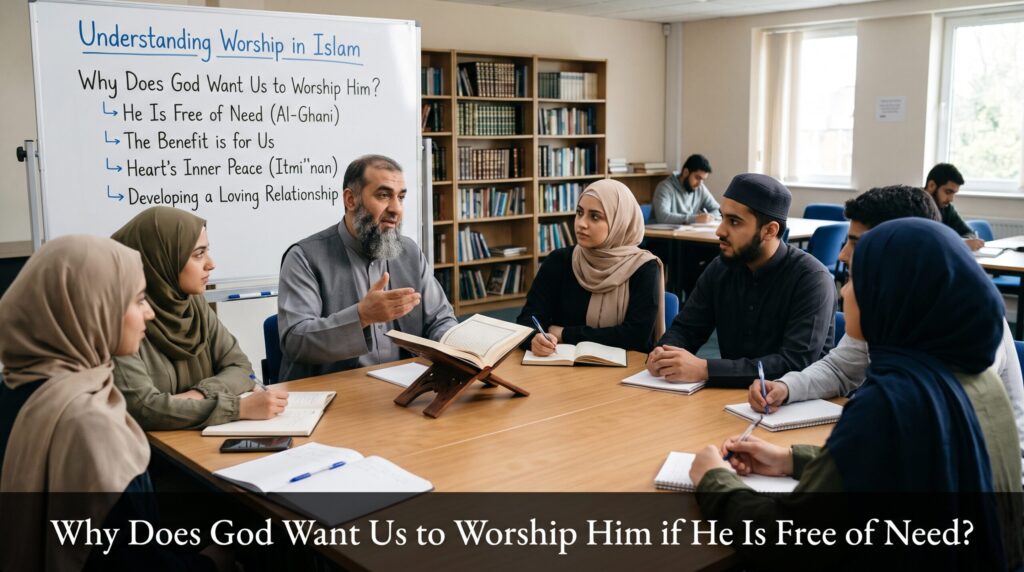
Many people reject religion because they misunderstand its purpose. They view religion merely as a set of restrictive rituals designed to serve a demanding deity. However, “Humanity By Quran” clarifies a profound reality: the Creator is completely free of all needs. Religion is not for the Creator; it is entirely for human beings.
“O mankind, you are the ones who stand in need of Allah, while Allah is Free of all need, the Praiseworthy.” (Surah Fatir 35:15)
True religion is a comprehensive system of laws, social ethics, justice, education, and training designed to make the human community function in a balanced way. Divine law regulates the things human intellect struggles with: how to build a fair economy (Zakat/charity), how to maintain family structures, and how to communicate ethically without destroying social trust.
Because humans are born physically weak and naturally reliant on one another, we need a flawless, unbiased instruction manual to survive our own egos. Divine law is that manual. It aligns perfectly with the laws of nature, ensuring that our inner spiritual lives and our outer social lives are in perfect harmony.
Ultimate Justice: The Anchor of Human Goodness
Can you be a good person without religion? You can do good deeds, but you cannot establish absolute, unbreakable goodness or universal justice without divine law.
If there is no Creator and no Day of Judgment, then the cruel oppressor who lives a life of luxury and dies peacefully in his sleep receives the exact same ultimate fate as the innocent person who spent their life helping the poor. That is the definition of profound injustice. The human soul naturally rebels against this idea because we are wired to crave ultimate fairness.
Islam teaches that life is a temporary exam hall. The true measure of “goodness” is not just what we do, but why we do it. When a believer acts with goodness, they do so out of a sincere intention to please the One who created them, knowing that perfect justice will be served on the Day of Accountability. Divine law does not just make us “good people”; it makes us purposeful, responsible, and eternally successful people.
Guidance Section
| Topic / Concept | Common Misconception or Ignorance | The Practical Truth (Based on Quranic Guidance) |
|---|---|---|
| Being a Good Person | I can be perfectly good and moral just by following my own heart and human empathy, without any religion. | Without divine law, morality becomes relative and shifts with desires. A shared, divine moral framework is required to prevent societal confusion and injustice. |
| The Purpose of Religion | Religion is just a collection of ancient rituals designed to control people and serve God’s needs. | The Creator is free of all needs. True religion is a practical system of social ethics, justice, and discipline designed entirely for the benefit and protection of human beings. |
| Accountability | If I don’t break the law of the land and no one sees me do wrong, I am free from any consequences. | Human laws are limited to what is seen. Divine accountability records every hidden intention, word, and action, ensuring absolute justice on the Day of Judgment. |
Disclaimer
The insights shared in this blog post are intended for educational and reflective purposes, drawing upon the concepts from the provided knowledge files and Islamic teachings. They aim to promote harmony, logical thinking, and moral responsibility. Readers are encouraged to seek knowledge, reflect upon nature, and consult qualified scholars for deeper theological studies.
A Sincere Invitation
True understanding comes from direct reflection and an open heart. We warmly invite you to read the Holy Quran at least once in your lifetime, in a language you fully understand. Let your own mind observe the wisdom, logic, and profound peace it offers to humanity.
Frequently Asked Questions (FAQs)
1. Can you be a good person without religion in Islam? Islam acknowledges that anyone can perform good deeds based on their natural human disposition (Fitrah). However, without the framework of divine law and accountability to the Creator, human “goodness” remains subjective, lacks ultimate purpose, and cannot guarantee universal justice.
2. Why is a personal moral compass not enough? Because every human being is influenced by their own desires, culture, and ego. If everyone defines right and wrong based purely on their own feelings, society falls into moral chaos. A universal, divine standard is required to maintain true justice.
3. What does “Humanity by Quran” say about relative morality? It highlights that without belief in the Creator and the afterlife, morality turns relative, shifting with circumstance and desire. This often leads to individuals choosing injustice when they are unseen, as they feel no fear of ultimate accountability.
4. Does the Creator need us to follow His laws? No. The Qur’an explicitly states that Allah is completely free of all needs. The divine laws—such as prayer, charity, and ethical communication—are prescribed entirely to discipline, purify, and protect human beings and their societies.
5. How does the belief in the Day of Judgment affect a person’s goodness? Belief in ultimate accountability forces a person to act with integrity even when no human is watching. It ensures that our actions are driven by sincere intentions and the knowledge that perfect justice will be served for every atom’s weight of good or evil.