కంటెంట్ సారాంశం
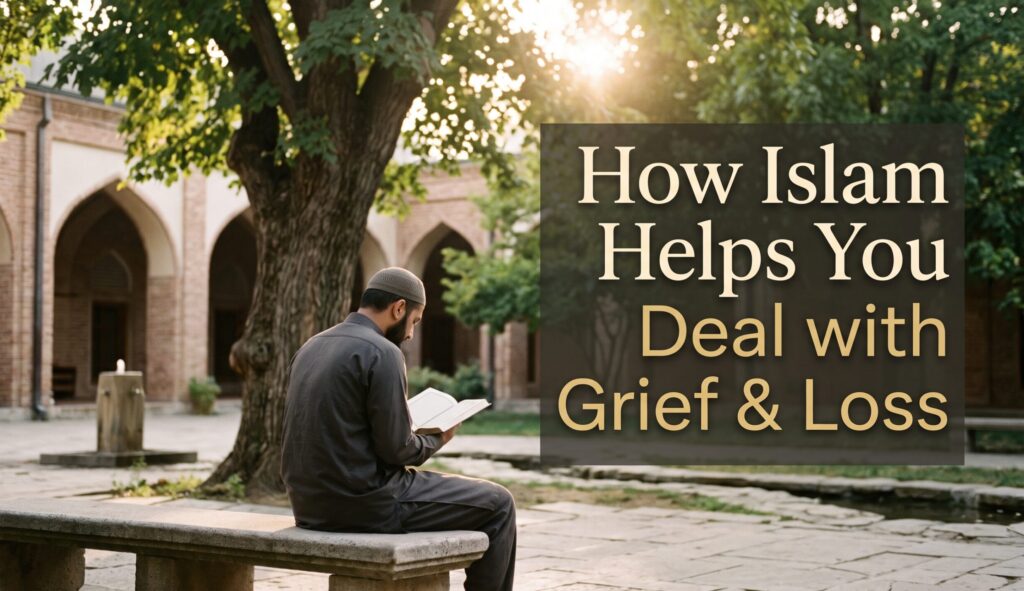
How Islam Helps You Deal with Grief and Loss: Losing a loved one, facing a life-altering setback, or experiencing deep heartbreak can leave you feeling overwhelmed and empty. Islam does not ask you to suppress your pain or pretend that loss does not hurt. Instead, it offers a compassionate, logical framework that validates human sorrow, reframes death as a temporary separation rather than permanent erasure, and guides you through practical steps toward healing and inner peace.
విషయ సూచిక
| విభాగం శీర్షిక | పరిష్కరించబడిన కీలక ప్రశ్నలు |
|---|---|
| Why Grief Hurts: Understanding Loss Through Human Nature in Islam | Why does loss feel so painful, and how does knowing our ultimate return bring relief? |
| Is Crying or Feeling Sad a Sign of Weak Faith? | Did the Prophets grieve, and what is the difference between natural sadness and despair? |
| Practical Steps to Heal from Grief and Loss in Islam | What concrete actions can you take to process pain, practice patience, and find comfort? |
| Guidance Section: Common Misconceptions Around Grief | Are fixed mourning anniversaries part of Islam, and what cultural habits contradict the Sunnah? |
| తరచుగా అడిగే ప్రశ్నలు (FAQలు) | How long is the mourning period, how can you help deceased loved ones, and is therapy allowed? |
Why Grief Hurts: Understanding Loss Through Human Nature in Islam
Grief is the natural price of love. Human beings are created with deep emotional bonds, empathy, and the desire for permanence. When someone you love passes away—or when a cherished chapter of life ends—your mind struggles to accept the sudden absence.
From an Islamic perspective, life on earth is never meant to be permanent. Every breath, relationship, and blessing we enjoy is a temporary trust from the ఒక కనిపించని సృష్టికర్త, not our permanent possession. The Quran prepares the human heart for this reality with honesty and mercy:
“And we will surely test you with something of fear and hunger and a loss of wealth and lives and fruits, but give good tidings to the patient, who, when disaster strikes them, says, ‘Indeed we belong to Allah, and indeed to Him we will return.’ Those are the ones upon whom are blessings from their Lord and mercy. And it is those who are the [rightly] guided.” — Surah Al-Baqarah (2:155–157)
అంటూ “ఇన్నా లిల్లాహి వ ఇన్నా ఇలాహి రాజి”ఉన్" (Indeed we belong to Allah, and indeed to Him we will return) is far more than a customary phrase spoken at funerals. Logically, it anchors your mind in two comforting truths:
- Ownership belongs to the Creator: Both you and your loved one belong to Allah, who is wiser and more merciful to them than even you could ever be.
- Separation is temporary: Death is not the end of existence; it is a doorway to the eternal hereafter where believers are reunited.
Is Crying or Feeling Sad a Sign of Weak Faith?
Many grieving Muslims carry unnecessary guilt, worrying that shedding tears means they are dissatisfied with Allah’s decree. Islam completely removes this burden. Feeling deep sorrow and crying are signs of a soft, merciful heart—not weak faith.
Even the greatest Prophets experienced profound grief. When Prophet Ya’qub (Jacob) lost his beloved son Yusuf, his sorrow was intense, yet he channeled his pain directly to his Creator rather than falling into hopelessness:
“He said, ‘I only complain of my suffering and my grief to Allah, and I know from Allah that which you do not know.'” — Surah Yusuf (12:86)
Similarly, when Prophet Muhammad (peace be upon him) held his dying infant son Ibrahim, tears flowed openly from his eyes. His words established the timeless balance between genuine human emotion and spiritual acceptance:
Narrated Anas bin Malik: The Prophet (peace be upon him) said, “The eyes shed tears and the heart grieves, and we will not say except what pleases our Lord. O Ibrahim! Indeed, we are grieved by your separation.” — Sahih al-Bukhari, Hadith 1303
Islam draws a clear, healthy boundary: sorrow of the heart and tears of the eye are completely natural, while screaming in rage, harming oneself, or questioning Allah’s justice is harmful to the soul.
Practical Steps to Heal from Grief and Loss in Islam
Healing from loss takes time, and Islam provides practical, structured habits that protect your mental and spiritual well-being while you grieve.
1. Anchor Your Shock in Patience (సబ్ర్) and Acceptance
In Arabic, సబ్ర్ does not mean coldly suppressing your emotions. It means holding yourself steady so that grief does not push you into destructive words or actions. True patience begins at the initial moment of shock, when emotions run highest:
Narrated Anas bin Malik: The Prophet (peace be upon him) said, “The real patience is at the first stroke of a calamity.” — Sahih al-Bukhari, Hadith 1283
Allow yourself to feel the weight of the loss, breathe calmly, and consciously choose words of acceptance rather than bitterness.
2. Pour Your Pain Out Directly to Allah
You do not need to hide your vulnerability from your Creator. Talk to Allah privately in your own words, especially during quiet moments of prayer (సలాహ్) and late at night. The Quran pairs patience directly with prayer as the primary source of strength:
“O you who have believed, seek help through patience and prayer. Indeed, Allah is with the patient.” — Surah Al-Baqarah (2:153)
3. Benefit Your Loved One Through Ongoing Charity (సదఖా జరియః) in Islam
One of the hardest parts of grief is feeling helpless. Islam transforms that helplessness into meaningful action. Even after a person passes away, your sincere prayers (దువా) for their forgiveness and charitable acts done on their behalf—such as feeding the hungry, funding clean water, or supporting useful knowledge—continue to benefit them in the next life.
4. Trust That Ease Always Follows Hardship
When grief feels suffocating, remember that Allah never places a weight upon a soul beyond what it can endure, and pain is never permanent:
“Allah does not charge a soul except [with that within] its capacity…” — సూరా అల్-బఖరా (2:286)
“నిజానికి, కష్టాలతో [సులభంగా ఉంటుంది. నిజానికి, కష్టాలతో [] తేలికగా ఉంటుంది].” — సూరా అష్-షార్ (94:5–6)
Guidance Section: Common Misconceptions Around Grief
Cultural traditions often mix with religious practice during times of mourning, sometimes adding financial and emotional pressure to grieving families. The table below clarifies common misconceptions against the Quran and authentic Sunnah:
| సాధారణ అపోహ లేదా ఆవిష్కరణ | Why It Contradicts Quran & Sunnah | Correct Islamic Guidance |
|---|---|---|
| Believing that crying means a lack of patience (సబ్ర్) | Tears and quiet sorrow are natural expressions of mercy practiced by the Prophets. Only wailing, slapping cheeks, or tearing clothes is forbidden (Sahih al-Bukhari, Hadith 1294). | Allow yourself to cry naturally while keeping your speech respectful and free of complaints against Allah. |
| Hosting fixed mourning feasts (such as 3rd-day or 40th-day Chehlum rituals) | Neither the Quran nor the authentic Sunnah prescribes specific anniversary mourning gatherings or requires the bereaved family to host feasts. | Neighbors and relatives should prepare food for the grieving family during the first days of loss so they are relieved of daily burdens. |
| Remaining in open-ended, paralyzing mourning for months or years | Prolonged despair prevents believers from fulfilling their living responsibilities and trusts. | Official mourning is limited to three days for relatives, and four months and ten days for a widow, after which healthy re-engagement with life is encouraged. |
| Asking deceased saints or intermediaries to relieve your grief | Directing prayers or pleas to anyone other than Allah contradicts pure monotheism (తౌహిద్). | Turn directly to the One Unseen Creator alone for comfort, healing, and mercy for your loved ones. |
తరచుగా అడిగే ప్రశ్నలు (FAQలు)
1. How long is the official mourning period in Islam? For the loss of any relative or friend, formal mourning in Islam is limited to three days. The only exception is a widow mourning her husband, whose prescribed waiting and mourning period (ఇద్దా) is four months and ten days, unless she is pregnant, in which case it lasts until childbirth.
2. Can I still feel sad after the three-day mourning period ends? Yes. The three-day rule applies to outward mourning restrictions, not human emotions. Missing someone you love for months or years is completely natural; what Islam discourages is letting grief permanently stop you from living responsibly.
3. How can I continue helping a loved one who has passed away? You can regularly pray for Allah’s mercy and forgiveness upon them, give ongoing charity (సదఖా జరియః) in their name, pay off any debts they left behind, and maintain kindness toward their family and close friends.
4. Does Islam allow seeking therapy or grief counseling? Absolutely. Islam encourages seeking beneficial remedies for both physical and emotional pain. Talking to a qualified counselor alongside maintaining prayer and remembrance of Allah is a wise and practical step toward recovery.
5. Why does Allah allow painful losses to happen to good people? In Islamic wisdom, hardship is not a sign that Allah has abandoned you. Rather, tests purify the heart, elevate a believer’s spiritual rank, and remind us not to attach our ultimate hope to a temporary world.
6. What short supplication (దువా) should I say when facing a loss? Recite the Quranic phrase “Inna lillahi wa inna ilayhi raji’un.” (Indeed we belong to Allah, and indeed to Him we will return), and ask Allah to reward you in your affliction and replace your loss with something better.

![Why is Life Not Perfect? Understanding the Design of Effort and Growth 5 Why is Life Not Perfect? Understanding the Design of Effort and Growth Content Summary Many people wonder why life is filled with challenges, limitations, and unanswered questions instead of effortless perfection. Through simple logic, observation of human nature, and timeless Quranic wisdom, this article explains that life on Earth was never meant to be a finished paradise. Instead, it is an intentional testing ground where human limitations, uncertainty, and daily effort work together to build character, resilience, cooperation, and lasting spiritual growth. Table of Contents Section Title Key Questions Addressed The Purpose Behind an Imperfect World Why isn't life on Earth effortlessly perfect? What is the true purpose of human existence? How Human Design Sparks Cooperation and Innovation Why were humans created physically weaker than many animals? How do our limitations drive growth? Why Uncertainty and Hardship Are Essential for Growth Why is the future hidden from us? How do struggles and changing circumstances shape human character? The Law of Effort, Intention, and Daily Habits How does sincere striving lead to success? What role do gratitude and repentance play when we make mistakes? Guidance: Common Misconceptions About Life's Struggles What common myths distort how people view hardship, mistakes, and an uncertain future? Frequently Asked Questions (FAQs) Clear answers to common questions about destiny, hardship, effort, and inner peace. The Purpose Behind an Imperfect World Almost every human being asks the same question at some point: If a Wise and Merciful Creator designed this universe, why is life so full of struggle, loss, and imperfection? The answer becomes clear when we look at what Earth is actually designed to be. Life in this world is not a final destination of endless comfort; rather, it is a temporary, purposeful testing ground. If life were completely painless, predictable, and effortless, human beings would never have a reason to think deeply, choose between right and wrong, show compassion, or develop inner strength. In the Quran, the Creator clearly explains the reason behind life and death: "He who created death and life to test you as to which of you is best in deed—and He is the Exalted in Might, the Forgiving." — Surah Al-Mulk (67:2) Imperfection in our surroundings is not a flaw in creation—it is the exact condition required for moral choice. Furthermore, human life is inherently tied to exertion and perseverance from beginning to end: "We have certainly created man in hardship." — Surah Al-Balad (90:4) When we stop expecting this temporary world to function like eternal paradise, our perspective shifts. Challenges stop looking like random accidents and start making sense as opportunities to prove our sincerity, patience, and integrity. How Human Design Sparks Cooperation and Innovation If you observe nature closely, you will notice something remarkable. Almost every animal enters the world equipped with everything it needs to survive in its environment. A cat does not need shoes, woven clothing, shelter-building tools, or cooked meals to endure the weather. Animals rely primarily on built-in physical strength and instinct. Human beings, however, were designed differently. Compared to many creatures, humans enter the world physically vulnerable and require years of care just to stand on their own. The Quran highlights this intentional aspect of our creation: "Allah wants to lighten for you [your difficulties]; and mankind was created weak." — Surah An-Nisa (4:28) Yet alongside this physical vulnerability, humans were given an extraordinary gift that no other earthly creature possesses: "He created man, [and] taught him speech." — Surah Ar-Rahman (55:3-4) Why Weakness Plus Speech Creates Growth This combination—a physically dependent body paired with advanced speech, memory, and reasoning—is the secret behind human civilization: Vulnerability creates interdependence: Because we cannot survive alone in harsh environments, we need families, communities, trade, shelter, and mutual support. Speech enables shared learning: Unlike animals that rely on short-term sensory instinct, humans attach words to experiences, store complex thoughts, write knowledge down, and pass wisdom to future generations. Necessity drives invention: Every tool, home, medicine, and technology exists because human beings had to overcome a limitation through thought and teamwork. If humans had been created physically invincible and completely self-sufficient, there would be no reason to cooperate, invent, teach, or care for one another. Our physical limits are the very sparks that ignite human intelligence and social unity. Why Uncertainty and Hardship Are Essential for Growth Another reason life feels imperfect is that we have zero control over tomorrow. No matter how much technology or data humanity gathers, no person knows what will happen in the next minute. The Quran reminds us of this universal boundary: "No soul knows what it will earn tomorrow, and no soul knows in what land it will die." — Surah Luqman (31:34) This hidden future is essential for real growth. If you already knew the exact outcome of every choice, courage, trust, and patience would lose all meaning. Because tomorrow is unseen, every decision you make today genuinely reflects your character and intentions. Ease and Difficulty Work in Pairs Life moves through changing seasons—youth and old age, health and illness, gain and loss. Both comfort and struggle serve as examinations of the human heart: "Every soul will taste death. And We test you with evil and with good as a trial. And to Us you will all return." — Surah Al-Anbiya (21:35) Crucially, hardship is never meant to crush the human spirit. Every difficulty is measured against our inner capacity, and relief is woven directly alongside struggle: "Allah does not burden any soul beyond its capacity." — Surah Al-Baqarah (2:286) "So surely, with hardship comes ease. Indeed, with hardship comes ease." — Surah Ash-Sharh (94:5-6) When you face an obstacle calmly, your mind learns problem-solving, your ego softens into humility, and your heart discovers resilience you never knew you had. The Law of Effort, Intention, and Daily Habits In a world designed for growth, wishful thinking alone produces nothing. Human progress operates on a clear, fair law of cause and effect: you receive the fruit of what you sincerely work toward. "And that man will have nothing except what he strives for, and his effort will be seen, then he will be fully rewarded for it." — Surah An-Najm (53:39-41) Practical Principles for Navigating an Imperfect Life Focus on Intention Over Outcomes: You cannot always control external results, but you have complete control over why you act. Events test your circumstances, while your intention defines your moral worth. Plant Good Daily Seeds: Every small action is like a seed. Repeated honesty, patience, and kindness grow into strong, rooted character, just as good words bring lasting benefit: "Have you not considered how Allah presents an example: a good word is like a good tree—its root firm and its branches in the sky. It gives its fruit at all times by the permission of its Lord." — Surah Ibrahim (14:24-25) Protect Blessings Through Gratitude: Health, time, intelligence, and opportunities grow when appreciated and used responsibly, while carelessness causes them to fade: "...If you are grateful, I will surely increase you..." — Surah Ibrahim (14:7) Learn From Mistakes Without Despair: Because humans enter the world without innate knowledge and learn step by step, making mistakes is natural. Imperfection does not mean hopelessness; sincere correction turns past errors into future wisdom: "Except for those who repent, believe, and do righteous deeds—for them Allah will replace their bad deeds with good deeds. And Allah is ever Forgiving, Merciful." — Surah Al-Furqan (25:70) Guidance: Common Misconceptions About Life's Struggles When people misunderstand why life is imperfect, they often fall into despair, blame, or unhelpful habits. The table below clarifies common misconceptions using Quranic wisdom and practical logic. Common Misconception / Ignorance Quranic Reality & Logical Truth "Hardship means the Creator is angry with me or has abandoned me." Both ease and hardship are natural tests of character (Surah Al-Anbiya 21:35). Struggles build patience, clarify priorities, and unlock hidden ease (Surah Ash-Sharh 94:5-6). "True success means achieving a problem-free, effortless life on Earth." Earth is a temporary testing ground for effort and moral growth (Surah Al-Mulk 67:2). Complete, effortless perfection belongs only to the eternal Hereafter. "Consulting horoscopes, palmists, or fortune-tellers can remove life's uncertainty." No created being knows tomorrow (Surah Luqman 31:34). Relying on guesswork distracts from practical planning, sincere effort (Surah An-Najm 53:39), and prayerful trust. "If I make repeated mistakes, I am permanently ruined and cannot change." Humans are lifelong learners who naturally stumble. Sincere repentance and corrected action wipe away past stains and transform character (Surah Al-Furqan 25:70). Frequently Asked Questions (FAQs) 1. Why didn't the Creator make human beings physically stronger like other animals? Humans were created physically dependent so they would rely on cooperation, family bonds, and intelligence rather than brute force. Combined with the gift of speech and reasoning, this vulnerability motivated humanity to build communities, invent tools, and share knowledge across generations. 2. If everything is known by the Creator, why does my daily effort still matter? While the Creator has complete knowledge of all things, the future remains hidden from you. Because you do not know tomorrow, your choices, intentions, and efforts today are completely real and voluntary. You are judged by how sincerely you strive within your knowledge and capacity, not by outcomes beyond your control. 3. Does experiencing pain or delay mean I am failing in life? No. Delays, obstacles, and pain are natural parts of human growth—just as muscles only strengthen under resistance. In Quranic wisdom, hardship is always paired with ease and serves to purify your intentions, teach patience, and prepare you for greater responsibility. 4. How should I respond when I feel overwhelmed by life's problems? Start by focusing on the present moment rather than replaying past regrets or worrying about an unknown future. Break the problem into what is within your control, take practical steps with patience, ask the Creator for guidance through sincere prayer (Dua), and trust that no soul is burdened beyond what it can bear. 5. Why do good people also face difficult trials? Trials are not exclusively punishments; they are often instruments of elevation and purification. Even the greatest prophets and most righteous people faced severe hardships so their patience, gratitude, and trust in truth could shine as examples for others. 6. What is the single best mindset for living peacefully in an imperfect world? Live with gratitude for what you have, sincerity in what you do today, kindness toward others, and humility when you make mistakes. When you view every situation—good or difficult—as an opportunity to do what is right, inner peace replaces frustration.](https://islamforeveryone.org/wp-content/uploads/2026/11/Why-is-Life-Not-Perfect-Understanding-the-Design-of-Effort-and-Growth-1024x572.jpg)