Краткое содержание содержания
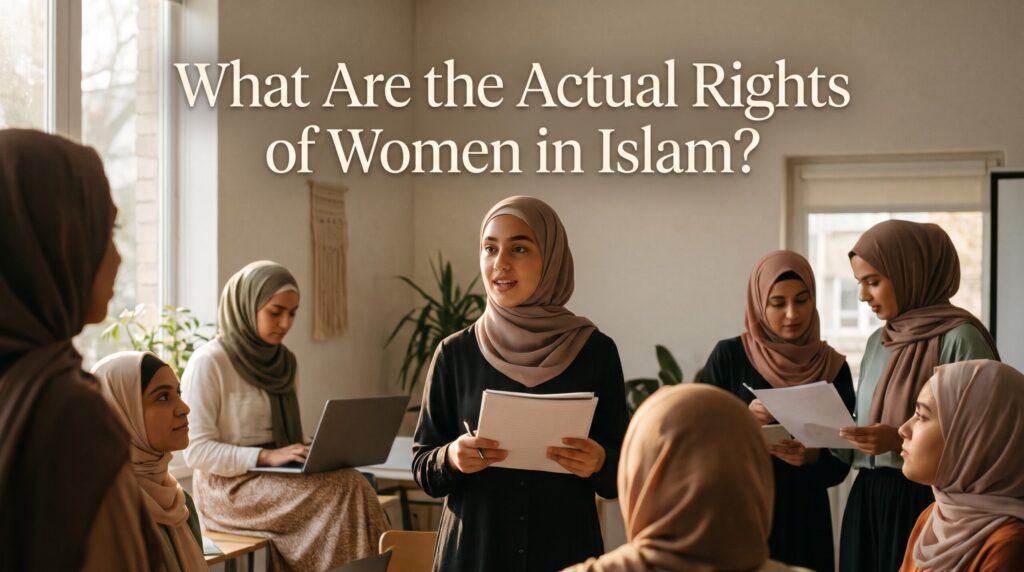
Каковы фактические права женщин в исламе? Полное руководство по юридическому, финансовому и моральному достоинству: Общественный дискурс часто относится к правам женщин в исламе с подозрением или непониманием, часто путая племенные культурные традиции с божественным законом. В действительности, исламское откровение ввело революционную структуру женской правосубъектности, независимого владения имуществом, супружеского самоопределения и духовного равенства более четырнадцати веков назад. В этой статье представлен всесторонний и логический анализ реальных прав, гарантированных женщинам в Исламе, основанных на Священном Коране, подлинных пророческих традициях и принципах естественного баланса и человеческого достоинства.
Оглавление
| Название раздела | Ключевые вопросы, которые рассматриваются |
|---|---|
| 1. Духовное равенство: моральная ответственность и божественная ценность | Считает ли ислам женскую душу равной мужской? Как божественная справедливость измеряет личную ценность |
| 2. Абсолютная финансовая автономия и экономическая защита. | Может ли мусульманка самостоятельно владеть богатством? Почему финансовое обеспечение полностью возложено на мужчин |
| 3. Супружеские и репродуктивные права: согласие, махр и развод. | Какие права имеет женщина при вступлении или прекращении брака? Как сохраняется репродуктивный цикл |
| 4. Интеллектуальная, гражданская и социальная активность | Является ли получение образования обязательным для женщин? Какую роль играют женщины как моральные лидеры и союзники общества? |
1. Духовное равенство: моральная ответственность и божественная ценность
Чтобы понять права женщин в Исламе, нужно начать с духовной основы. Коран утверждает, что мужчины и женщины имеют одно и то же человеческое происхождение, созданы из одной души (Нафс Вахида):
“О люди, бойтесь вашего Господа, который сотворил вас из одной души и создал из нее ее пару, и рассеял из них обоих множество мужчин и женщин…”
— Сура Ан-Ниса (4:1)
В исламской теологии женщины не несут клейма “первородного греха”. В Коране записано, что и Адам, и Ева были коллективно искушены, оба потерпели неудачу, обе искренне раскаялись (Тауба), и оба были полностью прощены Аллахом. Духовная ценность женщины не является ни вторичной, ни полученной через родственника-мужчину.
Мера ценности: богобоязненность
Превосходство перед Творцом никогда не определяется биологическим полом, богатством или этнической принадлежностью. Единственным стандартом чести является Таква (моральная целостность, Богосознание и праведное поведение):
“О люди, поистине Мы создали вас из мужчины и женщины и сделали вас народами и племенами, чтобы вы могли знать друг друга. Воистину, самый благородный из вас перед Аллахом - самый праведный из вас. Воистину, Аллах Знающий и Знакомый”.”
— Сура Аль-Худжурат (49:13)
Каждая женщина стоит перед Аллахом как независимый моральный деятель. Она будет испытана своим собственным выбором, намерениями и поступками и получит полную награду за свою праведность:
“И кто бы ни совершал праведные дела, будь то мужчина или женщина, будучи верующим, тот войдет в Рай, и ему не будут причинены несправедливости, [даже] соринке на финиковом семени”.”
— Сура Ан-Ниса (4:124)
2. Абсолютная финансовая автономия и экономическая защита.
За столетия до того, как современные правовые системы признали замужних женщин независимыми экономическими личностями, исламское право установило, что финансовая идентичность женщины является полной, постоянной и суверенной.
Независимая собственность и доходы
Мусульманка имеет полное законное право получать доход, покупать и продавать недвижимость, вести бизнес, подписывать юридические контракты и управлять инвестициями, не требуя разрешения, надзора или совместной подписи своего отца, мужа или брата.
Коран прямо защищает ее личные экономические приобретения:
“Для мужчин - доля из того, что они заработали, и для женщин - доля из того, что они заработали. И просите Аллаха о Его милости. Воистину, Аллах всегда обо всем знает”.”
— Сура Ан-Ниса (4:32)
Асимметрия финансовой ответственности (Нафака)
Хотя женщины пользуются абсолютной автономией в отношении своего богатства, исламский закон намеренно освобождает их от юридической обязанности финансировать семейное хозяйство. Финансовое бремя полностью лежит на мужчинах:
“Мужчины являются защитниками и помощниками женщин, потому что Аллах дал одной больше [силы/благосклонности], чем другой, и потому что они поддерживают их из своего богатства…”
— Сура Ан-Ниса (4:34)
Это создает экономический приют для женщин:
| Финансовая сфера | Обязанности мужа/отца | Права женщины/жены |
|---|---|---|
| Бытовые расходы | 100% обязательное (жилье, еда, одежда, здравоохранение, образование). | 0% обязательное юридическое обязательство. |
| Личный заработок | Обязан делиться и обеспечивать все хозяйство. | 100% частная собственность; любой ее вклад считается добровольной благотворительностью (Садака). |
| Доля наследства | Обязан распределять и тратить на иждивенцев. | Сохраняется как чистый личный капитал без обязательств по содержанию. |
| Legal Surname | Passed to children for lineage tracing. | Retained permanently; a woman never changes her maiden name upon marriage. |
By keeping a woman’s wealth completely separate from her husband’s, Islam protects women from financial coercion, exploitation, and dependency.
3. Супружеские и репродуктивные права: согласие, махр и развод.
В исламе брак (Никях) is not an indissoluble sacrament, nor is it a transfer of ownership between father and groom. It is a formal, transparent civil contract (Митак) requiring explicit terms, mutual consent, and legal accountability.
1. The Right of Unconditional Consent
A woman cannot be married against her will under any circumstances. Her explicit, voluntary consent is a mandatory legal condition (Шарт) for a valid marriage contract.
Пророк Мухаммад ﷺ прямо заявил:
“A previously married woman shall not be married until she is consulted, and a virgin shall not be married until her consent is sought.” They said: “O Messenger of Allah, how is her consent?” He said: “Her silence [or spoken assent].”
— Сахих аль-Бухари (5136)
If a woman is coerced into marriage by cultural pressure or parental force, the contract is legally void (Batil) under authentic Shariah, and an Islamic court is obligated to annul it upon her request.
2. The Right to the Bridal Gift (Махр)
Upon marriage, the groom must give the bride a mandatory financial gift known as the Махр.
“And give the women [upon marriage] their bridal gifts graciously. But if they give up willingly to you anything of it, then take it in satisfaction and ease.”
— Surah An-Nisa (4:4)
The Махр is not a “bride price” paid to the parents; it is the exclusive property of the woman herself. It provides her with immediate financial liquidity and personal independence at the start of the union.
3. The Right to Dignified Exit: Divorce and Khula’
Islam recognizes that living in emotional distress, incompatibility, or domestic cruelty damages human mental health and corrupts the domestic environment. Just as a man may initiate divorce (Талак), a woman possesses legal mechanisms to terminate an unhappy marriage:
- Khula’ (Wife-Initiated Dissolution): A woman can initiate the dissolution of the marriage if she feels incompatibility or aversion toward her husband, even without having to prove abuse or negligence, typically by returning the Махр.
- Faskh (Judicial Dissolution): An Islamic judge dissolves the marriage immediately if the husband commits physical abuse, fails to provide basic financial support (Нафака), deserts the marital home, or causes harm.
The Qur’an commands that all marital interactions—whether remaining together or separating—must be conducted with honor and grace:
“…Then, either keep [her] in an acceptable manner or release [her] with good treatment…”
— Сура Аль-Бакара (2:229)
4. Интеллектуальная, гражданская и социальная активность
A widespread cultural myth suggests that Islam confines women to silent domesticity, denying them intellectual and social development. Authentic Islamic history and scripture prove the complete opposite.
The Obligation to Seek Knowledge
Islam makes intellectual development an unconditional obligation for both sexes:
“Seeking knowledge is an obligation upon every Muslim.”
— Sunan Ibn Majah (224)
Because the Arabic term Muslim in this legal text is grammatically inclusive, education is not a male privilege—it is an individual duty (Fard Ayn).
Historically, Muslim women were scholars of jurisprudence, transmitters of Hadith, physicians, educators, and administrators. Aisha bint Abi Bakr was one of the foremost jurists and scholars of the early Islamic world, and Fatima al-Fihri founded the University of al-Qarawiyyin in 859 CE—the oldest continually operating degree-granting university in the world.
Social Guardianship and Moral Alliance
The Qur’an designates men and women as civic and moral partners in building a just society:
“Верующие мужчины и верующие женщины являются союзниками друг друга. Они повелевают одобряемое и запрещают предосудительное, совершают намаз, выплачивают закят и повинуются Аллаху и Его Посланнику. Аллах помилует их. Воистину, Аллах - Могущественный и Мудрый”.”
— Сура Ат-Тауба (9:71)
Men and women are Аулия (mutual protectors and allies). Both share the social responsibility to speak truth, challenge corruption, encourage justice, and contribute to the well-being of the broader community.
Supreme Honor in Motherhood
Islam assigns the maternal role the highest social honor and emotional reverence in human civilization. The biological load of gestation, childbirth, and nursing is matched by unparalleled ethical status:
A man came to the Messenger of Allah ﷺ and asked: “O Messenger of Allah, who among people is most deserving of my good companionship?” He replied: “Your mother.” The man asked: “Then who?” He replied: “Your mother.” The man asked: “Then who?” He replied: “Your mother.” The man asked: “Then who?” He replied, “Then your father.”
— Sahih al-Bukhari (5971)
By elevating the mother three times above the father in terms of devotion and companionship, Islam establishes that the physical sacrifices of motherhood are recognized with the highest earthly honor.
Раздел рекомендаций: Исправление распространенных заблуждений
| Заблуждение/Культурные инновации | За этим стоит коренное невежество | Коран |
|---|---|---|
| “Islamic law allows forced marriages.” | Patriarchal customs prioritizing family pride, tribal alliances, or money over individual consent. | Forced marriage is strictly prohibited and legally invalid. The Prophet ﷺ explicitly invalidated marriages that took place without the bride’s free consent (Sahih al-Bukhari 5136, 5138). |
| “A woman’s earnings belong to her husband.” | Importing pre-modern property concepts (such as укрытие) into Islamic jurisprudence. | A woman’s wealth is entirely hers (Surah An-Nisa 4:32). A husband cannot take a single cent without her explicit, cheerful permission (Surah An-Nisa 4:4). |
| “Islam discourages the education of women.” | Fear of female empowerment rooted in regional illiteracy and tribal traditions. | Seeking knowledge is an obligatory duty for every Muslim (Sunan Ibn Majah 224). Denying girls an education violates basic Islamic commandments. |
| “A Muslim woman cannot initiate a divorce.” | Cultural taboos that stigmatize divorce and deny women access to legal arbitration. | Islam established the right of Хула’ (wife-initiated divorce) and Faskh (court annulment) to ensure women are never trapped in unviable or harmful unions (Surah Al-Baqarah 2:229). |
Отказ от ответственности
This article is written for educational, philosophical, and moral clarification based on the Holy Qur’an and authentic prophetic teachings. It does not replace individualized legal decrees (fatwas) or legal counsel for marital disputes, divorce proceedings, or inheritance distribution, which require consultation with qualified Islamic jurists and local legal professionals.
Приглашение к размышлению
The Creator who fashioned humanity endowed men and women with equal spiritual dignity, distinct physiological gifts, and complementary societal duties. His laws were revealed not to oppress, but to liberate the human soul from exploitation, tyranny, and societal decay.
We invite every reader—regardless of your faith, background, or personal worldview—to pick up the Holy Qur’an and read it with reflection and an open heart at least once in your life in your own language. Examine its balanced legal protections, observe its deep defense of human dignity, and experience the clarity that comes from aligning life with divine truth.
Часто задаваемые вопросы (FAQ)
1. Does a Muslim woman have to change her last name after marriage?
No. In Islam, a woman permanently retains her father’s family surname. Taking a husband’s last name is a Western legal custom with no basis in Islamic jurisprudence. Keeping her own name signifies that she remains an autonomous legal entity, retaining her independent lineage and identity.
2. What is the difference between Хула’ и Талак?
Талак is a divorce initiated by the husband, where he bears financial responsibilities and forfeits claims to gifts given. Хула’ is a divorce initiated by the wife, allowing her to dissolve the marriage if she feels incompatibility or emotional aversion, typically by returning the Махр to release the contract fairly.
3. Can a Muslim woman own a business or work outside the home?
Yes. A Muslim woman has full legal authority to own businesses, manage real estate, and pursue employment, provided the work is ethical (Халяль) and respects Islamic moral boundaries. The Prophet’s ﷺ first wife, Khadijah, was one of the most prominent merchants in Arabia.
4. Why do daughters inherit half of a son’s share in certain family structures?
Islamic inheritance is balanced against financial obligations, not human worth. A brother is legally obligated by divine law to spend his wealth providing housing, food, and care for his mother, sisters, wife, and children. The sister’s share is 100% pure personal savings, as she has zero mandatory financial obligations toward anyone. Furthermore, in several other inheritance scenarios, women inherit equally or more than men.
5. What legal rights does a mother have regarding child custody?
In Islamic jurisprudence, maternal custody (Hadanah) is prioritized during the child’s tender early years because mothers are naturally suited for nurturing and emotional bonding. Even while the child is in maternal custody, the father remains 100% financially responsible for all living, healthcare, and educational expenses.
6. Does Islam tolerate domestic abuse?
No. Domestic violence, cruelty, and emotional abuse are strictly forbidden. The Qur’an commands men to “live with them in kindness” (Surah An-Nisa 4:19). The Prophet Muhammad ﷺ never struck a woman, servant, or child, and explicitly commanded: “Do not strike the female servants of Allah” (Sunan Abi Dawud 2146).
 English
 Bengali
 Chinese
 Dutch
 French
 German
 Greek
 Hindi
 Indonesian
 Italian
 Japanese
 Korean
 Marathi
 Latin
 Portuguese
 Russian
 Spanish
 Swahili
 Telugu
 Vietnamese