Content Summary
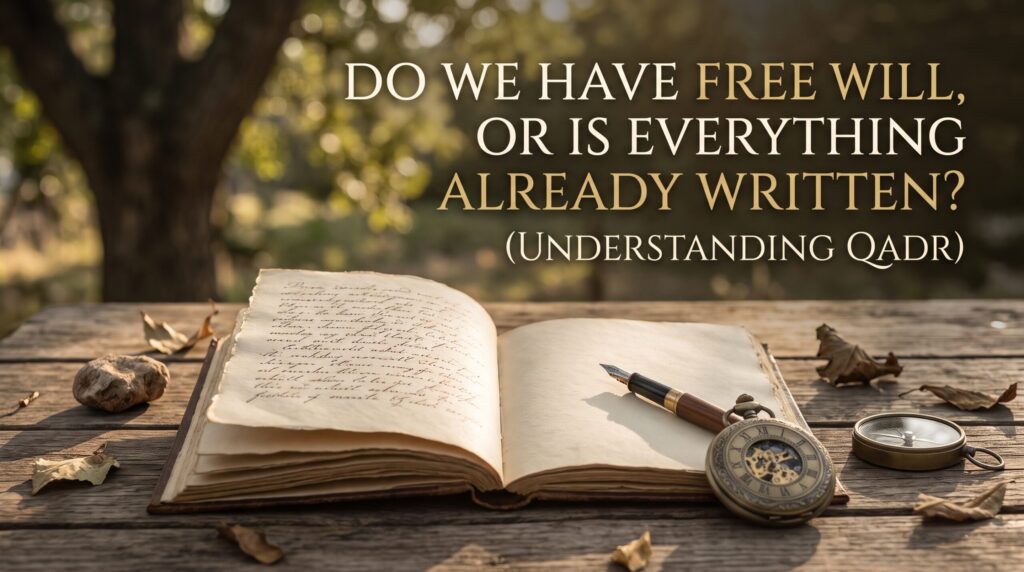
Do we have Free will or is everything already written: Many people struggle to reconcile the divine decree of God (Qadr) with the concept of human free will. If our destiny is already recorded in a preserved tablet, why are we tested, and why does accountability exist on the Day of Judgment? This blog post explains the harmony between God’s absolute foreknowledge and human moral choice. By examining the purpose of our hidden future, the nature of intention (niyyah), and the logic of accountability, we explore how understanding destiny empowers personal responsibility, removes anxiety, and brings lasting peace of mind.
Table of Contents
| Section Title | Key Questions Addressed |
|---|---|
| 1. The Core Question: Destiny vs. Choice | If everything is already written, why does God test us? |
| 2. Divine Foreknowledge: Recording vs. Compulsion | Does God writing our actions mean He forces our choices? |
| 3. The Veiled Future: Why Mystery Makes the Test Real | Why is the future hidden from humans, and how does that create free will? |
| 4. The Seat of Accountability: Intention and Effort | What does God actually hold us accountable for? |
| 5. Guidance Section: Misconceptions About Destiny | What are the common misunderstandings surrounding fatalism and Qadr? |
| 6. Practical Living: Finding Inner Peace Through Qadr | How does a sound understanding of destiny eliminate anxiety and despair? |
| Frequently Asked Questions (FAQs) | Common daily doubts answered directly and clearly. |
1. The Core Question: Destiny vs. Choice
One of the most frequent questions people ask about faith is both simple and deep: If God already knows what I will do tomorrow, and if my entire life has already been written, do I actually have free will? And if I do not have absolute control over the final outcome, why should I be judged?
At first glance, it feels like an unsolvable contradiction. If our path is determined, holding us accountable seems unfair; on the other hand, if God does not know our future, it would mean His knowledge is incomplete.
Islam resolves this dilemma by clarifying the purpose of life on Earth. Earth is not a place of final settlement or arbitrary control; it is an intentionally designed testing ground.
“He who created death and life to test you as to which of you is best in deed—and He is the Exalted in Might, the Forgiving.” — Surah Al-Mulk (67:2)
A meaningful test requires two foundational elements:
- The freedom to choose between right and wrong.
- The moral awareness to understand the consequences of those choices.
Without choice, virtue has no nobility, and wrongdoing carries no fault. Human beings were created with a unique balance: physically vulnerable and dependent on cooperation, yet gifted with conscious intellect, speech, and moral volition. Understanding Qadr begins by distinguishing between what God knows and what God compels.
2. Divine Foreknowledge: Recording vs. Compulsion
The primary misunderstanding about destiny comes from confusing foreknowledge with coercion.
God exists outside the boundaries of time and space. Humans experience reality chronologically—moving from one second to the next, limited to the present moment, remembering parts of the past, and knowing nothing of the future. God, however, is the Creator of time itself. His knowledge encompasses the beginning, the present, and the end simultaneously.
When God wrote the destiny of all creation, He recorded what every person would freely choose to do based on His infinite, eternal knowledge. He did not force their hands.
“And with Him are the keys of the unseen; none knows them except Him. And He knows what is on the land and in the sea. Not a leaf falls, but that He knows it…” — Surah Al-An’am (6:59)
A Simple Logical Comparison
Consider an experienced teacher who has observed two students over an entire school year. One student studies diligently every night, while the other neglects every assignment. Before the final exam, the teacher writes in a private notebook: Student A will score an A; Student B will fail.
When the exam results arrive exactly as written, did the teacher’s note force Student B to fail? Did the notebook compel Student A to study?
Certainly not. The teacher wrote the prediction based on thorough observation, but both students acted out of their own free will. If a limited human observer can anticipate outcomes without causing them, consider the supreme, perfect knowledge of the Creator who knows every hidden motive of the heart. God’s record is an expression of His absolute awareness, not a cage that strips away your freedom.
3. The Veiled Future: Why Mystery Makes the Test Real
Even though God has recorded all matters, human beings have zero knowledge of what tomorrow holds. This veiled future is the very mechanism that makes life an authentic test.
“…No soul knows what it will earn tomorrow, and no soul knows in what land it will die. Indeed, Allah is Knowing and Aware.” — Surah Luqman (31:34)
Because you cannot read what is written for you tomorrow, you must make real choices in real time. When you face a decision—whether to speak the truth or tell a lie, whether to work hard or give in to laziness, whether to forgive or seek revenge—you act purely upon your own judgment, desires, and moral intent.
[God's Eternal Foreknowledge] (Transcendent, unrevealed to creation)
             │
             ▼
   [The Unseen Future] (Veiled from human eyes)
             │
             ▼
 [Human Free Will in the Present] ──► Sincere Intention + Active Effort
             │
             ▼
  [Individual Accountability] ──► Fair Judgment on the Last Day
If your destiny were displayed on a screen before your eyes, the test would cease to exist. Uncertainty is intentional: it cultivates patience, builds humility, demands conscious striving, and teaches human beings to rely on God rather than their own limited strength.
4. The Seat of Accountability: Intention and Effort
God does not judge human beings for circumstances outside their control. You did not choose where you were born, who your parents were, your natural physical build, or the unexpected calamities that cross your path. These belong to the external domain of destiny.
What God holds you accountable for is your internal intention (niyyah) and your conscious response.
“And that man will have nothing except what he strives for, and that his effort will be seen—then he will be fully rewarded for it.” — Surah An-Najm (53:39-41)
“Whoever purifies his soul succeeds, and whoever corrupts it fails.” — Surah Ash-Shams (91:9-10)
Prophet Muhammad ﷺ underscored this foundational truth:
“Actions are judged by motives, and each person will be rewarded according to what he intended…” — Sahih al-Bukhari (Hadith 1), Sahih Muslim (Hadith 1907)
Destiny sets the stage and provides the circumstances; your soul chooses how to act upon that stage. When hardship arrives, destiny brought the circumstance, but your free will determines whether you respond with patience or bitter ingratitude. When wealth or success arrives, destiny opens the door, but your moral choice decides whether you respond with generosity or arrogance.
When the companions of Prophet Muhammad ﷺ asked whether they should stop striving since everyone’s ultimate destination is known to God, the Prophet ﷺ gave a clear directive:
“Work and strive, for everyone will be facilitated toward that for which they were created.” — Sahih al-Bukhari (Hadith 4949), Sahih Muslim (Hadith 2647)
5. Guidance Section: Misconceptions About Destiny
Over time, human misunderstandings have turned the empowering belief in Qadr into passive fatalism or an excuse for poor choices. The following table contrasts common human misconceptions with clear, Quranic realities.
| Common Misconception | The Reality Based on Quran and Sunnah | Practical Impact of the Correction |
|---|---|---|
| Passive Fatalism: “If God wrote that I will sin or fail, I cannot change it, so why try?” | God commands righteous action and warns against wrongdoing. Using destiny to justify willful sin is an evasion of personal responsibility. | Restores personal accountability; stops a person from blaming God for their own lazy or harmful decisions. |
| Neglecting Action for Prayer Alone: “If sustenance (rizq) is written, it will reach me even if I stay home.” | The same decree that wrote the provision also wrote that it must be attained through honest labor and legal means. | Promotes a strong work ethic; unites faith in God with practical planning and daily discipline. |
| Arrogance in Success: “My wealth and achievements are solely the result of my intelligence.” | God provided the faculties, health, opportunities, and timing that made the achievement possible. | Destroys ego; nurtures deep gratitude (shukr) and protects a person from pride and entitlement. |
| Despair Over the Past: “If only I had made a different choice, my misfortune wouldn’t have occurred.” | The past is completed and governed by God’s decree. Rehashing ‘what ifs’ opens the door to regret, grief, and mental distress. | Frees the human mind from past guilt; focuses all energy on constructive choices in the present moment. |
6. Practical Living: Finding Inner Peace Through Qadr
A genuine, balanced understanding of Qadr is not a philosophical burden; it is an incredible source of emotional resilience and inner tranquility. When you understand how free will intersects with divine decree, your everyday life transforms in three profound ways:
1. Freedom from Anxiety
When you strive toward a good goal—such as a career step, supporting your family, or helping your community—you give it your finest effort. If things turn out well, you thank God. If unexpected barriers block your way despite your honest striving, you do not collapse into depression. You recognize that the outcome was not decreed for you and that God’s wisdom encompasses what your limited mind cannot perceive.
2. Guarding the Tongue and Deeds
Knowing that your choices are recorded by vigilant observers makes you mindful of every word and action. Because you are free to speak kindly or harmfully, your tongue becomes an instrument of discipline. You realize that while you cannot control how others treat you, you have complete authority over how you respond.
“Not a single word does a person utter except that there is a watcher by him, ready to record.” — Surah Qaf (50:18)
3. Living Fully in the Present
You cannot rewrite yesterday, and you cannot predict tomorrow. The only ground where your free will actually functions is the present moment. By planting good seeds today—through sincere prayers, honest work, kindness to family, and fair dealings—you shape a destiny that will bring honor in this world and safety in the Hereafter.
Frequently Asked Questions (FAQs)
1. If God knows someone is going to Hell, why did He create them?
God creates human beings with genuine moral agency, the capacity to reason, and continuous opportunities to repent. A person enters punishment solely through their own persistent, willful rejection of truth and justice, not because God compelled them to choose evil. Foreknowledge of an outcome does not equal the enforcement of it.
2. Can Dua (supplication) change what is written in destiny?
Prophet Muhammad ﷺ mentioned that nothing repels divine decree except supplication (Dua). Scholars explain that the act of making Dua, along with the change it brings, was already part of the original decree written by God. It shows that prayer is an active, practical cause that shapes outcomes just like medicine or physical effort.
3. If everything is decreed, why do bad things happen to innocent people?
Earth is designed as a temporary trial of dualities—ease and hardship, health and sickness, justice and oppression. Suffering is not meaningless; for the innocent, patience through unchosen hardship elevates their status, purifies their character, and guarantees full, compensatory justice on the Day of Judgment, where no soul will be wronged by even an atom’s weight.
4. How can I tell if an event is a test or a punishment?
Look at your inner response. If a difficult circumstance draws you closer to humility, self-reflection, and prayer, it functions as a purifying test. If it leads you deeper into arrogance, bitterness, and persistent wrongdoing, it serves as a warning sign to correct your course immediately.
5. Isn’t it contradictory to say we have free will while God has absolute control?
No. Human free will operates within the greater sovereign authority of God. You have the absolute freedom to choose your intentions and desires. However, no human being has independent power over cosmic outcomes; your intention is yours, while the manifestation of results belongs to God.
 English
 Bengali
 Chinese
 Dutch
 French
 German
 Greek
 Hindi
 Indonesian
 Italian
 Japanese
 Korean
 Marathi
 Latin
 Portuguese
 Russian
 Spanish
 Swahili
 Telugu
 Vietnamese