콘텐츠 요약
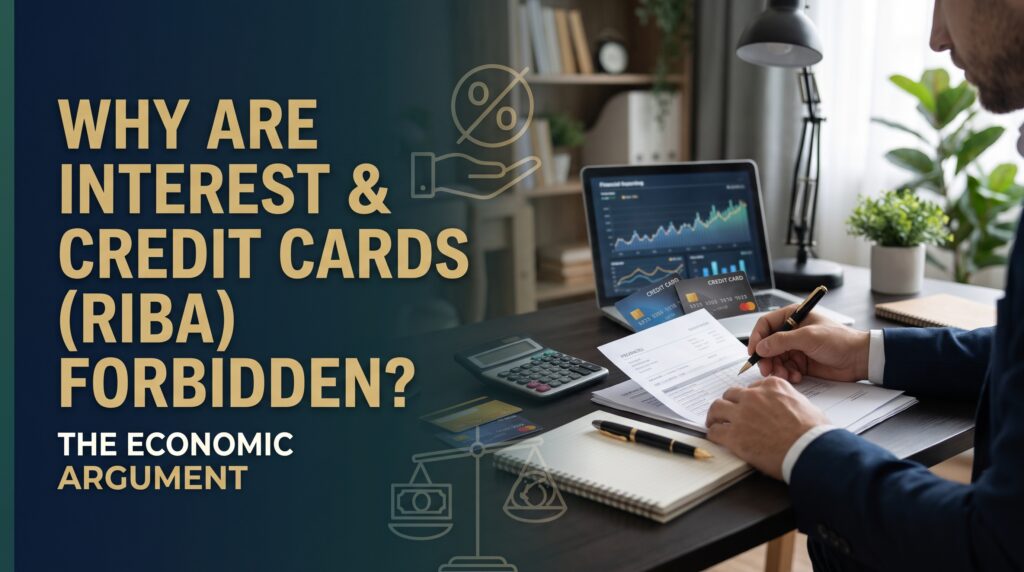
Why Are Interest and Credit Cards (Riba) Forbidden: In today’s modern financial world, interest-based loans and credit cards are treated as normal tools for daily living. However, when we look closely at how economies truly grow and how societies stay stable, we discover why Islam strictly forbids “Riba” (interest and usury). Far from being an outdated restriction, the prohibition of interest is a logical, practical economic safeguard. It protects working families from debt traps, stops wealth from concentrating in the hands of a few, and ensures that money serves real human effort rather than exploiting human need.
목차
| 섹션 제목 | 해결된 주요 질문 |
|---|---|
| Understanding the Purpose of Wealth and Fair Trade | Why do humans need trade to survive, and how does Islam separate fair trade from interest? |
| The Core Economic Argument Against Interest (Riba) | Why does charging interest harm the broader economy and create unfair risk? |
| How Credit Cards Fit Into the Riba Trap | How do modern credit cards encourage overspending and trap people in compounding debt? |
| Wealth Circulation: Islam’s Practical Alternative | What healthy financial system does Islam offer to keep wealth flowing fairly in society? |
| Guidance: Common Misconceptions About Interest and Credit Cards | What common myths prevent people from seeing the real purpose behind forbidding Riba? |
| 자주 묻는 질문(FAQ) | What are the practical answers to everyday questions about loans, inflation, and credit cards? |
Understanding the Purpose of Wealth and Fair Trade
To understand why interest (Riba) is forbidden, we first need to look at how human beings are designed to live on earth. Unlike animals that survive on instinct alone, humans are created with physical limitations that require cooperation. We need shelter, clothing, cooked food, tools, and organized communities to thrive. Because no single person can produce everything alone, human survival depends on fair exchange, mutual support, and honest trade.
In Islam, wealth is not just personal property; it is a trust from the 창조자 that tests how responsibly we earn and spend. Every financial transaction should leave both parties safe from harm and exploitation. When people exchange real goods or genuine services, both sides contribute effort and share real value.
“And do not consume one another’s wealth unjustly…” — Surah Al-Baqarah (2:188)
In ancient times—and even today—people often argued that lending money for interest is no different from earning profit in business. The Quran directly addresses this confusion by drawing a clear line between productive commerce and unproductive interest:
“Those who consume interest cannot stand [on the Day of Resurrection] except as one stands who is being beaten by Satan into insanity. That is because they say, ‘Trade is [just] like interest.’ But Allah has permitted trade and has forbidden interest.” — Surah Al-Baqarah (2:275)
Trade creates real value in the world—a farmer grows food, a builder constructs a home, or a merchant brings goods to a market. Interest, on the other hand, produces nothing. It simply demands extra money from someone who is already in need.
The Core Economic Argument Against Interest (Riba)
When viewed through simple economic logic, Riba breaks the natural balance of a healthy society in three major ways:
1. Guaranteed Profit Without Shared Risk
In any fair business partnership, if a project succeeds, both the investor and the worker share the reward. If it fails despite honest effort, both share the loss. Interest destroys this fairness. A lender demands a guaranteed return regardless of whether the borrower’s business fails, their crops dry up, or they lose their job. The lender takes zero risk while the borrower carries all the burden.
“…And if you repent, you may have your principal—[thus] you do no wrong, nor are you wronged.” — 수라 알-바카라(2:279)
2. Artificial Money Growth vs. Real Productivity
Money is meant to be a medium of exchange—a measuring tool for real goods and human labor—not a commodity that breeds on its own. When money generates more money simply through the passage of time, prices rise, inflation accelerates, and the gap between real work and financial wealth widens. True prosperity comes from human effort, innovation, and useful production, not from charging rent on cash.
3. Concentration of Wealth in a Few Hands
Interest acts like a financial vacuum. It continuously pulls small amounts of money away from millions of working individuals, families, and small businesses, funneling that wealth into the vaults of major lenders and financial institutions. Over time, the rich grow richer without producing goods, while the working class struggles under growing debt.
“And whatever you give for interest to increase within the wealth of people will not increase with Allah. But what you give in zakah, desiring the countenance of Allah—those are the multipliers.” — Surah Ar-Rum (30:39)
How Credit Cards Fit Into the Riba Trap
Modern credit cards may look sleek and convenient, yet they operate on the exact same mechanism of Riba. While marketed as tools of financial freedom, credit cards routinely lead everyday people into silent financial captivity.
- Spending Future Income Today: Credit cards train the mind to buy based on desire rather than actual capability. Instead of living within real means, people spend money they have not yet earned.
- The Compounding Interest Spiral: When a cardholder cannot pay the full balance at the end of the month, high compounding interest kicks in. A small emergency expense or impulse purchase quickly doubles or triples in cost, turning temporary convenience into years of stress.
- Signing an Unjust Contract: Even if someone intends to pay on time, signing a credit card agreement means agreeing to pay interest if a delay occurs—normalizing an unlawful financial condition.
- Mental and Family Strain: Debt does not only drain bank accounts; it damages mental peace, causes arguments within families, and compromises a person’s dignity and independence.
| 특징 | Fair Trade & Ethical Finance | Interest Loans & Credit Cards (Riba) |
|---|---|---|
| Source of Profit | Real goods, services, and human effort | Charging extra money for time and debt |
| Risk Sharing | Shared fairly between buyer, seller, or partners | Placed entirely on the borrower |
| Impact on Wealth | Circulates money across the community | Concentrates wealth among lenders |
| Social & Mental Effect | Builds trust, stability, and peace of mind | Creates debt stress, anxiety, and inequality |
Wealth Circulation: Islam’s Practical Alternative
Islam never forbids a harmful practice without providing a healthier, more practical alternative. Instead of building an economy on debt and interest, Islamic principles encourage wealth circulation, real partnership, and social solidarity.
When wealthy individuals hoard money or lock it into interest-bearing accounts, the real economy slows down. Islam strongly warns against hoarding wealth instead of letting it benefit humanity:
“…And those who hoard gold and silver and spend it not in the way of Allah—give them tidings of a painful punishment.” — Surah At-Tawbah (9:34)
To keep the economy alive and fair, Islam promotes three practical pillars:
- Zakat (Obligatory Wealth Circulation): Every eligible Muslim contributes 2.5% of their surplus saved wealth each year directly to the poor, the needy, and those burdened by debt. This ensures money constantly flows back into the hands of people who will spend it on basic necessities, stimulating real market demand.
- Profit-and-Loss Partnerships: Instead of lending money at interest, investors partner with entrepreneurs. If the business succeeds, they share the profit; if it fails, they share the loss. This encourages careful planning and genuine collaboration.
- Interest-Free Benevolent Loans (Qard Hasan): When someone faces a genuine personal emergency, helping them without demanding extra money builds brotherhood, gratitude, and social safety.
Guidance: Common Misconceptions About Interest and Credit Cards
Many people fall into interest-based systems because they misunderstand the real purpose of Islamic financial laws. The table below clarifies common misconceptions:
| 일반적인 오해 | Reality Based on Quranic Wisdom & Economic Logic |
|---|---|
| “Trade and interest are basically the same thing.” | Trade involves exchanging real goods or services where value is created and risk is shared. Interest charges money for money itself without creating any real product. |
| “A small interest rate or credit card fee does not hurt anyone.” | Every system starts small. When interest is normalized across millions of households, it inflates prices, weakens currency value, and traps vulnerable families in lifelong debt. |
| “Using a credit card is completely fine as long as I pay the bill before the due date.” | Signing a credit card contract legally binds you to an interest penalty if anything goes wrong—such as a medical emergency or delayed paycheck—making you a participant in a Riba agreement. |
| “Without interest, no one would ever help or invest in others.” | Economies thrive through equity partnerships, profit-sharing, trade financing, and 자카트, all of which reward real productivity without exploiting borrowers. |
| “Financial laws in religion are only rituals, not practical economics.” | Divine laws align with human nature and social balance. Forbidding Riba protects human dignity, prevents financial oppression, and keeps communities stable. |
자주 묻는 질문(FAQ)
1. What exactly does the word “riba” mean?
Riba literally means “excess,” “increase,” or “addition.” In financial terms, it refers to any guaranteed, unearned increase charged on a loan or debt—whether it is called bank interest, credit card APR, or usury.
2. Why is “Riba” considered such a serious sin in Islam?
Because Riba causes widespread social injustice. It takes advantage of people during times of financial need, concentrates wealth among the rich, and destroys the spirit of mutual help in society.
3. Are debit cards allowed in Islam?
Yes, debit cards are completely permissible. Unlike credit cards, a debit card only allows you to spend money you already own in your bank account, involving no loan and no interest.
4. What if I need to buy a home or start a business without interest?
Islamic finance offers ethical alternatives such as Murabaha (cost-plus trade financing where the bank buys the asset and sells it to you at an agreed transparent profit) and Musharakah (joint partnership where ownership and risk are shared fairly).
5. Does inflation justify charging interest on personal loans?
In Islam, a personal loan is meant to be an act of kindness, not a profit-making business. If someone wants to protect or grow their wealth against inflation, they should invest in real assets, trade, or profit-sharing businesses rather than lending cash at interest.
6. How can someone escape existing credit card debt?
Start by stopping all new credit card spending immediately and switching to cash or a debit card. List your debts from smallest to largest, cut unnecessary expenses, and pay off the balances as quickly as possible so you can free yourself from ongoing interest charges.


 English
 Bengali
 Chinese
 Dutch
 French
 German
 Greek
 Hindi
 Indonesian
 Italian
 Japanese
 Korean
 Marathi
 Latin
 Portuguese
 Russian
 Spanish
 Swahili
 Telugu
 Vietnamese