Ringkasan Konten
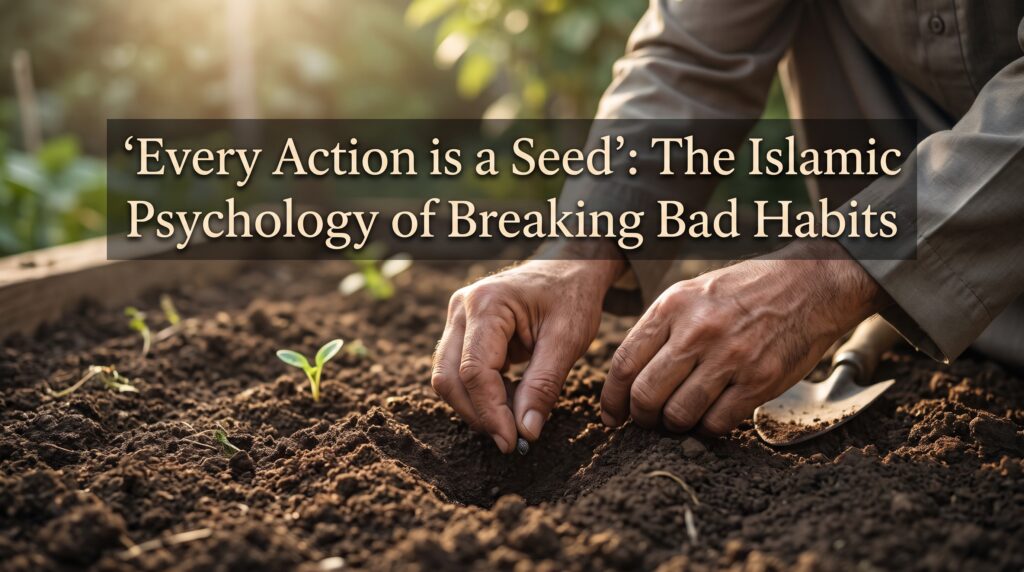
Every Action Is a Seed: The Islamic Psychology of Breaking Bad Habits: Bad habits rarely appear overnight; they grow quietly from small, repeated choices that eventually take deep root in the human mind and soul. In Islam, human behavior is understood through the connection between our natural inner compass (fitrah), our conscious choices (nafs), and the daily discipline of purposeful living. This guide explores the Islamic psychology behind habit formation, showing how small actions act like seeds—and how you can uproot destructive patterns and cultivate lasting self-control using timeless Quranic principles.
Daftar isi
| Judul Bagian | Pertanyaan Kunci Terjawab |
|---|---|
| The Seed Metaphor: How Small Choices Grow Into Deeply Rooted Habits | How do tiny daily actions turn into permanent habits? Why does the Quran compare good deeds and words to living trees? |
| Inside the Human Soul (Nafs): Why Breaking Habits Feels Hard | What happens inside the brain and soul when we repeat a bad habit? What role does Setan actually play in habit loops? |
| 4 Practical Islamic Steps to Uproot Bad Habits and Plant Better Ones | How can you stop feeding bad habits, redesign your environment, and use daily worship to rewire your routine? |
| Common Misconceptions About Habits, Destiny, and Repentance | Does believing in destiny mean you cannot change? What myths and un-Islamic practices stop people from self-improvement? |
| Pertanyaan yang Sering Diajukan (FAQ) | How long does repentance take to work? What if I relapse after trying to quit a bad habit? |
The Seed Metaphor: How Small Choices Grow Into Deeply Rooted Habits
Every human action works like a seed. When you perform an act once, it feels small and almost unnoticeable. However, every time you repeat that action, you water that seed. Over weeks and months, small positive choices grow into strong, fruitful trees of character, while repeated mistakes grow into deeply rooted habits that become difficult to pull out.
Modern psychology recognizes that the human brain records every sensory experience—what we see, hear, feel, and repeat. Because memories leave lasting imprints on the mind, repeated behaviors create automatic pathways. Islam highlighted this exact psychological reality over 1,400 years ago, reminding us that no deed is too small to matter:
“Maka siapa yang mengerjakan kebaikan seberat atom pun ia akan melihatnya, dan siapa pun yang mengerjakan keburukan seberat atom pun ia akan melihatnya.” — Surat Az-Zalzalah (99:7–8)
The Quran frequently uses the imagery of seeds and trees to show how consistent goodness multiplies and stabilizes a person’s life:
“Have you not considered how Allah presents an example: a good word is like a good tree—its root is firm and its branches reach the sky. It gives its fruit at all times by the permission of its Lord. And Allah presents examples for the people so they may reflect.” — Surah Ibrahim (14:24–25)
Just as a firm tree provides steady shade and nourishment, consistent good habits protect your peace of mind. Conversely, neglecting small harmful habits allows their roots to wrap tightly around your daily routine until they feel impossible to break.
Inside the Human Soul (Nafs): Why Breaking Habits Feels Hard
To change a habit, you first need to understand how human beings are designed. Every person enters the world with a clean inner compass known as the fitrah—a natural inclination toward truth, balance, fairness, and self-respect. Alongside this, humans are given free will and an inner self (nafs) capable of choosing between growth and self-harm.
“Demi jiwa dan Dzat yang membaginya, dan mengilhaminya dengan keburukan dan kebaikannya, sungguh beruntunglah orang yang mensucikannya, dan gagallah orang yang merusaknya.” — Surat Ash-Shams (91:7–10)
When we repeatedly indulge in a bad habit—whether it is anger, gossip, laziness, dishonesty, or digital addiction—we gradually bury our fitrah beneath layers of routine and excuse-making. What once felt uncomfortable begins to feel “normal.”
Understanding the True Limit of Setan‘s Influence
Many people assume that bad habits are forced upon them by external evil. In reality, the Quran teaches that Setan (Satan) has zero physical power over human beings. He cannot force your hand, control your brain, or compel you to act against your will. His only tool is subtle whispering (waswasah)—triggering old memories, beautifying harmful shortcuts, and convincing you that you are too weak to change.
“Sesungguhnya baginya (Setan) tidak ada kuasa atas orang-orang yang beriman dan bersandar kepada Tuhannya.” — Surat An-Nahl (16:99)
Once you realize that a bad habit is simply a watered seed—and that whispers only have power when you act on them—you reclaim full responsibility for your choices.
4 Practical Islamic Steps to Uproot Bad Habits and Plant Better Ones
Uprooting a deeply grown tree requires courage, self-honesty, and a steady strategy. Rather than relying on sudden bursts of willpower, Islamic psychology focuses on consistent, realistic steps that reshape your daily environment and mindset.
1. Start With Honest Inner Awareness (Niyyah)
Lasting change never starts from social pressure or trying to impress others; it begins with an honest decision inside your own heart. When you change your behavior solely for human approval, the habit returns the moment nobody is watching. When you change out of accountability to the One Unseen Creator—who sees every private effort—your motivation becomes unshakeable.
“Indeed, Allah does not change the condition of a people until they change what is in themselves.” — Surah Ar-Ra'd (13:11)
Identify one specific habit you want to uproot, name it honestly without excuses, and set a clear intention (niyyah) to replace it for the sake of your own spiritual and mental well-being.
2. Stop Watering the Root by Changing Your Environment
Because the human brain stores visual and auditory triggers, staying in the exact same environment that feeds a bad habit makes recovery exhausting. If you want a destructive tree to wither, you must cut off its water supply.
- Audit your triggers: Notice what time of day, emotional state, or digital space sparks the habit.
- Guard your senses: Lowering your gaze, filtering what you listen to, and stepping away from toxic gatherings prevent new harmful seeds from being planted in your memory.
- Choose uplifting company: Surround yourself with people who respect boundaries, speak truthfully, and remind you of your higher purpose.
3. Use Daily Worship as a Behavioral Reset System
Islam does not leave self-discipline to guesswork; it provides a built-in daily structure designed to interrupt autopilot behavior. The five daily prayers (Salah) divide your day into manageable intervals—dawn, midday, afternoon, sunset, and night—giving you five structured pauses to step away from distractions, wash up, and reset your focus.
“…Indeed, prayer prohibits immorality and wrongdoing…” — Surah Al-Ankabut (29:45)
Pairing your daily prayers with quiet, sincere Dua (personal conversation with Allah) calms anxious impulses and reminds you that you do not have to fight your struggles alone. Even a 30-second pause to ask for strength before acting can break an automatic habit loop.
4. Replace Past Shame With Present Repentance (taubah)
One of the biggest traps in breaking bad habits is living in past regret. Replaying yesterday’s failures drains your energy and leads to hopelessness—which is exactly what keeps people stuck in a cycle of relapse. In Islam, life only exists in the present moment, and the door to taubah (returning to the right path) remains open as long as you are breathing.
“Katakanlah, ‘Wahai hamba-Ku yang berbuat maksiat terhadap diri mereka sendiri [dengan berbuat dosa], jangan berputus asa dari rahmat Allah. Sesungguhnya Allah mengampuni segala dosa. Sesungguhnya Dialah Yang Maha Pengampun lagi Maha Penyayang.'” - Surat Az-Zumar (39:53)
Even more remarkably, sincere repentance paired with positive action transforms past regrets into future strength:
“Except for those who repent, believe, and do righteous deeds—for them Allah will replace their bad deeds with good deeds. And Allah is ever Forgiving, Merciful.” — Surat Al-Furqan (25:70)
Every time you slip, do not abandon your progress. Immediately seek forgiveness (Istighfar), plant one small good deed right away, and keep moving forward.
Common Misconceptions About Habits, Destiny, and Repentance
Cultural myths and misunderstandings often stop people from taking practical steps toward self-improvement. The table below clarifies common misconceptions using clear Quranic guidance.
| Kesalahpahaman atau Praktik Umum | Mengapa Ini Salah | Authentic Islamic Guidance |
|---|---|---|
| “My bad habits are part of my destiny (Qadr), so I cannot change them.” | Destiny reflects Allah’s knowledge, not forced compulsion; humans have free will and are accountable for their choices. | Allah gave you intellect and moral awareness to choose right over wrong; effort and intention determine your growth. |
| “Wearing charms, amulets, or visiting fortune-tellers will break my bad luck or addiction.” | Relying on superstitions, objects, or intermediaries contradicts pure monotheism and avoids personal responsibility. | Only Allah grants strength and guidance; seek help directly from Allah through Dua while taking practical, disciplined action. |
| “If I relapse once, all my previous progress is ruined and Allah will not accept me.” | Expecting instant perfection leads to despair and causes people to give up completely after a single mistake. | Growth is a steady journey; whenever you fall, renew your repentance immediately and continue planting good seeds. |
| “Breaking a habit requires extreme, isolated rituals not taught in the Quran.” | Inventing harsh or unnatural practices creates burnout and disconnects worship from balanced daily living. | Consistent, moderate daily habits—like punctual prayer, honest speech, and gratitude—produce lasting transformation. |
Pertanyaan yang Sering Diajukan (FAQ)
1. Why does Islam compare human actions to seeds?
Just like a seed requires repeated watering before it becomes a visible tree, small daily behaviors gradually shape your character and brain pathways. Recognizing every action as a seed reminds you that tiny, consistent choices eventually determine your future.
2. Apa perbedaan antara Fitrah Dan Nafs in Islamic psychology?
Fitrah is your natural, pure inner compass inclined toward truth, peace, and goodness. Nafs is your conscious inner self that experiences desires, emotions, and free will, and requires continuous training and purification to stay aligned with your fitrah.
3. Why do I feel intense guilt after repeating a bad habit?
Guilt is actually a healthy sign that your fitrah is still alive and recognizing that an action harms your well-being. Instead of letting guilt turn into hopelessness, use it as a signal to seek forgiveness and replace the habit with a constructive action.
4. How does the five-times-daily prayer (Salah) help break bad habits?
Salah acts as a built-in pattern interrupt. Stepping away from screens, work, or emotional triggers five times a day to focus on humility and mindfulness trains your brain in self-control and prevents bad habits from running on autopilot.
5. What should I do if I keep falling back into the same habit?
Never give up on repentance. Analyze what triggered the slip, adjust your environment to make the bad habit harder to access, make a small good habit easier to perform, and sincerely ask Allah for strength each day.
6. Can small good habits really erase the effects of old bad ones?
Yes. Planting and watering good habits creates new mental and spiritual pathways while starving old ones of attention. The Quran confirms that sincere repentance combined with righteous deeds replaces past wrongs with lasting goodness.

 English
 Bengali
 Chinese
 Dutch
 French
 German
 Greek
 Hindi
 Indonesian
 Italian
 Japanese
 Korean
 Marathi
 Latin
 Portuguese
 Russian
 Spanish
 Swahili
 Telugu
 Vietnamese