सामग्री सारांश
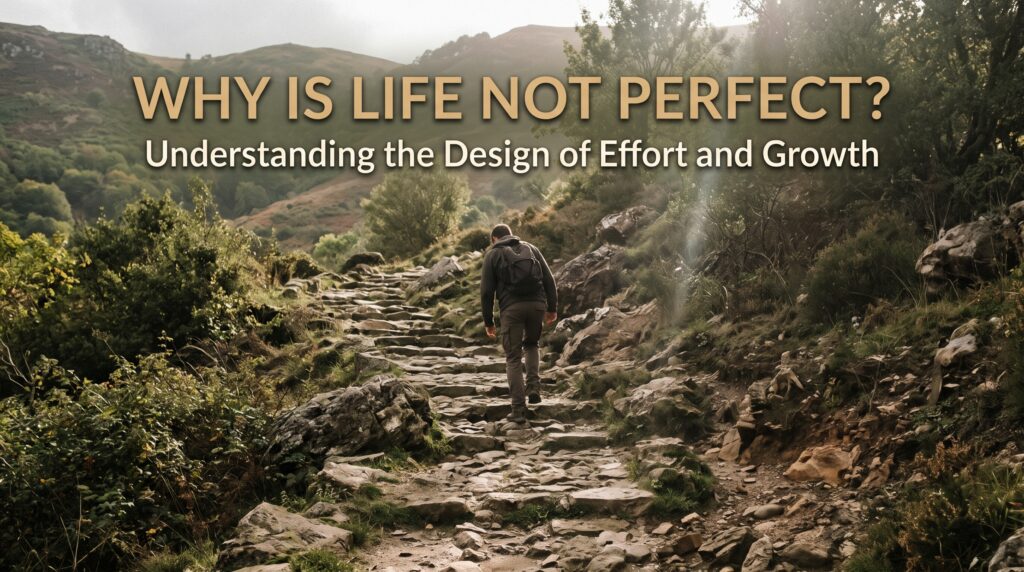
Why is Life Not Perfect? Understanding the Design of Effort and Growth: Many people wonder why life is filled with challenges, limitations, and unanswered questions instead of effortless perfection. Through simple logic, observation of human nature, and timeless Quranic wisdom, this article explains that life on Earth was never meant to be a finished paradise. Instead, it is an intentional testing ground where human limitations, uncertainty, and daily effort work together to build character, resilience, cooperation, and lasting spiritual growth.
विषयसूची
| अनुभाग शीर्षक | मुख्य प्रश्न संबोधित |
|---|---|
| The Purpose Behind an Imperfect World | Why isn’t life on Earth effortlessly perfect? What is the true purpose of human existence? |
| How Human Design Sparks Cooperation and Innovation | Why were humans created physically weaker than many animals? How do our limitations drive growth? |
| Why Uncertainty and Hardship Are Essential for Growth | Why is the future hidden from us? How do struggles and changing circumstances shape human character? |
| The Law of Effort, Intention, and Daily Habits | How does sincere striving lead to success? What role do gratitude and repentance play when we make mistakes? |
| Guidance: Common Misconceptions About Life’s Struggles | What common myths distort how people view hardship, mistakes, and an uncertain future? |
| अक्सर पूछे जाने वाले प्रश्न (एफएक्यू) | Clear answers to common questions about destiny, hardship, effort, and inner peace. |
The Purpose Behind an Imperfect World
Almost every human being asks the same question at some point: If a Wise and Merciful निर्माता designed this universe, why is life so full of struggle, loss, and imperfection?
The answer becomes clear when we look at what Earth is actually designed to be. Life in this world is not a final destination of endless comfort; rather, it is a temporary, purposeful testing ground. If life were completely painless, predictable, and effortless, human beings would never have a reason to think deeply, choose between right and wrong, show compassion, or develop inner strength.
In the Quran, the Creator clearly explains the reason behind life and death:
“जिसने तुम्हें परखने के लिए मृत्यु और जीवन को पैदा किया कि तुममें से कौन कर्म में सबसे अच्छा है - और वह अत्यंत शक्तिशाली, क्षमा करने वाला है।” — सूरह अल-मुल्क (67:2)
Imperfection in our surroundings is not a flaw in creation—it is the exact condition required for moral choice. Furthermore, human life is inherently tied to exertion and perseverance from beginning to end:
“We have certainly created man in hardship.” — सूरह अल-बलद (90:4)
When we stop expecting this temporary world to function like eternal paradise, our perspective shifts. Challenges stop looking like random accidents and start making sense as opportunities to prove our sincerity, patience, and integrity.
How Human Design Sparks Cooperation and Innovation
If you observe nature closely, you will notice something remarkable. Almost every animal enters the world equipped with everything it needs to survive in its environment. A cat does not need shoes, woven clothing, shelter-building tools, or cooked meals to endure the weather. Animals rely primarily on built-in physical strength and instinct.
Human beings, however, were designed differently. Compared to many creatures, humans enter the world physically vulnerable and require years of care just to stand on their own. The Quran highlights this intentional aspect of our creation:
“Allah wants to lighten for you [your difficulties]; and mankind was created weak.” — सूरह अन-निसा (4:28)
Yet alongside this physical vulnerability, humans were given an extraordinary gift that no other earthly creature possesses:
“He created man [and] taught him speech.” — सूरह अर-रहमान (55:3-4)
Why Weakness Plus Speech Creates Growth
This combination—a physically dependent body paired with advanced speech, memory, and reasoning—is the secret behind human civilization:
- Vulnerability creates interdependence: Because we cannot survive alone in harsh environments, we need families, communities, trade, shelter, and mutual support.
- Speech enables shared learning: Unlike animals that rely on short-term sensory instinct, humans attach words to experiences, store complex thoughts, write knowledge down, and pass wisdom to future generations.
- Necessity drives invention: Every tool, home, medicine, and technology exists because human beings had to overcome a limitation through thought and teamwork.
If humans had been created physically invincible and completely self-sufficient, there would be no reason to cooperate, invent, teach, or care for one another. Our physical limits are the very sparks that ignite human intelligence and social unity.
Why Uncertainty and Hardship Are Essential for Growth
Another reason life feels imperfect is that we have zero control over tomorrow. No matter how much technology or data humanity gathers, no person knows what will happen in the next minute. The Quran reminds us of this universal boundary:
“कोई नहीं जानता कि कल वह क्या कमाएगा, और कोई नहीं जानता कि वह किस देश में मरेगा।” — सूरह लुकमान (31:34)
This hidden future is essential for real growth. If you already knew the exact outcome of every choice, courage, trust, and patience would lose all meaning. Because tomorrow is unseen, every decision you make today genuinely reflects your character and intentions.
Ease and Difficulty Work in Pairs
Life moves through changing seasons—youth and old age, health and illness, and gain and loss. Both comfort and struggle serve as examinations of the human heart:
“प्रत्येक प्राणी मृत्यु का स्वाद चखेगा। और हम तुम्हें परीक्षा के लिये बुरे और भले से परखते हैं। और तुम सब हमारी ही ओर लौट आओगे।” — सूरह अल-अनबिया (21:35)
Crucially, hardship is never meant to crush the human spirit. Every difficulty is measured against our inner capacity, and relief is woven directly alongside struggle:
“अल्लाह किसी आत्मा पर उसकी क्षमता से अधिक बोझ नहीं डालता।” — सूरह अल-बकराह (2:286)
“तो निश्चित रूप से, कठिनाई के साथ आसानी आती है। वास्तव में, कठिनाई के साथ आसानी आती है।” — सूरह अश-शरह (94:5-6)
When you face an obstacle calmly, your mind learns problem-solving, your ego softens into humility, and your heart discovers resilience you never knew you had.
The Law of Effort, Intention, and Daily Habits
In a world designed for growth, wishful thinking alone produces nothing. Human progress operates on a clear, fair law of cause and effect: you receive the fruit of what you sincerely work toward.
“And that man will have nothing except what he strives for, and his effort will be seen; then he will be fully rewarded for it.” — Surah An-Najm (53:39-41)
Practical Principles for Navigating an Imperfect Life
- Focus on Intention Over Outcomes: You cannot always control external results, but you have complete control over why you act. Events test your circumstances, while your intention defines your moral worth.
- Plant Good Daily Seeds: Every small action is like a seed. Repeated honesty, patience, and kindness grow into strong, rooted character, just as good words bring lasting benefit:
“Have you not considered how Allah presents an example: a good word is like a good tree—its root firm and its branches in the sky. It gives its fruit at all times by the permission of its Lord.” — Surah Ibrahim (14:24-25)
- Protect Blessings Through Gratitude: Health, time, intelligence, and opportunities grow when appreciated and used responsibly, while carelessness causes them to fade:
“…If you are grateful, I will surely increase you…” — सूरह इब्राहीम (14:7)
- Learn From Mistakes Without Despair: Because humans enter the world without innate knowledge and learn step by step, making mistakes is natural. Imperfection does not mean hopelessness; sincere correction turns past errors into future wisdom:
“Except for those who repent, believe, and do righteous deeds—for them Allah will replace their bad deeds with good deeds. And Allah is ever forgiving and merciful.” — सूरह अल-फुरकान (25:70)
Guidance: Common Misconceptions About Life’s Struggles
When people misunderstand why life is imperfect, they often fall into despair, blame, or unhelpful habits. The table below clarifies common misconceptions using Quranic wisdom and practical logic.
| Common Misconception / Ignorance | Quranic Reality & Logical Truth |
|---|---|
| “Hardship means the Creator is angry with me or has abandoned me.” | Both ease and hardship are natural tests of character (Surah Al-Anbiya 21:35). Struggles build patience, clarify priorities, and unlock hidden ease (Surah Ash-Sharh 94:5-6). |
| “True success means achieving a problem-free, effortless life on Earth.” | Earth is a temporary testing ground for effort and moral growth (Surah Al-Mulk 67:2). Complete, effortless perfection belongs only to the eternal Hereafter. |
| “Consulting horoscopes, palmists, or fortune-tellers can remove life’s uncertainty.” | No created being knows tomorrow (Surah Luqman 31:34). Relying on guesswork distracts from practical planning, sincere effort (Surah An-Najm 53:39), and prayerful trust. |
| “If I make repeated mistakes, I am permanently ruined and cannot change.” | Humans are lifelong learners who naturally stumble. Sincere repentance and corrected action wipe away past stains and transform character (Surah Al-Furqan 25:70). |
अक्सर पूछे जाने वाले प्रश्न (एफएक्यू)
1. Why didn’t the Creator make human beings physically stronger like other animals?
Humans were created physically dependent so they would rely on cooperation, family bonds, and intelligence rather than brute force. Combined with the gift of speech and reasoning, this vulnerability motivated humanity to build communities, invent tools, and share knowledge across generations.
2. If everything is known by the Creator, why does my daily effort still matter?
While the Creator has complete knowledge of all things, the future remains hidden from you. Because you do not know tomorrow, your choices, intentions, and efforts today are completely real and voluntary. You are judged by how sincerely you strive within your knowledge and capacity, not by outcomes beyond your control.
3. Does experiencing pain or delay mean I am failing in life?
No. Delays, obstacles, and pain are natural parts of human growth—just as muscles only strengthen under resistance. In Quranic wisdom, hardship is always paired with ease and serves to purify your intentions, teach patience, and prepare you for greater responsibility.
4. How should I respond when I feel overwhelmed by life’s problems?
Start by focusing on the present moment rather than replaying past regrets or worrying about an unknown future. Break the problem into what is within your control, take practical steps with patience, ask the Creator for guidance through sincere prayer (Dua), and trust that no soul is burdened beyond what it can bear.
5. Why do good people also face difficult trials?
Trials are not exclusively punishments; they are often instruments of elevation and purification. Even the greatest prophets and most righteous people faced severe hardships so their patience, gratitude, and trust in truth could shine as examples for others.
6. What is the single best mindset for living peacefully in an imperfect world?
Live with gratitude for what you have, sincerity in what you do today, kindness toward others, and humility when you make mistakes. When you view every situation—good or difficult—as an opportunity to do what is right, inner peace replaces frustration.
 English
 Bengali
 Chinese
 Dutch
 French
 German
 Greek
 Hindi
 Indonesian
 Italian
 Japanese
 Korean
 Marathi
 Latin
 Portuguese
 Russian
 Spanish
 Swahili
 Telugu
 Vietnamese