सामग्री सारांश
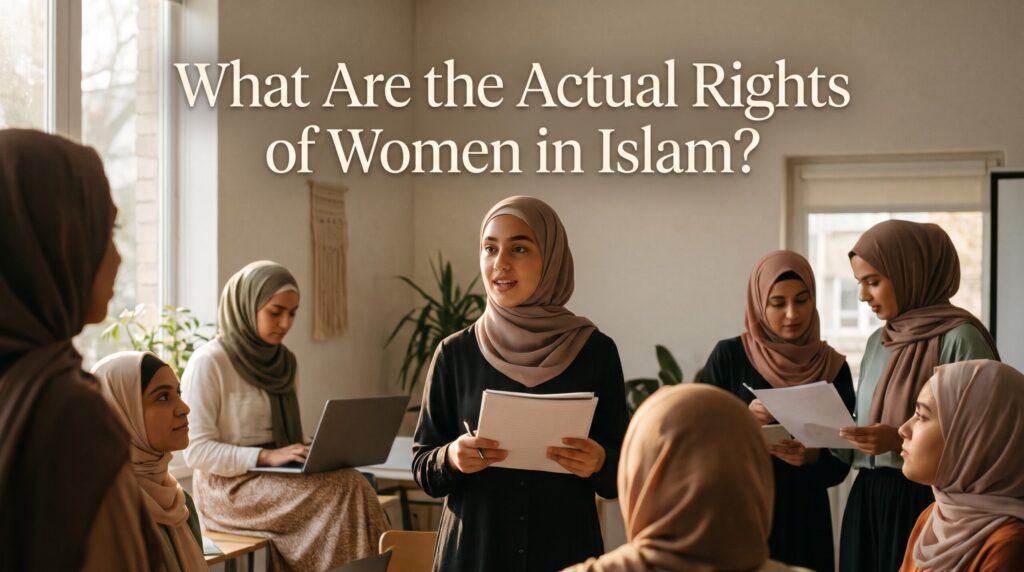
इस्लाम में महिलाओं के वास्तविक अधिकार क्या हैं? कानूनी, वित्तीय और नैतिक गरिमा के लिए एक संपूर्ण मार्गदर्शिका: सार्वजनिक चर्चा अक्सर इस्लाम में महिलाओं के अधिकारों को संदेह या गलतफहमी की दृष्टि से देखती है, अक्सर आदिवासी सांस्कृतिक प्रथाओं को दैवीय कानून के साथ भ्रमित करती है। वास्तव में, इस्लामी रहस्योद्घाटन ने चौदह शताब्दियों पहले महिला कानूनी व्यक्तित्व, स्वतंत्र धन स्वामित्व, वैवाहिक आत्मनिर्णय और आध्यात्मिक समानता का एक क्रांतिकारी ढांचा पेश किया था। यह लेख पवित्र कुरान, प्रामाणिक भविष्यवाणी परंपराओं और प्राकृतिक संतुलन और मानवीय गरिमा के सिद्धांतों पर आधारित इस्लाम में महिलाओं को दिए गए वास्तविक अधिकारों की एक व्यापक, तार्किक जांच प्रदान करता है।
विषयसूची
| अनुभाग शीर्षक | मुख्य प्रश्न संबोधित |
|---|---|
| 1. आध्यात्मिक समानता: नैतिक जवाबदेही और दिव्य मूल्य | क्या इस्लाम महिला आत्मा को पुरुष के बराबर मानता है? दैवीय न्याय व्यक्तिगत मूल्य को कैसे मापता है? |
| 2. पूर्ण वित्तीय स्वायत्तता और आर्थिक सुरक्षा | क्या कोई मुस्लिम महिला स्वतंत्र रूप से संपत्ति रख सकती है? वित्तीय रखरखाव पूरी तरह से पुरुषों पर क्यों डाला जाता है? |
| 3. वैवाहिक और प्रजनन अधिकार: सहमति, मैहर और तलाक | एक महिला के पास विवाह में प्रवेश करने या समाप्त करने के क्या अधिकार हैं? प्रजनन चक्र की सुरक्षा कैसे की जाती है? |
| 4. बौद्धिक, नागरिक और सामाजिक एजेंसी | क्या महिलाओं के लिए शिक्षा प्राप्त करना अनिवार्य है? नैतिक नेता और सामुदायिक सहयोगी के रूप में महिलाएँ क्या भूमिका निभाती हैं? |
1. आध्यात्मिक समानता: नैतिक जवाबदेही और दिव्य मूल्य
इस्लाम में महिलाओं के अधिकारों को समझने के लिए आध्यात्मिक आधार से शुरुआत करनी होगी। कुरान स्थापित करता है कि पुरुषों और महिलाओं की मानव उत्पत्ति बिल्कुल एक जैसी है, जो एक ही आत्मा से बनी है (नफ़्स वहीदा):
“ऐ इंसानों, अपने रब से डरो, जिसने तुम्हें एक आत्मा से पैदा किया, और उससे उसका जोड़ा बनाया और उन दोनों से बहुत सारे पुरुषों और महिलाओं को अलग कर दिया...”
— सूरह अन-निसा (4:1)
इस्लामी धर्मशास्त्र में, महिलाएं “मूल पाप” का कलंक नहीं झेलती हैं। कुरान में दर्ज है कि आदम और हव्वा दोनों को सामूहिक रूप से प्रलोभित किया गया था, दोनों विफल रहे, दोनों ने ईमानदारी से पश्चाताप किया (तौबाह), और दोनों को अल्लाह ने पूरी तरह से माफ कर दिया। एक महिला का आध्यात्मिक मूल्य न तो गौण है और न ही किसी पुरुष रिश्तेदार के माध्यम से प्राप्त होता है।
मूल्य का माप: तक्वा
सृष्टिकर्ता के समक्ष श्रेष्ठता को कभी भी जैविक लिंग, धन या जातीय पृष्ठभूमि से परिभाषित नहीं किया जाता है। सम्मान का एकमात्र मानक है तक्वा (नैतिक सत्यनिष्ठा, ईश्वर-चेतना और धार्मिक आचरण):
“हे मानव जाति, वास्तव में हमने तुम्हें नर और नारी से पैदा किया है और तुम्हारे लिए जातियाँ और जनजातियाँ बनाई हैं ताकि तुम एक दूसरे को जान सको। वास्तव में, अल्लाह की दृष्टि में तुममें से जो सबसे महान है, वही तुममें से सबसे अधिक धर्मी है। निस्संदेह, अल्लाह जानने वाला और जानने वाला है।”
— सूरह अल-हुजुरात (49:13)
प्रत्येक महिला एक स्वतंत्र नैतिक एजेंट के रूप में अल्लाह के सामने खड़ी होती है। उसकी अपनी पसंद, इरादों और कार्यों से परीक्षा ली जाएगी, और उसे अपनी धार्मिकता का पूरा इनाम मिलेगा:
“और जो कोई भी ईमान वाले होते हुए नेक काम करेगा, चाहे पुरुष हो या महिला, वह जन्नत में प्रवेश करेगा और उस पर खजूर के बीज के कण के बराबर भी अत्याचार नहीं किया जाएगा।”
— सूरह अन-निसा (4:124)
2. पूर्ण वित्तीय स्वायत्तता और आर्थिक सुरक्षा
आधुनिक कानूनी प्रणालियों द्वारा विवाहित महिलाओं को स्वतंत्र आर्थिक व्यक्तियों के रूप में मान्यता देने से सदियों पहले, इस्लामी कानून ने स्थापित किया कि एक महिला की वित्तीय पहचान पूर्ण, स्थायी और संप्रभु है।
स्वतंत्र संपत्ति और कमाई
एक मुस्लिम महिला को अपने पिता, पति या भाई की अनुमति, निरीक्षण या सह-हस्ताक्षर के बिना आय अर्जित करने, अचल संपत्ति खरीदने और बेचने, व्यवसाय संचालित करने, कानूनी अनुबंधों पर हस्ताक्षर करने और निवेश का प्रबंधन करने का पूरा कानूनी अधिकार है।
कुरान स्पष्ट रूप से उसके व्यक्तिगत आर्थिक अधिग्रहण की रक्षा करता है:
“पुरुषों के लिए जो कुछ उन्होंने कमाया है उसका हिस्सा है, और महिलाओं के लिए जो कुछ उन्होंने कमाया है उसका हिस्सा है। और अल्लाह से उसकी कृपा के बारे में पूछो। वास्तव में, अल्लाह हर चीज़ को जानने वाला है।”
— सूरह अन-निसा (4:32)
वित्तीय उत्तरदायित्व की विषमता (नफ़क़ाह)
जबकि महिलाओं को अपने धन पर पूर्ण स्वायत्तता का आनंद मिलता है, इस्लामी कानून जानबूझकर उन्हें परिवार के घर को वित्त पोषित करने के कानूनी दायित्व से मुक्त करता है। वित्तीय बोझ पूरी तरह से पुरुषों पर पड़ता है:
“पुरुष महिलाओं के संरक्षक और संरक्षक हैं क्योंकि अल्लाह ने एक को दूसरे की तुलना में अधिक [शक्ति/उपकार] दिया है और क्योंकि वे उन्हें अपने धन से समर्थन देते हैं...”
— सूरह अन-निसा (4:34)
यह महिलाओं के लिए आर्थिक आश्रय बनाता है:
| वित्तीय डोमेन | पति/पिता का दायित्व | महिला/पत्नी का अधिकार |
|---|---|---|
| घर के खर्च | 100% अनिवार्य (आवास, भोजन, वस्त्र, स्वास्थ्य देखभाल, शिक्षा)। | 0% अनिवार्य कानूनी दायित्व। |
| व्यक्तिगत कमाई | पूरे परिवार के लिए साझा करने और प्रदान करने के लिए बाध्य। | 100% निजी संपत्ति; उसके द्वारा किया गया कोई भी योगदान स्वैच्छिक दान के रूप में गिना जाता है (सदक़ा). |
| विरासत का हिस्सा | वितरित करने और आश्रितों पर खर्च करने के लिए बाध्य। | रखरखाव देनदारियों के बिना शुद्ध व्यक्तिगत पूंजी के रूप में रखा गया। |
| कानूनी उपनाम | वंश का पता लगाने के लिए बच्चों को दिया गया। | स्थायी रूप से बनाए रखा गया; एक महिला शादी के बाद अपना पहला नाम कभी नहीं बदलती। |
एक महिला की संपत्ति को उसके पति से पूरी तरह अलग रखकर, इस्लाम महिलाओं को वित्तीय दबाव, शोषण और निर्भरता से बचाता है।
3. वैवाहिक और प्रजनन अधिकार: सहमति, मैहर और तलाक
इस्लाम में विवाह (निकाह) एक अविभाज्य संस्कार नहीं है, न ही यह पिता और दूल्हे के बीच स्वामित्व का हस्तांतरण है। यह एक औपचारिक, पारदर्शी नागरिक अनुबंध है (मिथक) requiring explicit terms, mutual consent, and legal accountability.
1. The Right of Unconditional Consent
A woman cannot be married against her will under any circumstances. Her explicit, voluntary consent is a mandatory legal condition (Shart) for a valid marriage contract.
The Prophet Muhammad ﷺ explicitly declared:
“A previously married woman shall not be married until she is consulted, and a virgin shall not be married until her consent is sought.” They said: “O Messenger of Allah, how is her consent?” He said: “Her silence [or spoken assent].”
— Sahih al-Bukhari (5136)
If a woman is coerced into marriage by cultural pressure or parental force, the contract is legally void (Batil) under authentic Shariah, and an Islamic court is obligated to annul it upon her request.
2. The Right to the Bridal Gift (महर)
Upon marriage, the groom must give the bride a mandatory financial gift known as the महर.
“And give the women [upon marriage] their bridal gifts graciously. But if they give up willingly to you anything of it, then take it in satisfaction and ease.”
— Surah An-Nisa (4:4)
The महर is not a “bride price” paid to the parents; it is the exclusive property of the woman herself. It provides her with immediate financial liquidity and personal independence at the start of the union.
3. The Right to Dignified Exit: Divorce and Khula’
Islam recognizes that living in emotional distress, incompatibility, or domestic cruelty damages human mental health and corrupts the domestic environment. Just as a man may initiate divorce (तलाक), a woman possesses legal mechanisms to terminate an unhappy marriage:
- Khula’ (Wife-Initiated Dissolution): A woman can initiate the dissolution of the marriage if she feels incompatibility or aversion toward her husband, even without having to prove abuse or negligence, typically by returning the महर.
- Faskh (Judicial Dissolution): An Islamic judge dissolves the marriage immediately if the husband commits physical abuse, fails to provide basic financial support (नफ़क़ाह), deserts the marital home, or causes harm.
The Qur’an commands that all marital interactions—whether remaining together or separating—must be conducted with honor and grace:
“…Then, either keep [her] in an acceptable manner or release [her] with good treatment…”
— सूरह अल-बकराह (2:229)
4. बौद्धिक, नागरिक और सामाजिक एजेंसी
A widespread cultural myth suggests that Islam confines women to silent domesticity, denying them intellectual and social development. Authentic Islamic history and scripture prove the complete opposite.
The Obligation to Seek Knowledge
Islam makes intellectual development an unconditional obligation for both sexes:
“Seeking knowledge is an obligation upon every Muslim.”
— Sunan Ibn Majah (224)
Because the Arabic term Muslim in this legal text is grammatically inclusive, education is not a male privilege—it is an individual duty (Fard Ayn).
Historically, Muslim women were scholars of jurisprudence, transmitters of Hadith, physicians, educators, and administrators. Aisha bint Abi Bakr was one of the foremost jurists and scholars of the early Islamic world, and Fatima al-Fihri founded the University of al-Qarawiyyin in 859 CE—the oldest continually operating degree-granting university in the world.
Social Guardianship and Moral Alliance
The Qur’an designates men and women as civic and moral partners in building a just society:
“ईमान वाले पुरुष और ईमान वाली औरतें एक दूसरे के सहयोगी हैं। वे सही का आदेश देते हैं और गलत का निषेध करते हैं और नमाज़ स्थापित करते हैं और ज़कात देते हैं और अल्लाह और उसके रसूल की आज्ञा का पालन करते हैं। अल्लाह उन पर दया करेगा। वास्तव में, अल्लाह शक्तिशाली और बुद्धिमान है।”
— सूरह अत-तौबा (9:71)
Men and women are औलिया (mutual protectors and allies). Both share the social responsibility to speak truth, challenge corruption, encourage justice, and contribute to the well-being of the broader community.
Supreme Honor in Motherhood
Islam assigns the maternal role the highest social honor and emotional reverence in human civilization. The biological load of gestation, childbirth, and nursing is matched by unparalleled ethical status:
A man came to the Messenger of Allah ﷺ and asked: “O Messenger of Allah, who among people is most deserving of my good companionship?” He replied: “Your mother.” The man asked: “Then who?” He replied: “Your mother.” The man asked: “Then who?” He replied: “Your mother.” The man asked: “Then who?” He replied, “Then your father.”
— Sahih al-Bukhari (5971)
By elevating the mother three times above the father in terms of devotion and companionship, Islam establishes that the physical sacrifices of motherhood are recognized with the highest earthly honor.
मार्गदर्शन अनुभाग: सामान्य ग़लतफ़हमियों को सुधारना
| ग़लतफ़हमी/सांस्कृतिक नवप्रवर्तन | इसके पीछे मूल अज्ञान | कुरानिक |
|---|---|---|
| “Islamic law allows forced marriages.” | Patriarchal customs prioritizing family pride, tribal alliances, or money over individual consent. | Forced marriage is strictly prohibited and legally invalid. The Prophet ﷺ explicitly invalidated marriages that took place without the bride’s free consent (Sahih al-Bukhari 5136, 5138). |
| “A woman’s earnings belong to her husband.” | Importing pre-modern property concepts (such as आवरण) into Islamic jurisprudence. | A woman’s wealth is entirely hers (Surah An-Nisa 4:32). A husband cannot take a single cent without her explicit, cheerful permission (Surah An-Nisa 4:4). |
| “Islam discourages the education of women.” | Fear of female empowerment rooted in regional illiteracy and tribal traditions. | Seeking knowledge is an obligatory duty for every Muslim (Sunan Ibn Majah 224). Denying girls an education violates basic Islamic commandments. |
| “A Muslim woman cannot initiate a divorce.” | Cultural taboos that stigmatize divorce and deny women access to legal arbitration. | Islam established the right of खुला’ (wife-initiated divorce) and फस्ख (court annulment) to ensure women are never trapped in unviable or harmful unions (Surah Al-Baqarah 2:229). |
अस्वीकरण
This article is written for educational, philosophical, and moral clarification based on the Holy Qur’an and authentic prophetic teachings. It does not replace individualized legal decrees (fatwas) or legal counsel for marital disputes, divorce proceedings, or inheritance distribution, which require consultation with qualified Islamic jurists and local legal professionals.
चिंतन करने के लिए एक निमंत्रण
The Creator who fashioned humanity endowed men and women with equal spiritual dignity, distinct physiological gifts, and complementary societal duties. His laws were revealed not to oppress, but to liberate the human soul from exploitation, tyranny, and societal decay.
We invite every reader—regardless of your faith, background, or personal worldview—to pick up the Holy Qur’an and read it with reflection and an open heart at least once in your life in your own language. Examine its balanced legal protections, observe its deep defense of human dignity, and experience the clarity that comes from aligning life with divine truth.
अक्सर पूछे जाने वाले प्रश्न (एफएक्यू)
1. Does a Muslim woman have to change her last name after marriage?
No. In Islam, a woman permanently retains her father’s family surname. Taking a husband’s last name is a Western legal custom with no basis in Islamic jurisprudence. Keeping her own name signifies that she remains an autonomous legal entity, retaining her independent lineage and identity.
2. What is the difference between खुला’ और तलाक?
तलाक is a divorce initiated by the husband, where he bears financial responsibilities and forfeits claims to gifts given. खुला’ is a divorce initiated by the wife, allowing her to dissolve the marriage if she feels incompatibility or emotional aversion, typically by returning the महर to release the contract fairly.
3. Can a Muslim woman own a business or work outside the home?
Yes. A Muslim woman has full legal authority to own businesses, manage real estate, and pursue employment, provided the work is ethical (हलाल) and respects Islamic moral boundaries. The Prophet’s ﷺ first wife, Khadijah, was one of the most prominent merchants in Arabia.
4. Why do daughters inherit half of a son’s share in certain family structures?
Islamic inheritance is balanced against financial obligations, not human worth. A brother is legally obligated by divine law to spend his wealth providing housing, food, and care for his mother, sisters, wife, and children. The sister’s share is 100% pure personal savings, as she has zero mandatory financial obligations toward anyone. Furthermore, in several other inheritance scenarios, women inherit equally or more than men.
5. What legal rights does a mother have regarding child custody?
In Islamic jurisprudence, maternal custody (Hadanah) is prioritized during the child’s tender early years because mothers are naturally suited for nurturing and emotional bonding. Even while the child is in maternal custody, the father remains 100% financially responsible for all living, healthcare, and educational expenses.
6. Does Islam tolerate domestic abuse?
No. Domestic violence, cruelty, and emotional abuse are strictly forbidden. The Qur’an commands men to “live with them in kindness” (Surah An-Nisa 4:19). The Prophet Muhammad ﷺ never struck a woman, servant, or child, and explicitly commanded: “Do not strike the female servants of Allah” (Sunan Abi Dawud 2146).
 English
 Bengali
 Chinese
 Dutch
 French
 German
 Greek
 Hindi
 Indonesian
 Italian
 Japanese
 Korean
 Marathi
 Latin
 Portuguese
 Russian
 Spanish
 Swahili
 Telugu
 Vietnamese