Content Summary
When we look at the natural world, humans stand out in a deeply puzzling way. Compared to other creatures, we are born physically fragile and remain heavily dependent on our environment for survival. Yet, we possess an unmatched power: complex speech and intellect. This unique combination of physical weakness and mental superiority forces us to build societies, communicate, and make moral choices. But does blind evolution explain this perfectly balanced contrast, or is it a deliberate design? In this post, we explore insights from the document “Humanity By Quran” to understand how human vulnerabilities and strengths are not accidents of nature but intentional tests of our purpose, choices, and ultimate accountability.
Table of Contents
| Section Title | Key Questions Addressed |
|---|---|
| The Unique Balance of Human Design | Why are humans physically weaker than animals? How does this weakness force us to cooperate? |
| The Gift of Speech and Its Responsibility | How does speech elevate humanity? Why is communication a double-edged sword? |
| Darwin’s Theory vs. Human Reality | Why does human reality contradict the idea of upward physical evolution? |
| The Harm of Misusing Evolutionary Theories | What happens to society when we believe life has no higher purpose than survival? |
| Life as a Deliberate Test | How do our human traits prove that life is a testing ground for accountability? |
The Unique Balance of Human Design
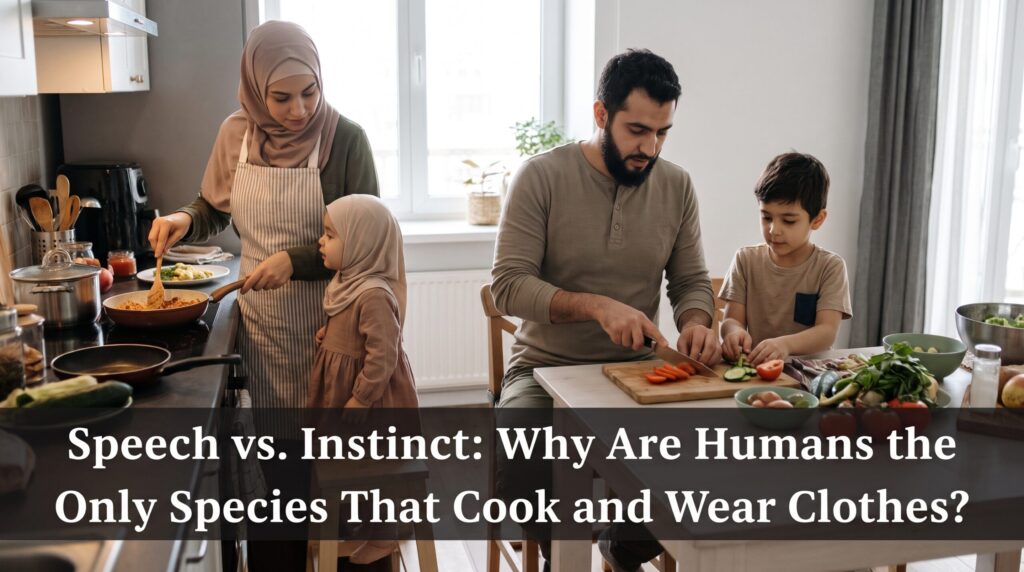
Look at the animal kingdom. A cat does not need to weave clothes to survive the winter, nor does a bird need to build a fire. Animals are equipped with physical traits—fur, tough skin, and natural instincts—that allow them to survive effortlessly in their environments. Humans, on the other hand, are remarkably fragile. We are born physically weak and remain vulnerable to the elements.
However, this physical weakness is not a flaw; it is a profound catalyst. Because we lack natural physical defenses, we are forced to think, invent, and cooperate. Our need for shelter, clothing, and cooked food drives us to build communities and establish trade. This dependency creates the foundation of human society. If we were physically self-sufficient like wild animals, we would never have needed to connect, empathize, or build civilizations.
“We have certainly created man in the best form; then we return him to the lowest of the low.” (Quran, At-Tin 95:4-5)
Our physical fragility is designed to teach us humility, interdependence, and the necessity of mutual support.
The Gift of Speech and Its Responsibility
While our bodies are weak, our minds are granted an extraordinary superpower: speech. Animals can memorize sights and sounds for short-term survival, but humans can assign names to complex concepts, build thoughts, and transfer vast amounts of knowledge across generations.
Speech is the tool that allowed early humans to communicate the discovery of fire, the weaving of clothes, and the laws of justice. It is the foundation of all human progress. Yet, speech is also our greatest test. Words possess the power to heal, inspire, and unite, but they can just as easily destroy, deceive, and ignite conflicts.
“He created man. He taught him speech.” (Quran, Ar-Rahman 55:3-4)
The Prophet Muhammad (peace be upon him) deeply emphasized the weight of our words:
“Whoever guarantees me what is between his jaws (kind and wise use of tongue) and what is between his legs (lawful use of private parts), I guarantee him Paradise.” (Sahih al-Bukhari)
Because humans are uniquely capable of complex communication, we are uniquely accountable for it. Our ability to speak is not merely an evolutionary advantage; it is a divine trust.
Darwin’s Theory vs. Human Reality
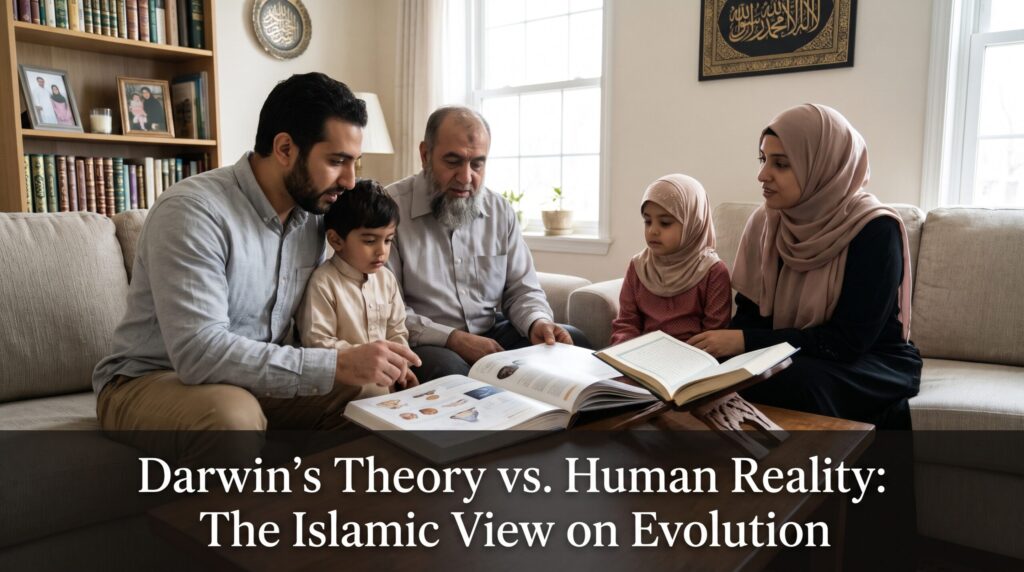
Modern evolutionary theories, particularly Darwin’s, suggest that humans evolved from earlier primates through a process of natural selection, driven purely by the need to survive. However, when we compare this theory to present human reality, significant contradictions emerge.
If natural selection is meant to improve a species for better survival, then the human body should have evolved to become tougher and more resilient to the environment. Instead, human reality shows the exact opposite: as our intellect advanced, our physical forms became weaker and entirely dependent on external tools and clothing.
This stark contrast points away from blind, accidental evolution. A random process of survival of the fittest would not logically produce a creature so physically dependent yet intellectually supreme. This delicate balance reflects intentional design by a Supreme Creator. We were not shaped just to dominate physically; we were shaped for moral responsibility, intellect, and spiritual testing.
The Harm of Misusing Evolutionary Theories
While biology and the study of nature bring great benefits, treating unverified evolutionary assumptions as absolute truths can deeply harm human society. When we teach generations that humanity is merely a cosmic accident driven by “survival of the fittest,” we strip life of its higher purpose.
According to “Humanity by Quran,” when society removes the Creator and accountability from its foundation, the results are devastating. The focus shifts entirely to materialism and biological desires. Morality becomes subjective, and the justification for selfishness, injustice, and exploitation grows. We end up producing highly advanced, technologically rich societies that are emotionally empty and devoid of true meaning.
If life is only about survival and reproduction, then justice, sacrifice, and empathy have no logical anchor. But humans inherently crave justice and meaning, proving that our inner compass demands a connection to something greater than mere biology.
Life as a Deliberate Test
Human abilities—creativity, morality, intellect, and speech—cannot be explained by blind physical processes. We are the only creatures who look up at the stars and ask, “Why am I here?” This deep inner awareness, combined with our physical limits, proves that life on Earth is a well-organized testing ground.
The Creator designed us with free will, the ability to choose between right and wrong. Because we do not know the future, every choice we make, every word we speak, and every action we take is part of our personal test. The ultimate purpose of humanity is to recognize the One Unseen Creator through the signs in nature, to live with justice and gratitude, and to prepare for the Day of Accountability.
“Did you think that We created you without purpose and that you would not be returned to Us?” (Quran, Al-Mu’minun 23:115)
Our weaknesses keep us grounded, our speech allows us to seek and share the truth, and our free will ensures that our ultimate return to the Creator is based on the conscious choices we made during our temporary stay on Earth.
Guidance Section
| Topic / Concept | Common Misconception or Ignorance | The Practical Truth (Based on Quranic Guidance) |
|---|---|---|
| Human Evolution | Humans are just advanced animals that evolved purely to survive and reproduce. | Human uniqueness (weak bodies + advanced speech and morality) points to intentional design for a moral test, not blind survival. |
| Purpose of Weakness | Physical weakness is an evolutionary flaw or disadvantage. | Weakness forces humans to cooperate, build families, and establish societies, which are the grounds for our moral testing. |
| Accountability | There are no consequences to our actions as long as we avoid human laws. | Every word and action is a seed. There is a precise, divine record, and ultimate accountability rests with the Creator in the afterlife. |
Disclaimer
The insights shared in this blog post are intended for educational and reflective purposes, drawing upon the concepts from the provided knowledge files and Islamic teachings. They aim to promote harmony, logical thinking, and moral responsibility. Readers are encouraged to seek knowledge, reflect upon nature, and consult qualified scholars for deeper theological studies.
A Sincere Invitation
True understanding comes from direct reflection. We warmly invite you to read the Holy Quran at least once in your lifetime, in a language you fully understand. Let your own heart and mind observe the wisdom, logic, and profound peace it offers to humanity.
Frequently Asked Questions (FAQs)
1. Why are humans physically weaker than many animals? Human physical weakness is a deliberate design that prevents us from living in isolation. It forces us to use our intellect, invent tools, wear clothing, and most importantly, cooperate with one another to build communities where our moral tests take place.
2. How does the Quran explain human speech? The Quran states that the Creator explicitly taught humanity speech (Ar-Rahman 55:3-4). Speech is not just a biological tool; it is a divine gift that allows us to think deeply, share knowledge, and bear the responsibility of ethical communication.
3. Why can’t evolutionary theory fully explain human purpose? Evolutionary theory focuses on biological survival (survival of the fittest). It cannot explain why humans have an innate sense of morality, a desire for justice, or a spiritual yearning for a Creator. Blind nature cannot produce conscious, purposeful morality.
4. What happens when a society believes life is an accident? When society believes there is no Creator and no afterlife accountability, morality often becomes subjective. This can lead to selfishness, exploitation, and an emotional emptiness where life is only valued by material gain and momentary pleasures.
5. If Allah controls everything, why is life a test? While the Creator has ultimate knowledge, humans do not know the future. We are given free will in the present moment. Life is a test of our intentions, choices, and responses to the situations we face, ensuring our accountability is based on our own actions.