Content Summary
In an increasingly globalized and diverse world, many people wonder: How does Islam instruct believers to interact with neighbors who practice a different faith or no religion at all? While modern discourse can sometimes become polarized by political friction or cultural insularity, the Holy Quran and the authentic Sunnah of Prophet Muhammad ﷺ provide a clear and compassionate standard of conduct. Islamic theology establishes that kindness, generosity, and justice toward neighbors are universal obligations that transcend religious labels. Drawing from the Quranic command of universal benevolence, the ethics of social safety, and the Prophetic model of neighborly coexistence, this guide outlines the rights of non-Muslim neighbors and how every believer can become a genuine source of peace and value in their local community.
Table of Contents
| Section Title | Key Questions Addressed |
|---|---|
| 1. The Universal Mandate: Who Is Your Neighbor in the Quran? | How does Surah An-Nisa (4:36) define the rights of neighbors, and why are these rights independent of belief? |
| 2. The Prophetic Injunction: Why Jibril Elevated the Rights of Neighbors | What authentic Hadiths demonstrate the extraordinary religious weight placed upon caring for neighbors? |
| 3. The Ultimate Test of Faith: Guaranteeing Safety and Psychological Peace | Why is a person’s faith deemed deficient if their neighbor does not feel safe in their presence? |
| 4. Practical Etiquette: Generosity, Food Sharing, and Honoring Boundaries | What tangible daily actions—such as sharing meals, respecting privacy, and curbing noise—are commanded? |
| 5. The Ethics of Communication: Repelling Negativity with Gracious Speech | How do words function as seeds in neighborhood harmony, and how should believers handle conflicts? |
| 6. Justice in Action: Protecting Non-Muslim Neighbors from Harm and Injustice | What legal and moral protections does Islam provide to shield non-Muslim neighbors from discrimination and abuse? |
1. The Universal Mandate: Who Is Your Neighbor in the Quran?
In the Quranic worldview, society is not built upon cold transactional contracts or isolated individualism. Human beings were created with biological vulnerability and mutual dependency, requiring organized communities to thrive.
In Surah An-Nisa, the Creator pairs the core foundation of pure monotheism (Tawheed) directly with social ethics toward the vulnerable, specifically singling out diverse categories of neighbors:
“Worship Allah and associate nothing with Him, and to parents do good, and to relatives, orphans, the needy, the neighbor farther away, the companion at your side, the traveler, and those whom your right hands possess. Indeed, Allah does not like those who are self-deluding and boastful.”
— Surah An-Nisa (4:36)
Understanding the Categories of Neighbors
Classical commentators, such as Ibn Abbas, Al-Qurtubi, and Ibn Kathir, analyzed the comprehensive phraseology of this verse:
- The Near Neighbor (Al-Jar dhi al-qurba): A neighbor who is also a relative or one who lives immediately adjacent to your home.
- The Neighbor Farther Away (Al-Jar al-junub): A neighbor who has no familial ties to you or one who belongs to a different religious, cultural, or ethnic background.
- The Companion at Your Side (As-Sahib bil-janb): Coworkers, classmates, travel companions, and temporary acquaintances.
The Quran does not restrict neighborly kindness to those who share your prayer space or ethnic heritage. Rather, it commands believers to extend good treatment (Ihsan) across all social boundaries:
“Allah does not forbid you from those who do not fight you because of religion and do not expel you from your homes—from being righteous toward them and acting justly toward them. Indeed, Allah loves those who act justly.”
— Surah Al-Mumtahanah (60:8)
Notice the deliberate pairing of two words in this verse: Birr (deep, tender benevolence—the same word used for honoring parents, Birr al-Walidayn) and Qist (uncompromising, objective justice). This proves that goodness toward a peaceful non-Muslim neighbor is not merely a polite tolerance; it is an active spiritual duty beloved by the Creator.
2. The Prophetic Injunction: Why Jibril Elevated the Rights of Neighbors
The Prophet Muhammad ﷺ received repeated divine revelations emphasizing the sanctity of the neighbor. The Archangel Jibril (Gabriel) impressed this duty upon him so forcefully that the Prophet ﷺ anticipated an explicit command of financial inheritance:
“Jibril kept enjoining good treatment of the neighbor upon me until I thought he would make him an heir.”
— Sahih al-Bukhari (Hadith 6014), Sahih Muslim (Hadith 2624)
In Islamic jurisprudence, legal inheritance is reserved for immediate family bonds. By likening the rights of a neighbor to those of an heir, the Prophet ﷺ demonstrated that physical proximity creates a profound moral and social kinship.
The Living Example: Sharing with Jewish and Christian Neighbors
This instruction was applied directly to non-Muslim neighbors throughout early Islamic history. Abdullah ibn Amr, a senior companion of the Prophet ﷺ, had a sheep slaughtered for his household. Upon returning home, his first concern was his non-Muslim neighbor:
Abdullah ibn Amr asked his servant, “Did you give some of the meat to our Jewish neighbor? Did you give some to our Jewish neighbor? For I heard the Messenger of Allah ﷺ say, “Jibril kept enjoining good treatment of the neighbor upon me until I thought he would make him an heir.”
— Sunan Abi Dawud (Hadith 5152), Jami’ at-Tirmidhi (Hadith 1943); graded Sahih
The companion did not ask whether the neighbor was wealthy, poor, or shared his creed. The simple fact that the Jewish man lived in the neighborhood made him an automatic beneficiary of the household’s blessings.
3. The Ultimate Test of Faith: Guaranteeing Safety and Psychological Peace
As highlighted in the foundational principles of Humanity by Quran, the true measure of a meaningful, God-conscious life is when those around you feel entirely safe in their person, mind, dignity, property, and reputation.
A person cannot claim true spiritual maturity while causing anxiety, discomfort, or distress to their neighbors:
The Prophet Muhammad ﷺ declared, “By Allah, he does not believe! By Allah, he does not believe! By Allah, he does not believe!” It was asked, “Who, O Messenger of Allah?” He replied, “The one whose neighbor is not safe from his harm.”
— Sahih al-Bukhari (Hadith 6016), Sahih Muslim (Hadith 46)
The Arabic word used in this Hadith is Bawa’iq, which encompasses betrayal, malicious deception, sudden aggression, annoyance, and petty toxicity.
[ Lack of God-Consciousness ] ───> Noise, Injustice, Inconvenience ───> Neighbors Live in Anxiety
[ Living with Tawheed ]       ───> Respect, Quiet, Generosity     ───> Neighbors Experience Safety
The Safety and Value Matrix
To embody the Prophetic standard, a Muslim must transition from merely avoiding harm to actively creating a beneficial presence:
| A Muslim Avoids Inflicting Harm | A Muslim Actively Brings Value | A Muslim Honors Personal Boundaries |
|---|---|---|
| No noise pollution (loud machinery, late parties, shouting) | Welcoming newcomers to the street | Respecting private property lines |
| No property encroachments (blocking driveways, dumping trash) | Clearing snow, leaves, or hazards from shared walkways | Avoiding intrusive questions or spying on their yard |
| No emotional intimidation or condescending stares | Offering physical help during emergencies or illnesses | Giving families personal privacy and quiet hours |
| No gossiping or slandering their family character | Sharing wholesome home-cooked food and surplus garden produce | Keeping neighborly confidences and agreements strictly intact |
4. Practical Etiquette: Generosity, Food Sharing, and Honoring Boundaries
Islam bridges ideological differences through everyday hospitality. The Prophet Muhammad ﷺ gave practical instructions to ensure neighbors were never forgotten during daily meals:
“O Abu Dharr, when you cook a stew, add extra water to it and look out for your neighbors.”
— Sahih Muslim (Hadith 2625)
Adding extra broth to a pot of soup costs very little, but the psychological message it conveys is profound: You were on my mind while I was feeding my family.
Practical Ways to Care for Non-Muslim Neighbors:
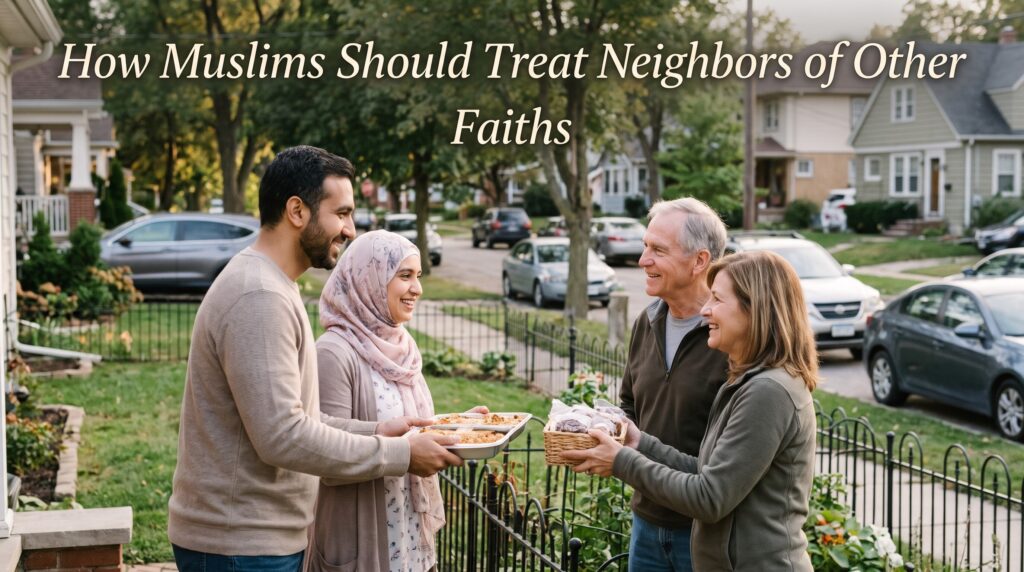
- Exchange Wholesome Gifts: The Prophet ﷺ taught: “Give gifts to one another, and you will love one another” (Al-Adab al-Mufrad 594). Exchanging fruits, sweets, or gifts over fences builds lasting goodwill and dismantles media-driven stereotypes.
- Curbing Disturbances: A believer must be acutely conscious of everyday nuisances. Leaving barking pets untended, allowing car alarms to sound repeatedly, parking inconsiderately, or revving vehicle engines late at night violates the prophetic command of neighborly respect.
- Checking on the Elderly and Ill: When a neighbor falls sick, undergoes surgery, or loses a loved one, offering sincere condolences, mowing their lawn, or picking up their groceries is a living manifestation of Islamic mercy.
When the Prophet’s young Jewish neighbor fell gravely ill, the Prophet Muhammad ﷺ visited the boy in his home to offer comfort and ask about his health (Sahih al-Bukhari 1356), setting an eternal precedent that sickness transcends sectarian divides.
5. The Ethics of Communication: Repelling Negativity with Gracious Speech
Living side-by-side with people of differing worldviews inevitably produces occasional misunderstandings, lifestyle differences, or property disputes. When frictions arise, how should a Muslim respond?
In the Quranic paradigm, words act like seeds planted within human memory. Harsh, defensive words cultivate thorns of bitterness and resentment, while gentle, reasoned words grow into trees of peace:
“Have you not considered how Allah presents an example: a good word is like a good tree—its root firm and its branches in the sky.”
— Surah Ibrahim (14:24)
The Creator commands believers to diffuse hostility through superior moral character:
“And not equal are the good deed and the bad. Repel [evil] by that [deed] which is better; and thereupon the one whom between you and him was enmity [will become] as though he was a devoted friend.”
— Surah Fussilat (41:34)
Prophetic De-escalation in the Neighborhood:
- Listen Without Defensiveness: If a neighbor complains about your children, pets, or yard, listen with empathy instead of counter-attacking.
- Apologize Quickly for Inconveniences: Humility dissolves conflict. Acknowledging an honest oversight (e.g., “I’m so sorry our car blocked your driveway this morning; I will ensure it doesn’t happen again”) preserves long-term community peace.
- Avoid Malicious Assumptions (Zann): The Quran warns: “Avoid much assumption. Indeed, some assumption is sin” (Surah Al-Hujurat 49:12). Never interpret an ambiguous act by a non-Muslim neighbor as hostile discrimination without verifiable facts.
6. Justice in Action: Protecting Non-Muslim Neighbors from Harm and Injustice
Islamic law does not view non-Muslim citizens or neighbors as second-class human beings. On the contrary, the Prophet Muhammad ﷺ issued a stern warning against anyone who attempts to exploit, cheat, or oppress peaceful non-Muslims living within the community:
“Beware! Whoever oppresses a non-Muslim protected citizen (Mu’ahid), curtails his rights, burdens him beyond his capacity, or takes something from him without his good will—I will be his adversary on the Day of Resurrection.”
— Sunan Abi Dawud (Hadith 3052); graded Sahih
Consider the weight of this warning: On the Day of Judgment, when every human will desperately seek the Prophet’s intercession and mercy, the Prophet Muhammad ﷺ himself will stand as the legal adversary of any Muslim who wronged or defrauded a peaceful non-Muslim neighbor.
Upholding Property and Civil Rights
- Financial Integrity: A Muslim cannot default on shared neighborhood association dues, cheat a non-Muslim contractor, or damage shared fences.
- Defending Their Dignity: If a neighbor faces racial, religious, or ethnic harassment from others, a God-conscious believer stands beside them, offering legal support and solidarity.
- Environmental Stewardship: Keeping the street clean, properly bagging waste, and preserving local tree canopies are shared civic responsibilities commanded by Islamic teachings on environmental purity.
Guidance Section: Cultural Misconceptions vs. Quranic Truth
| Area | Misconception / Cultural Habit | True Islamic & Quranic Perspective |
|---|---|---|
| Scope of Neighborly Rights | Believing that neighborly obligations in Islam apply exclusively to fellow Muslims. | Completely false. Surah An-Nisa (4:36) specifically mandates good treatment to the “distant neighbor” (Al-Jar al-junub), and the Prophet’s companions shared meat with Jewish and Christian neighbors. |
| Sharing Halal Food | Assuming it is prohibited to share food with non-Muslim neighbors or accept gifts of permissible food from them. | Permissible and highly encouraged. The Prophet ﷺ accepted gifts of food from non-Muslims and explicitly commanded his companions to share stew with their neighbors. |
| Cold Emotional Detachment | Believing that maintaining a cold, unsmiling, or dismissive attitude toward non-Muslim neighbors is a sign of religious piety. | Contradicts the Sunnah. The Prophet ﷺ said: “Your smiling in the face of your brother is charity” (Jami’ at-Tirmidhi 1956). Kindness (Rifq) and warm greetings are foundational Islamic values. |
| Participating in Neighborly Harm | Overlooking minor offenses against non-Muslim neighbors (such as dumping rubbish near their boundary or parking illegally) as trivial. | Severely sinful. The Prophet ﷺ declared that a person does not truly believe if their neighbor is not safe from their harm (Sahih al-Bukhari 6016). |
| Forced Preaching | Overwhelming neighbors with unsolicited religious debates, unsolicited pamphlets, or aggressive debates. | Guidance must be delivered through wisdom, beautiful character, and respectful dialogue (16:125). Sincere moral behavior (Akhlaq) is the most potent and authentic form of conveying truth. |
Disclaimer
This publication is intended solely for moral, educational, and theological reflection based on the Holy Quran, authentic Sunnah, and recognized classical jurisprudence. It does not constitute a formal legal ruling (Fatwa), nor does it serve as formal civil arbitration for ongoing municipal or legal neighborhood disputes. In cases of property disagreements or criminal damage, parties should consult local legal authorities and accredited mediators.
An Invitation to Reflect
The Holy Quran was not sent to divide humanity into hostile camps; it was revealed as a universal criterion of truth, teaching humans how to build stable, compassionate societies grounded in accountability before the One Unseen Creator. Its verses urge humanity to honor treaties, preserve speech, lower wings of humility, and bring safety to every home and neighborhood. We warmly invite every seeker of truth, neighbor, and reflective thinker to open the Holy Quran and read it with deep contemplation in your own native language at least once in your life. Observe how its guidance dismantles tribal prejudice, establishes social harmony, and provides an eternal blueprint for peaceful coexistence.
Frequently Asked Questions (FAQs)
1. Can a Muslim give gifts or food to non-Muslim neighbors on their holidays?
Yes, exchanging neighborly gifts or sharing permissible (halal) food on their festive or cultural occasions is generally permissible according to many classical and contemporary scholars (including opinions from Ibn Taymiyyah and modern Islamic councils), provided the food itself is halal (no alcohol, pork, or unslaughtered meat) and the gesture is made as an act of neighborly kindness, friendship, and civil coexistence rather than participating in theological acts of polytheistic worship.
2. What should a Muslim do if a non-Muslim neighbor is habitually noisy or rude?
Respond with patience, wisdom, and dignified communication. First, initiate a polite, private conversation explaining the impact of the noise on your rest, children, or work. If the behavior continues, involve neutral neighborhood mediators or building managers. The Prophet Muhammad ﷺ advised a companion facing a difficult neighbor to remain patient while taking transparent, measured steps to resolve the harm without retaliating with equal ugliness.
3. How does Islam view greeting non-Muslim neighbors with “Peace”?
A Muslim should always greet neighbors with warmth, respect, and courteous civility. Greeting them with customary phrases like “Good morning,” “Hello,” or returning expressions of peace promotes warmth and dismantles hostility. The Quran commands: “And when you are greeted with a greeting, greet [in return] with one better than it or [at least] return it [in a like manner]” (Surah An-Nisa 4:86).
4. Is a Muslim allowed to help a non-Muslim neighbor financially?
Yes, absolutely. While obligatory Zakat has specific scriptural channels of distribution, voluntary charity (Sadaqah), interest-free loans, gifts, and humanitarian assistance can be given unconditionally to non-Muslim neighbors experiencing medical crises, job loss, or poverty. Caliph Umar ibn al-Khattab famously allocated regular financial stipends from the Islamic state treasury (Bayt al-Mal) to support elderly and destitute non-Muslim citizens.
5. Can a Muslim visit a non-Muslim neighbor when they are sick or attend their funeral?
Yes. Visiting an ailing non-Muslim neighbor is an established Prophetic practice, as demonstrated when the Prophet ﷺ visited his young Jewish neighbor. Attending the funeral of a non-Muslim neighbor or relative to offer personal condolences, comfort the grieving family, and provide emotional support is also fully recognized in Islamic jurisprudence, provided one does not join in theological prayers that associate partners with the Creator.
6. What did classical scholars say about the physical radius of a “neighbor”?
Early Islamic scholars, including Al-Hasan al-Basri and Imam Az-Zuhri, noted that the traditional neighborhood radius encompasses up to forty houses in every direction (north, south, east, and west). While urban dynamics vary today, this generous definition reminds believers that our circle of care, vigilance, and safety extends far beyond the family living directly next door.