Content Summary
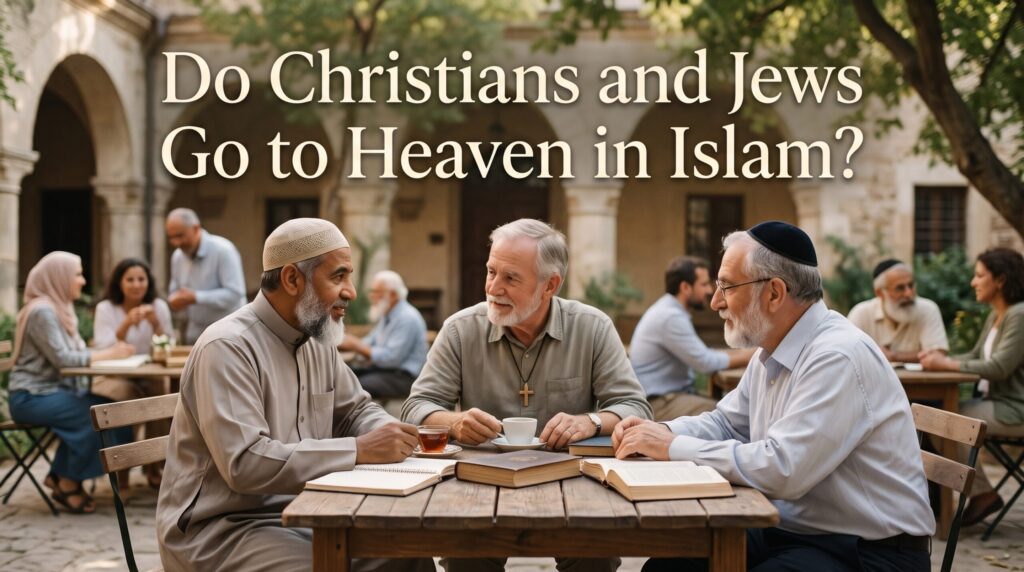
Do Christians and Jews go to heaven in Islam? Quranic Guidance on Salvation, Accountability, and Divine Justice: Few theological questions stir as much passion, debate, and misunderstanding as the question of eternal salvation: Do Christians and Jews go to Heaven according to Islam? While popular cultural assumptions often reduce this inquiry to tribal slogans or narrow exclusion, the Holy Quran presents a far more profound, objective, and justice-centered framework. Salvation in Islam is not an ethnic privilege or an automatic birthright. Instead, it is governed by universal divine laws: sincere devotion to the One Unseen Creator (Tawheed), avoidance of associating partners with Him (Shirk), belief in the Day of Accountability, righteous deeds, and how an individual responds to truth based on the knowledge available to them. This comprehensive guide explores what the Quran and authentic Sunnah explicitly declare about the People of the Book (Ahl al-Kitab), past dispensations, and divine justice.
Table of Contents
| Section Title | Key Questions Addressed |
|---|---|
| 1. The Rejection of Religious Tribalism | Why does the Quran reject the idea that entering Paradise is based on ethnic or sectarian titles alone? |
| 2. The Universal Foundation: Surah Al-Baqarah (2:62) | What does the Quran say about righteous Jews, Christians, and Sabians who lived prior to or alongside prophetic revelations? |
| 3. The Foundation of Monotheism: Tawheed vs. Shirk | Why is pure monotheism the non-negotiable criterion of salvation, and how does the Quran address the Trinity? |
| 4. The Universal Call of Prophet Muhammad ﷺ | How did the final revelation alter spiritual responsibility for humanity, and what did the Prophet ﷺ state regarding the People of the Book? |
| 5. Divine Justice and the Unreached: What If Someone Never Knew Islam? | How does Allah judge individuals who never received the uncorrupted message of Islam during their lifetime? |
| 6. The Ultimate Judge: Sincerity, Effort, and the Scales of Justice | Why are human beings forbidden from passing absolute individual judgments on who enters Heaven or Hell? |
1. The Rejection of Religious Tribalism
In many societies, religion is treated as a cultural tribe. People assume that because they were born into a particular community, carry a specific name, or practice inherited rituals, they hold an exclusive, guaranteed passport to Paradise.
The Quran thoroughly dismantles this complacency. During the era of the Prophet Muhammad ﷺ, both historical groups made exclusive claims to divine salvation, asserting that God’s grace belonged exclusively to their identity groups.
The Creator addresses this claim directly:
“And they say, ‘None will enter Paradise except one who is a Jew or a Christian. ‘That is [merely] their wishful thinking. Say, ‘Produce your proof if you should be truthful.’ Yes! On the contrary, whoever submits his face in Islam to Allah while being a doer of good will have his reward with his Lord. And no fear will there be concerning them, nor will they grieve.”
— Surah Al-Baqarah (2:111-112)
Allah clarifies that Paradise is not distributed through wishful thinking (Amani). The word “Islam” in its primary linguistic and spiritual reality means “conscious submission to the One Creator.”
Salvation is governed by an individual’s inward sincerity and outward moral integrity, not by sectarian branding.
2. The Universal Foundation: Surah Al-Baqarah (2:62)
To understand how Islam views righteous believers from earlier communities, one must study one of the most foundational verses in the Holy Quran regarding the People of the Book (Ahl al-Kitab):
“Indeed, those who believe, and those who were Jews or Christians or Sabeans—those [among them] who believed in Allah and the Last Day and did righteousness—will have their reward with their Lord, and no fear will there be concerning them, nor will they grieve.”
— Surah Al-Baqarah (2:62)
This principle is repeated with equal emphasis in Surah Al-Ma’idah:
“Indeed, those who believed, and those who were Jews or Sabeans or Christians—those [among them] who believed in Allah and the Last Day and did righteousness—no fear will there be concerning them, nor will they grieve.”
— Surah Al-Ma’idah (5:69)
Historical Context and Classical Understanding
When the Prophet’s companion Salman al-Farsi (may Allah be pleased with him) asked about the pious monks and righteous Christian mentors he had studied under before meeting Prophet Muhammad ﷺ—men who lived strictly upon the monotheistic teachings of Jesus, fastidiously worshipped God, and died before the final message reached them—this verse was revealed.
Classical Quranic commentators, including Ibn Kathir and At-Tabari, explain that this verse guarantees divine reward for:
- The True Followers of Moses (A.S.): Those who adhered faithfully to the Torah and worshipped the One God without deviation until the arrival of the prophet Jesus (A.S.).
- The True Followers of Jesus (A.S.): Those who held to the pure monotheistic Gospel (Injeel), recognized Jesus as a noble servant and Messenger of God, and died before the advent of Prophet Muhammad ﷺ.
- The Sincere Monotheists (Hunafa and Sabians): Those who rejected idolatry and polytheism, living upon pure natural monotheism (Fitrah) in eras between prophetic missions.
Allah does not erase or disregard the sincere devotion and sacrifices of past righteous generations. Their reward is preserved with their Lord.
3. The Foundation of Monotheism: Tawheed vs. Shirk
While the Quran honors the righteous among past communities, it draws an unshakeable boundary when it comes to the nature of the Creator. Islam teaches that humanity was created to recognize the One Unseen Creator directly, without human intermediaries, symbols, or associates.
The Quran highlights that deviations entered previous faiths over time—not out of ignorance, but through theological alterations, translation shifts, and cultural compromises:
“Say, ‘O People of the Book, come to a word that is equitable between us and you—that we will not worship except Allah and not associate anything with Him and not take one another as lords instead of Allah.’ But if they turn away, then say, ‘Bear witness that we are Muslims [submitting to Him].'”
— Surah Aal ‘Imran (3:64)
Correcting the Concept of Divinity
The Quran firmly rejects the attribution of divine offspring, partnership, or co-equality to the Creator. While Islam honors Jesus (‘Isa ibn Maryam) as one of the greatest Messengers of God, the Messiah, and a Word bestowed upon Mary, it rejects the doctrine of the Trinity and divine sonship:
“They have certainly disbelieved who say, ‘Allah is the Messiah, the son of Mary,’ while the Messiah has said, ‘O Children of Israel, worship Allah, my Lord, and your Lord.'” Indeed, he who associates others with Allah—Allah has forbidden him Paradise, and his refuge is the Fire. And there are not for the wrongdoers any helpers. They have certainly disbelieved those who say, “Allah is the third of three,” and there is no god except one God…”
— Surah Al-Ma’idah (5:72-73)
“Say, ‘He is Allah, [who is] One. Allah, the Eternal Refuge. He neither begets nor is born, nor is there to Him any equivalent.'”
— Surah Al-Ikhlas (112:1-4)
The Quran identifies Shirk (associating partners with the Creator) as the ultimate spiritual distortion because it directs worship—the very purpose of human creation—toward created, mortal beings.
       [ Pure Tawheed ]                [ Theological Deviation ]
   Direct worship of the One           Worshiping human beings,
        Unseen Creator                  idols, or divine sons
              │                                   │
              ▼                                   ▼
    Preserves Spiritual Root             Severs Connection to Root
  Accepted Path to Salvation             Forbidden Entry to Paradise
4. The Universal Call of Prophet Muhammad ﷺ
When Prophet Muhammad ﷺ was sent, his mission was not to introduce a brand-new religion, but to confirm, clarify, and complete the original message taught by Abraham, Moses, David, and Jesus.
Because the text of the Holy Quran was divinely protected from textual corruption, it was established as the final criterion (Al-Furqan) for all humanity until the Day of Judgment:
“And we have revealed to you, [O Muhammad], the Book in truth, confirming that which preceded it of the Scripture and as a criterion over it…”
— Surah Al-Ma’idah (5:48)
The Prophet Muhammad ﷺ clarified the universal scope of this final message:
“By the One in Whose hand is the soul of Muhammad, no one of this nation—Jew or Christian—hears of me and then dies without believing in that with which I was sent, except that he will be of the companions of the Fire.”
— Sahih Muslim (Hadith 153)
What Does “Hearing of the Prophet” Mean?
Eminent Islamic scholars, including the classical master Imam Al-Ghazali (in his celebrated work Faysal al-Tafriqah), explained this Hadith with profound nuance:
- Those who never heard of the Prophet: They are exempt from this warning and are judged separately under divine mercy.
- Those who heard only a deformed, slanderous caricature: People who only know Prophet Muhammad ﷺ as a violent tyrant, impostor, or false figure—as presented by biased propaganda—have not truly received the message. Al-Ghazali argues they fall into the same category as those who never heard it.
- Those to whom the authentic message was presented clearly: An individual who receives the uncorrupted message of Islam, recognizes its truth, but rejects it out of worldly pride, family pressure, political arrogance, or stubbornness falls under the direct warning of the Hadith.
5. Divine Justice and the Unreached: What If Someone Never Knew Islam?
A frequent, compassionate question arises: What about a sincere, morally righteous Christian, Jew, or non-Muslim living in an era, geography, or environment where the true, unadulterated message of Islam never reached them?
The Quran establishes a universal principle of divine fairness:
“…And never would we punish until we sent a messenger.”
— Surah Al-Isra (17:15)
“Allah does not burden any soul beyond its capacity…”
— Surah Al-Baqarah (2:286)
“And no bearer of burdens will bear the burden of another…”
— Surah Al-An’am (6:164)
The Principle of the Period of Interval (Ahl al-Fatrah)
Islamic theology establishes that God’s justice is absolute (‘Adl). People who lived in remote areas, children who died before reaching the age of mental maturity, individuals with severe cognitive disabilities, or people who were never presented with the authentic message of Islam are classified as Ahl al-Fatrah (people of the interval).
On the Day of Judgment, Allah—who knows every nuance of the human heart, every circumstance, and every limitation—will test these souls directly with a distinct, customized trial suited to His supreme knowledge and justice. No individual will ever enter Hellfire unjustly or for failing to follow a guidance that never reached them.
6. The Ultimate Judge: Sincerity, Effort, and the Scales of Justice
Human life on Earth is designed as an individual, recorded test:
“He who created death and life to test you as to which of you is best in deed—and He is the Exalted in Might, the Forgiving.”
— Surah Al-Mulk (67:2)
“And We place the scales of justice for the Day of Resurrection, so no soul will be treated unjustly at all. And if there is [even] the weight of a mustard seed, We will bring it forth. And sufficient are We as accountant.”
— Surah Al-Anbiya (21:47)
Why Believers Never Pronounce Personal Judgments
It is a grave sin in Islam for any human being to look at a specific living individual and declare: “That person is guaranteed Hellfire” or “That person is guaranteed Paradise.”
Judgment belongs exclusively to the Creator:
- The Unseen Heart (Qalb): No human knows what another person whispers to their Creator in their final hours, nor what genuine repentance (Tawbah) may take place before death.
- True Circumstances: Only Allah knows what barriers, generational trauma, misinformation, and cognitive hurdles an individual faced during their search for truth.
- The Prophetic Standard: Our duty as Muslims is to convey the truth with kindness, live as trustworthy examples of moral beauty, defend justice, and pray for guidance—leaving the ultimate ledger of judgment to the Lord of all the worlds.
Guidance Section: Misconceptions vs. Quranic Truth
| Area | Misconception / Cultural Habit | True Islamic & Quranic Perspective |
|---|---|---|
| Tribal Salvation | Believing that anyone born with a Muslim name enters Paradise automatically, regardless of their sins or rejection of accountability. | The Quran severely refutes tribal entitlement. Faith requires sincere submission, pure monotheism, and righteous deeds (Surah Al-Baqarah 2:112). A Muslim who oppresses others or lives hypocritically faces severe accountability. |
| Blanket Damnation of All Past Non-Muslims | Claiming that all Christians and Jews throughout history are in Hellfire, including those before Prophet Muhammad ﷺ. | Contradicts Surah Al-Baqarah (2:62). Sincere followers of Moses upon the Torah and followers of Jesus upon the original monotheistic Gospel who died before Islam reached them have their reward with Allah. |
| Total Theological Pluralism | Believing that all modern theological beliefs—including the Trinity, worshipping Jesus, or idol worship—are equally valid and approved paths to God. | Islam does not endorse theological relativism. Tawheed (uncompromising monotheism) is the absolute foundation of truth. Attributing partners or offspring to the Creator (Shirk) is definitively rejected in Surah Al-Ma’idah (5:72-73). |
| Damnation of the Unreached | Assuming that a good person who lived and died in isolation without ever hearing of Islam is automatically thrown into Hell. | Directly contradicts Surah Al-Isra (17:15): “And never would We punish until We sent a messenger.” Allah does not punish anyone who did not receive true, uncorrupted guidance. |
| Usurping Allah’s Judgment | Lay Muslims arrogantly pointing fingers at specific living individuals and pronouncing whether they are destined for Heaven or Hell. | Strictly prohibited. Only Allah knows the ultimate fate of any individual soul. A believer must maintain humility, hope for mercy, and avoid issuing divine sentences. |
Disclaimer
This article is prepared solely for spiritual, educational, and theological reflection based on the Holy Quran and authentic Sunnah. Islamic theology regarding the afterlife (Al-Akhirah) is governed by divine revelation, and final judgment on any individual soul belongs exclusively to Allah, the All-Knowing, the Most Just. This publication does not constitute an official legal ruling (Fatwa), nor does it pronounce judgment upon any living person.
An Invitation to Reflect
The Holy Quran was not revealed to breed hatred or entrench sectarian boundaries; it was revealed as a universal criterion of truth, calling all human beings back to direct connection with their Creator. It removes human intermediaries, honors all previous messengers, and establishes justice upon the Earth. We warmly invite every Christian, Jew, agnostic, and seeker of truth to open the Holy Quran and read it with reflection in your own native language at least once in your life. Observe how its pristine verses elevate human dignity, clarify the mysteries of faith, and invite the soul to ultimate tranquility and peace.
Frequently Asked Questions (FAQs)
1. Does Surah Al-Baqarah (2:62) mean that all Christians and Jews go to Heaven today?
Classical scholars, such as Ibn Abbas and Ibn Kathir, clarify that verse 2:62 refers to those followers of Moses and Jesus who lived in their respective eras upon genuine monotheism and righteous deeds before their scriptures were altered or before the arrival of the subsequent prophet. For anyone living after the arrival of Prophet Muhammad ﷺ to whom the message has been clearly and accurately presented, the universal path to salvation requires embracing the final revelation and accepting pure Tawheed.
2. What happens to a Christian or Jew who lived a life of immense charity and goodness?
In Islam, no good deed is lost or wasted. The Quran declares: “Whoever does an atom’s weight of good will see it” (Surah Az-Zalzalah 99:7). For deeds to achieve eternal salvation in the Hereafter, they must be anchored in the correct spiritual foundation: pure belief in the One Creator without associating partners (Tawheed). If an individual never received the authentic message of Islam, their sincere deeds and pursuit of truth will be weighed by the All-Just Creator on the Day of Resurrection.
3. Why is associating partners with God (Shirk) considered unforgivable?
The Creator is the sole fashioner, sustainer, and provider of human existence. To attribute His attributes, prayers, or divinity to a created mortal—whether an idol, a saint, or a prophet—is the greatest injustice against reality itself. However, as the Quran states in Surah Az-Zumar (39:53), Shirk is completely forgiven if a person sincerely repents and returns to pure monotheism during their worldly lifetime before death arrives.
4. Can Muslims attend the funerals of Christian or Jewish friends and family?
Yes, Muslims are encouraged to show kindness, comfort grieving families, and offer condolences to neighbors and relatives of other faiths. While a Muslim does not participate in theological rites that involve prayers to anyone other than the One God (such as invocations to Jesus or saints), offering emotional presence, expressing sympathy, and maintaining respectful kinship ties is an established Prophetic virtue.
5. What is the status of the “People of the Book” (Ahl al-Kitab) in Islam?
The Quran accords Christians and Jews an elevated, honorable status distinct from polytheists or atheists. Islam permits Muslims to consume their lawfully slaughtered meat and permits Muslim men to marry chaste women from among them (Surah Al-Ma’idah 5:5). These legal permissions reflect historical, scriptural kinship and foster social peace and mutual respect.
6. What should a Muslim say when asked, “Will I go to Hell because I am not a Muslim?”
Respond with wisdom, humility, and theological clarity: “I do not know where I myself will end up, because final judgment belongs only to Allah. Islam teaches that God is perfectly just and will never wrong any soul. He judges everyone based on the knowledge they received, their sincerity in seeking truth, and their devotion to the One Creator. Our duty is simply to seek the truth sincerely, worship God alone without partners, and do good.”