Content Summary
Psychology of Bad Language: Words are the invisible threads that hold human society together. While physical actions are visible, the psychological impact of our speech often runs much deeper. Bad language, particularly backbiting and gossip, is not just a bad habit; it is a destructive psychological behavior that tears apart the fabric of trust and unity. According to the profound insights found in the document “Humanity By Quran,” the unique human ability to speak is a divine trust, and misusing it through backbiting is one of the quickest ways to destroy social relationships. In this post, we will explore the psychology behind why people backbite, the immense social harm it causes, and how the practical, logical guidance of Islam provides the ultimate cure for our tongues and our communities.
Table of Contents
| Section Title | Key Questions Addressed |
|---|---|
| The Hidden Harm of Words: More Than Just Sounds | Why is human speech considered a profound superpower? |
| The Psychology of Backbiting: Why Do We Do It? | What drives humans to speak poorly about others behind their backs? |
| The Social Destruction: How Gossip Tears Communities Apart | How does bad language destroy trust and social stability? |
| The Divine Solution: Accountability and Guarding the Tongue | How does Islam cure the psychological urge to backbite? |
| Planting Good Seeds: Cultivating Ethical Communication | How can we replace toxic language with words that heal and build? |
The Hidden Harm of Words: More Than Just Sounds
Unlike animals, which use basic sounds to communicate immediate physical needs like hunger or fear, humans possess the complex ability to build thoughts, share abstract concepts, and transfer knowledge across generations. This is what makes human speech a true superpower.
However, because words have power, they do not just vanish into thin air after they are spoken. Words act like seeds planted in the minds and hearts of others. As highlighted in “Humanity By Quran,” this immense capability makes the tongue the primary tool through which our character is tested. Bad language, insults, and backbiting leave lasting psychological scars. They trigger defensiveness, awaken the ego, and create lingering anxieties. When we use words carelessly, we are not just making sounds; we are actively altering the emotional reality of those around us.
The Psychology of Backbiting: Why Do We Do It?
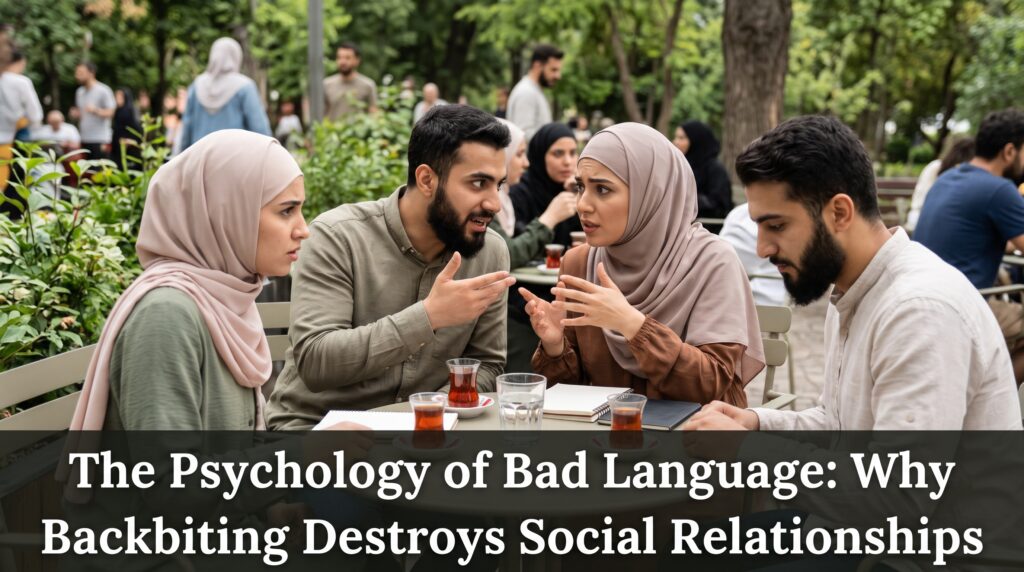
To stop backbiting, we must first understand the psychology behind it. Why is it so tempting to speak negatively about someone who is not in the room?
Psychologically, backbiting often stems from inner insecurity, jealousy, or a desire to bond with others by creating a mutual “enemy.” When people feel inadequate, lowering someone else’s status through gossip provides a temporary, artificial boost to their own ego. It is a defense mechanism used to deflect attention from one’s own flaws.
Islam recognizes these hidden psychological diseases. The Qur’an identifies that differences among people often lead to jealousy and rivalry, which then manifest through the tongue. To cure this, the Qur’an strongly prohibits letting assumptions and insecurities turn into harmful speech:
“O you who have believed, avoid much assumption. Indeed, some assumption is sin. And do not spy or backbite each other…” (Surah Al-Hujurat 49:12)
By addressing the root cause—our inner thoughts and assumptions—Islam cuts off the psychological pathway that leads to backbiting.
The Social Destruction: How Gossip Tears Communities Apart
Society functions on a single, fragile currency: trust. When you know that someone is willing to smile at you but speak poorly of you behind your back, trust is instantly shattered.
According to “Humanity By Quran,” human beings were designed physically weak so that we would rely on one another to survive. We need communities, families, and trade to thrive. Backbiting strikes at the very core of this necessary social interdependence. When gossip spreads, it creates paranoia. People begin to isolate themselves, fearing they will be the next target.
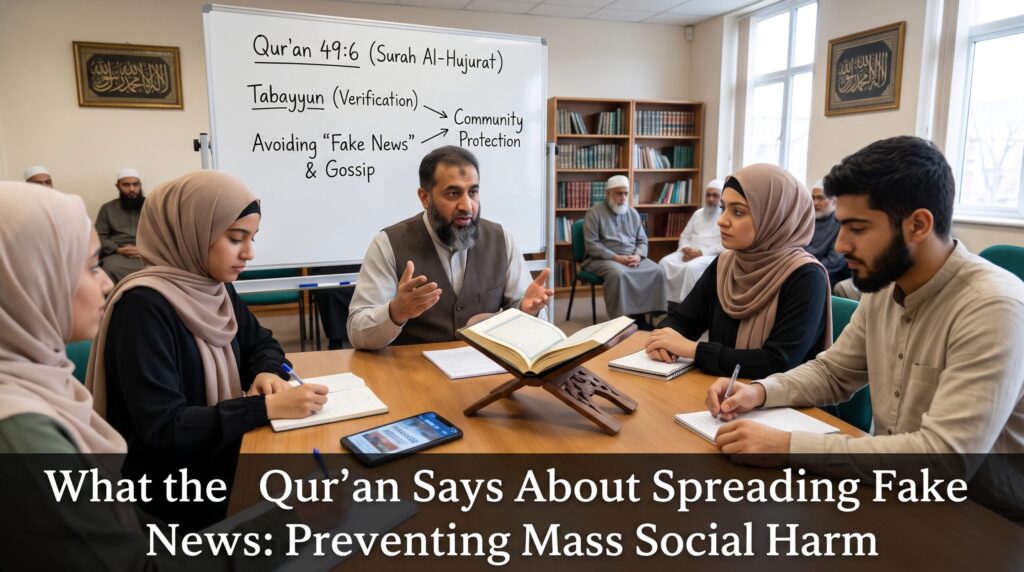
Furthermore, bad language and backbiting often involve forwarding unverified information, which can ruin reputations and spark conflicts that last for generations. The Qur’an provides a timeless ethical command to prevent this social destruction:
“O you who have believed, if there comes to you a disobedient one with information, investigate, lest you harm a people out of ignorance and become, over what you have done, regretful.” (Surah Al-Hujurat 49:6)
The Divine Solution: Accountability and Guarding the Tongue
The ultimate cure for the psychology of bad language is the deep realization of divine accountability. When a person truly believes that they are unseen by human eyes but fully seen and heard by the Creator, their behavior completely changes.
In Islam, there is no such thing as “harmless gossip.” Every word has weight, and the Creator has established a perfect system where our words are permanently documented.
“Not a word does he utter but that there is an observer near him ready [to record].” (Surah Qaf 50:18)
Prophet Muhammad (peace be upon him) understood that the tongue is the hardest part of the body to control, which is why he offered a profound guarantee regarding it:
“Whoever guarantees me what is between his jaws (kind and wise use of the tongue) and what is between his legs (lawful use of private parts), I guarantee him Paradise.” (Sahih al-Bukhari)
When we filter our speech through the fear of accountability, we discipline our minds. We stop speaking just to satisfy our egos and start speaking to promote justice and peace.
Planting Good Seeds: Cultivating Ethical Communication
To eliminate bad language, we must replace it with good language. The psychology of positive reinforcement shows that when we actively practice kindness, our mindset shifts from critical to compassionate.
“Humanity By Quran.pdf” beautifully explains that every word is like a seed. If you repeatedly water it, it becomes a strong tree. We have the choice to plant weeds of gossip or trees of wisdom. The Qur’an itself uses this powerful metaphor:
“Have you not considered how Allah presents an example, [making] a good word like a good tree, whose root is firmly fixed and its branches [high] in the sky?” (Surah Ibrahim 14:24)
By consciously choosing to speak well of others, replying to harshness with patience, and keeping the secrets of our friends, we become a source of safety. A truly successful person is one whose presence brings peace and whose words bring value.
Guidance Section
| Topic / Concept | Common Misconception or Ignorance | The Practical Truth (Based on Quranic Guidance) |
|---|---|---|
| Backbiting (Gheebah) | Backbiting is harmless as long as the person doesn’t hear it; it’s just “venting” or sharing opinions. | Backbiting is a major sin that destroys social trust. It is psychologically damaging and strictly forbidden, compared in Islam to eating the flesh of one’s dead brother. |
| Casual Gossip | Spreading rumors or unverified news is just part of normal social conversation and entertainment. | Forwarding unverified news causes immense harm and injustice. The Qur’an commands us to verify information to prevent destroying reputations out of ignorance. |
| Freedom of Speech | I have the freedom to say whatever I want, including insulting others, if it is my honest opinion. | Freedom comes with profound accountability. Every word is recorded by angels. True ethical communication demands justice, respect, and avoiding mockery and offensive nicknames. |
Disclaimer
The insights shared in this blog post are intended for educational and reflective purposes, drawing upon the concepts from the provided knowledge files and Islamic teachings. They aim to promote harmony, logical thinking, and moral responsibility. Readers are encouraged to seek knowledge, reflect upon nature, and consult qualified scholars for deeper theological studies.
A Sincere Invitation
True understanding comes from direct reflection and an open heart. We warmly invite you to read the Holy Quran at least once in your lifetime, in a language you fully understand. Let your own mind observe the wisdom, logic, and profound peace it offers to humanity.
Frequently Asked Questions (FAQs)
1. Why is backbiting so psychologically damaging? Backbiting destroys the foundational trust required for healthy human relationships. Psychologically, it creates paranoia and insecurity within a community, as people realize that if someone gossips to them, they will likely gossip about them.
2. What does Islam say about bad language and insults? Islam strictly forbids mockery, insults, and the use of offensive nicknames. The Qur’an teaches that human speech is a divine trust that must be used for justice and kindness, not to degrade or humiliate others.
3. How can I stop the habit of backbiting? The best way to stop is to realize that every word is recorded for the Day of Judgment. By actively remembering divine accountability, pausing before speaking, and choosing to walk away from gossip circles, you can discipline your tongue.
4. Does backbiting have consequences in the afterlife? Yes. In Islam, backbiting is considered a violation of another person’s rights. Even if one repents to the Creator, they must also seek forgiveness from the person they gossiped about, making it a heavy burden on the Day of Accountability.
5. What is the Islamic alternative to speaking badly about someone? If you have an issue with someone, Islam encourages direct, respectful communication to resolve the conflict privately. If you cannot speak good or resolve it ethically, Prophet Muhammad (peace be upon him) advised that it is better to remain silent.