Περίληψη Περιεχομένου
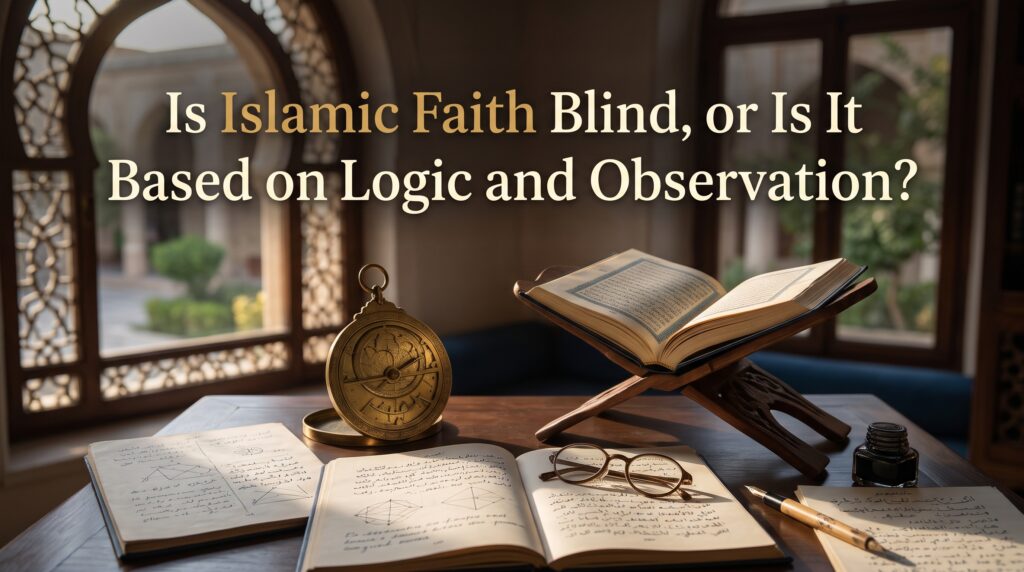
Is Islamic Faith Blind, or Is It Based on Logic and Observation?: Many people assume that religious belief requires switching off your critical thinking and accepting ideas without proof. However, Islam takes the exact opposite approach. Rather than demanding blind obedience, the Quran repeatedly invites human beings to observe the universe, reflect on their own creation, and verify truth through reason. This article explores how Islamic faith balances belief in the unseen with real-world observation, logical evidence, and personal accountability.
Πίνακας περιεχομένων
| Τίτλος Ενότητας | Βασικά Ερωτήματα που εξετάστηκαν |
|---|---|
| Understanding “Belief in the Unseen” vs. Blind Faith | Why does the Creator remain unseen during human life? How does this preserve free will and make life a meaningful test? |
| Observation: The True Foundation of Islamic Conviction | How does the Quran use nature, astronomy, and biology as evidence? Why is observing reality central to faith? |
| Human Creation: A Logical Clue to Purposeful Design | What does the contrast between human physical weakness and our gift of speech reveal about our purpose? |
| Why Islam Rejects Blind Imitation and Baseless Assumptions | Does Islam allow following traditions without understanding? How does the Quran treat guesswork and blind following? |
| Guidance: Clearing Misconceptions About Faith and Logic | What are the most common misunderstandings regarding reason, science, and religious innovations in Islam? |
| Συχνές Ερωτήσεις | Answers to common questions about proof, science, doubt, and rationality in Islamic belief. |
Understanding “Belief in the Unseen” vs. Blind Faith
A common misunderstanding about religion is that “faith” means believing in something without any reason or evidence. In Islam, belief is centered on Al-Ghayb (the Unseen)—specifically, recognizing Ένας Αόρατος Δημιουργός and the reality of accountability in the Hereafter.
However, believing in the unseen does not mean believing blindly. There is a clear, logical reason why the Creator remains unseen during our time on Earth: life is designed as a genuine test of free will and moral choice.
If the Creator were physically visible in the sky for everyone to see with their own eyes, belief would no longer be a sincere choice—it would be forced by fear and compulsion. Human society would lose its moral testing ground because no one would dare disobey out of sheer terror. Instead, the Creator placed humanity in an orderly world, gave us intellect and an inner sense of right and wrong, and invited us to recognize Him through His signs.
“This is the book about which there is no doubt, a guidance for those conscious of Allah—who believe in the unseen, establish prayer, and spend out of what We have provided for them.” — Surah Al-Baqarah (2:2-3)
“Αυτός που δημιούργησε τον θάνατο και τη ζωή για να σας δοκιμάσει ποιος από εσάς είναι ο καλύτερος στην πράξη—και είναι ο Υψηλός σε Δύναμη, ο Συγχωρητής”. — Σούρα Αλ-Μουλκ (67:2)
True conviction in Islam comes from connecting what you can observe (the order and precision of creation) to what you cannot yet see (the Creator behind it).
Observation: The True Foundation of Islamic Conviction
Instead of discouraging questions, the Quran actively commands people to look closely at the world around them. Throughout its chapters, it points to the sky, the earth, the water cycle, the diversity of human languages, and the development of life as clear evidence for anyone willing to think.
“Indeed, within the heavens and earth are signs for the believers. And in your own creation, and whatever living beings He dispersed, are signs for people of sure faith.” — Surah Al-Jathiyah (45:3-4)
Consider how a thoughtful person looks at everyday reality. Every atom follows a strict physical law, planets move in precise orbits, and rain revives lifeless soil to sustain every living creature. When you see a well-engineered building or a complex machine, logic tells you it did not assemble itself by accident. In the same way, the Quran directs human attention to nature as a mirror of divine wisdom:
“Then do they not look at the camels—how they are created? And at the sky—how it is raised? And at the mountains—how they are erected? And at the earth—how it is spread out?” — Surah Al-Ghashiyah (88:17-20)
Furthermore, the Quran challenges humanity to test its message against observable reality—both in the outer universe and within human psychology and biology:
“We will show them our signs in the horizons and within themselves until it becomes clear to them that it is the truth. But is it not enough that your Lord is a Witness over all things?” — Σούρα Φουσιλάτ (41:53)
Human Creation: A Logical Clue to Purposeful Design
One of the strongest logical proofs in Islamic thought lies in studying how human beings are designed compared to every other creature on Earth.
The Balance of Physical Weakness and Speech
Look at any animal in nature—a cat, a bird, or a camel. Each animal is born with a body naturally suited to survive in its environment without needing clothes, shoes, cooked food, or constructed shelters. Human beings, on the other hand, are born physically weak and helpless. Without clothing, tools, shelter, and long-term parental care, a human cannot survive the elements.
Yet, alongside this physical weakness, humans were given something no other creature possesses: the power of speech, abstract thought, and moral reasoning.
- Physical weakness creates dependence, forcing humans to cooperate, build communities, trade, and invent tools.
- The gift of speech allows us to store knowledge, share ideas across generations, establish justice, and reflect on our own existence.
If life were merely the result of blind, random survival processes, becoming physically weaker while simultaneously developing complex moral awareness would make little sense. Instead, this deliberate balance shows that humans were intentionally designed not just to survive like animals but to think, cooperate, and bear moral responsibility.
“Were they created by nothing, or were they themselves the creators? Or did they create the heavens and the earth? Rather, they have no certainty.” — Surah At-Tur (52:35-36)
Why Islam Rejects Blind Imitation and Baseless Assumptions
Not only does Islam encourage observation, but it also strictly forbids following ideas blindly—even in religious matters. Throughout history, people have fallen into division and confusion because they followed ancestral customs, cultural myths, or unverified assumptions without asking for proof.
The Quran establishes a clear rule for intellectual honesty: never follow something you have no knowledge of, because your hearing, sight, and mind are trusts that you will be questioned about.
“And do not pursue that of which you have no knowledge. Indeed, the hearing, the sight, and the heart—all those will be questioned.” — Σούρα Αλ-Ισρά (17:36)
“Say, ‘Produce your proof, if you are truthful.'” — Surah Al-Baqarah (2:111)
Islam teaches that every human being is born with a Fitrah—a natural, uncorrupted inner compass that recognizes truth, fairness, and the existence of One Creator. Blind imitation, ego, and superstition bury this natural compass. Returning to true faith means clearing away baseless assumptions and aligning your life with truth and natural balance:
“So set your face toward the religion, inclining to truth—the natural disposition (fitrah) of Allah upon which He has created mankind. No change should there be in the creation of Allah.” — Σούρα Αρ-Ρουμ (30:30)
Guidance: Clearing Misconceptions About Faith and Logic
Many misunderstandings arise when cultural habits or false assumptions are confused with the actual teachings of the Quran. The table below clarifies common misconceptions about how faith, reason, and evidence work in Islam:
| Κοινή παρανόηση | Islamic Reality (Quranic Guidance) | Practical Impact on Life |
|---|---|---|
| “Faith means accepting things without asking questions.” | Islam commands believers to verify information, seek knowledge, and reflect on nature before accepting claims. | Protects individuals from superstition, fraud, and blind manipulation. |
| “Believing in the Unseen has no logical basis.” | Belief in the Unseen Creator is built on observing the undeniable order, balance, and design of the visible universe. | Grounds faith in gratitude, humility, and personal accountability rather than fear. |
| “Following ancestral traditions is enough for faith.” | The Quran condemns blind imitation of forefathers, idols, or human intermediaries when it contradicts clear truth. | Encourages every individual to take personal responsibility for seeking and practicing truth. |
| “Science and religion are enemies.” | Nature is the work of the Creator, and the Quran is the word of the Creator; true observation of nature strengthens faith. | Inspires continuous learning, ethical innovation, and harmony with natural laws. |
Συχνές Ερωτήσεις
1. If Islam is based on logic, why can’t we see God directly?
Life on Earth is a temporary test of sincerity and moral choice. If God were directly visible, every person would be forced to believe out of fear, removing genuine free will. Instead, God provides clear signs in nature and within ourselves so that sincere thinkers can recognize Him willingly.
2. Does the Quran discourage scientific exploration?
No. The Quran repeatedly urges humans to study the heavens, the earth, water, embryos, and living creatures. In Islam, exploring the laws of nature is a way of appreciating the Creator’s wisdom, provided knowledge is used ethically to benefit humanity.
3. What does the Quran say about following guesswork or assumptions?
The Quran explicitly states that assumptions can never replace truth. Believers are instructed to verify news, avoid baseless speculation, and rely on clear evidence and sound reasoning.
4. Why do people end up with different beliefs if nature points to one truth?
According to the Quran, humanity originally shared one pure message, but divisions arose over time due to human ego, jealousy, cultural additions, and blind imitation of leaders or traditions rather than returning to the original, preserved guidance.
5. Is it wrong to ask questions when trying to understand Islam?
Asking sincere questions to understand truth is encouraged in Islam. The Quran frequently uses rhetorical questions—such as asking whether creation came from nothing—to awaken human intellect and guide people toward clarity.
6. How does believing in accountability affect a person’s daily logic and behavior?
Recognizing that every action and intention is recorded gives human beings an internal moral compass. Even when no other human is watching, a logical believer chooses honesty, justice, and kindness because they know they are accountable to the Creator.



 English
 Bengali
 Chinese
 Dutch
 French
 German
 Greek
 Hindi
 Indonesian
 Italian
 Japanese
 Korean
 Marathi
 Latin
 Portuguese
 Russian
 Spanish
 Swahili
 Telugu
 Vietnamese