বিষয়বস্তুর সারাংশ
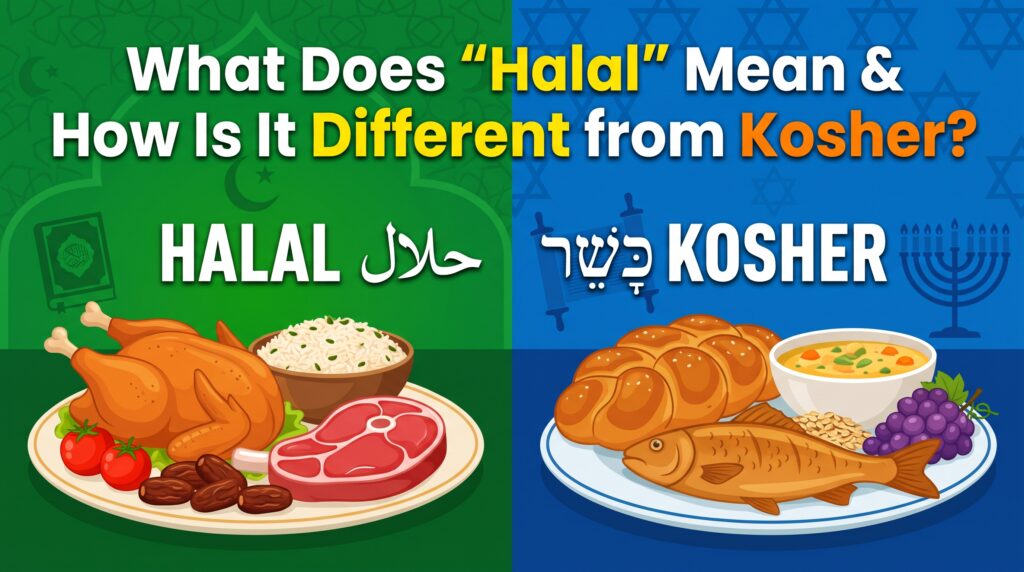
What Does ‘Halal’ Mean & How Is It Different from Kosher?: Many people view হালাল এবং Kosher simply as religious food labels, yet both concepts carry much deeper meaning. In Islam, Halal means “permissible” or “lawful” and extends beyond diet to encompass ethical earnings, pure living, and social harmony in alignment with human nature. While Halal and Kosher share monotheistic roots and several dietary rules, they differ significantly in slaughter blessings, alcohol restrictions, food combinations, and permissible ingredients. This guide breaks down what Halal truly means and how it compares to Kosher in clear, practical terms.
সূচিপত্র
| বিভাগের শিরোনাম | মূল প্রশ্ন সম্বোধন করা হয়েছে |
|---|---|
| What Does ‘Halal’ Truly Mean in Islam? | What is the literal and spiritual meaning of Halal? How does it apply beyond food? |
| Core Dietary Rules of Halal Explained | What foods are allowed or prohibited in Islam, and what is the wisdom behind these rules? |
| What Does ‘Kosher’ Mean, and Where Do Both Traditions Meet? | What is Kosher law, and what dietary principles do Islam and Judaism share? |
| Key Differences Between Halal and Kosher | How do Halal and Kosher differ in slaughter methods, alcohol, dairy mixing, and seafood? |
| Guidance: Common Misconceptions About Halal and Kosher | What are the biggest myths surrounding Halal and Kosher practices? |
| প্রায়শই জিজ্ঞাসিত প্রশ্ন (FAQs) | Can Muslims eat Kosher meat? Can Jewish people eat Halal? Are fruits and vegetables automatically Halal? |
What Does ‘Halal’ Truly Mean in Islam?
In Arabic, “halal” literally translates to “permissible,” “lawful,” বা “allowed.” Its opposite is “haram,” which means “unlawful” or “prohibited.” While most people associate Halal strictly with meat, in Islamic guidance, Halal is a complete system of living designed by the One Creator to protect human health, dignity, wealth, and social peace.
In the Quran, the word “halal” is frequently paired with “tayyib,” which means “pure,” “clean,” “wholesome,” এবং “beneficial.” God does not create rules to make human life difficult; rather, divine laws align with natural human well-being (ফিতরা) so that individuals and societies can thrive without self-harm.
“O mankind, eat from whatever is on earth [that is] lawful and good and do not follow the footsteps of Satan. Indeed, he is to you a clear enemy.” — Surah Al-Baqarah (2:168)
Beyond Food: Halal as a Complete Way of Life
To understand Halal fully, it helps to see how it governs everyday human choices:
- Halal Earnings and Finance: Money must be earned through honest work, fair trade, and transparency. Fraud, gambling, and interest-based exploitation are prohibited because they create greed, conflict, and injustice in society. “And do not consume one another’s wealth unjustly…” — Surah Al-Baqarah (2:188)
- Halal Mind and Health: Anything that clouds human judgment or harms the body—such as alcohol and intoxicants—is forbidden so that people remain mindful, responsible, and safe to those around them. “Satan only wants to cause between you animosity and hatred through intoxicants and gambling and to avert you from the remembrance of Allah and from prayer. So will you not desist?” — Surah Al-Ma’idah (5:91)
- Halal Speech and Relationships: Truthful communication, kindness, and lawful marriage protect families and future generations from emotional and social harm.
Core Dietary Rules of Halal Explained
When it comes to food and drink, Islam establishes simple, logical boundaries. All natural foods—fruits, vegetables, grains, nuts, and legumes—are inherently Halal unless contaminated by an unlawful substance.
For meat and animal products, the Quran outlines clear prohibitions aimed at hygiene, spiritual mindfulness, and respect for life:
“He has only forbidden to you dead animals, blood, the flesh of swine, and that which has been dedicated to other than Allah. But whoever is forced [by necessity], neither desiring [it] nor transgressing [its limit], there is no sin upon him. Indeed, Allah is Forgiving and Merciful.” — Surah Al-Baqarah (2:173)
Based on Quranic guidance, Halal food follows four essential principles:
- No Pork or Carnivorous Animals: Pigs and scavenging or predatory animals are prohibited.
- No Blood or Carrion: Animals that died of natural causes, illness, or strangulation before proper slaughter cannot be eaten.
- Mindful Slaughter (Dhabihah): Permissible animals (such as cattle, sheep, goats, and poultry) must be healthy, treated humanely, and slaughtered swiftly with a sharp blade to drain the blood completely. Crucially, the name of Allah (বিসমিল্লাহ—”In the name of God”) must be pronounced at the time of slaughter to acknowledge that life belongs to the Creator alone.
- Broadly Lawful Seafood: Unlike stricter dietary codes, the Quran makes seafood broadly permissible as a natural provision for humanity.
What Does ‘Kosher’ Mean, and Where Do Both Traditions Meet?
Kosher (from the Hebrew word Kashrut) means “fit,” “proper,” বা “acceptable” according to Jewish dietary law. Its core principles originate in the Torah (revealed to Prophet Moses) and were later expanded through centuries of rabbinic interpretations and traditions in the Talmud.
Because Islam and Judaism both trace their lineage back to Prophet Abraham and the worship of One Unseen Creator, Halal and Kosher share several foundational similarities:
- Complete Ban on Pork: Neither Muslims nor observant Jews consume pork or any pork byproducts.
- Prohibition of Blood and Carrion: Both traditions forbid eating animals that died naturally and require thorough blood drainage during meat preparation.
- Swift, Humane Slaughter: Both require a single, swift cut to the throat using an ultra-sharp, flawless blade to minimize pain and ensure rapid blood drainage.
- God-Centered Mindfulness: Both systems view eating not merely as physical survival but as an act of gratitude and obedience to the Creator.
Because of these shared roots, the Quran explicitly addresses the dietary connection between Muslims and the People of the Book (Jews and Christians):
“This day [all] good foods have been made lawful, and the food of those who were given the Scripture is lawful for you, and your food is lawful for them…” — সূরা আল মায়িদাহ (৫:৫)
Key Differences Between Halal and Kosher
Despite their shared monotheistic origins, Halal and Kosher are not the same. Over time, Jewish law incorporated detailed rabbinic restrictions, whereas the Quran restored a clear, universal, and practical framework for all humanity.
| বৈশিষ্ট্য | Halal (Islamic Law) | Kosher (Jewish Law) |
|---|---|---|
| Pronouncing God’s Name | The name of Allah (বিসমিল্লাহ) must be spoken over each individual animal at the moment of slaughter. | A blessing is recited at the beginning and end of a slaughter session, not over every single animal. |
| Alcohol & Intoxicants | Strictly prohibited in all forms, including wine, beer, and cooking extracts. | Permitted, provided the wine or grape products are produced under Jewish supervision. |
| Mixing Meat & Dairy | Completely allowed. Meat and dairy can be cooked, served, and eaten together without restriction. | Strictly forbidden. Meat and dairy cannot be eaten together, and separate dishes, utensils, and waiting periods are required. |
| Permissible Animals & Seafood | Permits cattle, sheep, goats, poultry, camels, and rabbits. All seafood is broadly lawful. | Permits only mammals that chew cud and have split hooves (excludes camels and rabbits). Only fish with fins and scales are allowed (excludes shrimp, crab, and lobster). |
| Who Performs Slaughter | Any sane adult Muslim (or observant Jew/Christian following lawful slaughter rules). | Only a specially trained and certified Jewish religious official (Shochet). |
| Mutual Compatibility | Muslims can generally eat Kosher meat as long as it contains no alcohol. | Observant Jews cannot eat Halal meat because it does not follow rabbinic Kashrut supervision. |
Guidance: Common Misconceptions About Halal and Kosher
Misunderstandings often arise when cultural habits or assumptions replace clear scripture. The table below clarifies common myths using logical, Quran-based guidance.
| ভুল ধারণা | The Reality & Quranic Guidance | Practical Purpose |
|---|---|---|
| “Halal” only refers to how animals are slaughtered. | Halal covers food, drink, honest business, truthful speech, and respectful relationships. | Builds holistic personal discipline and a trustworthy, peaceful society. |
| “Halal slaughter is a ritual sacrifice offered to feed God.” | God is completely free of all need. Invoking His name simply acknowledges Him as the Creator who permitted humans to use animals for nourishment. Unnecessary ritual slaughter without purpose is rejected in Islam. | Cultivates gratitude, humility, and respect for animal life rather than careless consumption. |
| “All Kosher food is automatically Halal.” | While Kosher meat meets Islamic slaughter standards, Kosher recipes and processed foods frequently use wine or alcohol, which is strictly হারাম in Islam. | Protects mental clarity and prevents intoxicant-related harm. |
| “Halal and Kosher are overly complicated burdens.” | In the Quran, God explicitly states He intends ease, not hardship. Most natural foods—fruits, grains, vegetables, dairy, and seafood—are naturally Halal without special labels. | Keeps daily life simple, balanced, and aligned with natural human needs. |
প্রায়শই জিজ্ঞাসিত প্রশ্ন (FAQs)
1. Can Muslims eat Kosher meat?
Yes, in most cases. Because Kosher slaughter avoids pork, drains blood, and is performed by believers in One God, Kosher meat aligns with Quranic guidance (Surah Al-Ma’idah 5:5). However, Muslims must ensure the Kosher dish or product does not contain wine or alcohol.
2. Can Jewish people eat Halal meat?
No. Observant Jewish dietary law (Kashrut) requires slaughter by a certified Shochet, specific post-slaughter organ inspections, and strict separation of meat and dairy utensils, which Halal certification does not require.
3. Is Halal slaughter painful for the animal?
Halal rules prioritize animal welfare. The animal must be well-fed, rested, kept calm, and never slaughtered in front of other animals. Using a razor-sharp knife to sever the major blood vessels of the neck causes an immediate drop in blood pressure to the brain, leading to rapid loss of consciousness.
4. Why is pork prohibited in both Halal and Kosher?
Both faiths prohibit pork primarily out of obedience to the Creator’s command. Logically, pigs are natural scavengers with biological traits that historically carried parasites and toxins, making avoidance a safeguard for both spiritual discipline and physical cleanliness.
5. Are fruits, vegetables, and grains automatically Halal and Kosher?
Yes. Fresh fruits, vegetables, grains, nuts, and water are naturally Halal and Kosher. They only become impermissible if contaminated with unlawful additives, insects (in Kosher), or alcohol.
6. Does Halal apply to non-food items like cosmetics and medicine?
Yes. In daily Muslim life, Halal principles extend to skincare, cosmetics, and pharmaceuticals, ensuring products are free from pork derivatives, blood, and intoxicants, unless a specific medication is required to save a life in an emergency.



 English
 Bengali
 Chinese
 Dutch
 French
 German
 Greek
 Hindi
 Indonesian
 Italian
 Japanese
 Korean
 Marathi
 Latin
 Portuguese
 Russian
 Spanish
 Swahili
 Telugu
 Vietnamese